Showing posts with label Chevy Volt. Show all posts

Georgia Tax Credit Ending Soon, BMW i3 Owners Rejoice at SAE Combo DCFC Rollout

With the proliferation of electric vehicles like the i3, the absence of a robust fast charge infrastructure becomes more and more difficult to ignore. There are indeed areas of California which are served very well with DC Fast Charge stations, however for many EV owners outside California, Fast charge stations are something they only dream about. Georgia however, has been making some great progress with DCFC. Georgia resident and i3 owner Chris Campbell tells us what's happening with DC Fast Charge in the Peach State.

Chris with his Volt back in 2010
You may remember Chris from a post he made here last year. Chris was the very first Chevy Volt owner in Georgia back in 2010. He authored a guest blog post here telling his story and why he had decided to get a BMW i3 when he turned in his Volt. Many i3 purchases have come from buyers which were early adopters and had leased an early Volt or LEAF. Chris has been active in the Atlanta area's EV scene for a while and maintains a website full of EV information, which can be found here: www.http://electrifyatlanta.com
__________________________________________________________________________


For over a decade, Georgia has offered a generous $5,000 tax credit in support of getting an electric vehicle (EV). But only in the last three to four years has the market offered affordable cars with usable range, and suddenly huge numbers of Georgians have taken advantage of that incentive. In the last session, the state legislature took notice of this growth and killed the tax credit altogether, with it officially ending this month. June 30th is the last day that Georgians can get an EV (purchased or leased) and still be able to claim the credit when filing taxes next year.

So there is now one last mad rush to take advantage of one of the best EV incentives in the country. Potential EV owners are making their final decisions and dealers are scrambling to respond to demand and maintain inventory.

BMW i3 owner "heat map" illustrates Atlanta hot spot
The Nissan Leaf, by far the highest volume EV in the Georgia market, continues to dominate sales, but the BMW i3 has also enjoyed success in the Atlanta market, as illustrated by this "heat map" showing locations where owners voluntarily listed themselves on the i3 owner map. Atlanta is a true hotspot for EV ownership, and has an active i3 owner group!

NRG EVGO station at Mall of Georgia, CHAdeMO only
Besides the state tax credit, however, there has been another factor energizing EV uptake in Georgia: a large and accelerating roll out of DC Fast Charging (DCFC) stations. The first DCFC stations (CHAdeMO for Leafs) arrived in north Georgia in July 2013 via The EV Project (aka Blink), but the CHAdeMO rollout really accelerated in November 2014 when NRG entered the Atlanta market with their EVGO CHAdeMO stations. As of this writing there are now over 30 CHAdeMO stations in the metro Atlanta region, with another dozen expected online in June.
Two competing DCFC plug standards, SAE Combo (left) and CHAdeMO (right)

Of course, as most EV owners know, there is not just one DCFC plug standard -- there are three!  In 2008, before the current wave of EVs, the automakers all (except for Tesla) agreed on a Level 2 standard, the J1772 plug that is now familiar to all EV owners. But they did not come to an agreement on DCFC (sometimes inaccurately called Level 3), and so the EV market split into three camps:

- Nissan and other East Asia automakers: CHAdeMO
- Tesla: Proprietary Supercharger
- Everyone else including BMW, VW, GM:  SAE Combined Combo System (CCS)

Since that market split, the three different camps have proceeded with their respective DCFC station rollouts, with Chademo and Tesla fighting for the lead and SAE Combo in a distant third. However, we have started to see "dual standard" DCFC stations hit the worldwide market, offering both CHAdeMO and SAE Combo. While these stations do not directly support the Tesla interface, Tesla owners can now buy a $450 adapter from Tesla Motors, that lets them charge from CHAdeMO stations. So these dual-standard stations effectively support all three standards. Of course Tesla cars have far larger batteries, offer far more range, and typically take advantage of their own network of ultra-fast DCFC stations.
BMW-branded DCFC unit, SAE Combo only, 24 kW
The SAE Combo flavor of DCFC (compatible with the BMW i3) first appeared in Atlanta in late 2014, with a single dual-standard cabinet at a Georgia Power testing facility, unfortunately accessible during weekday business hours only. In January a second SAE Combo unit appeared at BMW NA's offices, however that BMW-branded unit only offers 24 kW peak power. Obviously with just these two i3-compatible DCFC stations, one with limited access and the other offering low power, and both located in the same side of town, they were of limited utility to i3 owners.

It was not until this week that the true potential of the BMW i3 was realized in the north Georgia market, with a wave of SAE Combo DCFC sites going online.
Georgia Power's first dual-standard DCFC station
Following nearly a year of planning and construction, regional electric utility Georgia Power has now launched their network of DCFC stations, which are DUAL-STANDARD. These new stations offer both CHAdeMO and SAE Combo plugs, and thus are able to charge every DCFC-capable EV in the U.S. (even the Model S via Tesla's new adapter).  Georgia Power's DCFC sites deliver 50 kW and will offer Level 2 charging stations as well. Their network launched in May with pilot stations at 11 Georgia Power locations in 4 cities, and will expand to a total of 60 stations statewide by the end of 2016. The first wave of stations launched temporarily with only CHAdeMO capability, but on June 2nd Georgia Power finally delivered on their promise and brought their first dual-standard station online, with more expected this week.

This is just the first wave. Georgia Power plans to spend 2015 installing 25 more stations at locations around the state, and then another 25 in 2016. Some will be in metro areas, essentially serving commuters, but some will be installed along interstate corridors, serving those EV owners eager to stretch the legs of their new car. Since every one of these stations will offer dual-standard DCFC, these stations will support ALL EV owners. Atlanta-area BMW i3 owners have been straining at the leash for these stations to finally go online, and the day has now arrived.

Pictured at left: NRG's new dual-standard BTC hardware

But Georgia Power is not the only player in the market offering dual-standard charging.  NRG entered the Atlanta market in November 2014 with CHAdeMO-only stations, but recently has been expanding their presence with dual-standard DCFC stations made by BTC Power. Unfortunately, while these BTC stations have internal hardware that supports both CHAdeMO and SAE Combo charging, these new stations have been popping up with the SAE Combo side disabled. It is rumored that NRG (and partner Nissan) have asked BMW to chip in on the cost of these stations. If that is indeed the case, I believe it would be wise for BMW to step up and contribute to this much needed infrastructure.


Signet DCFC cabinet with Greenlots network
A similar situation is playing out with some state-funded stations. The Georgia Environmental Financing Authority (GEFA) is an arm of the state government that normally funds projects like water and sewer improvements, but in 2014 they announced a grant opportunity for GEFA-funded electric car charging stations at municipalities and educational institutions. Following a frenzied application window that reportedly lasted only hours before the funding was all used up, GEFA delivered on those grants in late 2014, and since then stations have been popping up in locations around the state, beyond metro Atlanta. Three of these locations are Athens, Augusta and Columbus, where GEFA-funded DCFC stations went online in April.  These stations launched with only CHAdeMO capability, despite the GEFA grants specifically requiring dual-standard DCFC. Indeed the Signet hardware that was physically installed did include SAE capability, with even the cord and plug installed and ready to go, but the SAE Combo plug was disabled in software (via the Greenlots activation network). Again it appears that Nissan maneuvered to have the stations installed with SAE Combo, but with that capability disabled until BMW chipped in. Local i3 owners raised this concern with BMW via a variety of methods, and in late May, these three locations saw their SAE Combo plugs quietly get enabled. The rumor now is that this solution will soon spread to similar stations that have appeared in the Carolinas, further enabling regional travel by i3 owners. BMW of North America has made no public statements about what is going on at any of these, frustrating local i3 owners.

Table comparing DCFC cabinets seen in Georgia market
Georgia now boasts EIGHT different makes of DCFC station hardware, operating on six different networks (click here for details on the station hardware now operating). Thus, the state now has one of the most heterogenous DCFC station populations in the world, exceeded only by California, and certainly Georgia can be seen as a great market to evaluate DCFC developments and test car compatibility.

All of this DCFC activity, especially the SAE Combo roll out, has delighted local BMW i3 owners, who have been chomping at the bit to go on road trips in their new cars!

SF Bay to Tahoe in an i3 REx: What was learned?

IMG_20141018_151716-M.jpg
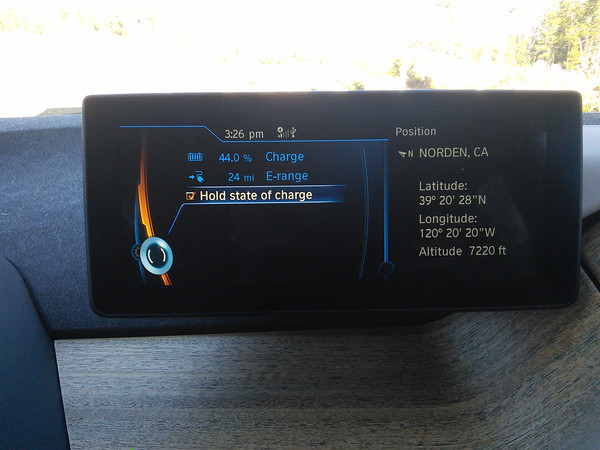
Donner Summit is the highest point along Interstate 80 in California at 7,228 feet elevation.
Last week we heard from i3 REx owner John Higham in a post he wrote which detailed his thoughts on the i3's range extender restrictions for the North American market. John certainly didn't mince words and offered his reasoning why he believes the range extender on the i3 should have its artificial restrictions (which are in place to satisfy CARB), relaxed a bit. John also promised to do a road trip which would take him from the San Francisco Bay area up to the 7,228ft Donner Summit in Lake Tahoe and report on the range extender's performance under these strenuous conditions. Below are his findings.

SF Bay to Tahoe by the Numbers, Part 2

Nailed it.  Well, nearly.

In Part 1 of this post about all things REx, I declared that a US spec BMW i3 REx could not make the popular weekend getaway of Lake Tahoe from the San Francisco Bay area without being speed limited within 15 miles of Sacramento. How speed limited depended on the slope of the road as you climbed east into the mountains, but top speed would range from 40 to 55 MPH. The alternative was to fully charge in Sacramento before any significant climbing begins and then again in Colfax about halfway up the hill. This makes such a drive impractical.

I also declared that a European spec’d i3 would make it no problem, so long as one kept the diminutive 1.9 gallon tank filled and the feature known as “Hold Mode” engaged. In fact, European cars have made similar drives into the Alps.

The basis of these declarations is simple physics. In Part 2 we test the physics from Part 1.Twice. First with a U.S. spec BMW i3 REx and then with a European spec i3 REx.

OK, I lied. I don't have a European spec i3. But I do have a US spec i3 that has been modified to behave like its schnitzel eating cousin.
I drive the BMW i3 from my home in Mountain View, California to Donner Memorial Park in Truckee.  The state park is placed at one of the sites where the ill-fated Donner Party settled for the winter in 1846.  The snow that winter was as high as the memorial behind the i3.


A Quick Summary of Part 1

The California Air Resources Board (CARB) developed a class of car called the Battery extended range Electric Vehicle (BEVx). Some say the BEVx was never intended to be a car with mass appeal that can be driven like any ICE-mobile.  But I ask, why not? Actually, what I usually say is “Why the hell not!” while shouting and pounding the table with my fist. I digress.
I believe that the BEVx class of cars represents the bridge from plain ol' Internal Combustion Engine (ICE) cars to pure electric that will finally allow the public to embrace EVs without looking back. Except.

There is one teensy exception and it is what engineers call a "corner case." In this situation the “corner case” refers to those people who require a car to maintain freeway speeds over sustained elevation gains. That’s what this post is all about -- to test how big that corner case actually is.

California's San Francisco Bay Area lies at sea level and the drive east to Lake Tahoe follows the Sacramento river, never gaining significant altitude for about 50 to 100 miles, depending on one's starting location. Continuing east past the capital of Sacramento begins what is at first a gentle climb into Gold Country. Assuming the route is along I-80, the slope increases significantly past Gold Country until Donner Summit (elevation 7,228 feet) is reached 95 miles east of Sacramento.

The i3's APU is sized such that it can maintain freeway speeds, but not to maintain freeway speeds and simultaneously gain significant altitude.  It’s simply not possible to drive from the SF Bay Area to Tahoe in a reasonable amount of time with the US spec’d i3. Of course if you have the patience to charge every 60 to 80 miles, you can drive your i3 from the Bay Area to Tahoe or anywhere else for that matter. But that is impractical, even with with so-called fast chargers.

Since this post comes in two parts, and the test drive to Tahoe also comes in two parts, potential for confusion exists when referring to them.  Let’s dispatch any confusion and call the first test The Apple Pie Test and the second test The Lederhosen Test.

The purpose of these tests isn’t to prove you can drive an i3 to Tahoe by taking logical opportunities to charge. You can. It’s been done. The purpose is to prove the assertions made in Part 1. First, that the US spec’d i3 REx is hobbled as compared to its European counterpart and second (and more importantly) that an i3 REx is more than a great EV; it has potential to be the only car you need.

Oh yeah. No math in this post. I promise.


The Apple Pie Test

The Apple Pie Test is simple: try to “REx it” to Tahoe and see how far you get. (Oh, I’ve made REx a verb, but the Oxford dictionary hasn't caught up yet.) Since this is my test, I get to make up the rules. The rule is simply to take a BMW i3 as CARB intended it to be delivered to the public and drive it along I-80 until the car becomes speed limited, then compare the observed results with the predicted results from Part 1.

To do this test I left the Benicia, California, CCS fast-charger with 90% SOC and a predicted range of 60 miles.  The drive toward the Tahoe region is essentially flat for about 63 miles along I-80, then the road climbs into the Sierra Nevada mountains. I planned this section of the drive to be all electric until such time I hit the foothills. The goal was to set the cruise control to the posted speed limit (65 MPH) and simply keep driving powered by the REx until the car became speed limited.

In Part 1 I calculated that the car would become speed limited at about 725 feet elevation gain and by using the elevation profile in Google Earth, I estimated that would occur about 12 miles east of Sacramento.

The actual drive didn’t work out exactly like that, but close enough for the rough assumptions that were made. At first the speed limitation was subtle. I started to suspect the car was speed limited at around 800 feet elevation (750 gained), “flooring it" to coerce an increase from 65 MPH with the cruise control set, I achieved about 67 or 68 but no more. But by 950 feet elevation gain the effect was no longer subtle. Not only could I no longer keep pace with traffic, but was feeling very vulnerable and was searching for an exit in earnest. On some of the steeper portions of that section I was under 55 MPH indicated with traffic whizzing past at 70 MPH and above.
IMG_20141018_113048-M.jpg
The BMW i3 was clearly speed limited on this section of road after leaving Sacramento powered solely on the REx

IMG_20141018_113054-M.jpg
This photo was snapped moments after the previous photo

Anyone who has owned a BMW for very long can tell you that the speedometers are optimistic by at least 5%, if not 7%. So, that 58 MPH in the photo is closer to an actual speed of 55 MPH.  In Part 1 of this post I made a table of predicted top speed as a function of the grade of the road. Using the GPS coordinates of the road and Google Earth, I found the grade of the road at the precise point is 3%; the table from Part 1 predicts a top speed of 60 MPH on a 3% grade; close, but some refinement of that table is in order.

In summary, the Apple Pie Test demonstrated that all that analysis, the calculations, graphs and so forth from Part 1 were within the margin of error that could be expected for the rough assumptions that were made.  

More importantly, It proves that you can’t just REx it to Lake Tahoe in an i3. Luckily, there is a CCS charger in Sacramento, so moments after the above photos were taken I turned around and headed straight for it. With the miracle of regeneration the i3 got its SOC back up to a respectable level and I REx’d it all the way back to that CCS charger with no issues.


Hold Mode and Coding

The Lederhosen Test requires the use of a feature known as “Hold Mode”, which is on all Euro-spec i3 equipped with the REx; perhaps even all such cars destined for anywhere in the world outside of North America. What Hold Mode does is engage the REx (or more specifically in CARB-speak the APU) to maintain the battery State of Charge (SOC). Sounds a bit boring and perhaps it is.

The fact of the matter is, US spec’d cars have Hold Mode; the car’s onboard intelligence switches it on automatically when the battery SOC reaches 6.5%. The European version of the car also will switch on Hold Mode automatically when the battery SOC reaches 6.5%, but the European version also allows the driver to manually engage Hold Mode whenever the battery SOC is 75% or less.

The difference in the US spec’d car and its European counterpart is perhaps subtle, but as we shall see, the difference means everything if you require a car to maintain freeways speeds and gain significant elevation simultaneously.

What is important here is to understand that the US-spec cars do in fact have the European-spec Hold Mode programmed into the car.  The menu option that allows the driver to engage Hold Mode manually is simply hidden from the i3’s iDrive menu. For someone skilled in the seedy underbelly of the BMW tuner world known as “coding,” enabling this hidden feature in the iDrive menu is trivial.  To be clear, this practice is most likely frowned upon by both BMW NA and CARB.

To satisfy scientific curiosity, I “coded” my i3 to enable Hold Mode, Euro-style. On to the Lederhosen Test!    (click through this link to read about how to code your i3: Code your i3)


The Lederhosen Test

As noted in the last paragraph of the Apple Pie Test, as soon as I became speed-limited near Auburn, I turned around and returned to Sacramento and specifically to the CCS fast charger there. After plugging in and after i3’s SOC had reached 90%, I once again set out along the same route toward my final destination in Truckee, California, near Lake Tahoe. Hold Mode is only available if the SOC is 75% or less, so after leaving the CCS charger I drove the first 12 or 13 miles all electric.


IMG_20141018_122036-M.jpg
The CCS fast-charger in Sacramento in Sacramento is at an elevation of 50 feet.

The only difference in the two drives was the SOC at the bottom of the hill and manually engaging Hold Mode. This simply means the REx was used in the Apple Pie Test to “hold” a 6.5% SOC but on the Lederhosen Test, it was used to “hold” a 75% SOC.
IMG_20141018_131052-M.jpg
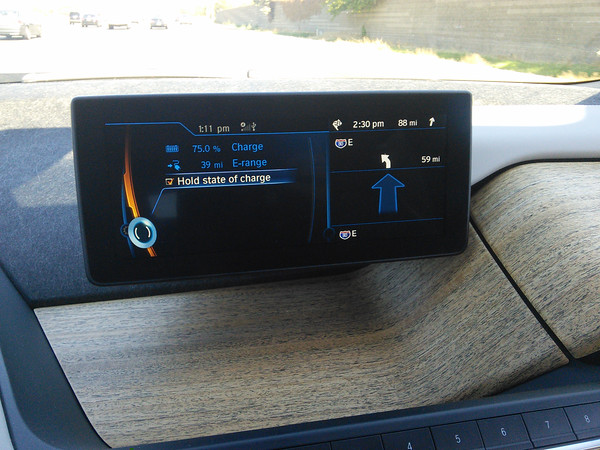
Engaging Hold Mode at 75%.  Note there are 88 miles to my destination, with 39 miles of all-electric range available.  

In Part 1 of this post I calculated that by engaging Hold Mode at 75% SOC the i3 should be able to climb essentially any mountain pass in North America, so long as one keeps the gas tank filled. What isn’t visible in the photo above is that Donner Pass, a 7,228 foot climb, is between me and my destination; it is time to put my hypothesis from Part 1 to the test.

With Hold Mode engaged, as one drives the i3 the REx keeps the battery SOC constant at the level set.  If driving conditions are such that the REx (due to its limited power output) cannot keep the battery SOC maintained, then energy from the battery makes up the difference and the battery SOC falls commensurately.

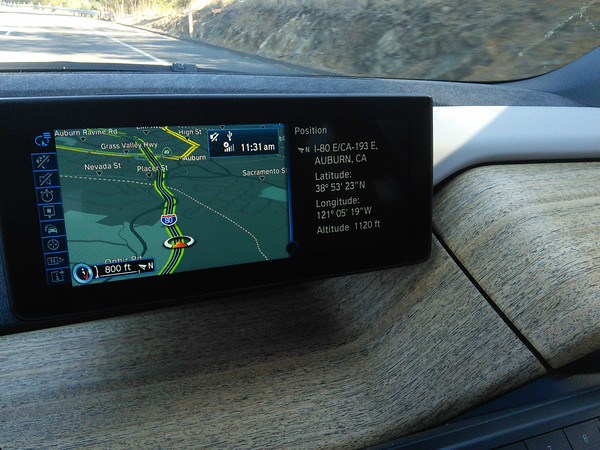
Soon after leaving the CCS charger in Sacramento and engaging Hold Mode at 75% SOC I found myself once again in Auburn near where I had turned around just 90 minutes earlier during the Apple Pie Test.  It was time for a lunch stop.

IMG_20141018_140702-M.jpg
As expected the battery SOC falls as elevation is gained
The photo above was taken at my lunch stop in Auburn. Note that the SOC has fallen 4% to 71% at 1210 feet elevation (1160 feet of gain).  If I had stopped the car and let the REx run sufficiently long, the SOC would have returned to 75%. But that would have both taken time I didn’t want to spend and defeated the purpose of the Lederhosen Test. So, after a quick bite to eat I got back in the car and re-engaged Hold Mode at 71% SOC.

Leaving Auburn, I resumed toward my destination of Donner Memorial State Park 65 miles away in Truckee, California. The only thing between me and my destination was Donner Pass at 7228 feet, one more stop for gasoline, and the potential to run out of battery. But I had done my homework and was confident that I had plenty of energy left in the battery to complete my drive.

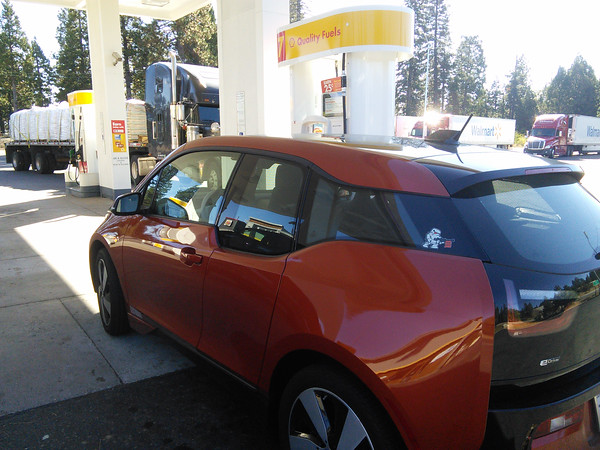
It was the perfect day for such a drive; the sky was a beautiful blue, the temperature was in the mid 70’s, the traffic light and SiriusXM’s Classic Vinyl accompanied me. During the drive I took pictures of the i3’s displays every 1,000 feet of elevation gain, but suffice it to say that the battery SOC slowly dropped in an expected and predictable fashion as I glided up the mountain's slope. After 45 minutes or so I once again stopped to top off the fuel tank.

IMG_20141018_144840-M.jpg
The i3’s other “fast charge” port.  I don’t like to use this method of adding energy, but sometimes a guy’s gotta do what a guy’s gotta do.

IMG_20141018_145546-M.jpg
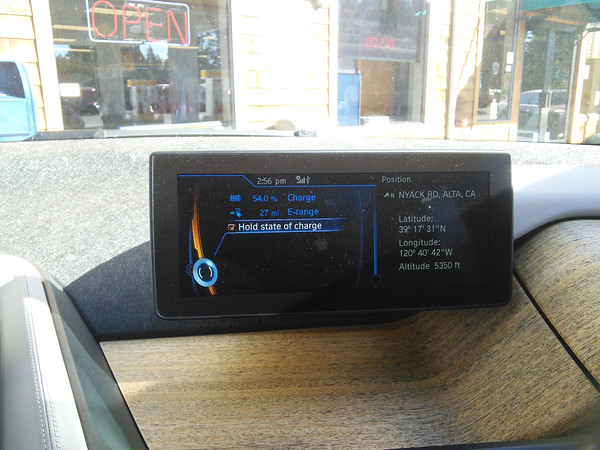
The battery SOC has fallen from 75% to 54% after climbing 5300 feet.

After refueling, Donner Summit was less than 30 minutes away. I found myself so absorbed in monitoring the progress of the battery SOC prediction that I nearly blew past the sign marking the summit! 
IMG_20141018_152622-M.jpg
The i3, with Hold Mode engaged, used a mere 31% (75% at the bottom of the hill less 44% at the summit) of its SOC to gain nearly 7,200 feet of elevation.  In simple terms, one can think of it as if the REx’s power output is used to propel the car forward, the battery’s power output is used to climb the hill.

By using less than a third of its battery to gain those 7,228 feet, the i3 REx is obviously capable of much more. In Part 1 I asserted that the i3 with the European-style Hold Mode was probably capable of summiting any road in North America. After making the drive over the Sierra Nevada’s I-80, I believe that point has been verified.


Summary

The i3 REx with the European-style Hold Mode is more than capable of conquering Donner Summit simply by engaging the feature at the beginning of the climb and keeping the tank filled.  The US spec i3 REx is not.  But the implications are far greater than this.

The entire thesis of this post and the previous one is much larger in scope than “can BMW’s i3 make the drive to Lake Tahoe.” The thesis is much more than the car or the corporation. It’s about an idea.  A brilliant idea.

It’s about a transitional electric vehicle that the public can embrace without looking back, without asterisks and without range anxiety. The embodiment of that transitional electric vehicle is the BEVx class; to date only one car is made to that standard. It’s a brilliant piece of engineering.  Yet that brilliant piece of engineering is emasculated by regulations imposed by a governing body that should be championing it.

I’m surprised that Sir Isaac Newton hasn’t leapt from his grave and set his hair on fire.

The use case I have been passionately trying to demonstrate, that the i3 is fully capable of, may be an inconsequential corner case for the majority of owners worldwide.  But it is a legitimate use case and one that the many buyers consider. And people buy to the corner case, especially if it is their only means of transportation.

Until such time that adding energy to an EV takes as much thought and effort as adding energy to an ICE-mobile, technologies like the BEVx are going to be required to get the public to embrace electric mobility.

If removing the restriction on the operation of the APU is not made, the genius of the BEVx classification will never bear fruit.  That’s because even though the average driver does less than 40 miles a day, they also want the flexibility to take their car wherever they want, whenever they want. For this reason, PHEVs are about as “electric” as the general public is willing to go.

Once the current limitation of the APU software managing the SOC is understood by the public, the public will eschew the BEVx classification for PHEVs, such as a Volt. While that may be a better choice for the environment than, say, a Camry, the Volt driver will not be able to drive as much on electricity as if he bought a BEVx, such as an i3.

That’s why I’m writing; to beg CARB to Unleash the REx. It’s been said that the PHEV is the gateway drug to a pure BEV. If that is so, the BEVx has the potential to be crack -- instantly addictive. Make it so.


Facts about my trip from Mtn. View -> Truckee -> Mtn. View
Left home with 100% SOC
528.2 miles round trip
246 miles on REx
6.6 gallons of gas purchased
Ended trip with about ½ gallon more gas in the tank then when I left
4.1 mi/kWh
4 CCS charging sessions totaling 62.8 kWh
0 Level 2 charging sessions
Arrived home on the REx (6.5% SOC)

Born Electric Guest Blogger: Meet Mike From Virginia


My name is Mike from metro Richmond, Virginia.  I was Born Electric for the second time on August 11, 2014, with the purchase of a new i3 with Range Extender!  

The i3 is my first BMW but my sixth car from the BMW Group as I have owned several MINIs over the past twelve years ranging from a base Cooper to the track-ready JCW GP.  The i3 shares currently shares driving duties with my first EV, a 2012 Nissan LEAF SL.  It’s the first time in 25 years of driving that I don’t own an ICE car as well as a car with a manual transmission.  I think I am having serious withdrawals with no clutch as I really miss shifting for myself!

Racing the Sun
My first exposure to electric vehicles came at Virginia Tech as a student in the College of Engineering.  As a guy passionate about cars practically since birth, I naturally found myself working with peers to design and build a solar electric vehicle for entry in Sunrayce 97, a multi-day competition sponsored by GM and DOE.  This race would pit us against other schools from the U.S. and Canada and have us driving the car on public roads between Indianapolis and Colorado Springs with pit stops along the way.  A typical one-day stage had us driving 50-200 miles completely on electricity.  Hyper-miling techniques would take on new meaning and would have to be the norm rather than the exception!  Like the i3, the solar car made use of carbon fiber (plus Kevlar) and aluminum to keep weight low and strength high.  Unlike the BMW, our car employed several pounds of lead-acid batteries which were mandated as a means to level the playing field and keep costs low.  Boy has battery technology really evolved since 1997!  I would have the honor and privilege to qualify the car first at the GM Proving Grounds in Michigan and then across the bricks at the Indianapolis Motor Speedway. Throughout the event at IMS, I remember watching GM reps drive through Gasoline Alley in an EV1 and thinking about how futuristic and cool it was at the time.  We ultimately made the race and I was able to drive the car across the finish line in Colorado.  It was both scary and thrilling at the same time!  I just knew at some point down the road I would have an electric vehicle of my own. Little did I know that the knowledge and experience that I gained from the solar car program would not only boost my interest in EVs, but also somewhat change my driving habits. 

Enter Nissan LEAF
Fast forwarding into this century, I had anxiously awaited the arrival of LEAF and Volt in my area.  The Volt is nice, but I was more interested in the Nissan.  I carefully monitored sales, waited until prices came down a good bit, took a few test drives of the Nissan, and finally leased a new fully loaded 2012 LEAF SL in Blue Ocean.  The LEAF was my introduction to production electric vehicles and would allow me to gauge over a 24-month period whether or not a battery electric vehicle would mesh with my driving habits work in my life, allow me to explore the local charging infrastructure (or lack thereof), and force me to setup charging at home.  The central Virginia infrastructure currently shows only a few public charging stations, but we do have Tesla supercharging stations so hopefully more Level 2 stations will be installed in the near future.  More on the LEAF later, but let us now move into BMW territory.
One LEAF and one i3 REx. Could be the perfect garage!
No Availability of MINI-E and ActiveE
As a longtime MINI owner until a few months ago, I would have jumped at the opportunity to participate in the MINI-E and ActiveE trial programs but was unable to do so because neither one was available for lease in my area.  Shame on MINI and BMW for not offering these cars in non-urban markets!  I did get to see an ActiveE in person earlier this year which was an unexpected thrill.  An ActiveE owner from the greater New York City area moved to Virginia and returned the car to my local dealer.
Tom's MINI-E and my ActiveE, side by side.  Yes, I'm definitely jealous!
Choosing the i3 w/Range Extender
The BMW driving experience and range extender option are the two main reasons why I chose the i3.  The LEAF is a very good car especially for the price, however, I simply wanted more in my next plug-in: 
1)      Greater range with the ability to travel to Washington DC, North Carolina (to visit my family) and beyond without stopping for a lengthy recharge, even if it meant using a little gas
2)      Better all-around performance – handling, braking, acceleration
3)      More attractive styling outside and inside
4)      Remain practical enough to tote around my 8-year old son (who loves to ride!) and occasionally carry a few adults and stuff
5)      Greater use of available lightweight and/or sustainable materials
6)      All of the above for a decent price
The i3 Rex fits the bill almost perfectly for me (except for the lofty price!) because I can limit my environmental impact by driving the car as a BEV about 90% of the time and engage the Rex 10% of the time for long journeys.  My daily commute is less than 20 miles roundtrip.  Most of the time I won’t need the Rex, but it’s there when I do need it thus eliminating the need on a daily basis for an ICE vehicle.  The i3 is compact and roomy but not as limited in some areas as the MINI, it’s nimble and quick, it features traditional BMW rear-wheel-drive, it doesn’t look like any other car in terms of the exterior and interior styling, and I can take my 8-year son just about anywhere anytime.  I actually like the rear window styling and think it makes changing lanes a little safer since it improves visibility!  Does it look a bit strange?  Yes it does, but the rear window along with the rest of the i3 is interesting in a good way.
I think all of the entries in the plug-in category are terrific however the Tesla Model S and Cadillac ELR (not really a consideration) are priced out of my range.  The Chevy Volt is modern and refreshing on the outside but not so exciting on the inside.  I might have considered a Mercedes-Benz B-Class Electric Drive or VW e-Golf (my pick between these two cars) however both cars will not be available in my area for quite a while.  Sadly, the Honda Fit EV, Fiat 500e, Toyota RAV4 EV, and Chevy Spark EV are also not for sale leaving only a handful of plug-in EV models from which to choose out of the increasing pool.


Order, Production, and Shipping of my i3
My first trip to the local dealer took place way back in August 2013 not long after BMW released the first bits of information and images of the production i3.  The MINI sales manager, whom I knew very well, introduced me to the BMW sales manager.  I told him that I was very interested in the i3 and wanted to place my name at the top of the list.  The only major thing that I wasn’t sure about was the price as it had not been announced yet.  Meanwhile, I kept in touch with the dealer, followed the press releases, and discovered many i3 discussion groups and online forums.  Many thanks to Tom Moloughney, Chris Neff, and other i3 owners around the world for their knowledge sharing and great blogs!  I finally placed an order in early February for an i3 on somewhat of a reasonable budget with the following options: 

·        Range Extender
·        Solar Orange metallic paint (changed from my initial order of Andesite Silver)
·        Giga World trim
·        Technology and Driving Assistant Package
·        Heated Seats

The dealer pulled some strings to secure me a production slot in Week 10 (early March) only to have BMW headquarters push my order back a couple of months to build pre-configured i3s, accommodate supply constraints such as the shortage of Tera World leather, etc.  I am a patient guy so it was fine with me as long as I ultimately got the car I ordered in the right configuration.  While I received some updates from the dealer about my order, I frequently called the BMW Concierge to get information about my car. The Concierge was great and more than happy to give me the status of my order and answer any questions.  Thank you, BMW, for this welcome service!  My car entered production on May 21, completed production on May 30, passed QA with flying colors onJune 2, but then got held up at the factory nearly a month.  It shipped out to the VPC (New Jersey) at the end June and eventually arrived in Virginia around the 1st of August.  I was perfectly fine with letting BMW keep my car as long as necessary to do more quality control, perform hardware and software updates, etc. as long as it arrived just the way I asked for it and without significant issues.  Total time from order to delivery was about 6 months.
i3 Colors
I ordered my i3 with the gorgeous Solar Orange metallic paint.  It really glows in the sun (pun intended!) and looks great with the two-tone interior of the Giga World trim level!  The color palette is pretty limited at the moment with too many silvers and greys, so it’s a good thing that I have wanted to buy an orange car for a long time.  Solar Orange truly hits the mark!  For the time being, I am the only one in my area with an i3 in this color although someone else in a different part of town has a Solar Orange / Mega i3.  My second and third choices, respectively, would have been Ionic Silver and Capparis White with either Mega World or Giga World trims.  I had considered the Andesite Silver, but deemed it too brown.
 
Options
Here is my opinion regarding each trim level and individual option:
·        Range Extender – Must have in my case, biggest distinguishing feature between i3 and other EVs
·        Mega World – Looks good with some colors, if seats are a bit light and materials not as rich looking as Giga World and Tera World trim, no Comfort Access and Sirius radio (can be added)
·        Giga World – Best suits my taste with two-tone cloth and leather combination, leather dash, and eucalyptus wood plus you get Comfort Access, Sirius satellite radio, and garage door opener
·        Tera World – Too dark for my taste, reduces the light and airy feeling of the passenger compartment; Climate is too hot / cold here in Virginia to have dark brown leather seats
·        Technology and Driving Assistant Package – Required in my opinion since you are spending this much money on a high-tech car you should have the big center screen and bells / whistles too
·        Parking Assistant Package – Did not order, but decent value at $1,000; Most likely would never use the autonomous parking; Backup cameras will be required on all U.S. cars starting in 2018
·        20-inch Wheels – Gorgeous, but slightly harsher ride, more noise, perhaps more punctures
·        DC Fast Charging – Currently no infrastructure in my area to support this option
·        Heated Seats – Won’t buy a new car without them, great with cloth and/or leather seats
 
Solar Orange with Giga World interior is the best combo IMO.
Frustrating Delivery
I feel that I should mention here that the actual delivery of my new i3 Rex was quite disappointing.  Not only was the car not even halfway charged nor did it contain even remotely close to a full tank of gas (even if it is only a whopping 1.9 gal!), but I would ultimately have to return to the dealer not once but TWICE to re-sign all of the Owner’s Choice with Flex financing paperwork making a total of three times to sign all the important documents.  The dealer had driven the car to a local music festival along with other vehicles without asking me when they knew darn well that I had ordered the car and was close to coming to get it as I was negotiating with the sales manager but had not yet taken full possession of it. Plus it was not plugged into the charger, thus leaving the SOC around 30% at the time of the delivery.  We did go to the gas station and fill up the tiny tank with Shell premium unleaded for just $6.55.  At least it was squeaky clean as they had run it through the detail shop.  While my car was on order, my Client Advisor had been promoted to a Finance person so I will chalk up the first mistake to the learning curve with his new role. The second mistake was inexcusable as I was told i3 financing paperwork had to be printed on “special” printer paper.  Excuse my ignorance, what is wrong with the regular printer paper which is probably made of the same recycled paper?  Honestly, I could discern no differences when I sat down for the third time to sign the paperwork.  At least I got the dealer to discount the car by $1,000 (not great considering better deals could be had 100 miles away) and throw in some accessories.  

Accessories and Paint Protection
As part of my deal for the i3, I asked the dealer to provide me with the all-weather mats and trunk mat/box free of charge.  The trunk mat doubles as a cargo box with the pull of the drawstring which is kind of cool.  I highly recommend the all-weather mats as they are significantly easier to live with than the standard Giga crème mats!  For extra protection in the interior, I went to Target and purchased charcoal grey bath towels to place over the seats, particularly in the rear where my son will sit.  The dealer also gave me a voucher for $50 for use in the parts shop which I took over to get two blue glow-in-the-dark key covers and the BMW i notebook.  Additionally, I placed a call to Joe @ Autobahnd (for those of you with i3s in central Virginia he does top notch work) shortly after delivery to cover the front of my i3 with clear bra to protect that luscious orange paint.  Joe did a great job and charged me $650 for full hood, front bumper, headlights, fog lights, A-pillars, and the trapezoidal lower sections behind the front wheels.  I will ask Joe to return in the near future to do my lower doors and front fenders also.
Applying the clear bra
Home EVSE
I charged the LEAF over the past two years using a combination of Level 1 (home) and Level 2 (work) chargers.  Now that I own two EVs, I went ahead and purchased a Bosch Power Max EL-51253 home charging station from Amazon for about $550 (after using a $50 gift card that I had lying around).  The only disadvantage is the 18 foot cord, but it is long enough for my needs.  I highly recommend this charger as it was easy to install, looks great in my garage, and charges the i3 and the LEAF without fail!

Overall Impressions
The i3 has been a blast to drive and trouble-free throughout my ownership period of two months and 1200 miles, with no warning lights or error messages.  Overall, the car is fast, comfortable, efficient, fun, and turns some heads!  The acceleration throws you back in the seat and the steering is very responsive, almost too fast.  BMW engineers nailed the steering however I will have to spend more time evaluating the suspension to determine if BMW got the handling right because while the ride is fine I am not sure if the suspension and large wheel / tire combination really hit the mark.  The i3 carves a very nice arc and corners more flatly than the LEAF but it doesn’t feel as stable and composed over bumps as I would expect from a BMW.  My favorite part of the car is the strong regenerative braking – I LOVE the one-pedal driving!  Switching the car into Eco Pro or Eco Pro+ mode allows me to complete local but long round trip drives (without tapping into the range extender) that I could not previously do in the LEAF, even driving conservatively in the middle of summer.  The i3 BEV is fantastic also, but the range extender makes the car just that much more versatile.  Visibility to the front and sides is excellent with a commanding view of the road ahead.  I feel like I sit higher in the i3 than I do in the LEAF, which is surprising.  I would not call visibility to the rear great, but the standard parking sensors work well enough.  I am not a music lover, however, the base stereo sounds good considering there are no rear speakers and I have come to enjoy the Sirius radio on my commutes to work.  My last few cars have all had Sirius and I had never spent more than a few minutes listening to it but now I do in the i3.  If there is one thing to which I am not accustomed yet, it would be the drive pod (transmission).  While easy to operate, it does not feel intuitive as I find myself often selecting Drive rather than Reverse or vice versa.
    
Operation of Range Extender
A few weeks ago, I was able to experience the range extender by taking a 215-mile roundtrip deep into the Blue Ridge mountain range to do some apple picking with my son.  The trip would prove one way or the other if the Rex was worth the extra dough as I would be driving mostly at highway speeds along both flat stretches of road and moderate hills along Route 29 between Charlottesville and Lynchburg.  The night before going to the orchard, I was pulling the i3 into my garage when I noticed a message on the professional navigation screen saying the Rex would run in maintenance mode the next time I drove the car below 75% SOC.  Sure enough, the next day driving along I-64 the little engine came to life for about 10 minutes holding the charge steady as I cruised around 70 mph on the way to the orchard.  I can enthusiastically say that we made it to the orchard and back without a hitch!  Here is the mileage I was able to obtain during this trip starting with a full charge and the gas added by the dealer at delivery:

·        EV range (highway):  74 miles
·        1st Rex tank (used 2/3 tank of fuel):  47 miles
·        2nd Rex tank (used ½ tank of fuel):  49 miles
·        3rd Rex tank (used ½ tank of fuel):  45 miles
·        Total mileage:  EV:  74 miles; Rex:  141 miles
I arrived home with just under ½ tank of fuel after depleting the batteries and stopping twice very conservatively for a couple splashes of gas.  This trip was my first chance to try out the Rex and I didn’t want to be left stranded somewhere with my son.  The Rex performed flawlessly, going about its business without much fanfare!  I could not tell it was operating at all on the highway, even with the windows up although we had the windows cracked all the way to the orchard.  I could only make out a little bit of noise below 50 mph or so with more noise as I approached stoplights.  There is also a tad bit of vibration through the seats when the Rex is running.  The vibration becomes more pronounced when the Rex is really cranked to its max.  I wouldn’t go so far as to call it thrashing, but it is definitely more noticeable at times.  The only negative thing I noticed was some hesitation in power during one of two hill climbs, however, the car never lost more than a few mph and giving me the confidence to continue driving with a few changes to my throttle position.  I should add that the hesitation occurred after the blue bar had dropped down below the 6.5% threshold and inched closer to the 0% SOC mark.  Prior to this hesitation, I had taken off quickly from a stoplight in Comfort mode to gain momentum going up a hill but didn’t think about my acceleration affecting the power.  The blue bar WILL move toward away from the small triangle and toward the 0% SOC mark if you accelerate hard and expend more power than the Rex is producing.  I would suggest selecting Eco Pro or Eco Pro+ to avoid over exerting your right foot and closely monitoring both your speed and the SOC level.  You shouldn’t have any problems!
Likes
Here are the aspects of the i3 that I like the most: 

1.      Strong regenerative braking – love using the motor to stop the car instead of the brakes
2.      Strong acceleration – put the hammer down and it flies
3.      Steering – ultra quick with a ridiculous turning circle
4.      Exterior styling – futuristic and bold, especially in Solar Orange or Ionic Silver
5.      Interior styling – love the design and use of different materials throughout
6.      iDrive – completely new to me but I like it so far
7.      Comfortable and supportive seats – conform well to my 5’7”, 160-pound body, no   aches / pains
8.      Clamshell (“suicide”) rear doors – easy getting stuff and / or my son in and out
9.      Range Extender – brilliant, so far it has worked as advertised!
10.   Adaptive Cruise Control – makes the car even easier to drive on the highway
11.   Mirrors that fold down in Reverse – nice touch that makes parking that much easier
12.   Enhancements – can be mostly done with software and hardware updates for current owners
Dislikes
There are a few things that either I don’t like or would like to see  about the car, even though it is genius in several ways!  Most of these items are minor and some even downright petty:

1.      Unsettled suspension motions over bumps and changing pavement -  could be more composed
2.      Thin steering wheel – nice material, small diameter, but wimpy thickness
3.      White / cream floor mats with Giga World – practically useless to me, what was BMW thinking?
4.      Car  is turned on but then turns off when door is opened – lawyers went overboard here   
5.      Transmission control stalk – not intuitive as I get confused selecting Drive or Reverse
6.      Extras not available – heated steering wheel and opening rear side windows would be welcome
Summary
The i3 Rex has generally lived up to my expectations thus far as the first electric offering from BMW.  This car is the most expensive vehicle that I have ever purchased, so I just hope it will deliver real value as the LEAF has a lot going for it at just $250 per month in my case!  Frankly, the more I drive the i3 the more I really like it although I need to spend more time with it to understand its full capabilities.  It was very exciting to drive my i3 a total distance of 200+ miles in one day – a genuine delight!  I plan to keep the car for about 5 to 7 years and really look forward to a positive and rewarding ownership experience!