Showing posts with label DC quick charge. Show all posts

Road Trip Refueling a BMW i3 REx

Fill 'Er up!
I know many readers here have spent countless sleepless nights pondering the the age-old question: How long does it take to refuel a BMW i3's tiny gas tank?

Well maybe not, but I have had people argue that driving the i3 REx on an extended trip would be very inconvenient because they would have to stop to fill up the gas tank every 50-60 miles. I've done quite a few road trips with my i3 REx, and stopping once an hour for a couple of minutes to refill the tank never really bothered me much.

I wrote a post last year which detailed a 462 mile round trip I made to Vermont from my home in New Jersey and refueling was one of the topics that many people commented on. On that trip, I had to stop for gas a total of seven times, as I only recharged the car once, which was at my destination. I drove 111 miles on battery, 351 miles on the range extender and used a total of 9.87 gallons of gas, averaging 35.5 mpg.
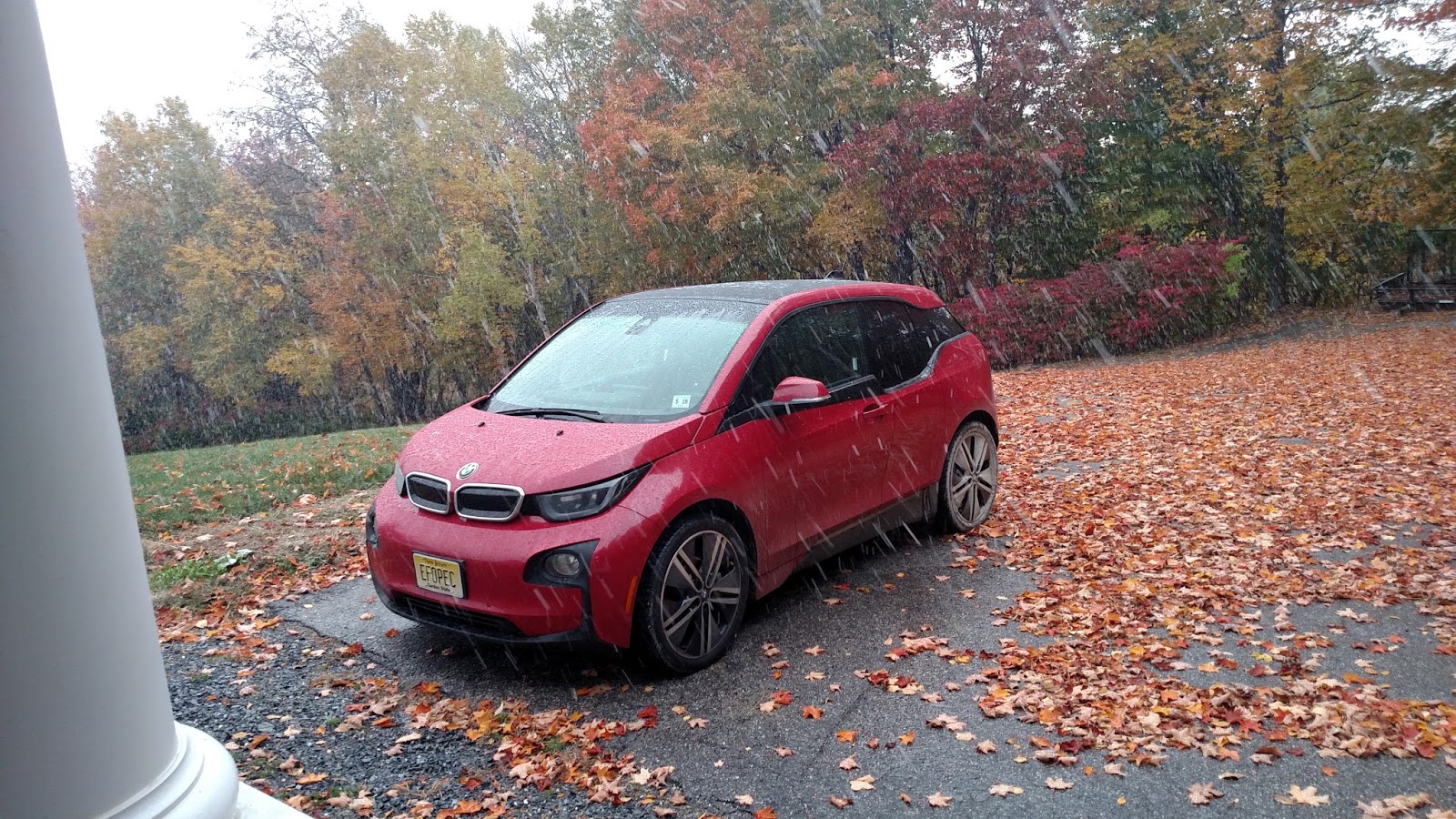
It was snowing in Vermont when we arrived

In that post, I wrote that I found it funny how quickly the gas tank fills because it's only 1.9 gallons. My wife started timing how long it took to stop for gas and we averaged a little over two minutes. I remember wishing we had recorded one of the gas breaks so we could demonstrate just how quick you can pull off the highway, fill up, get back into the car and back out onto the highway. I made a note that the next time we drove back up to Vermont, we would do just that.

So last week we made the Vermont trip again, and as planned we recorded one of the gas stops:


As you can see, I started the stopwatch before we exited the highway, and stopped it when we were back on the highway. I didn't jump out of the car and rush like a NASCAR pit crew filling up. I took my time and even spent a couple extra second topping off so I'd get every drop that I could into that tiny tank and we still did it in under two minutes.

The point of the exercise was to demonstrate that it's really not that inconvenient to make a quick gas break about once every every hour. I will qualify that statement with the fact that here in the Northeast there are gas stations everywhere. It seems that I'm never more than a couple miles from one, so when I'm doing these long drives I can plan the stops at convenient intervals when the tank is nearly empty. While that is the case for many large city and suburban areas throughout the country, there are plenty of rural areas where gas stations aren't as prevalent, and the small gas tank would be a problem. The i3 REx most likely isn't well suited for use in those areas. But hey, BMW calls it a "city car" after all.


As I mentioned above, when I made the trip last year I only did 111 miles on battery and drove 351 on the REx. This year I was able to drive 270 miles on battery, and needed only 184 miles with the range extender maintaining the battery state of charge. This was possible because of the always improving charging infrastructure. I was able to stop twice (once each way) at Prestige BMW in Mahwah, NJ and use their new DC fast chargers. Also, on the way home I stopped for a couple hours at a friend's house who just recently installed a 240v level 2 EVSE in his garage. These stops allowed me to more than double the all-electric miles for the trip, and I only needed 4.9 gallons of gas for the 184 miles I drove with the range extender running, as I averaged 37.5 mpg.
I used the recently installed DC Fast Charger at Prestige BMW on both legs of the trip. 
I now have over 36,000 miles on my i3 after seventeen months of ownership, and only about 1,750 of those miles were on the REx. The range extender has been a great feature and I'm still very happy I got it. It does what it is supposed to; it gets you home without worrying about finding a charging station on the rare days that the electric range isn't enough, and it enables the occasional long road trip. There are limitations though, and extreme hill climbing while the REx is running for prolonged periods at highway speeds, can result in reduced power. Fortunately I've never had that happen to me but I don't really have any big mountains which I need to climb. On my Vermont trips I set the Active Cruise Control to 70 mph and have never had an issue yet, even though there are some prolonged climbs at the end of the trip. I did get the "Reduced Power Possible" warning once though, as the state of charge hit a low point of 2% once. However it held there until I crested the climb and once I was on flat ground the SOC climbed back up to about 6%. I left the cruise at 70 mph because I actually wanted to see at what point it would go into reduced power mode, but it never happened.  
On one climb, I was able to get the SOC down to 2% and at that point the car warns you that reduced power may occur if you continue without altering your driving. Basically it's saying "Slow Down!"
Still, in a perfect world I'd prefer a 150 mile, all-electric-range i3 combined with adequate DC fast charge infrastructure. Personally, I really don't need 250 or 300 miles of range, and I'd rather not pay for it. However, even though the infrastructure is improving, I think 200 miles of range is probably more acceptable until DC fast chargers are ubiquitous. It appears with Nissan and Chevy poised to bring 200 mile EVs to market in the coming year, the "affordable" electric vehicle market is going to get very interesting. BMW's CEO recently announced that the 2017 i3 will have a longer all electric range also, but didn't comment on exactly how much more. That's good news because as much as I like how the REx works, and how quickly I can refill the gas tank, I'd still much prefer going on battery alone. 

VW: Das-eption and the path to Redemption

Volkswagen CEO Martin Winterkorn resigned on Wednesday.

While this blog's primary focus is the BMW i3, I occasionally sprinkle in some featured EV products and discuss topics not necessarily i3-centric, but are instead just general electric vehicle information. In light of the recent revelations that Volkswagen has been deliberately cheating on emissions testing for many years now, I wrote the following article for Green Car Reports.

So far, no other automaker has been caught as VW has - with proof that they purposely installed a "defeat device" on the vehicles so the cars would curb their emissions only during actual emission testing. However it's fair game to speculate if other OEMs may also be exposed as cheaters now that the EPA knows what they have to look for, and how to expose it. It will certainly be interesting to watch this all unfold.

In any event, Volkswagen is going to face huge fines for intentionally violating Federal emission standards and I wanted to offer my thoughts on how I believe some of that money should be used. If we don't use at least a portion of that money to help reverse the damage done by these heavily polluting "clean diesels", I believe we will have missed a great opportunity to improve the quality of air we all breathe.


 How VW Can Atone For Diesel Deception: Electric-Car Advocate's Thoughts

The full impact of Volkswagen's diesel-emission cheating scandal has yet to be realized, but what it has apparently already admitted to doing could result in the largest civil fine ever levied by the Federal government on an automaker. And that's just the beginning.

Besides paying civil penalties, and coping with a spate of criminal actions, and class-action lawsuits, and investigations by multiple levels of government, VW also needs to deal with the 482,000 cars it sold--plus more in limbo at dealers--that clearly do not comply with emission laws.

In real-world use, these vehicles emit 10 to 35 times the allowable legal limit of certain pollutants, so they're not just slightly out of compliance. They will need to be modified to comply, or VW will have to buy them back. And if owners don't like the modified cars, they'll likely have to buy those cars back too.
After all that, VW has to figure out how to regain the trust of the public.

There are lots of aspects to this debacle, and all will undoubtedly be discussed ad nauseam over the coming weeks. But the aspect I find most interesting is how Volkswagen can best right the wrongs it has done. How does paying fines, settling lawsuits, and bringing highly-polluting vehicles into compliance really undo the damage done? It doesn't. All it does is punish Volkswagen. And I believe the public deserves more.

Make no mistake: If VW is guilty as charged, it absolutely deserves to be punished--and severely.
It turns out they aren't as clean as we were told - not nearly, actually.
But I hope the Justice Department also considers what can be done to offset the damage to air quality created by the offending so-called "clean diesels." And I hope VW, separately, does the same. We've seen penalty estimates as high as $18 billion dollars (the maximum allowed of $37,500 per vehicle for intentionally violating the Clean Air Act. I doubt the actual penalty will be anywhere close to that, but it will likely be in the billions. I think it's not unreasonable to expect the fine to be somewhere around $2.5 billion, or about $5,000 per non-compliant vehicle sold.

Why not use a portion of that civil fine to invest in a nationwide DC Fast Charge network for electric vehicles?

If just half of a $2.5 billion fine were dedicated to this purpose, we could blanket the majority of Interstate highways and major high-traffic corridors with DC fast chargers that would make switching from gasoline and diesel cars to zero-emission electric vehicles a much easier decision for many buyers. Here's why I believe that is what should be done. Helping to advance the proliferation of cleaner electric vehicles would, over time, more than reverse the emissions damage that has been done, and further improve the quality of air we breathe, instead of just punishing the offender. And shouldn't that really be the goal here?

A second thought: As well as using the fine to build out a national DC fast-charging network, how about Volkswagen getting out in front of this crisis itself and telling us how it will do its part to help clean the air it polluted?

BMW, Volkswagen and ChargePoint teamed up to create "Express Charging Corridors" on the East and West coasts. While it's a good start, much more fast charge infrastructure is needed to allow the average electric car of today to be a viable choice for long distance driving.
Rather than just declaring that it will be a leader in electric mobility, as the company has done before, show us the proof that it's serious about how it plans to expand its zero-emission vehicle offerings? VW Group could combine that with a generous investment in public charging infrastructure, on a much greater scale than last December's partnership with BMW and ChargePoint to install approximately 100 DC fast chargers.

That program in just now starting to get under way, but it's really only the beginning of what's needed. VW should commit to expanding it to 400 or 500 stations, including high-volume corridors not only on the East and West coasts but across the country--essentially following the Tesla Supercharger road map.
Tesla North American Supercharger map.
Yet another idea to consider: Give the owners of the affected vehicles the option to replace their car with a new electric Volkswagen e-Golf. Some current Volkswagen TDI diesel owners have said they now feel guilty for having driven their diesel for the past few years, with a main reason for their purchase having been both fuel economy and because it was a "clean" diesel.

Offering those owners the option to return the polluting car for a much cleaner Volkswagen could demonstrate that VW understands and is concerned with its customers' desire to drive clean cars. Many owners won't take advantage of such an offer--diesel partisans can be just as committed to their technology as electric-car advocates--but the offer would send a powerful signal about the company's intent. I believe these are the sort of things Volkswagen must consider if it wants to convince the public it is serious about making proper restitution for this egregious deception.
How about offering eGolfs to the customers that don't want their dirty diesel anymore?
There are plenty of ways to make some good come out of this shameful episode. No matter how you slice it, it will be very painful for Volkswagen AG. How well or poorly the company manages this crisis will  have a lingering effect for years to come, even decades.

It appears VW intentionally deceived both the American consumer and the U.S. government, and put public health at risk, by knowingly planning and executing a fraud. To me, and I think to many others, that's much worse than a carmaker trying to delay or prevent a vehicle recall.

But Americans are forgiving people, and sin followed by redemption is a part of our national myth. As long as we believe the offender is genuinely remorseful for what it did, and is taking steps to prove it hase learned from the offense, recovery is possible--perhaps even lauded and held up as a shining example of redemption.

Now that we've found out the real truth in German engineering, the ball has moved into VW's court to decide on what it can do to begin to offset the damage it has done to itself, its customers, and the environment.
Let's hope Volkswagen is smart enough to make the right decisions.

*Edit: BMW released a statement regarding the recent discussion of diesel engines and emission compliance. You can read it HERE.

Born Electric Guest Blogger: Meet Steve from Washington


Hi! My name is Steve and I was born electric on August 15, 2012.


You highly intelligent, super savvy readers may be questioning my sanity. Or, at the very least, fact-checking. And those dubious thoughts are spot on. The above picture is me putting gas into a new kind of EV: a BMW i3. And those understanding of the i3 know that, in 2012, the i3 only existed as an internal tension at BMW between the maniacal engineers that thought a mass-market car could be made extensively with carbon fiber and the bean counters that believed BMW i was a financial money pit destined to ruin Team Bavaria. Eureka!

EV Bloodline

Our first three EVs were all-electric Nissan LEAFs. 
Back in the summer of 2012, we started replacing our gasoline-fueled family hauler fleet. The second LEAF came eight months later, making us an all-EV household. My wife and I defiantly and definitively proclaimed that we would never again visit a gas station. Then in 2014, I traded my beta test 2012 LEAF for a ready-for-market 2014 LEAF.  We were seemingly set with two very capable EVs in our garage: a 2013 Nissan LEAF SL and a 2014 Nissan LEAF SL.

Then the electric vehicle market expanded +1 in Washington state. BMW started selling its i3 in the State the latter half of 2014. By Christmas, I had one on an extended test drive. When we turned the i3 back over to the BMW dealership, we were conflicted. The i3, with its onboard gas generator, or Range Extender (REx), was far more capable as a transporting vehicle. However, Nissan's LEAF, with its CHAdeMo-equipped quick charging, was far more capable as an EV. 
Fallen LEAF


Carbon Fiber Reinforced Plastic (CFRP) Passenger Cell
Unless you are a bot scouring the Interwebs, you have correctly surmised that we ended up buying an i3. On March 12, 2015, we traded in my wife's 2013 LEAF for a BMW i3 REx. The i3 is unlike any vehicle on the road: carbon fiber, suicide rear doors, and series-hybrid purity. The features and headlines that make the i3 such an emotionally appealing vehicle are all present in our Bimmer. Yes, there are plenty of bits to get excited about with the car. However, the deciding factor in selling a LEAF for the i3 was the REx option. 

For the past three years, we have traveled far, but not wide, in a LEAF. We have shown that all-electric travel is quite possible the 1,500 miles between Kamloops, British Columbia and the U.S.-Mexico border. But EV travel (sans Tesla EVs) is only practically doable in a narrow 200 mile east-west corridor along the entirety of the West Coast.

Road Trip! A Coram Family tradition.
My wife and I have a long history of road trips...long before we had EVs, long before we had kids. Now that we have EVs and kids, we have naturally invoked our parental obligations of perpetuating traditions with our Littles. And, we've all but exhausted the territory that we can travel to by LEAF. From here on out, the i3 will be taking over as the primary road trip car. With that in mind, I wanted to prepare a day trip for the i3 that would serve as a suitable first, of many, REx adventures.

One of the great tests for EVs lies in day-tripping to the Olympic Peninsula from the Seattle area. I've done this trip twice with my children. The first attempt, ended in failure. The second a success, as we made it to Hurricane Ridge, a spectacular mountain region south of Port Angeles. What makes EV day travels to the Olympic Peninsula challenging is that the last ferry on the Kingston-Edmonds route departs at 11:00pm. In addition, there is not DC quick charging support, and only a limited number of Level 2 charging stations in the region. Basically, the furthest west a current generation LEAF can go in a day, from where we live in Lake Stevens, is Port Angeles.

The i3 REx faired much better. This is our report..
Topping off the 1.9 gallon gas tank!
We pulled out of the garage at about 7:00am, and made the ferry crossing and drive to Port Angeles by mid-morning. And after charging at a Sun Country-branded Clipper Creek High-Amp Level 2 (HAL2) charging station for a bit over an hour, we topped off the gas tank and continued west: Destination Cape Flattery 70+ miles away.

We made it to Neah Bay after about two hours of driving; WA-112 is not an interstate. The typical travel speed was about 45mph, and we had to watch out for the occasional herd of elk!
A herd of a few dozen elk crossed the road we were driving on!
The Makah Tribe, in the Neah Bay region, have started supporting electric vehicle tourism with several recent EVSE installations. The first, a HAL2 and dual Tesla High-Power Wall Chargers (HPWCs) are located in the town of Neah Bay. The second, another HAL2 and dual HPWCs are located at the Hobuck Beach Resort.

Both locations are glorious, in scenery and in EVSE support. In between these two gems, is a marvel in its own right: Cape Flattery. The Cape Flattery experience is second to none. It provides quintessential Pacific Northwest ocean views and kid-friendly hiking abound.

So, after trekking around Cape Flattery in the early afternoon, we let the kids play on the mile-wide Hobuck Beach, which has sand more reminiscent of a Hawaiian coastline than the typical pebbled Northwest affair.

Hobuck Beach: End of the road
By late afternoon, we were heading back east, towards Port Angeles, the Kingston-Edmonds ferry, and eventually home. Pulling into the garage at just past midnight, we were all exhausted, with both kids soundly asleep in the back of the i3. What was different about this trip: We covered 340 miles in a day (using less than 5 gallons of gasoline), and the kids were dead-tired because we had so much adventure outside of traveling in the car.

Tuckered out after a day of fun.
Road trips will forever be different for us, now that we have an i3 with REx. Whereas before, with a LEAF, every moment of the trip was in service of charging. The motto, "if it ain't movin', it better be chargin', " was not coined by somebody driving a hybrid, or Tesla for that matter.

With the i3, we will be able to drive all-electric, all the time. Or, if we wish, we can utilize the REx to take us where no Coram has gone before. Now, that sounds like an EVenture!
We love our new i3!

i3 Owner Explains Her 312 Mile All Electric Day

Kris charging up at an NRG Fast Charge station
One of the many things that Tesla Motors understands as well as anybody is how a robust Fast Charge network will liberate their customers from being on an "Electric Leash." Ubiquitous DC fast charging stations are, in my opinion, just as important as longer range electric vehicles. In fact, they may even be more important.

BMW apparently shares that opinion and has recently announced that they are getting into the DC fast charge game with a partnership that includes Volkswagen and ChargePoint, and will be installing fast chargers at 50 mile intervals on the East and West coasts to create "Express Charging Corridors." However it won't end with there. BMW is going to continue to invest in DC fast charge infrastructure here in the US, as they realize that they need to participate in creating the foundation for BMW i to succeed.

As with most things EV-related, California is ahead of most of the US when it comes to DC fast charge infrastructure. While the SAE Combo (CCS) fast charge units are only beginning to be installed, there are some already in the ground there, and they are allowing people to take their i3s further in a shorter period of time than they could if they were relying on 240v Level 2 public charging.

Kris & I at a recent i3 meet
Which brings me to the story below that I found interesting.  My friend Kris Kluzak, a former ActiveE Electronaut, offered to write a guest post for this blog detailing a day when she drove her i3 312 miles using public charging infrastructure.  It shows that even a medium-range EV, like the i3, can easily cover hundreds of miles in a day if the appropriate infrastructure is in place.

Here's how it went down, in Kris's words:


A 312 mile, all electric day in a BMW i3 REx:

On November 11th, 2014 I was scheduled for a research study for my car in Sherman Oaks, California. From my house in East San Diego County, it is about 160-mile trip one-way.

On any given day this “normal” trip would take approximately 3-4+ hours in any vehicle with an engine (ICE) as the main power source. Those of us living in Southern California know the different routes to take to avoid traffic blunders, and are often looking for the carpool lane when it’s an option.

In order to arrive on time for my 2pm appointment, my husband and I had to build in a few charge/food stops; this set us to leave right after 8am. First, we stopped 39 miles away at the Carlsbad Premium Outlets to charge and grab coffee at Starbucks. *We charged for 30 minutes knowing we had enough range to reach our next stop in Santa Ana. 
 
Like me, Kris's previous electric car was a BMW ActiveE
We next stopped at Crevier BMW, 58 miles from Carlsbad. Just days prior they had installed four DCQC (SAE Combo) stations and we were on a mission to check them out. Normally we would not choose this route through Los Angeles, but since it was a Federal holiday we took advantage of the “lighter” traffic. We charged for an hour while our SOC (state of charge) reached 99%. While we didn’t plan to stay that long, we enjoyed talking to the "iGenius" in the new "iBuilding".  There was also a Starbucks and restroom on site for us to use.  We left there with our next intended stop in Sherman Oaks, not knowing for sure where we would charge, but would look once we got up there.  I was fully prepared to have my range extender kick in if needed, but I really was trying to do this trip without it.

We found that the local KIA dealership claimed to have an ABB charger, which is the same unit that NRG eVgo uses (yes, CHAdeMO and SAE Combo). We called to see if - 1) the charger exists, which it does, and 2) to see if we could charge, which we were told yes, to come on by.  It was a few miles from the Sherman Oaks location, so off we went.  The charger was blocked, but they immediately moved a car and allowed us to charge.  Unfortunately, the charger was so new, that it hadn’t been provisioned yet, and did not work.  At this point I had 22 miles of range, and 27 miles to the next, known Freedom Station in Hermosa Beach.  So we set off, knowing my range extender would probably kick in.

With some luck, and HEAVY Los Angeles traffic on the 405, we managed to get to Hermosa Beach with 6 miles to spare, and no REx usage.  I drove **83.3 miles on that one charge from Crevier. Once at Hermosa Beach, we managed to find the charger, a nearby bar offering Taco Tuesday, and managed to do all of this while just getting a 30 minute charge. Next stop, the Westminster Shopping Mall ***27 miles away.  We arrived at the mall with no range issues, and were able to charge again for just 30 minutes.  FroYo and a potty stop…and away to Carlsbad for the last stop.

We arrived in Carlsbad, once again hit the Starbucks and charged for only 20 minutes, enough charge to get home.  We were there about 30 minutes, but the charger faulted and stopped early.  We arrived home at just before 10pm.  312 total miles driven, all electric, no REx used, and all charges were free.  We spent a few dollars at Starbucks and for the dinner, but overall, did the whole trip for less than $50, all-inclusive.


Some key points to this trip:


I did not use any climate control until the last leg, there was no need for heating or cooling, but I had to run the defrosters a few times for the last 30 miles.

I ran the entire trip in Eco Pro driving mode.

I preconditioned the car that morning prior to leaving, hoping to warm the batteries before the trip for maximum range.

I purposely did not use the carpool lane. While this might have been necessary in another situation where time was an issue, I preferred to stay in the traffic in order to get maximum range. 

The total time spent portal to portal was 14 hours. I was at the research facility for almost 3 hours, and then we spent almost another 45 minutes to an hour at the Kia dealership talking to the manager about the charger, and looking at their Soul EVs.

Charging added 3 hours, which by using the DC quick charging options, made this a very reasonable trip.  If we had stopped in an ICE for breakfast and dinner, and potty stops, the total stoppage time would have been less, but not significantly, maybe an hour less, overall.
Kris and her "Storm Trooper" Capparis White i3. She's wearing a limited edition i3 Super Bowl jersey that BMW made for this year's game to go along with the i3 commercial that aired during the first quarter. 
My Personal Records:

312 all electric miles in one day (previously 187 in my Active E, which did not have L3 charging)

83.3 all electric miles in one charge (previously 80 miles, in the summer, while hypermiling and drafting behind a truck for 20+ miles)

Cheapest day EVER to drive 312 miles, food and energy included.

*These outlets have two NRG eVgo charging options: level 2 and level 3. The level 2 option has one universal J1772 plug, and the level 3 option has a CHAdeMO (for Nissan Leaf’s, Kia Soul’s, and other Asian brand EVs) as well as a SAE combo (CCS) (for BMW’s, VW eGolf, etc.). This Freedom Station powered by NRG eVgo is part of free fast charging offered by BMW. 

**This car will definitely do better on range with slower speeds, ie: bumper-to-bumper traffic, and city stop-and-go vs full, freeway speeds.

***The mileage between Hermosa Beach and Carlsbad is 87.1 miles.  While we could have easily avoided a stop and used the REx, I would have been forced to charge longer at Hermosa to get a bigger charge, thus not saving any time AND using gasoline.

Did The DC Quick-Charging 'Standards War' Just Quietly End For Electric Cars?

A BMW i3 and a Volkswagen e-Golf charge on DC fast chargers side by side at BMW Headquarters in Woodcliff Lake NJ.
I wrote this article for Green Car Reports, where it was published a few days ago. The proliferation of a robust DC fast charge network is vital to electric vehicle adoption, and I wanted to give this story as wide an audience as possible, which is way I let GCR publish it first. Now that they had it for a while, I'd like to share it with the readers here.
I was invited up to BMW NA headquarters by BMW product manager Jose Guerrero to try out the new DC fast chargers installed there. There are three of them, along with four Level 2 EVSEs, all of which are open to the public 24/7.
A couple weeks ago at the DC Auto Show, BMW, Volkswagen, and ChargePoint jointly announced they would install about 100 DC fast chargers for electric cars. Their goal is to create “Express Charging Corridors,” on both the East and West coasts, by the end of this year. The most intriguing news, however, was that the hardware will--in most cases--offer fast charging for electric cars using two different standards: CCS (used by BMW and VW) and CHAdeMO, used by Japanese and Korean automakers.


The three DC fast chargers at BMW NA HQ are CCS only. The reason being is these are not directly included in the Express Charging Corridors, but secondary locations which are more likely to support local driving, not long distance traveling.
I say “most cases” because not every single location will have a dual-standard fast charger that provides CHAdeMO, although most will. Today, CHAdeMO stations are far more widely installed in certain areas--totaling several hundred in the U.S.--than CCS stations, of which only a few dozen exist today. The "Express Charging Corridor" project will determine whether a desired location is close to an existing CHAdeMO station. If so, that location will provide only CCS cables.

I suspect this may only happen in a few locations, largely on the West Coast, since the East Coast has very few operational CHAdeMO stations to date. The East Coast corridor will connect Boston to Washington, D.C., while the West Coast corridor will extend from Portland to San Diego. Both corridors will have DC fast chargers installed at intervals of less than 50 miles, making it possible--if tedious--to do long-distance trips in electric cars with ranges of 75 to 90 miles, including the BMW i3 and the Volkswagen e-Golf.

Then, less than a week after the DC Auto Show, Kansas City Power & Light announced that it had partnered with Nissan and ChargePoint to install 1,000 electric-vehicle charging stations throughout the greater Kansas City region.


That in itself is fantastic news. But if you drill down into the press release, you will find that only 15 of the stations will be DC fast charge stations--a little disappointing. However, these 15 stations “will charge any model of electric vehicle on the market,” meaning they too will support both CHAdeMO and CCS. So BMW and Volkswagen’s project will provide CHAdeMO charging, and Nissan’s endeavor will include CCS support.

These Efacec units will be installed along the new "Express Charging Corridors" by ChargePoint and support both CHAdeMO and CCS
What just happened here?

Did the automakers all quietly agree to support both standards, so every electric-car driver can benefit? I interviewed BMW’s Electric Vehicle Infrastructure Manager, Robert Healey, on the morning of the DC Auto Show. He told me BMW has no problem with supporting dual-standard stations, because the main goal is to advance the proliferation of charging infrastructure for plug-in cars as rapidly as possible.
CHAdeMO and CCS connector side by side comparison.
He went on to say that in these early stages of adoption, “a rising tide raises all boats”--and this kind of cooperation among competitors is in everyone’s best interest. While he couldn’t elaborate or speculate on the future, Healey said he would be open to similar partnerships with other automakers, should the opportunity arise.

So it's looking more and more as though the DC fast-charge standards war that everyone was predicting may be over, really before the first shot was even fired. I hope so, because if this trend continues, everybody indeed wins. Especially electric-car drivers--not only today's, but the many more to come.

BMW Partners With Volkswagen & ChargePoint. Announces Beginning of Large Scale CCS Fast Charge Rollout in US


Today at the DC Auto Show, BMW announced they have partnered with Volkswagen and ChargePoint to begin what will be the largest roll out of CCS Fast Charge stations in the US. This first phase will consist of the installation of roughly 100 CCS Fast Charge stations, split between the East and West Coasts. 

On the East coast, there will be locations approximately every 50 miles between Washington DC and Boston, and on the West coast the new "CCS Highway" will span from San Diego, CA all the way to Portland OR. All of these locations will feature 50kW dual-head Fast Charge stations, including CHAdeMO charging capabilities as well as CCS. In addition, these locations will have multiple Level 2 ChargePoint EVSE's, allowing the user to "top off" once the vehicle reaches 80% state of charge from the DC fast charger. 

In addition to the "CCS Highway" locations, BMW is also going to install a network of their 24kW DC Fast Chargers at secondary locations which are somewhat off of the main arteries. 

I spoke with BMW infrastructure manager Rob Healey today and he wanted to stress how this announcement signifies only the beginning of the commitment that BMW and their partners have to proliferate the deployment of DC Fast charge infrastructure. He pointed to the fact that the decision to include CHAdeMO on all their 50kW locations on the East & West coast deployment indicates their commitment to the success of overall e-mobility, not just their plug-in offerings. Healey used the phrase that "a rising tide lifts all boats" and in this case I believe he's absolutely correct. 

BMW and their partners are still identifying locations and are working with public and private entities to secure locations that are a maximum of 50 miles apart. There isn't a set time frame on completion of this first phase but the installations have begun on the West Coast and will soon begin on the East. BMW has already installed three 24kW DC stations and four dual-head Level 2 charging stations at their North American Headquarters in Woodcliff Lake, NJ. I was even invited there to test them out with my i3 this week, which I did. All of these stations will be open to the public 24/7 and they already appear on the ChargePoint map. 


I believe this is a great first step for BMW and their partners with regards to DC fast charge, but it's only the first step. There will also be attention paid to the other areas of the country that aren't included in this announcement. It's a big country, and areas like Atlanta which have become EV hot spots aren't going to be ignored, but these two corridors were considered the most important ones to begin with. I also believe we're going to see even more collaboration between the OEMs. It's no secret BMW and Tesla have had discussions in the past, and in my opinion, installing CHAdeMO on all of their locations on the CCS Highway is extending a huge olive branch to Nissan. How great would it be if Nissan then turned around and said they will do the same thing now? This little detail could end up being the biggest thing to come out of the whole announcement...


Full Press release:

Washington, D.C., January 22, 2015At the 2015 Washington Auto Show, two of the top automakers, BMW of North America and Volkswagen of America, together with ChargePoint, the largest electric vehicle charging network, announced an initiative to create express charging corridors along heavily-traveled routes on the East and West Coasts. Designed to increase the number of fast charging locations, the initiative will help meet the large and growing demand for convenient, publicly available electric vehicle fast chargers, including direct current (DC) Fast charging locations, and support the adoption of electric vehicles in the United States. In the initial phase, the aim is to install nearly 100 DC Fast charging ports across both coasts, with plans to expand the program to increase access to fast charging across the country. These newly installed DC Fast chargers will be added to the growing ChargePoint network of more than 20,000 charging spots in North America.

With more than 280,000 electric vehicles sold in the United States, EV owners need more charging flexibility while on the go. The express charging corridors will provide electric vehicle drivers access to DC Fast chargers along the most heavily populated and highly-trafficked regions on Interstate 95 on the east coast, from Boston to Washington, D.C., and on the west coast covering and connecting the metropolitan areas of Portland, San Francisco, Los Angeles, and San Diego. The installations will occur both within and between relevant metro areas, strategically-spaced at a maximum of 50 miles apart, making it even easier to take long road trips in an EV.

“A robust network of conveniently located DC Fast charging stations will go a long way toward increasing electric vehicle adoption and making electric vehicle ownership even more enjoyable,” said Robert Healey, Head of EV Infrastructure at BMW of North America. “The express charging corridors are another important step in the development of the U.S. e-mobility infrastructure that makes longer distance travel a real option for consumers, particularly along the most heavily trafficked portions of both coasts—making the BMW i3 and other electric vehicles even more appealing.”

“Volkswagen believes in a holistic approach to e-mobility in order to create a seamless experience for the consumer,” said Jörg Sommer, vice president, product marketing and strategy, Volkswagen of America. “The investment in the express charging corridor will provide e-Golf and other electric vehicle owners with the added support to travel their day-to-day and popular long distance routes.”

Each fast charging location along the express charging corridors is expected to include up to two 50 kW DC Fast chargers, or 24 kW DC Combo Fast chargers with the SAE Combo connector, used in both BMW and Volkswagen electric vehicles as well as many other electric vehicles that incorporate a DC Fast Charging capability. When charging at a 50 kW station, both the BMW i3 and the Volkswagen e-Golf can charge up to 80 percent in 20 minutes. Both vehicles can charge up to 80 percent in 30 minutes at a 24 kW station. Locations will also include Level 2 chargers, currently the most commonly available public charging stations, which are compatible with all electric vehicles. Level 2 stations can dispense up to 25 miles of range per hour of charging, providing a full charge for the BMW i3 and the VW e-Golf within 3.5 to 4 hours.

The DC Fast charging stations will be part of the ChargePoint network and can be easily accessed with a ChargePoint or ChargeNow card or with the ChargePoint mobile app.

“Our goal at ChargePoint is to get everyone behind the wheel of an EV and provide EV charging everywhere they go,” said Pasquale Romano, ChargePoint CEO. “With strategically-placed stations where drivers need them, these express charging corridors will give EV drivers the freedom to go farther and have an EV as their only car without limitation.”

Installations have already begun on the west coast, with the first location in San Diego County. There is a target of nearly 100 DC Fast charging ports in the first phase, available by the end of 2015. DC Fast chargers along the express charging corridors are expected to be installed in convenient locations such restaurants, shopping centers, rest stops, and more. ChargePoint will leverage its existing customer base and knowledge on usage to pick strategic locations either where drivers currently charge, or to fill in spaces where there is currently a lack of infrastructure.

With the investment, BMW, Volkswagen and ChargePoint are providing drivers with the ability and confidence to enjoy longer distance driving and recharge their electric vehicles quickly, ultimately leading to greater electric vehicle adoption. 


BMW Group In America
BMW of North America, LLC has been present in the United States since 1975.  Rolls-Royce Motor Cars NA, LLC began distributing vehicles in 2003.  The BMW Group in the United States has grown to include marketing, sales, and financial service organizations for the BMW brand of motor vehicles, including motorcycles, the MINI brand, and the Rolls-Royce brand of Motor Cars; DesignworksUSA, a strategic design consultancy in California; a technology office in Silicon Valley and various other operations throughout the country.  BMW Manufacturing Co., LLC in South Carolina is part of BMW Group’s global manufacturing network and is the exclusive manufacturing plant for all X5 and X3 Sports Activity Vehicles and X6 and X4 Sports Activity Coupes.  The BMW Group sales organization is represented in the U.S. through networks of 339 BMW passenger car and BMW Sports Activity Vehicle centers, 147 BMW motorcycle retailers, 122 MINI passenger car dealers, and 35 Rolls-Royce Motor Car dealers.  BMW (US) Holding Corp., the BMW Group’s sales headquarters for North America, is located in Woodcliff Lake, New Jersey.

About Volkswagen of America, Inc.
Founded in 1955, Volkswagen of America, Inc., an operating unit of Volkswagen Group of America, Inc. (VWoA) is headquartered in Herndon, Virginia. It is a subsidiary of Volkswagen AG, headquartered in Wolfsburg, Germany. VWoA’s operations in the United States include research and development, parts and vehicle processing, parts distribution centers, sales, marketing and service offices, financial service centers, and its state-of-the-art manufacturing facility in Chattanooga, Tennessee. The Volkswagen Group is one of the world's largest producers of passenger cars and Europe's largest automaker. VWoA sells the Beetle, Beetle Convertible, CC, Eos, e-Golf, Golf, Golf GTI, Jetta, Jetta SportWagen, Passat, Tiguan, and Touareg vehicles through approximately 651 independent U.S. dealers.

About ChargePoint
ChargePoint operates the world’s largest electric vehicle (EV) charging network, with more than 20,000 spots to plug in and charge. We are transforming the transportation industry by providing the charging stations, mobile apps, analytics and the charging network that allow property owners and drivers to benefit from EV charging. We are also transforming the energy industry by providing intelligent solutions to help people and businesses shift away from fossil fuels and use electricity more efficiently. Our mission is to get all drivers behind the wheel of an EV and provide them a place to charge whether at home, at work, around town or out-of-town. 

Over 165,000,000 gas-free miles have been driven on our network, and our drivers have collectively avoided more than 6.9 million gallons of gasoline and 51 million pounds of COemissions. Real-time network information is available through the ChargePoint app and in many top-selling EVs.
BMW i Announces New DC Quick Charger and It's a Potential Game Changer

The very first public display of the new BMW i DC quick charger
BMW stole the show today at the start of Plug-in 2014 in San Jose, California by not only announcing a new DC quick charger that will charge an i3 to 80% in 30 minutes, but also by saying the use of these chargers will be free for i3 users through the end of 2015. 

This is a huge step forward for BMW i and the EV movement in general. I have consistently contended that the mass adoption of electric vehicles will hinge on the deployment of rapid charging. Even though the majority of charging will be at a slower rate and overnight, for EVs to really be taken seriously by the masses they need to be capable of refueling in less than an hour while making longer journeys. Tesla and Nissan have already demonstrated that they understand this and have made significant investments in DC quick charge infrastructure, and today's announcement from BMW is proof that BMW also realizes this and appears ready and willing to jump into the DC quick charge game.  
The new BMW i 24kW DC quick charger
The interesting thing about BMW's approach is that they didn't just use existing DCQC equipment. Instead, they took a different approach working with Bosch to create an entirely new type of DCQC that is specifically tailored to suit the needs of their car, the i3. One of the barriers to installing DC quick chargers is the cost of bringing the high voltage service to the location.  By limiting the draw to 24kW's the site won't incur the sometimes-astronomical utility demand fees which can make DC Fast charging cost as much as filling up a car with gas. BMW has worked with utilities to agree on a level of supply which would avoid these high demand charges. 

So if these DC quick chargers only supply 24 kW's that must mean they charge the cars much slower than a conventional 50kW DC quick charger, right? Wrong. This is what I meant about these being tailored for the i3. The i3's relatively small battery can't really utilize a higher rate than 24kW effectively. All DC Quick chargers taper off to a lower charge rate once they get close to fully charging the battery to prevent overcharging and damaging the cells. The i3 only has a usable battery capacity of 18.8kW's so on a 50kW quick charger it only will charge at the full rate for about 10 minutes before it starts ramping down to a lower charge rate. In fact, BMW claims the i3 will charge to 80% in about 25 minutes on a 50kW DC quick charger. On this new 24kW unit, it only takes about 5 minutes longer, charging to 80% SOC in 30 minutes. So for only an extra 5 minute penalty, you get:

1) A low-cost solution for DCQC. BMW will sell the unit to their partners for only $6,548 which is less than half as expensive as the least expensive 50kW CCS DC quick charger made by ABB. "Partners" include BMW dealerships, utilities and municipalities that want to provide this service. BMW hasn't decided on a regular retail cost for the units but they are willing to discuss it with interested parties.
2) The unit is small, measuring 31"(H) x 19" (W) x 12"(D) and only weighs about 125 lbs. It can even be pedestal or wall mounted, unlike any other DCQC on the market.
3) The sites won't have to pay the excessive demand charges for electricity. Instead it will be the regular  electric rate, allowing for a reasonable cost to be assessed for use of the charger. 

Even with all this great news, you'll notice the title reads that this is a "potential" game changer. As good as these units sound, they won't do any good if they aren't installed. It's already been announced that in California the NRG eVgo DC Fast Charging network will deploy a minimum of 100 BMW i3 compatible DC Fast Chargers, but what about the rest of the country? Will BMW step up and prove they are "all in" like Nissan and Tesla have and assist (yes that means subsidize) the deployment of these quick charge stations in other markets? Only time will tell, but I have to say I like what I'm seeing so far. Let's keep the ball rolling BMW.
Specifications for the new DCQC unit

Below is the full press release from BMW:
 
San Jose, CA/Woodcliff Lake, NJ – July 28, 2014… At Plug-In 2014, a conference dedicated to discussing key issues for the long-term success of electric vehicles, BMW of North America launched its BMW i DC Fast Chargers which can charge the BMW i3 all-electric vehicle’s battery up to 80 percent in 30 minutes. A joint development between BMW and Bosch Automotive Service Solutions, BMW i DC Fast Chargers will change the face of public charging as the first compact and affordable DC Combo fast charger. The first BMW i DC Fast Charger will be on display at Plug-In 2014 on July 28 at the San Jose Convention Center. BMW also announced its new ChargeNow DC Fast program in cooperation with NRG eVgo, in which BMW i3 drivers in California can enjoy no cost unlimited 30 minute DC fast charging, at NRG eVgo Freedom Station® sites equipped with DC Combo Fast Charging, through 2015.

Introducing the BMW i DC Fast Charger
Conventional DC fast chargers are about the size of a standard refrigerator, cost tens of thousands of dollars and require a significant amount of electricity. Half the size of a traditional electric vehicle DC charger – measuring 31”H x 19”W x 12”D and weighing approximately 100 pounds – BMW i DC Fast Chargers can be mounted on a wall, a first for electric vehicle DC fast chargers. In addition, BMW i DC Fast Chargers will be priced significantly less than other DC Combo chargers in the market at $6,548 for authorized BMW partners.

“This is a milestone in the development of the DC fast charging infrastructure. With more than five years of real world experience, we understand that a robust network of publicly available DC Combo Fast Chargers is a key part of the mobility of tomorrow,” said Robert Healey, EV Infrastructure Manager, at BMW of North America. “BMW is offering the BMW i DC Fast Charger at an appealing price point, and more manageable size, to make the convenience of DC fast charging more accessible for BMW i3 owners.”

The 24 kW DC Fast Charger feeds the current directly to the vehicle’s battery, resulting in a more efficient and faster charge. BMW i DC Fast Chargers use the SAE Combo 1 connector, the North American automotive industry standard for fast charging; feature a rugged aluminum IP54 enclosure; meet NEMA 3 requirements; and are designed to perform in extreme weather conditions, from -40°F to 185°F. Additionally, the BMW i DC Fast Charger is ChargePoint network-enabled, allowing electric vehicle drivers with the SAE Combo 1 inlet to access the BMW i DC Fast Charger using a ChargePoint or ChargeNow card. Major automakers including BMW, GM, Ford, Chrysler, Daimler, Volkswagen, Audi and Porsche have committed to adopting the SAE Combo 1 inlet for DC charging. The BMW i DC Fast Chargers will be available for BMW i Centers across the U.S. beginning in August.

Introducing ChargeNow DC Fast for BMW i3 Drivers
In keeping with its holistic approach to making DC fast charging more accessible and, in turn, increasing the adoption of electric vehicles, BMW, in cooperation with NRG eVgo, will offer no cost charging to BMW i3 drivers at participating eVgo Freedom Station sites equipped with DC Combo Fast Charging in California through 2015.

Using their ChargeNow cards, BMW i3 drivers will have access to unlimited 30-minute DC fast charging sessions with the ChargeNow DC Fast program. BMW i3 owners can sign up easily for ChargeNow DC Fast at chargenow.com/us. In order to receive the full benefits of the program, BMW i3 drivers must use the ChargeNow card, provided with their BMW i3, to charge the vehicle at least once by December 31, 2014, at a participating eVgo Freedom Station. By doing so, BMW i3 drivers will enjoy continued access to no cost DC charging sessions through the end of 2015. Eligible BMW i3 vehicles must be equipped with the DC Fast Charging option (SAE).

“We’re confident the rapidly-expanding NRG eVgo DC Fast Charging network will provide significant benefits to BMW i3 drivers in California,” continued Mr. Healey. “With the cooperation between ChargePoint and NRG eVgo, ChargeNow DC Fast brings us closer to the reality of one card, one account public charging network interoperability.” eVgo will deploy a minimum of 100 BMW i3 compatible DC Fast Chargers across California to support the ChargeNow DC Fast Program.
“This is a milestone in the development of the DC fast charging infrastructure. With more than five years of real world experience, we understand that a robust network of publicly available DC Combo Fast Chargers is a key part of the mobility of tomorrow,” said Robert Healey, EV Infrastructure Manager, at BMW of North America. “BMW is offering the BMW i DC Fast Charger at an appealing price point, and more manageable size, to make the convenience of DC fast charging more accessible for BMW i3 owners.” - See more at: http://www.longtailpipe.com/2014/07/bmw-shows-smallest-and-lowest-cost-dc.html?utm_source=dlvr.it&utm_medium=facebook#sthash.B9P4jL3V.dpuf

8 BMW i3 Questions with Brad Berman of Plug In Cars

I was recently interviewed by Brad Berman of Plugincars.com about my initial thoughts on my i3. The interview just went live on the site so I've bought it over here for my followers to read. Please leave your thoughts on my answers in the comments section.
____________________________________________________________________________

Tom Moloughney, long-time EV driver and first owner of a BMW i3 with the range-extender option, answers fundamental questions about the car.

1) How is the BMW i3’s range-extending system different from the Chevrolet Volt and Toyota Prius Plug-in Hybrid?

The range extender on the BMW i3 works differently than systems on plug-in hybrids (that to varying degrees sometimes power the wheels from the engine). The rear-wheel-drive i3 is the only pure series plug-in hybrid currently available. The i3’s two-cylinder range-extender engine never mechanically drives its wheels. The Fisker Karma worked this way, but that vehicle is no longer in production.

2) Under what conditions does the gas engine come on?

In the United States, the range-extender turns on when the state of charge drops below 6 percent. Unlike the European version, the operator cannot manually turn on the engine to maintain a higher level of charge. In Europe, once the state of charge drops below 75 percent, the range extender can be turned on manually.
BMW eliminated this feature on U.S. models, so the i3 would qualify for the California Air Resources Board’s BEVx designation. While BMW never announced why they chose to eliminate the hold feature in favor of getting the BEVx designation, observers believe BMW took the step in order to get more ZEV credits per REx vehicle sold.

3) How does the driving experience change after the gas engine comes on?

So far, I’ve had the opportunity to drive my i3 for about 100 miles in charge sustaining mode. I intentionally didn’t charge it for a couple days so I could fully test the functionality with the range-extender operating. The power is slightly muted. I’d say maybe 85 percent of how it feels with a full charge.
When the range-extender turns on, you cannot hear it at all from inside the car because it initially runs in the lowest of the three power levels. If you continue to drive at speeds higher than 40 miles per hour, it will kick up to the next power level and you can then hear a low hum from inside the car. If you are driving at highway speeds, it will jump up to its highest (28kW) power output, and then you can definitely hear it. It’s nothing that you can’t overcome with the radio.

The REx turns off when you slow down to less than 15 mph, unless your state-of-charge is lower than 3 percent. I’m impressed by how well the little motor can sustain the charge. I’m convinced it can do whatever I need to do, and I will have no problem driving long distances with it running.

On level ground, the car can continuously sustain speeds up to 75 mph for as long as you need to drive. You have plenty of power to pass cars at that speed, and to climb hills that are a few miles long. There really aren’t any mountains in New Jersey where I live, so I haven’t tested driving up long steep inclines, but there is definitely a point where the range extender will not be able to maintain highway speeds.
If you exceed the range extender’s capability, it will slow down to 40 mph. At that speed, it can maintain just about any climb. I will be taking my i3 on a 230-mile trip to Vermont soon. Hopefully I can do some mountain testing there when I do. I haven’t noticed any difference in the handling when the REx running.

4) What's the top speed for the i3 before, and after use of gas engine?

The i3’s top speed in electronically governed at 93 mph. It pulls strongly all the way up there, with or without the range extender running. As noted above, it’s just slightly less powerful in charge sustaining mode.

5) How did BMW make its decisions about the of the i3’s engine and gas tank?

The i3 was not initially designed to have a range-extender. BMW added the feature after the car was more than a year into development. Perhaps that had something to do with what size motor they could fit, but that is just an educated guess.

The size of the gas tank is another thing entirely. In the United States, the i3 REx has a 1.9-gallon tank, and the European version uses a 2.4-gallon tank. The 1.9-gallon tank for the US was announced only weeks before the i3 launch. The reason for the reduced size is probably tied to the BEVx designation that BMW clearly wanted the car to attain. BMW has not confirmed the reason for the reduced tank size.

One of the qualifications of the BEVx certification is the vehicle’s all-electric range must be greater than its gasoline range. Again, this is speculation, but if the i3’s electric range was certified by CARB at lower than BMW expected, that would explain the need to reduce the range when running on gasoline.
Personally, this isn’t an issue for me. I’ll be using the range-extender only on those rare days when my electric range is just slightly insufficient. It’s a good backup strategy, and allows me to not even think about those times when I’m pushing the limit of the car’s range.

6) Should drivers think of the gas engine as a way to extend range to 160 miles—or only as a backup to an 80-mile EV?

I’m not going to tell anyone how to use his or her car. I don’t think there is one simple answer. I believe there will be people that routinely drive their i3 REx 130 to 160 miles and more, and don’t mind filling up frequently when they need to. I can say this about filling up: with such a small tank, you pull in, fill up and pull out of a gas station in about two minutes.

There will be others that see filling up every 50 or 60 miles as too cumbersome. Perhaps the car isn’t the right choice for them. A Volt may be a better PHEV for some people that frequently need to cover hundreds of miles in a day, or live in a mostly mountainous region. For daily driving of less than 150 miles or so, it works great.

7) Given the unique i3 system, how does it affect incentives and perks like carpool access?

The i3 REx, like the Volt, Plug-in Prius and other PHEVs qualifies for California’s Green HOV access sticker, which is currently not available. The 40,000 allocated green stickers PHEVs have been exhausted. However, AB 2013 proposes to make 45,000 more stickers available, and is currently headed to the California Senate for vote.

Washington State recently announced the i3 REx would qualify as a zero emission vehicle and therefore gets exempt from sales tax there. BMW i3 sales in New Jersey were also scheduled to be tax-exempt. But just after BMW began selling the i3 in New Jersey, it was announced that the i3 with range-extender would indeed have to pay sales tax. The BEV i3 doesn’t. That essentially doubles the price of the $3,850 REx option, making it nearly an $8,000 option in New Jersey. That is likely to hurt i3 REx sales in the Garden State.

8) Is the i3 REx approach a stopgap measure, or should it be considered a long-term strategy across the EV market?

I believe other manufacturers will adopt the range-extender approach. However I believe it is a short-term measure. (Maybe 10 years?) As battery chemistry advances and energy density improves, electric vehicles will have continually better electric range.

That, combined with increased DC quick charge stations, will make the range-extender unnecessary. Tesla and Nissan are doing the lion’s share of the work getting these fast charge stations installed. It’s about time some of the other carmakers join in.

The i3 is only the first electric vehicle to emerge from the new BMW i brand. More vehicles are already far along in development. It’s my hope that BMW recognizes the need for DCQC infrastructure, and follows Tesla and Nissan. If the combo-cord fast charge standard has any chance of gaining traction in the US, it will be up to BMW to take the lead. It is the only manufacturer currently selling a serious (not a low-volume compliance-only) electric vehicle that uses the combo cord. In my opinion, the proliferation of DC quick charge is absolutely necessary if we are going to get off petroleum, and make a transition to electrified transportation. A small, efficient range-extender like the i3 will work for many people today. It's a great step until battery range grows and more quick charging is installed.