Showing posts with label Down syndrome. Show all posts

Inclusion Pays Off in Vermont / MN Series On Disability and Work

The Star Tribune has a great  five-part series about disability and work, focused on Minnesota, but looking more broadly - Failing the Disabled.

Here's one I like, because it's a positive outcome.
With her zest and ambition, Wollum personifies the remarkable strategy that has made Vermont a leader in the civil rights movement for adults with disabilities. If she lived in Minnesota, Wollum might have been steered into a sheltered workshop or mobile cleaning crew, where thousands of disabled adults perform mundane tasks and have little or no contact with the broader community.
But here, in this state of hardscrabble hillside farms and country roads lined with sugar maples, sheltered workshops are a thing of the past. Disabled adults are expected to take their place each day alongside other working people. In the 16 years since the U.S. Supreme Court ordered states to end the segregation of people with disabilities, few states have carried the flag as boldly as Vermont.
This is achievable everywhere.
Instead, even in Minnesota, a state that prides itself on its commitment to disability justice, we get this:
Though both have Down syndrome, Erin, 26, and Suzanne, 23, have been on starkly different career paths.
Erin makes as little as $2.75 an hour at MRCI, a sheltered workshop operator.
Suzanne makes $10.10 as a breakfast hostess at the Hampton Inn.

While Erin and her cleaning crew are largely hidden from public view, Suzanne’s is the first face that many visitors see each morning in this southern Minnesota town.
Just how Erin and Suzanne wound up on such different trajectories is a case study in the fickle nature of job opportunities for Minnesotans with disabilities.
Jobs have been the big quest for decades now. I'm glad Vermont is showing what's possible.

Inclusion Denied in West Virginia

(Reposted from 9/16/15 on a defunct part of the site)

In West Virginia, a young man with Down syndrome is being told he can't attend the inclusive school near his house

It all started when Roy's parents noticed he was becoming more disinterested in school while attending Magnolia High School during his freshman year.
In Wetzel County students with "severe" special needs are to be placed at Magnolia, regardless of where they live. The Stevens family lives within the territory of Hundred High School, but the school system believes Magnolia is better equipped to deal with students with special needs.
Magnolia is about an hour drive away from the Stevens' home.
Last year Roy's family was granted a temporary reprieve, which allowed him to attend Hundred. At the time, Roy was having trouble getting up early enough to catch the bus to Magnolia. His family said he ended up missing school on quite a few occasions, despite his flexible attendance schedule. Karen would take Roy to school later in the day on some of these occasions, which was two hours round-trip.
While attending Hundred High School, Roy flourished. He attended more than half of regular education classes, performed hands-on work, and joined clubs and activities, including the school band.
"He made so many friends, and now, when he sees people in town, his friends know him, they're not afraid of him, they tell their parents about him, and their parents know him," Karen said. "And as Roy transitions into adulthood, that's the greatest thing for him where he lives."

Every time you read a story about a child being denied a FAPE in LRE (Free and Appropriate Public Education in the Least Restrictive Environment), remember there are lots more people like Roy being denied as well. 

West Virginia - Wetzel County anyway - is structurally designed to make a less independent, less included, adult population. 

We've got to fight that. 

Rape Culture and Down Syndrome

Content Note: This post does not describe rape, but does describe the way our justice system embodies rape culture. 

In March, 2013 - I wrote about a rape case involving a woman with Down syndrome. Her rapist was convicted, but the judge threw out the case because "she didn't act enough like a victim." The Down syndrome community reacted as if this was an attack on disability rights, which it was, but it's also a standard manifestation of rape culture in our society.

Her rapist was re-convicted yesterday. This time the conviction was upheld.

Here's my piece. I'm going to quote it at length. But you can just click over.
The Georgia appeals court judge, Christopher McFadden, argued that the verdict went "strongly against the weight of the evidence" because, in his judgment, the woman in question -- I'll join other writers in calling her Jane -- didn't act like a victim and the man didn't act like a rapist.
Jane has Down syndrome and the growing national outrage to this case has focused, with reason, on her disability. But Down syndrome is only part of the story.
The outrage is not only because this judge didn't understand Down syndrome, but that judges frequently impose their perceptions on cases of sexual assault, reducing sentences even for convicted rapists on the grounds that the victim didn't act "correctly." Jane's troubling case reveals the intersections between rape culture and the way we strip agency from people with disabilities.
So in the first place the judge didn't think Jane acted correctly. He doesn't know anything about Down syndrome. But the problem is so much bigger.
Down syndrome may be a reason this judge decided that Jane's words carried less weight when measured against his perception, but many nondisabled women, women of all social classes, races, sexual orientations, and levels of ability, have experienced precisely the same kind of dismissal.

Here are a few examples that do not involve disability.
Last year in Montana, a judge reduced a former teacher's rape conviction to 31 days because the victim, a 14-year-old girl, was "as much in control of the situation" as her rapist and, in his opinion, "older than her chronological age."
In California, a judge reduced a sentence of a convicted rapist because the woman didn't fight hard enough. The judge said, "If someone doesn't want to have sexual intercourse, the body shuts down. The body will not permit that to happen unless a lot of damage is inflicted, and we heard nothing about that in this case. That tells me that the victim in this case, although she wasn't necessarily willing, she didn't put up a fight."
In Arizona, a judge reduced a sentence of a police officer convicted of sexual abuse to community service and probation, instead blaming the victim for being in a bar. The judge said, "If you wouldn't have been there that night, none of this would have happened to you. ... When you blame others, you give up your power to change."
In Alabama, a judge structured a 40-year sentence for rape so the rapist would serve two years in a community program for nonviolent criminals and three years of probation at home. The judge, much like McFadden, argued that the victim just didn't behave correctly. He said, "You didn't hear the evidence. The original allegation was that both of these crimes were forcible. But then you have to believe that although she was forcibly raped twice, she continued to come back and have a social relationship (with the rapist)."
Other women have been prosecuted for false reporting of rape because they didn't "act traumatized." Rape convictions have been vacated entirely because the victim didn't fight back, such as in Connecticut, when the state supreme court freed a rapist because his victim, a woman with cerebral palsy and a mental age of 3, with no ability to speak, didn't bite, kick, or scratch her attacker.
As disability blogger Sarah Levis has commented, all of these stories should push our attention to this aspect of rape culture in the courtroom. Rape culture creates the myth that victims of rape must react within a predictable set of norms or raise doubts about the legitimacy of the rape. All of these women, including Jane, behaved in a way that judges didn't understand, so they overturned convictions or reduced sentences.
And here is where disability comes back into play. Because of her Down syndrome, Jane is relatively immune to the kinds of victim-blaming endured by other women who are assaulted or abused...All of the myths about false reporting of rape don't apply to Jane because of her disability, and for that at least we can be thankful. Jane's experience points to the offensive way women's behaviors are interrogated when they seek justice.
Finally, I said:
Do not focus on Jane because she is a woman with Down syndrome. Focus on Jane because she is a woman who says that she was raped. Focus on Jane because she's joined the ranks of other women, women of all races, classes, sexual orientations, and levels of ability who have said that they were raped and then had their testimony disregarded by a judge on the basis of not acting enough like a victim.
There is no one correct way to respond to being violated, but there are so many ways that our justice system can make it worse.
I'm glad Dumas is convicted. But there's so much more work to do on our justice system and to fight rape culture.

Disability Abortion Narratives - The Stakes and Some Questions

UPDATE: I am leaving the essay below as is. I am increasingly persuaded by my smart interlocutors that the correct response to these kinds of essays is to offer empathy to the mother and to tell one's own story as best one can in one's own spaces. Thanks for all the feedback.

Websites and newspapers like publishing Down syndrome and other disability abortion narratives. They like them almost as much as Heroic Mother/Father/Child narratives. The pattern is pretty clear - a mother says that she got her diagnosis, was deeply upset, terminated, and remains upset about it but pretty sure she did the right thing.

Let's get some ground rules out. I am pro-information, pro-choice, and anti-eugenics. I believe a woman has the right to have an abortion under any circumstances, for any reason, at any time. I want doctors and counselors to have access to the best and most current information, to offer that information to women, but its her choice whether she listens, whether she takes it into account, and what she does with her body.

I am, though, concerned about our ongoing and intensifying eugenic age. I frequently say that what's going on with prenatal testing is just a test run for the future of human procreation, and it's a test we're largely failing. Gene editing is coming, and as Wired published, we need to figure out the ethics of that now! I believe our future is one in which disability codes increasingly for poverty and lack of access to modern medicine. I call it the "Gattaca scenario," and it doesn't make me happy.

These two above paragraphs require me to walk a very, very, fine line, and I make mistakes trying to do so all the time. When I read disability selection termination narratives, I always run the risk of rendering judgment for a woman making a choice I don't like, and that plays right into the hands of the anti-choice movement.

That said, the decision to write a public essay about one's abortion is different than the decision to have an abortion. I do think  - I hope and trust you, dear reader, will let me know if I'm wrong - that there's room to engage with the rhetoric of these essays without rendering judgement on the choice of the woman herself. That's what I'm going to try to do below.

Here's one from Yahoo! Parenting in February -  The mother got the diagnosis and then made a decision to abort. Again, her body, her choice. But here's how she describes the process.
I didn’t want to keep the baby. My child deserved better than a life of struggle and frustration due to a condition that he or she would never be able to change. Plus, there was no predicting the severity of the disorder — some children with Down Syndrome are able to feed themselves and attend school; others require more urgent and consistent care. Knowing that my husband and I wouldn’t live long enough to provide the necessary long-term care for our child was stressful, to say the least. I did not want him or her to ever feel lonely, lack independence, or be confined to a nursing home when we passed on.
“Do you remember the people who live in Nana’s nursing home — the ones who aren’t elderly?” I tried explaining to my husband. Mostly they just sat in their wheel chairs, staring into space. “No one comes to visit them,” Nana had said, adding that most had older parents who’d already passed on. My husband listened, then resumed his search...
 On our way home, we stopped at a sidewalk cafe. There I noticed an older couple with their son who appeared to have Down Syndrome. They were trying to prevent him from running out into the street so they could hand-feed him a slice of pizza and wipe his face with a napkin. Though he behaved like a rambunctious toddler, I wondered if he were a teenager or older (it’s often difficult to determine the age of someone with Down’s). I looked at my husband. He had noticed them too.
Notice there's no actual information there. There's supposition, fear, and a chance encounter on the street. This essay reinforces the notion that Down syndrome equals suffering, an argument that in fact vast reams of data contradict. The woman in question is, of course, under no obligation to engage with that data when making her decision. But is it fair to ask her to engage with it when writing an essay that has been shared almost 17,000 times on Facebook?

That's not a rhetorical question, but a genuine one, especially for my pro-choice friends. Is it fair? Or does it play into the hands of anti-choice ideology?

People are going to read this essay and some will cast judgment (the Down syndrome community is not happy about this piece). Others will sympathize and agree that a disabled life isn't worth living if you can avoid it.

I keep being drawn to this line: "I did not want him or her to ever feel lonely, lack independence, or be confined to a nursing home when we passed on." People feel lonely. People lack independence. Sometimes people live in institutions.

This week there was a similar piece on XOJane - "IT HAPPENED TO ME: I Terminated a Planned Pregnancy: How my second pregnancy became a mother's worst nightmare."
I called my husband and he headed home from the city. As I waited for him, I spent the next two hours googling this chromosomal abnormality on my phone and wondering "What did we do? How did this happen? Was there something we could have done?"
When my husband arrived, we met with the geneticist. She told us that the blood test I had taken had indicated that the chances were 99 percent that our child was affected by this condition and that we needed an amniocenteses to confirm. She then described in detail the obstacles that we, our son and, potentially, our daughter could face with the arrival of this baby. She explained that it was totally random and there was nothing we could have done and no way to cure it. I scheduled the amnio for the next day.
In the morning, we went back to maternal fetal medicine. I didn't even feel the needle in my stomach and couldn't look at the sonogram screen. On Friday the preliminary results were confirmed.
Over the next few days, we spoke to expert after expert and it became clear that we would have no choice.
Overall, this is better than the Yahoo piece, but again something is missing. She says it wasn't Trisomy 21 (Down syndrome), but it was a chromosomal abnormality. The essay works pretty hard at avoiding naming the abnormality, but I'm guessing it was one of the other trisomies - many of which produce non-viable fetuses or infants with a very short lifespan (Trisomy 18 gets news because Rick Santorum has a child with Trisomy 18 and writes about it in anti-choice media).

Again - is it wrong for me to want this essay to explain the parameters of "no choice?" Can I ask for that while still unambiguously supporting reproductive rights? I'd like to know what the condition was and why she felt she had no choice. I feel that writing this essay without that information leaves the reader feeling like any diagnosis of chromosomal abnormality, according to "experts," mandates termination. That's simply not true.

These are things I'm struggling with in my attempt to find that pro-choice and anti-eugenic rhetoric. I think it's vital work, not just for the Down syndrome community, but because this is the near future of human procreation.

I am extremely open to criticism on this one (ideally on everything, but especially here) from my pro-choice friends and readers. Does questioning the rhetoric of these narratives, these public essays, feed anti-choice ideology, especially when it comes from a male writer like myself?

The Shooting of Jeremy Hutton and Law Enforcement Narratives

In 2010, Jeremy Hutton, a 17 year-old-boy with Down syndrome, was shot by a police officer who claimed Hutton was driving right at him. That claim held up in the post-incident review.

Here's a video showing that's untrue (original source), the officer was safely to the side.

A video of police shooting a car driven by a boy with Down Syndrome. The video contradicts police narratives that the boy was deliberately driving straight at the deputy.
Posted by David M. Perry on Wednesday, April 29, 2015
We cannot trust police narratives, even if 99% of them are true, because the other 1% involves life and death. Moreover, all video must be made accessible to all parties in a case.

More to come on this case.

Anti-Women, Anti-Information: Indiana abortion bill advances.

A few weeks ago I wrote about an anti-choice bill in Indiana that was designed to drive a wedge between disability rights and reproductive rights activists. I argued:

As we head into the 2015 legislative session, we need to be prepared for anti-choice filed a bill last week to prohibit abortions based on fetal determinations of sex or potential disability. The proposed Indiana bill is very similar to legislation that failed to pass in last year’s session and mirrors a North Dakota bill that did pass in 2013. Regardless of this bill’s progress, it should serve as a warning to pro-choice disability rights activists of the legislative maneuvers sure to take place in the coming months.
individuals and groups to use the issue of disability-selection abortions to try and widen the divide between disability rights activists and those working for reproductive rights. It’s already begun in Indiana.
Here's the bad news - The bill is, in fact, advancing. And here's the worse news - A similar bill has been proposed in Ohio.
A yet-to-be introduced bill would prohibit abortions sought because a pre-natal screening or diagnostic test showed the fetus could have Down syndrome, also known as trisomy 21. The genetic disorder causes developmental delays and intellectual disability of varying degrees. Mike Gonidakis, president of Ohio Right to Life, said details such as how the law would be enforced are still being determined as the bill is drafted.
This language is being pushed by anti-choice organizations in collaboration with their favorite lawmakers. It is the a new front (there are so many) of the abortion wars, and pro-choice anti-eugenics pro-information advocates need to be ready.

What's more,  the anti-choice lawmakers are doing the usual deception that this is pro-woman. The co-author of the bill said:
Bill co-author Sen. Liz Brown, R-Fort Wayne, said physicians too often steer women toward decisions without giving them enough information.
"I think what we're seeing today is a rush to judgment," Brown said.
There is just enough truth here to be dangerous. In fact women do make the decision to terminate the pregnancies based on partial or erroneous information, as Mark Leach discusses here. However, if Brown is really concerned with information, then pass a pro-information bill mandating physicians and genetic counselors provide full and accurate information. Instead, Indiana is going another direction.

Other lawmakers in Indiana have introduced a faux-information bill, following Louisiana in an attempt to hijack the pro-information coalition and bend it to serve anti-choice needs. I wrote:
In my RHRC essay I stated that pro-choice disability rights advocates like myself must agree that disability-selection abortion should be legal AND agree that talking about eugenic principles at play in such abortions can be discussed without undermining choice.

With right-wing legislators using pro-information as a way to further restrict access to reproductive choice, I don't know that I can make that second statement in good faith. I don't know that I can advocate for pro-information bills anymore.

In general, conservative legislatures pass anti-choice bills while simultaneously removing social supports for poor families. Even when the bills explicitly deal with disability-selection abortions, as in the two Indiana bills, they are not disability rights legislation. They are attempts to divide and conquer.
The state has no right to control women's bodies. The state also has no right to mandate health care providers lie or conceal  information from pregnant women.

And other right-wing states are sure to follow, because the national anti-choice organizations are drafting legislation and passing it around. Be ready.

Internet Communities and Special Needs Parenting

I have a new piece up at CNN (here's the English language version. I've just never, to my knowledge, been translated before, so sharing this!). I try to make some big points, but at the core there's an amazing story.

I got a message about an expectant mother of twins, one of who had Down syndrome, who was thinking about leaving her child with Down syndrome at the hospital (under safe haven laws this is not a crime). Still, it's not the best answer, so I got in touch with a friend, Amy Allison, who then put me in touch with Stephanie Thompson, the head of the National Down Syndrome Adoption Society. Stephanie reached out to "Jane," the mother, and eventually Jane decided to keep both children. To my mind, contact with the community - information - helped ease the fear of the unknown.

Here are a few points I want to emphasize:

1. I did nothing much. This isn't a story of me saving the day, but just sending a couple emails. As a result, lives changed. That's astounding.

2. We don't know the end of the story. This is not a "happy ending," but a better beginning. I wish Jane, her spouse and her children the best, but I also don't want to pretend the challenges aren't real.

3. This argument applies to all kinds of niche groups. The link was dropped in edits, but I wanted to link to Seth Mnookin's New Yorker article on fighting rare diseases. I know many people in the Queer community feel similarly that internet contacts are amazing for people, especially kids, who are isolated. There's a dark side too - hate groups find these connection tools equally powerful.

4. I cannot imagine a more pro-life story than this one. It's about a family trying to stay together after receiving better information and good contacts. I am, as anyone who reads me knows, pro-choice and anti-eugenics. I want people to choose life. I want people NOT to choose to abort based on pre-natal diagnoses of disabilities. But it is NOT the job of the state to regulate women's bodies. It is not the job of the state to make abortion, of any kind, illegal. It is ALSO not the job of the state to practice eugenics itself. Pro-choice, pro-information, anti-eugenics.

Now that stance is going to upset some of you in the Down syndrome community, and I regret that. What I really regret, though, are the reactionary voices who, because they disagree with me on abortion, can't celebrate the story I'm sharing here.

The Jérôme Lejeune Foundation is a strongly pro-life Down syndrome group. We don't see eye-to-eye on many things. But in the end, both of us want better lives for people with Down syndrome and to help parents, children, adults with Down syndrome, and communities do better. So they shared my story. And then came the reactionary backlash.


Sullivan basically wants to exclude anyone from the Down syndrome community who doesn't cleave to his hardline on abortion. He enters threads and demands that every conversation be solely about abortion and banning abortion. He's not alone, but rather an egregious example of a type.

So let's be clear. I welcome collaboration to my pro-life colleagues to our ongoing efforts to make life better for people with Down syndrome and other disabilities. I will try to persuade you that state regulation of women's bodies is not an ethical OR practical solution (it will just made Down syndrome code for poor as, elites will continue to abort, for example). I expect you to try to persuade me that I'm wrong. I am ready for that debate.

We have to build coalitions. I'm here. Are you?


Abortion vs Hardship / Happiness vs Murder - The False Binaries of the Down Syndrome Abortion Debate

I have a new piece up at Reproductive Health Reality Check. It continues to explore the themes of how we generate a new rhetoric for people who are pro-choice, pro-information, and anti-eugenics.

It takes as its lede a story about a woman who wishes she had aborted her child with Down syndrome, born these 47 years ago. Rather than condemn her choices then or her wishes now, I try to unpack her narrative to think about what it says regarding hardship and advocacy.

I write:
Relf wrote that while she loves her son, she wishes she had aborted him. For parents of fetuses with Down syndrome, Relf implied, abortion is the only way out of a lifetime of obstacles.
The broader Down syndrome community of parents typically responds to stories like these with outrage or sadness. Instead of acknowledging the validity of the hardship narrative, we often chooseto promote superficial cute and happy imageries of life with Down syndrome, as if to acknowledge the challenges would be to promote aborting fetuses with disabilities. We, too, have bought into a narrative of limited, inaccurate choices: that someone must either constantly celebrate Down syndrome with no discussion of the difficulties it can present, or effectively be supporting eugenics.
I argue we need something more complex:
So here we have two different false binaries. Neither is true; both remove the agency from people with Down syndrome. Furthermore, neither identifies the clear missing piece—what if, instead of leaving people like Relf isolated and struggling, we identify ways to build a robustly inclusive and caring society? What if we fight to expand access to support for all parents? We can break these dualistic fallacies apart.
So that's where I stand, at least for now, as my understanding develops. Working to make a better world. Working to make sure prospective parents get the best information possible. And then respecting whatever choices such women make.

Seeking a pro-choice and anti-eugenic rhetoric

I often say that the world of prenatal testing for Down syndrome is a test run for the future of human procreation, and that it's a test we are generally failing.

It seems to me that as our access to pre-natal information gets better and better, cheaper and cheaper, more and more accurate, we slide inexorably towards what I call the GATTACA future. The rhetorics, laws and best medical practices we develop around testing for Down syndrome, the first common condition (more or less) detectable non-invasively and early in pregnancy, will shape the way we handle the next wave of advances. Already, individuals with certain genetic risk factors for fatal conditions can get in-vitro fetuses screened before implantation. I am sure that wealthy individuals are also already traveling abroad to create designer babies, a technology that is only accelerating.

Slippery-slope arguments are always tricky, but this slope looks pretty clear to me. In the world of Down syndrome, two technologies are racing each other. One - testing - enables early abortion. The other - medicine intended to improve cognitive function - not only might ameliorate some of the hardships generally associated with Down syndrome, but might also transform societal impression of the disability.

Meanwhile, the pro-life side increasingly radicalizes, turns violent (rhetorically and actually), and successfully restricts access to abortion across the country - and uses Down syndrome as a wedge issue - it becomes harder for a pro-choice voice like me to raise concerns about the way decisions are made.

I believe, without equivocation, that access to abortion should be universal, affordable, protected by law, and solely the choice of the woman.  But I also believe that in making such choices we reveal all kinds of underlying principles about what is valued, what is good, and what is normal. In general, disability is perceived as none of these things. I am trying, and mostly flailing about, to develop a pro-choice and anti-eugenic rhetoric.

I am writing this because Katha Pollitt has a new book out called Pro, which I haven't read yet, and did an interview in the New York Times. She, too, is interested in the rhetorics of abortion and is trying to change the conversation from "safe, legal, and rare" to "safe, legal, and available." Rare places a moral weight on abortion so that even if it's legal, that legality is grudging, and there's an idea that there's a right amount of abortion. She's working against the right-wing fanaticism, and good for her.

But then she wrote:
Q: Are there any arguments on the other side of the debate that either give you pause or that you respect on a purely intellectual (if not practical) level?
A: Someone (actually, a pro-choicer at a Planned Parenthood fundraiser) said to me, it’s okay to say you’re not going to have a baby now, but it’s wrong to say you’re not going to have this baby now. I struggle with abortion for, say, Down syndrome. At the same time I ask myself: if Down syndrome could be prevented, that would be a good thing, so why does abortion feel different, since it’s not yet a person? I don’t find the anti-choice perspective intellectually persuasive at all — the personhood of the fertilized egg, sex as a kind of contract to have a baby. But emotionally there is something appealing about accepting life with all its imperfections and difficulties and even sorrow, rising to the occasion and making something good out of it.
The problem is they want to force this view on others, and by others I mean women, because they have no more interest than the culture at large in demanding real sacrifice by men who get women pregnant.
Pollitt and I are roughly on the same page in all but one phrase. She says - there's something appealing about accepting life in all its forms. I agree. Not just appealing, in fact, but important. If a diverse society is important, if a diverse society is a better society, than neuro-diversity and physical diversity and chromosomal diversity has to be part of that. I suspect Pollitt would agree (we chatted briefly on twitter and I sent her an email at her invitation).

Furthermore, I share Pollitt's deep anger at the right-wing for trying to force such views on women, especially because too many "pro-life" people also don't want to pay for better schools, medical access, accessible buildings, integrated work opportunities, and all the other things. Disability is expensive. Pro-life people should demand the state pay for such expenses to the extent necessary.

But I'm not here to talk about the right-wing's endless hypocrisy, but rather to focus on just this line: "If Down syndrome could be prevented, that would be a good thing."

Would it be? What does prevented mean?

  • Injecting magic stem cells into a fetus with Down syndrome and have the fetus develop without chromosomal abnormalities? (proposed, unlikely)
  • Aborting every fetus with Down syndrome? (not happening, but happening plenty)
  • Finding a drug combination that works against the general cognitive delays associated with Down syndrome (in clinical trials now)
  • Building a more inclusive society to help bear the weight when things get hard, as they do? (depends where and who you are. Pretty good in the suburbs).
What is a cure? 

I'm not the first to talk about this. I like Michael Bérubé on the subject and the "race for the reasonable accommodation." 

I would like my son's life to be easier. I'd like to have more tools to counter the ways in which Down syndrome makes it hard for him to learn. I'd like to be able to function in public without feeling shame and isolation when Nico's behavior collapses. These things are, in fact, happening.

On the pro-choice side, we need a new rhetoric. We need to proudly embrace a rhetoric of diversity and disability. Not because it's glorious to accept hardship and we can make something good out of it, as Pollitt says, but because often our perceptions our flawed. The things we were sure we know about Down syndrome 30 years ago turned out to be wrong. 

We think we know what normal is. We think we know what a good life is. We're often wrong. 

This ... is a work in progress. 

#JusticeForEthan and the Election of a Sheriff

I started writing about police violence and disability because of the death of Ethan Saylor. I had read stories like this for years, but when Ethan died, unlike during previous tragedies, I had a few links to media.

I first wrote this piece for The Nation.
I then wrote this widely-read piece for CNN and did a lot of radio after.

I began to study police training in earnest, first wrote the words "cult of compliance," and have now published repeatedly on this subject. It's always in Ethan's memory.

Right now, in Frederick MD, there's a sheriff's election about to take place. The men who killed Ethan were deputies. In the wake of his death, the right-wing tea-partier anti-immigrant pro-income-inequality Sheriff Jenkins made it clear that his boys did nothing wrong in his eyes. He got support from the local government, too (this is my piece on the villains of the story).

He's up for re-election. Karl Bickel is running against him with the full support of the Saylor family and the disability community. Follow this link for a Saylor-family online fundraiser for Bickel.

That's not actually why I'm writing this blog. I'm writing because Sheriff Jenkins' brother, Gary Jenkins, put a letter about Ethan Saylor in the local paper, which I will quote in full.
It is unfortunate that Ethan Saylor lost his life in a preventable situation. With that said, I for one am tired of hearing all the theories of who is to blame, especially the security officers (who happened to be off-duty deputies). According to The Frederick News-Post, all witnesses conveyed that security did not act inappropriately or mistreat him in any way.
Some people tried to blame the movie theatre staff, saying they could have let him stay for free. These are mostly young adults doing what they are told and afraid to lose their jobs. Patti Saylor blames Sheriff Chuck Jenkins, again misplaced.

I would suggest Patti go to the bathroom, look in the mirror and face the blame. What was she doing that night so important she could not accompany Ethan to the movie? I know we all need time alone, however, she should have known better to send him out in public with someone ill-equipped to handle him. If she couldn’t go, keep him home in his comfort zone or send him with someone properly trained. According to The News-Post, she directed his care provider to leave him alone in the theater, another mistake for which she is to blame. Her poor choices are to blame and she should accept responsibility.

Then we have Karl Bickel show up with a political agenda and criticize our sheriff over the incident, while he has no clue what happened as he did not bother to read the report, according to an article in the Aug. 28 News-Post (“Saylor endorses Bickel”). Here again, he is trying to capitalize on the death of a young man. Disgusting and shameful behavior; certainly not what I would expect from a candidate for sheriff.
I want to focus on that this paragraph, the one that blames Patti Saylor for her son's death. To Jenkins, society cannot adapt to people with disabilities; rather, people with disabilities must be kept contained at all times or their parents are to blame for what happens. Patti and her aide made reasonable decisions.

The only people who made unconscionable decisions were the deputies who decided that Ethan's non-compliance justified throwing him to the ground and handcuffing him, a process during which he asphyxiated. They have never been held accountable for their actions.

These are the stakes in the battle for inclusion. These are the stakes in the battle to support the ADA and its continued implementation. The stakes are high.

Good luck to Karl Bickel.

#CultOfCompliance - How a White Guard Decides It's Funny to Fake-Frisk Black Boy with Down Syndrome

Yesterday, in something of a rage, I wrote the story of an African-American boy with Down syndrome who was heading to his first day of school in Syracuse. His parents were with him and, as they entered the school, they paused to take a picture.

A white security guard intervened and pushed the boy against the wall to 'assume the position' as if he were being frisked.
"Wait, wait, wait, hold on,'' Brandiss Pearson [the boy's mother] recalls the sentry saying. Then the sentry turned Brandon to face the wall and lifted Brandon's hands above his head on the wall, as if to be frisked, she said.
"And he starts laughing and says, 'Now take the picture, he's in the right position,' '' Pearson recalled.
This is racism, ableism, and authoritarianism. Racism because the "right position" for a black boy in this guard's eyes is against the wall. Ableism because he's relying on the fact that Brandon has Down syndrome to make it funny - indeed, Brandon thought it was all a game. To me, that intensifies the awfulness of it.

Authoritarianism because this is one way that the cult of compliance has entered our schools.

I don't want to overlook this last point as I wallow in the anger at the racism and ableism. Schools are not militarized yet, not in the ways our police forces are, but they are increasingly a part of our compliance-driven state.

Within the school, the guard has intensifying power to control the space and control the bodies - especially the bodies belonging to people of color - all in the name of safety. And sure, safety is important, but as Bruce Schneier says, 1) We're bad at assessing risks and 2) all security comes with trade-offs.

There are consequences when we fill our schools with guards, with metal detectors, with draconian dress codes, with zero tolerance policies, with the constant drumbeat of fear that your school or your kids' schools or your neighborhood school is beset by armed gangs ready to do battle or psychopaths ready to commit a massacre! There are consequences and we have not properly assessed the trade-offs here between security and not just loss of freedom, but loss of sense of self-worth and the price of empowering men like this security guard.

Our schools do need security, sadly. What they don't need is a demand for total compliance. They need guards who understand their job is to protect and empower the students as they chase their future, not control, not dominate, not bully.

This guard is a bully. He's the same as the kids who dumped feces and urine over an autistic boy who thought he was doing the ice bucket challenge. He's the same as the people who sent mean texts to a girl with seizures. He's the same as the "teachers" who use electrical shocks to "control" people with autism. He's the same.

But he has a kind of power in the school that he's used to exercising, and it seemed like it would be funny to him, and if it's funny to him, surely it's funny to the parents and boy too.

The incident is disgusting. The guard will likely be fired (he's been suspended). If he talks to the press, he'll express regret, he'll say that he was just trying to make a joke and didn't think about it. I believe him that he didn't think. Such acts of petty control have become normal, and if Brandon didn't have Down syndrome, if the guard just pushed another black boy up to assume the position, we probably wouldn't hear about it.

I'm going to end with a quote from Alice Goffman's controversial book On the Run. One thing that even her critics agree is that she did a good job showing the consequences of police abuse, not just on the people arrested, but on the whole community. She writes:
I saw children give up running and simply stick their hands behind their back, as if in handcuffs; push their body up against a car without being asked; or lie flat on the ground and put their hands over their head. The children yelled, “I’m going to lock you up! I’m going to lock you up, and you ain’t never coming home!” I once saw a six-year-old pull another child’s pants down to do a “cavity search.”
These are the trade-offs of our pursuit of perfect safety and total compliance - Brandon against the wall, the six-year-old pretending to do a cavity search.

UPDATE: The guard was fired. That's good. The question is whether the school admin will also think about the culture that enables such a guard to exist in the first place.

Backpacks, Gender norms, and My Son

Yesterday, I had my first piece published on the Huffington Post. It's about my daughter's backpack.
The boy came down the hall just as I was arriving at preschool with my daughter, Ellie. In a voice filled with excitement, she said, "Michael [not his real name], come look at my new backpack! It's the Avengers!" Indeed it was, or at least the four male heroes. Thor, Iron Man, Captain America and the Hulk, in vivid color, charging forward to fight evildoers.
Michael responded with far too much skepticism for a 5-year-old boy. "You mean, you like Avengers? Or is that your brother's backpack?"
Ellie completely missed it. "No," she said, "My brother got Minions. I got Avengers!" Then she raised her arms in the air, blasting laser beams out of her hands at the bad guys, and ran off to her classroom. Evil doers, beware.
In the essay, I talk about parenting against the grain. It's not enough, I argue, to just provide choice, because all of society is telling children that they must conform, conform, conform. The process of gender norming accelerates once they start school. There is no free choice. Instead, we push gently against that dominant message, hoping to create enough space for Ellie to choose whatever she likes.

The clever reader will have noticed, "My brother got Minions." I've been repeatedly asked - what about boys? Do you push Nico towards Hello Kitty or whatever? Do you push boys against the grain too?

Off to school, backpacks rampant!
These are good questions. I, like my questioners, have the sense that a lot of people push girls towards boy stuff and push boys towards boy stuff too. Boy stuff is powerful! Girls wearing boy clothes are powerful! Boys wearing girl clothes ...?

The lack of balance reflects and intensifies the patriarchal nature of our society, rather than fighting it. On the other hand, I could never advise a parent to push a boy into a dress, because that's not a gentle parenting against the grain. That's trying to smash the barriers. The problem is that a girl in "boy clothes" is pretty standard. A boy in a dress is a target. How far should we go?

I have two thoughts.

First - "Against the grain" is about gentle pushing, not creating targets for bullying. For boys, I think, the key is to focus on behaviors. Soraya Chemaly, one of my favorite writers, writes about these issues a lot, such as in "the problem with boys will be boys." We need to enable our sons, we need to push our sons, to exhibit behaviors not typically associated with masculinity. When they cry, we need to comfort and love, not say, "boys don't cry." I think that's what parenting a boy against the grain looks like.

Second - I have no idea what parenting a boy against the grain looks like, because Nico has Down syndrome.

People with Down syndrome are by no means immune to gender norming, but Nico has very limited verbal skills. He's not getting the kind of language replication of gender norms that our daughter has been showing for years now. "Pink is a girl's color," she says. Nico is as likely to pick a pink, blue, purple, or orange bowl. Moreover, when he picks a bowl, our goal is to get him to say a two-word sentence like "purple bowl," rather than focusing on gender issues.

Moreover, our primary goal with Nico is to find things that stimulate him, and then push push push for reaction, speech, enjoyment, development, engagement. So whatever it is that grabs him, that's what we go for. We have played with baby dolls. We have played with trucks. Right now, though, it's a pretty equal balance between Frozen and Minions. You should see him stand in the middle of the room, swooping his arms around, singing to "Let it Go." I think the gender issues are going fine there.

Would I send my son to school in a Hello Kitty backpack? Absolutely. But I confess I'd be very nervous about it. Nico is already so marked as "other" by his disability and we - teachers, parents, Nico, his friends, his sister - work very hard to make sure that otherness doesn't become too pronounced. If he had picked one with Elsa, he'd be wearing it today.

But right now, Nico really likes minions.


This American Life and the R-word - a 2013 Re-broadcast of a cruel joke from 1996

Yesterday, I published a piece on CNN focusing on an episode from This American Life that, I felt, mocked people with Down syndrome. What was interesting to me, though, is that the comedian in question (Wyatt Cenac) wasn't just telling jokes using the r-word, but had something more complex going on. As a listener, it felt like he was trying to both tell the joke while avoiding controversy for using the joke, and I thought that was worth exploring. After the piece was published, Cenac called me and we talked for a long time, which I summarized here.

I was deeply impressed with his willingness to engage, to discuss, to explain, to listen, and I left the conversation feeling pretty good about things. I still stand by my experience of listening to the piece as genuine, but intention does matter.

Tom Delaney, a parent of a child with Down syndrome, emailed me, though, about another complex case of upsetting speech on This American Life. I'm just going to quote from his letter. It was written after a 1996 show (episode 47) re-aired in 2013:
I am writing this letter with a heavy heart. I am a huge fan of NPR and PRI. Every Saturday I look forward to hearing the variety of programs offered. I have always found comfort in the political views, satire, and social-conscious commentary offered on WBEZ.

This Saturday I was running errands and listening to “This American Life” with Ira Glass. David Sedaris (whom I LOVE) was telling a wonderful story entitled “Christmas Freud.” I was engrossed in the story and vividly immersed into his experience as a Christmas Elf at Macy’s. I will never forget hearing this story…or… the street I was on, the car I was driving, the time of day, the weather, the stores to the left and right of me, the coat I was wearing; I will remember everything about the moment I heard…
“At noon, a large group of retarded people came to visit Santa and passed me on my little island. These people were profoundly retarded. They were rolling their eyes and wagging their tongues and staggering towards Santa. It was a large group of retarded people and, after seeing them for 15 minutes, I could not begin to guess where the retarded people ended and the regular New Yorkers began. Everyone looks retarded once you've set your mind to it.”
I cannot explain my reaction to hearing this in any other way than to say that I felt like I was punched in the gut. I suddenly could not breathe, I had to pull over the side of the road, I turned off the radio, and then I cried. I cried so hard because I have been waiting for this moment for 6 years. I have been waiting for someone to overtly make a discriminatory comment that shook me to my core.

I have a son with Down syndrome. He is beautiful, loved, loving, and a valuable person to everyone who meets him. When he was born I knew that someday I would hear people make hurtful comments about him.

I know this story was written in 1996 and re-aired this weekend. When I came home and shared this experience with my husband we looked up the transcripts. I am baffled at how my beloved NPR would not recognize the insensitivity of the comments in this section of this story.
 I know that gut-punch feeling. You've got your head on swivel, waiting for the harassment, waiting for the problems, and they just don't come. We've made so many strides in society in terms of overt harassment. As I wrote for CNN:
The good news is that in recent years, sustained awareness campaigns against dehumanizing speech, coupled with some 20 years of inclusive education since the passage of the Americans With Disabilities Act in 1990, have made things a lot better in America. No one is likely to call my son the r-word to his face.
And yet, when the blow comes, it hits sharp and hard.

I think David Sedaris is often both profound and hilarious. I love This American Life. As a historian, I work on the way humans craft stories about their experience and release them into cultures, tracking ripples and aftershocks of acts of narrative innovation. As Ira Glass point out, they have also done really good episodes on Down syndrome.:  Episode #311  and Episode #358. NPR, in general, has a commitment to inclusivity that I value so deeply and that is rare in the media world.

Moreover, 1996 really was a long time ago in terms of the discourse of disability. It's not that the r-word didn't hurt people against whom it was wielded, but general awareness of that fact had not yet permeated the culture.

My question is this - what obligations do the producers of This American Life have when re-broadcasting something like this. A warning up front? Bleeping the r-word? To simply not broadcast this Sedaris bit ever again? I mean, the "rolling their eyes and wagging their tongues and staggering" is pretty terrible caricature and some bleeping isn't going to fix that. This is not about policing the r-word, but something much deeper in the humor.

Like Cenac, Sedaris might claim this was his authentic experience using authentic language from the era, but I just don't think that holds up in this case. In many ways, comparing Cenac's careful piece drawing the distinction between his imagined Down syndrome and the real thing shows how far we've come, when compared to Sedaris' lines.

I don't know the answer here. My gut says, this piece is dead. You can't play it to an informed audience and expect it to have a positive result, to make people laugh. The joke - New Yorkers look like retards - simply doesn't play anymore.

Jokes fade. Stories fade. Sometimes, the bias implicit in a story is so powerful, so central, that it will no longer have its intended effect. I think that's the case here.

I have reached out to This American Life for comment and will, of course, post any followups.

NOTE: Comments welcome. As always, people being rude to my readers get deleted without further warning.

Wyatt Cenac and This American Life - Mocking Down Syndrome

I have a piece up on CNN today about comedy and disability, focusing on an episode of This American Life. I'm interested in the use of disclaimers, something I've talked about before, as a way to try to escape the consequences of one's words. I know some will disagree. They'll say it's just comedy. Or he didn't mean to be offensive. I'll have more to say about that tomorrow.

Here are some resources, such as the transcript and Ira Glass' response to a parent who wrote him. That parent is named Julie Ross, and I am giving the rest of my blog space to her, so that she can fully articulate her position. Comments are welcome, but people who get nasty to Julie will find themselves deleted promptly. No warning.

--------------------------------------------------------------------------------

Open Letter to Ira Glass, Senior Producer of This American Life

RE: “I Was So High” Episode #524

My husband and I always enjoy listening to This American Life (TAL). A few weeks ago, our family was listening to the broadcast, including my younger daughter who has Down syndrome. Episode #524 was like most: entertaining, thought provoking, and amusing. We were laughing up until we heard comedian Wyatt Cenac say “Down syndrome” –we feared how it would be discussed in the context of drug abuse. In his segment of the show, Cenac describes an incident where he ate a marijuana-laden brownie. He becomes so intoxicated that he cannot speak coherently, compulsively uses the bathroom and his thinking becomes disorganized and paranoid.

I anticipated hearing the R-word, Retard (a slur and term of derision). But Cenac was choosing his words carefully; he stopped short of using the R-word. He describes being so inebriated he fears he’s “grown an extra chromosome” and has acquired “adult-onset Down syndrome”.

Transcript (excerpt):
And I did it in that voice. And I have never done that voice before in my life. I don't know where that voice came from. But I heard myself use that voice. And in my mind, I went, oh [BLEEP]. I just gave myself Down Syndrome.

[LAUGHTER]

The butt of the joke is not the drug abuser or drug abuse in general, but instead people with intellectual disability (ID). The punch line of his monologue is having Down syndrome.

Cenac didn’t have to drag people with ID into his bit. He could’ve claimed he feared brain damage or memory loss as a result of drug abuse. Instead Cenac chose to mention Down syndrome (Ds): a genetic condition coupled with distinct physical traits, cognitive & developmental implications, and co-occurring health conditions that set people with Ds apart as a specific entity. And even though Cenac avoids using the R-word, he tries to hide behind the medical label “Ds” – believing it’s a safe, politically correct way to deliver an insult. As historian and author James W. Trent, Jr. writes (from Inventing the Feeble Mind: A History of Mental Retardation in the U.S.):

These words – idiot and imbecile, feebleminded, moron, defective and the like – are today offensive to us, and yet they reveal in their honesty the sensibilities of the people who used them and the meanings they attached to mental retardation…More recently, the mentally retarded have become mentally retarded persons and…persons with developmental disabilities
Behind these awkward new phrases, however, the gaze we turn on those we label mentally retarded continues to be informed by the long history of condescension, suspicion, and exclusion. While our contemporary phrases appear more benign, too often we use them to hide from the offense in ways that the old terms did not permit [emphasis mine].

Furthermore, Cenac must have known he was approaching a controversial subject because he makes an awkward attempt at a disclaimer, offering his synopsis of Down syndrome:

             Transcript (excerpt):

(NORMAL VOICE) Now let me just say, I know what Down Syndrome is. I know that Down Syndrome is something that you're born with when you are born with an extra chromosome. I know all that information. I knew that information then. But something about eating this [pot] brownie made me think that somehow I had grown an extra chromosome and I now had adult-onset Down Syndrome.

[LAUGHTER]

For Cenac and his audience (people without Ds) the thought of having an intellectual disability is “terrible” however oblivious to the sufferers themselves. It’s clear that the brunt of his joke is people with Down syndrome: the mentally retarded. The reason his audience and Wyatt himself find this story amusing is because in the end, thankfully he isn’t one of THEM.He is one of US: the mentally accelerated.

            Transcript (excerpt):

And for people who have Down Syndrome, it's something they grow up with. And they grow up and they have healthy and happy lives. I just got it.

Nevertheless it is Cenac’s own freak-out that delivers the value judgment. It’s clear that having Ds is something dreadful, something to weep over and worthy of total panic.

Transcript (excerpt):

[LAUGHTER]

And I start freaking out. I'm just like, I'm going to have to explain this to people. And I start panicking. And I just start freaking out, freaking out to the point where I start weeping in the middle of Dodger Stadium.

This negative view of ID stands in spite of any claims he makes about overall positive outcomes or attributes of Down syndrome. Is the audience supposed to ignore Cenac’s dramatic reaction and horror at the thought of living with ID, and instead accept his blanket assertion that intellectual disability is otherwise okay for those “born with it” –and presumably living happily? His description of Down syndrome is notable only because it is a disclaimer used to shield himself from criticism for mocking persons with ID. I’m also not impressed with Cenac’s general opinion (informed by what, if any, anecdote or evidence Cenac fails to mention) of the collective health and quality of life for a large, diverse group of persons. And while his statement about Ds isn’t unfavorable as an assertion, it is of little consolation in light of his personal disdain for ID.

This stuff is no joke: it isn’t a stretch of the imagination to call it hate speech when persons of privileged status denigrate and malign a group of people of lesser social status/power. Clearly there is pronounced power inequality between Cenac (presumably non-disabled) and people with Ds (having an intellectual disability). People with ID do not possess an equal measure of access, power, respect, and privilege that Cenac enjoys. People with ID are often denied civil rights including quality education, the vote, marriage, employment, reproductive rights, and the opportunity to live independently in their own communities. We envision full civil rights, access, and power for people with ID, but this is not yet a reality. Therefore, when Cenac impersonates and mocks ID– it’s not humor or entertainment; it’s derisive and discriminatory speech.

I’d expect to see Cenac’s monologue on Bill Maher’s show (he’s no stranger to alienating audiences and perpetuating certain stereotypes) -but not on public radio. I’m not asking Wyatt Cenac to edit himself or curb his free speech– his own prejudices and perspectives seem clear and I doubt my words would convince him. I am however reaching out to TAL and Chicago Public Media because I’m aware of its mission, my local NPR station included, and its aim to serve a greater good. I can’t seem to reconcile the desire to foster community with contemplative commentary and conversation while broadcasting Cenac’s disparaging monologue. I hope you agree that jokes about having Ds and impersonations of people with ID are objectionable; TAL should immediately remove this segment from the episode.

If, however, you decide to continue to air this segment, perhaps you can help answer a question I’ve been wrestling with. As I mentioned, my family listened to Cenac’s monologue live on air that day. My question is: How would you, a parent of a child with Down syndrome, explain to your kids why having Ds is “horrible” or funny?

I believe it is neither.

Best regards,
Julie Ross


\

Telling the Sibling - Collecting Stories

On Sunday, my daughter and I went out to go grocery shopping while Nico and my wife did things around the house. As we drove by the local high-school, my daughter, 5, said, “If we still live here that will be my highschool someday!”

“That’s right,” I replied, “And you will be able to walk or bike there, or maybe even drive when you are old enough.”

She said, “Or my big brother Nico can drive me! Because he’s going to go there too and he’s older than me, so he’ll be able to drive first.”

The words struck me hard. Nico, of course, has Down syndrome. He may well learn to drive someday, but it's not very likely that he'll be driving his sister to school at age 16. This conversation was, to me, a sign that soon I was going to have to talk to Ellie about her brother's diagnosis. In a few weeks, they start school again, and for the first time will be in the same building. The other kids will talk about "special needs." Who knows what the other kids will say. Ellie needs to be ready.

It's not like she doesn't have a clue. We've had the "Nico has to work hard to learn to talk," conversation, in regards to therapy. But Nico is not medically complex, as these things go, so our lives together have not been permeated with lots and lots of doctor visits and hospitalizations, events that might have forced this conversation earlier. Ellie has never asked, "what's wrong with Nico," or "why can't he really talk yet." Life with Nico is normal, the only life she's ever known, and it's a damn good life. And yet, it's time. She's ready.

In a few days or weeks, I'll share our conversation. First, though, I'd like to hear from all the other parents who have faced this moment. What did you say? How did it go? Let me know here in comments, on twitter, via email (lollardfish At gmail), on my public Facebook page. 

Thank you.

Sunday Roundup: Prenatal testing and TASERs.

I've been busy researching several new pieces this week so the blogging has been a bit light. That's likely to continue next week as well. Bear with me! Good stuff is coming.

The most important piece I wrote this week was about the efforts of a radical right-wing group to use Down syndrome prenatal testing as a wedge issue in the abortion wars. They do not care about living people with Down syndrome. They do not care about parents. They do not care about schools, inclusion, ABLE, or anything else - just wedge issues and abortion. They threaten the existence of the pro-information coalition. 

I had two pieces on TASERS - one general, one about Toronto, and another about police violence and the deaf. I am, in general, increasingly skeptical of CIT training and awareness efforts to protect the disabled. Police culture needs to change.

Finally, a thought or two about writing and the internet (and music). I am grateful for you, my readers, whether you are silent, a frequent commentator, or a writer yourself. The online community sustains my efforts. 

Resource Post: This American Life and Down Syndrome

Resource Posts on "How Did We Get Into This Mess?" provide full or partial transcripts of relevant documents, organized links, and minimal commentary on issues. 

A fellow parent and internet friend alerted me to a show on This American Life in which Wyatt Cenac, former Daily Show correspondent and comedian, made some jokes about Down syndrome. With the permission of my friend, I am posting excerpts of her email, the response from Ira Glass (producer and host of the show), and the transcript of the relevant piece.

Here's the transcript of show 524: I was so High. You can also listen to it on their site.
And my phone rang. I answered the phone. But no words would come out. I couldn't say anything. And I could hear my friend Laura on the other end. And she's saying hello.
Then, I'm trying so hard. I'm just like, say something. Just talk. Talk damn it! And finally, I am like, (UNUSUAL ACCENT) I am so [BLEEP] high. This is terrible.
[LAUGHTER]
And I did it in that voice. And I have never done that voice before in my life. I don't know where that voice came from. But I heard myself use that voice. And in my mind, I went, oh [BLEEP]. I just gave myself Down Syndrome.
[LAUGHTER]
(NORMAL VOICE) Now let me just say, I know what Down Syndrome is. I know that Down Syndrome is something that you're born with when you are born with an extra chromosome. I know all that information. I knew that information then. But something about eating this brownie made me think that somehow I had grown an extra chromosome and I now had adult-onset Down Syndrome.
[LAUGHTER]
And for people who have Down Syndrome, it's something they grow up with. And they grow up and they have healthy and happy lives. I just got it.
[LAUGHTER]
And I start freaking out. I'm just like, I'm going to have to explain this to people. And I start panicking. And I just start freaking out, freaking out to the point where I start weeping in the middle of Dodger Stadium.
And then, I start laughing. And then, I start weeping again. And then, a bunch of cops start walking towards me. And something in my brain just clicks on. It's like, Wyatt, you have to keep it together right now. I was like, (UNUSUAL ACCENT) yes. Keep it together.
(NORMAL VOICE) Yeah, Wyatt, there are cops right there. They cannot know you are high. (UNUSUAL ACCENT) No, they cannot know I am high. (NORMAL VOICE) And now, my internal monologue has become my external monologue. And I start pointing at the cops.
[LAUGHTER]
And I'm like, (UNUSUAL ACCENT) you cannot know I am high. I have to fool you. I am fooling you.
[LAUGHTER]
(NORMAL VOICE) We thought maybe it's time we should leave Dodger Stadium. I'm not sure exactly how far into the game we were. I know it was past the first inning. We might not have made it to the third inning.
My friend, J., wrote to complain and to ask that the segment was removed. That obviously hasn't happened. She wrote:
I am writing you in reference to the “I Was So High” episode broadcast a few weeks ago. We are members of our local NPR station KERA and we enjoy listening to This American Life. On this particular Sunday, my husband & I were listening to the radio on our front porch while our children were playing nearby. We tuned in about ten minutes into the episode before Cenac’s piece aired. This episode was like most: entertaining, thought provoking, and amusing. We were laughing up until the moment we heard Cenac say the words “Down syndrome” – at that moment we feared what might come next. Both of my daughters, including my younger daughter, who happens to have Down syndrome, were watching us and listening to the story, which now had our complete attention.
 When Wyatt Cenac said “Down syndrome” we feared how it would be discussed in the context of a comic’s routine about drug abuse. We anticipated hearing the R-word, Retard (a term of derision). But Cenac was choosing his words carefully and he stopped short of using the R-word in his monologue. Yet his implicit denigration for those with Down syndrome was impossible to overlook. In essence, Cenac describes an incident of abusing marijuana: he is unable to speak coherently, compulsively uses the bathroom and his thinking becomes disorganized and paranoid. He describes being so inebriated that he fears he has “grown an extra chromosome” and is convinced he has acquired “adult-onset Down syndrome”. The punch line of his monologue is having a cognitive disability: “Oh Shit!” Cenac says, “I just gave myself Down syndrome” and the crowd erupts in laughter. “This is terrible!” he repeatedly states. 
The letter, which is excellent, continues to analyze Cenac's reaction and says:
Even though Cenac avoids using the R-word, he tries to hide behind the medical term – believing it’s a safe, politically correct way to deliver an insult. As historian and author James W. Trent, Jr. writes (from Inventing the Feeble Mind: A History of Mental Retardation in the U.S.):
These words – idiot and imbecilefeeblemindedmorondefective and the like – are today offensive to us, and yet they reveal in their honesty the sensibilities of the people who used them and the meanings they attached to mental retardation…More recently, the mentally retarded have become mentally retarded persons and…persons with developmental disabilities or personas specially challenged…Behind these awkward new phrases, however, the gaze we turn on those we label mentally retarded continues to be informed by the long history of condescension, suspicion, and exclusion. While our contemporary phrases appear more benign, too often we use them to hide from the offense in ways that the old terms did not permit [emphasis mine]. 
To air a program that equates cognitive disability with the effects of drug abuse is far from humorous and entertaining – it’s reprehensible. I would no more laugh at this story than I would a racist joke. Try replacing the words “Down syndrome” for “Cripple” or “Transsexual”: disability-rights and LGBT activists would be alarmed and outraged! Hate speech against persons with cognitive disabilities is no less deplorable. 
In response to complains, Ira Glass wrote:
Hi J. -
Apologies for taking so long to get back to you.  Thanks for your thoughtful emails.  Sorry you've had to be so persistent in reaching out to get a response.
We've done many stories about people with various disabilities, including two about kids and parents of kids with Down Syndrome (Episode #311 <http://www.thisamericanlife.org/radio-archives/episode/311/a-better-mousetrap?act=1#play>  and Episode #358<http://www.thisamericanlife.org/radio-archives/episode/358/social-engineering?act=3#play> ).  I agree with you completely that nobody should have to listen to stories that mock and denigrate them.  This was a concern for me and my producers when we were working with Wyatt Cenac on his story for episode #524.  We talked about it as we shaped the story.  
But I don't agree with you that his story mocks and denigrates people with Down Syndrome.  Perhaps we will never agree on this point, but just to share my side of it: In my view, the only people being made fun of in his story are people who get high.  Wyatt goes out of his way to point out that Down Syndrome means that you have an extra chromosome (not offensive).  He points out that people with Down Syndrome grow up with it and have healthy and happy lives (also not offensive).  And he talks about his own freakout.  The only thing that possibly could be offensive is his imitation of what a person with Down Syndrome sounds like, and again - we may disagree about that - I think that's fair game for a comedian.  Black comedians imitate white people.  White comedians imitate black people.  Male comedians imitate females and females imitate men.  Wyatt isn't doing a disability version of some racist comic making fun of Mexicans or something.  In my view, it's clear he's the butt of the joke.  
If I felt differently, I wouldn't have put this on the air.  
If there's something you think I'm missing here, I welcome your thoughts.  Let's discuss it here in email.  Again, I say respectfully that it's possible we are not going to agree on this one, but if it's possible to come to some understanding with each other, I'd like that.
I've pasted below the transcript from our website, of this part of Wyatt's story.
Best regards,

Ira Glass
There we have it. I think J's letter makes the argument every strongly, but Glass wasn't persuaded. Expect to see more on this in the near future.

Sunday Roundup - Eden Foods,

Unexpectedly, Eden Foods became my big story of the last few weeks. It introduced my writing to thousands of new readers, for which I am grateful. 

I came to this topic because it's about language and power. 

Like any consumer, I wrote Eden to complain, got their response, and thought, "grotesque," now there's an interesting word. A week later, ten thousand views, three pieces on my blog,  a radio interview, a new CNN piece, and I'm now deeply invested in the topic.

I'll have one more blog tomorrow on Eden, so check back in the morning.

I wrote two pieces on medieval metaphors, and why it's vital that we understand both the ways that history does and does not inform our current situation. The first was a quick hit on Karl Steel's blog and his critique of using "feudal economy" to describe our current situation. Our current situation is vastly more unequal. 

The second worked from Stephanie Miller, a liberal radio host that I like, criticizing the "war on women" as medieval. It's the modern elements that concern me.

I also wrote one more essay on Down syndrome diagnosis. It's much more likely that you will be called on to support someone who has had a diagnosis than to receive one yourself. Be ready. My friends got themselves ready and helped us immensely as we struggled in those first hours.

I'm buried in copyedits on a 90,000-word book. Blogging may be limited. 

Behind the Scenes: Another story of our Down Syndrome diagnosis.

Last week I wrote the story of our son's diagnosis with Down syndrome. Lots of people read it, for which I am grateful.

There's another story here, though, and one that might matter even more than ours - the stories of our friends who supported us.

Each of us is more likely to confront a situation in which someone else needs support post-diagnosis than to face such a diagnosis ourselves (even those of us who have been through it once).

In the essay, I wrote about putting a comment-locked post on Livejournal - you can see my days's postings here - to let the community know, at a moment when we were wracked with shame, grief, and fear. Yes, shame. So at 10:32 pm, January 11, a few hours after Nico was born, I wrote:
Friends,
Nicholas Quillen Perry is a mostly healthy baby boy, born 8:21, 7+ lbs (I forgot) and of a reasonable size.
He probably has Downs Syndrome, although we are unlikely to know for sure for a week. He has the features and the doctor and midwife are sure.
We appreciate all your support over the recent months, and will need much more in the future.
Right now, he's having a little difficulty breathing, but that is expected to pass within a few hours.
Comments have been disabled. Please do not call, write, try to visit, or otherwise contact us before we contact you. It's going to be a bit rough on us for awhile.
The next day, this happened:
Then our community of friends and family, who had spent the hours since my late-night post and the following morning learning about Down syndrome, kicked into gear. In those first bitter hours, among the more trivial of my dark thoughts was that the man we had asked to be Nico’s godfather wouldn’t want to be involved with Down syndrome. I thought that I should let him off the hook. I felt ashamed of my son, of myself, of my thoughts. I wanted to hide. But our friends … including Nico’s godfather … were up to the task.

When they talked to me on the phone, when they came to see us, they said what you would say to any new parent, “Congratulations!”
“Stop it,” I wanted to shout, “there’s nothing to congratulate us about! This is a tragedy. Lives are ruined.”
But they were wiser, and stubborn, and just kept congratulating us. They came to visit laden with flowers and champagne and chocolate cake and presents. They showered us all with love. They told us our baby was beautiful and cooed over him. Together, my son and my friends carried me out of the first shock of grief. They shifted my perception so that I didn't see just a bundle of symptoms and potential problems, didn't just see a diagnosis, but instead saw my wonderful boy.
In between my post to Livejournal and their arrival, something very important happened. Our friends started searching the internet, they called each other, they planned. They didn't just happen to show up with chocolate and congratulations, they made an informed, smart, decision to provide us with the support we needed.

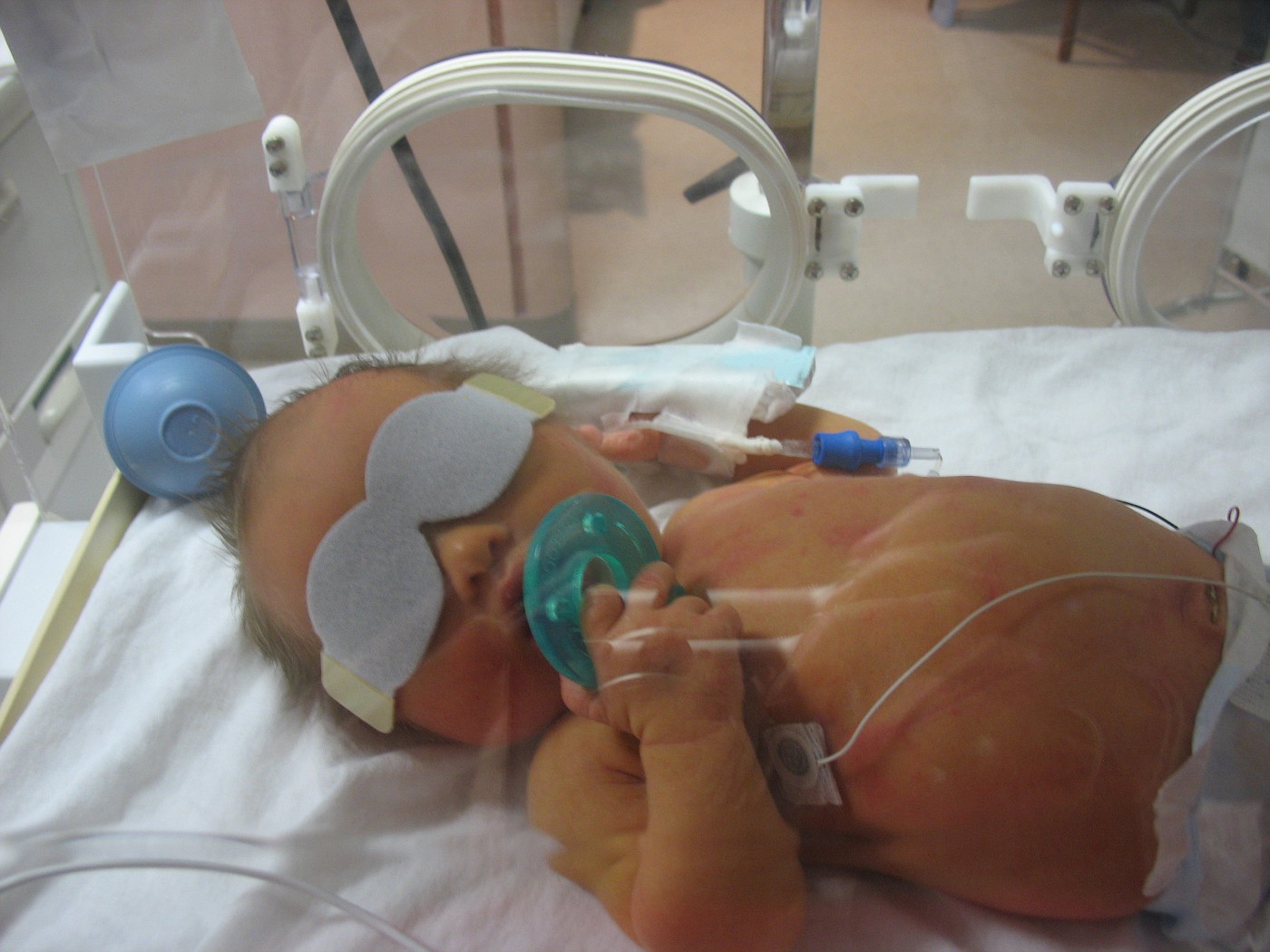
Nico under the grow lights, day 4 or so
And of course they did it because that information was out there, waiting for them to look. It's another reason that I am pro-information.

You never know when you will be called on to react. Sometimes, like my friends, you might have a night to prepare. Other times, the news reaches you swiftly demanding instant response. People who read this blog and blogs like it are ready. We have to find ways to make sure the information is available more broadly, to have people with disabilities find ways to represent themselves in media and popular discourse, to speak for them when they can't speak for themselves (but mostly, they can!).

Be ready to be that support network. When I think back on those weeks, I weep, but it's not from sorrow anymore. It's a kind of recollection of grief mixed with the love I feel for my son, my wife, my daughter now, even though she wasn't born, and the community that carried us through.

And now I'm off to re-read some old posts and sniffle.