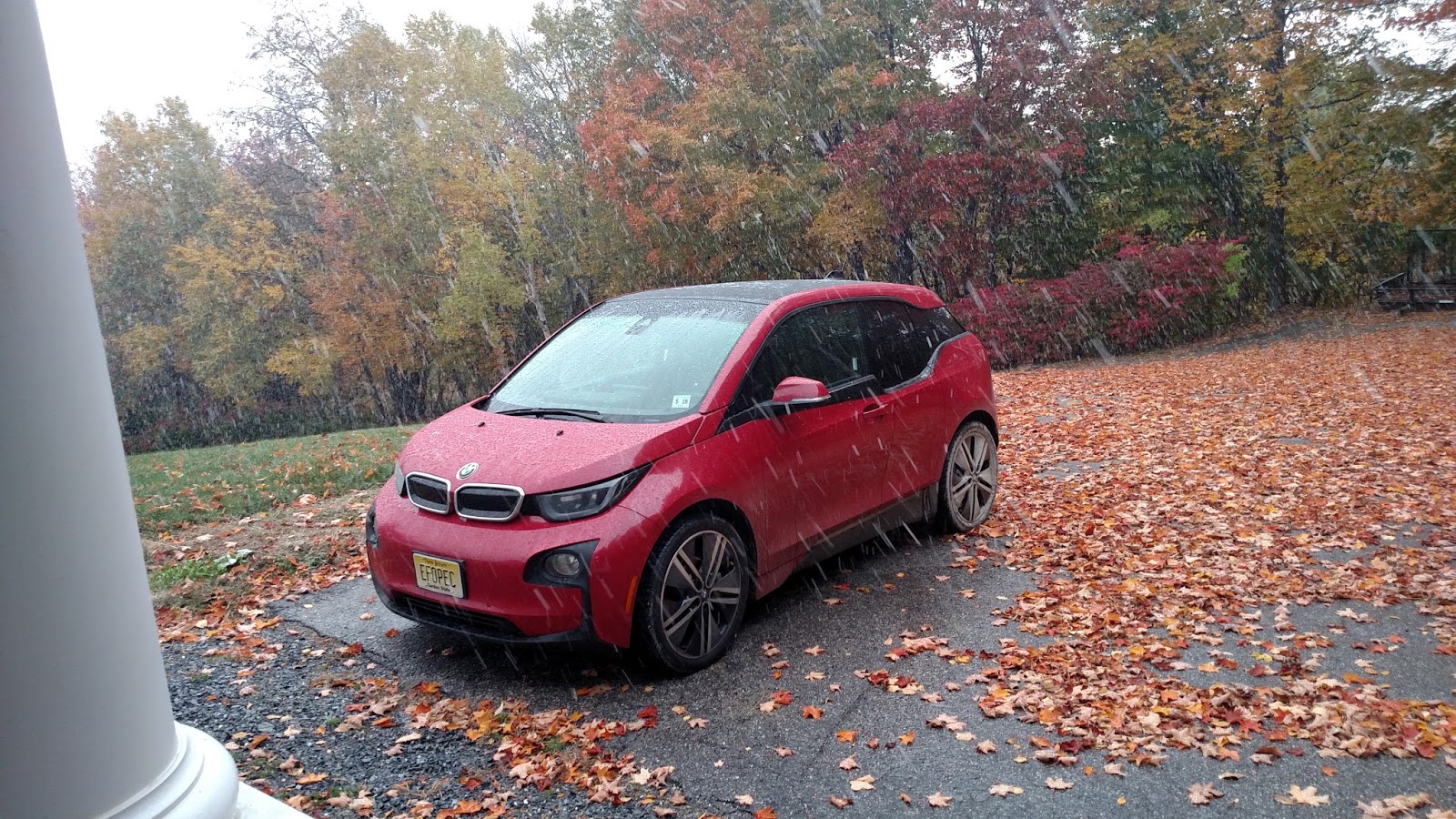
I know many readers here have spent countless sleepless nights pondering the the age-old question: How long does it take to refuel a BMW i3's tiny gas tank?
Well maybe not, but I have had people argue that driving the i3 REx on an extended trip would be very inconvenient because they would have to stop to fill up the gas tank every 50-60 miles. I've done quite a few road trips with my i3 REx, and stopping once an hour for a couple of minutes to refill the tank never really bothered me much.
I wrote a post last year which detailed a 462 mile round trip I made to Vermont from my home in New Jersey and refueling was one of the topics that many people commented on. On that trip, I had to stop for gas a total of seven times, as I only recharged the car once, which was at my destination. I drove 111 miles on battery, 351 miles on the range extender and used a total of 9.87 gallons of gas, averaging 35.5 mpg.
It was snowing in Vermont when we arrived
In that post, I wrote that I found it funny how quickly the gas tank fills because it's only 1.9 gallons. My wife started timing how long it took to stop for gas and we averaged a little over two minutes. I remember wishing we had recorded one of the gas breaks so we could demonstrate just how quick you can pull off the highway, fill up, get back into the car and back out onto the highway. I made a note that the next time we drove back up to Vermont, we would do just that.
So last week we made the Vermont trip again, and as planned we recorded one of the gas stops:
As you can see, I started the stopwatch before we exited the highway, and stopped it when we were back on the highway. I didn't jump out of the car and rush like a NASCAR pit crew filling up. I took my time and even spent a couple extra second topping off so I'd get every drop that I could into that tiny tank and we still did it in under two minutes.
The point of the exercise was to demonstrate that it's really not that inconvenient to make a quick gas break about once every every hour. I will qualify that statement with the fact that here in the Northeast there are gas stations everywhere. It seems that I'm never more than a couple miles from one, so when I'm doing these long drives I can plan the stops at convenient intervals when the tank is nearly empty. While that is the case for many large city and suburban areas throughout the country, there are plenty of rural areas where gas stations aren't as prevalent, and the small gas tank would be a problem. The i3 REx most likely isn't well suited for use in those areas. But hey, BMW calls it a "city car" after all.
As I mentioned above, when I made the trip last year I only did 111 miles on battery and drove 351 on the REx. This year I was able to drive 270 miles on battery, and needed only 184 miles with the range extender maintaining the battery state of charge. This was possible because of the always improving charging infrastructure. I was able to stop twice (once each way) at Prestige BMW in Mahwah, NJ and use their new DC fast chargers. Also, on the way home I stopped for a couple hours at a friend's house who just recently installed a 240v level 2 EVSE in his garage. These stops allowed me to more than double the all-electric miles for the trip, and I only needed 4.9 gallons of gas for the 184 miles I drove with the range extender running, as I averaged 37.5 mpg.
I used the recently installed DC Fast Charger at Prestige BMW on both legs of the trip.
I now have over 36,000 miles on my i3 after seventeen months of ownership, and only about 1,750 of those miles were on the REx. The range extender has been a great feature and I'm still very happy I got it. It does what it is supposed to; it gets you home without worrying about finding a charging station on the rare days that the electric range isn't enough, and it enables the occasional long road trip. There are limitations though, and extreme hill climbing while the REx is running for prolonged periods at highway speeds, can result in reduced power. Fortunately I've never had that happen to me but I don't really have any big mountains which I need to climb. On my Vermont trips I set the Active Cruise Control to 70 mph and have never had an issue yet, even though there are some prolonged climbs at the end of the trip. I did get the "Reduced Power Possible" warning once though, as the state of charge hit a low point of 2% once. However it held there until I crested the climb and once I was on flat ground the SOC climbed back up to about 6%. I left the cruise at 70 mph because I actually wanted to see at what point it would go into reduced power mode, but it never happened.
On one climb, I was able to get the SOC down to 2% and at that point the car warns you that reduced power may occur if you continue without altering your driving. Basically it's saying "Slow Down!"
Still, in a perfect world I'd prefer a 150 mile, all-electric-range i3 combined with adequate DC fast charge infrastructure. Personally, I really don't need 250 or 300 miles of range, and I'd rather not pay for it. However, even though the infrastructure is improving, I think 200 miles of range is probably more acceptable until DC fast chargers are ubiquitous. It appears with Nissan and Chevy poised to bring 200 mile EVs to market in the coming year, the "affordable" electric vehicle market is going to get very interesting. BMW's CEO recently announced that the 2017 i3 will have a longer all electric range also, but didn't comment on exactly how much more. That's good news because as much as I like how the REx works, and how quickly I can refill the gas tank, I'd still much prefer going on battery alone.
An i3 sits next to a 24kW DC Fast Charge unit during the announcement of the BMW, VW & ChargePoint joint venture earlier this year.
It's been seven months since BMW, along with Volkswagen and ChargePoint announced a joint venture which would install roughly 100 DC fast charge units on the East and West coasts. While there's been a lot of work identifying potential locations and negotiating with site managers, there hasn't really been any tangible progress that electric vehicle owners could see.
The plan is to create "Express Charging Corridors" on both coasts, with DC Fast Charge stations placed no more than 50 miles apart. The East Coast Corridor will connect Washington DC to Boston, Massachusetts and the West Coast Corridor would extend from San Diego, California to Portland, Oregon. There would be two kinds of DC Fast Charge stations utilized. The stations placed directly on the highway locations of the corridors would be 50kW units, most of which will be dual head CCS & CHAdeMO stations. Then, on secondary locations slightly off the direct corridors, 24kW CCS-only units will be placed. While these 24kW units aren't necessarily quite fast enough to be convenient for long distance travel of hundreds of miles, they are very useful for intercity travel and charge at three to four times the speed of standard level 2 public charging.
ChargePoint's East and West Coast Express Charging Corridor Infographic
I applied, and was recently approved under the program guidelines to have one of the 24kW units installed on my commercial property in Montclair New Jersey. I'm currently awaiting the permits to be approved and hope to have the station installed and working before my National Drive Electric Week event on September 12th. Always the competitor, I was also hoping to be the first East Coast public location in the program to get a station installed, but I'm actually happy to report that won't be the case. That's because a friend of mine and fellow BMW i3 owner, Bruce Redman Becker has beaten me to it. Bruce, and architect and developer, is responsible for 777 Main Street in Hartford Connecticut, a newly developed 285 unit apartment building with a 250 car parking garage. In describing the location to me, Bruce had this to say:
"The site is just two blocks from exits off I-91 and off I-84. We have one SAE combo DC fast charger and 10 level 2 chargers (3 duals in the surface lot and 2 duals up the ramp within the covered garage). Power for all 11 Chargepoint chargers comes from a 400kw fuel cell adjacent to the chargers that also provides renewable clean energy to heat and power the apartment tower….We have three coffee shops on our block, including a Blue State Coffee on the first floor of 777 Main opening in September. And there are over a dozen great restaurants nearby as well as a great camera shop, CVS, banks and the Hartford Atheneum museum to enjoy while charging."
An i3 using the DC Fast Charger at 777 Main Street, Hartford Connecticut
So while none of the main corridor, 50kW units have been installed yet, it seems the secondary, 24kW stations are beginning to materialize here on the East Coast, which is welcome news. I know some i3 owners have been frustrated by the seemingly lack of action with regards to the DC Fast Charge roll out, but I also know first hand that BMW and ChargePoint have been working very hard to locate potential locations, negotiate site agreements and collect bids for the installation. They've been at it for half a year now and I believe we're going to begin to see some real progress made in the next couple months. Getting the first one up and running can sometime seem like the biggest hurdle in programs like this. Well, now that that's done I'm optimistic that in the next six months we'll see dramatic progress made on both coasts.
Three 24kW DCFC units have been up and running at BMW Headquarters in Woodcliff Lake, NJ since January. They are open to the public and free to use.
The latest addition to my EVSE obsession collection is the JuiceBox Pro 40, seen here charging my i3
One of the first things many first time electric car owners ask once they've bought (or are about to buy) their new car is what home charging solution should they choose. Other than asking for advice on specific plug-in cars, it's the most popular question I get from readers here.
Luckily, there are some really good choices on the market now, and the prices for home EVSEs are considerably less than they were when I first started driving electric in 2009. Back then, the only level 2 home EVSEs that I would recommend were from Clipper Creek. Clipper Creek still makes very good products, and I still recommend them, but the competition is getting better all of the time, and one company in particular, eMotorWerks has been gaining momentum in this competitive market.
Before I get into the review, I'd first like to explain some basic EV charging levels and terminology. This applies to charging in North America, as electric supply is different for most European countries.
EVSE: Electric Vehicle Supply Equipment. These are quite often called "chargers" or "charging stations." That really isn't the correct terminology though, because they don't actually charge the car. They really just safely supply the electricity from the power source to the vehicle. The actual charging equipment is built into the electric cars. Some EVSEs are portable, while others are hard wired and permanently installed.
Level 1: Every electric car sold or leased in the US that isn't a Tesla comes with a Level 1 portable EVSE. Some manufacturers, like BMW, call it an "occasional use charger." Level 1 EVSEs can be plugged into a simple 120 volt household outlet and typically charge at 6, 8 or 12 amps. Tesla doesn't bother with Level 1, 120 volt EVSEs because their vehicles have such large batteries that they would take very long to slow charge on 120 volts. For that reason, every Tesla comes standard with a portable 240 volt EVSE for more robust charging at home or on the road.
Level 2: Level 2 EVSEs charge at 240 volts and most of the time are permanently installed in a garage or public parking lot. However, recently some manufacturers have been selling portable 240 volt EVSEs, allowing the owner the flexibility of using the equipment at home as well as on the road, provided they can find a 240 volt outlet that they can plug into. The JuiceBox Pro 40 which I'll be reviewing here today is one of those newer units, and comes with a NEMA 14-50 plug instead of requiring the owner to hard wire it to their home.
DCQC / DCFC: DC Quick Charge or DC Fast Charge. DC fast charge allows rapid charging of electric vehicles, enabling long distance travel with little inconvenience. DC Quick Charge stations can charge many EVs up to 80% full in about 30 minutes, but are not something an individual would buy for home use because of the cost and required 480 volt electric supply. These units are very expensive and are only just beginning to really proliferate. Unlike Level 1 and 2 charging, there are multiple connectors used by different manufacturers, as a single standard hasn't been established yet.
Some people live fine with their EV, charging solely with the supplied 120 volt portable EVSE. However most owners will prefer using a 240 volt EVSE, so that they can charge much faster, enabling the vehicle to be driven more miles if needed. For example, a basic 120 volt EVSE will replenish about 4 to 5 miles of range per hour, while a standard, 30 amp 240 volt unit will add 20 to 30 miles of range per hour to the typical EV. That can make the difference of being able to use the car or not on some days.
JuiceBox Pro 40 EVSE
I think I've charged my EVs on every brand of EVSE on the market today, and I have a host of EVSEs in the garage at my house which I use for various testing and when I have visitors that also have cars that plug in. I had been reading a lot about how eMotorWerks has been expanding lately, and how they recently sold their 3,500th JuiceBox EVSE. So when the opportunity came for me to test out the latest offering from eMotorWerks, the JuiceBox Pro 40, I happily accepted. I want to make it clear I did receive the EVSE free of charge, however I wasn't paid to do the review, and there were no conditions or promises on what I would write. In other words, if I didn't like it, I would say so, or perhaps not even write a review.
First, I'd like to point out the JuiceBox Pro 40 can deliver up to 40 amps of power. The vast majority of Level 2 EVSEs currently on the market are limited to delivering 30 amps of power. There are a few other companies like Clipper Creek for instance, that do offer a 40 amp EVSE, but for the most part, the industry norm is 30 amps and even less in many cases. When buying any EVSE, make sure you find out what the maximum power the unit can deliver before purchasing it. I know more than one EV owner who bought an EVSE and didn't know it could only deliver 16 or 20 amps until they installed it. Why does 40 amps matter as compared to 30 amps? Well, for most EVs today, it doesn't. Only Tesla makes on board charging equipment that can accept more than 30 amps from a level 2 source, however that is going to change. I like to recommend future-proofing your garage, and if you're investing in a home charging solution which you may be using for ten or more years, why limit the charging supply to today's norm when home charging will only get faster as EV adoption increases? If your home has the capacity to add a dedicated 50 amp circuit (a 50 amp circuit is required for a continuous 40 amp load), then I say pay the few extra dollars today so you don't have to go back and upgrade in the future.
Voltage, amperage and kW draw displayed
Switch between Amperage or kW draw screens
The feature I love the most about the JuiceBox Pro 40 is that is has built in WiFi and connects to eMotorWerks servers. This allows for real time charging monitoring which includes voltage and current measurement accurate to 0.2%. This is the only EVSE I know of currently available which allows you to monitor this kind of charging data. I know a lot of EV owners, and one of the things that keeps coming up is people asking how they can find out what the car is drawing during charging. ChargePoint allows the current measurement to be viewed on their app if you are charging on one of their networked EVSEs, and they used to offer a home EVSE (CT-500) which allowed the same, but that has been discontinued. Having the ability to monitor your vehicle's electric draw is particularly useful to BMW i3 owners like myself. The original i3s shipped with faulty onboard chargers, causing many of them to fail. This resulted in the car charging at half the speed than it was supposed to (15 amps instead of 30 amps). To make matters worse, while BMW engineered a new onboard charger, the dealers were instructed to de-rate the i3's current charging capabilities to about 24 amps, in an effort to keep the charger from failing. Many i3 owners didn't know if their car was de-rated, if their charger had failed or if they were charging at the full 30 amp rate. Without a way to really measure the energy the car was accepting, many were left in the dark for a few months while BMW built and installed the new, modified onboard chargers. If they had an EVSE that had the capability of displaying the rate the car was charging at, they would never have to wonder what the car was capable of drawing since they could simply look at the app when they plugged in.
If you're wondering if you can mount and use the JuiceBox outdoors, this video demonstration should satisfy any concern you have.
The connector has a cover
As mentioned above, the JuiceBox Pro 40 doesn't need to be hardwired. Instead, it comes with a NEMA 14-50 connector. This allows the owner to take the EVSE with them, all they need to do is find a NEMA 14-50 receptacle and they can plug in. The 14-50 outlet is commonly used by RVs and thousands of RV parks across the country have 14-50 receptacles where you can plug in on the road if needed. But in my opinion, the real beauty of having a portable, plug-in EVSE is you can install 14-50 receptacles in places like your parents or friends home, or even work, and take the EVSE with you and charge at your destination. This is much less expensive than installing EVSEs in locations you may need to occasionally charge at. The JuiceBox is small and light enough to take with you when needed. You can see this on the photo above compared to the other EVSEs I have mounted on my garage wall. The connector also has a rubber cap if you do mount or use it outdoors.
The app is very easy to set up, and should take you less than ten minutes to complete. There is also a web portal which you can log into for past history charging info (it stores data from your last 20 charging sessions) and soon you'll be able to set up notifications from the site. eMotorWerks also offers 60 amp, as well as 30 amp EVSEs, with and without WiFi connectivity. The JuiceBox Pro 40 with WiFi currently costs $599.00 which is $100 more than the basic JuiceBox 40. Personally, the WiFi feature is well worth the upcharge and I highly recommend getting it. You'll really appreciate the ability to look at your past charging sessions and energy consumption and it definitely helps you to see exactly how much energy your EV car uses because you'll have a true "wall to wheels" measurement, which includes charging losses. The in-car energy use calculators don't include charging losses or the energy used from battery or cabin preconditioning while charging, but this does. The difference can be significant, especially during the winter months when the battery may needs to be warmed while charging. The JuiceBox Pro 40 comes with a 24 foot cable which is a little longer than most standard EVSE cables. The extra few feet of cable can make the difference of having to back into your garage or pull straight in, and possibly allow you to park on either side of the garage in any position and still have enough cable to plug in.
Don't let the plain, metal box look fool you. This is a seriously good EVSE
The EVSE market is getting better all the time. The products available today are more powerful, lighter, some are portable and overall less expensive than the products available only a few years ago, and this is welcome news to EV owners. eMotor Werks is a relative new comer to the field of EVSE manufacturers, which is mostly dominated by larger, well established companies. However, the people there seem to understand what the EV owner is looking for in an EVSE, and they have delivered it with the JuiceBox Pro 40, which is why I recommend it. The price is right, the size is right, it's powerful and portable. About the only thing you can criticize is the plain-looking metal case which houses the electronics. If that really bothers you, you can always paint it, or apply a vinyl wrap or sticker to add some pizzazz. :)
During the i3's development, BMW often used a large city as a backdrop for the concept i3 photo shoots.
Megacity: A metropolitan area with a total population in excess of ten million people.
BMW has all along told us that the i3 was designed for urban transport, a glimpse at the future of personal mobility in the megacities of the world. Heck, the code name for it was even "The Megacity Car." However now that the i3 has been available for over a year, BMW is realizing that the Megacity car is selling better outside the city limits.
I've never really accepted that the i3 would do well in the megacity markets, at least in the US, and I've voiced that opinion on many occasions. Having lived with electric cars for the past six years, I've had the experience of driving and charging in the both suburbs and in the city, so I'm intimately aware of the challenges of public charging. I live about 50 miles from New York City and go there frequently. Driving my electric cars to and around the city isn't a problem, however charging it there is. There just aren't enough places to charge your car there to make living with an EV in New York City palatable. There are public parking garages and a few lots that have EVSEs, but finding one that works is one problem. Then, if you're lucky enough to find a lot that has one which is working, you often have to fight with the attendant to make sure they plug you in once you've left your car there.
My car was unplugged after only about 45 minutes of charging. It was sitting right where I left it so they didn't need to move it, someone there just decided to unplug me. With only 28% state of charge, I needed the range extender to get me home. This is a typical EV charging experience in NYC
The last three times I've gone to the City I had nothing but problems getting my car charged. In fact, two of those times I had to drive home using my range extender because the car wasn't charged. Just last week I went to the New York Auto Show and parked at the 9th Avenue Edison Park Fast lot because it had a ChargePoint charging station. When I pulled in I told the attendant I needed to charge for a minimum of three hours and he seemed to understand what I was saying. He said "Oh this is electric? No problem I'll plug you in." I even gave the guy a $5 tip up front with the hopes that he'd take care of me. As I was walking to the Javits Center a few minutes later I checked my BMW i Remote app and saw my car was charging so I figured I was good. I left the car with only 10% state of charge and wanted to be at at least 90% for the trip home, and that would take about three hours of charging. No problem because I planned to be at the show for about six hours. As I was walking back to my car later that day I checked my app just to make sure I was charged and to my surprise I saw I was only at 28% SOC and the car wasn't charging. When I arrived I asked why my car wasn't charged and the attendant only said, "We charged it." I figured maybe they had to move it for some reason, or maybe another EV came that needed to charge but no, someone just decided to unplug it after about 45 minutes of charging. The car was still parked in front of the EVSE, it wasn't blocking anyone so it hadn't been moved, it was just unplugged hours ago for no apparent reason.
This time in New York I was able to charge up at an underground parking garage, but only after 45 minuted on the phone with ChargePoint trying to get this unprovisioned station operational.
This has happened before to me in New York City, so I wasn't really surprised. I've even had the attendant promise to plug me in and never do it. I now either wait to watch them plug it in or check my app as I'm walking away to make sure someone plugs it in. Luckily I had the REx to bail me out or I'd have been in a real jam, as I needed to be somewhere else in about an hour.
Electric range insufficient. Not what you want to see when you return to your car after leaving it in a public parking lot to charge. Luckily I had the range extender to fall back on.
I could go on and on about previous difficulties I've had trying to charge in the city, but I think I'll dedicate an entire post to that sometime soon. The point here is charging an EV in the city is difficult at best. Yes, if you live there it is possible to make arrangements with the garage where you keep your car, and install an EVSE for your personal use, but many of the garages don't have the additional electrical capacity for a dedicated 40 amp circuit even if you're willing to pay for the installation and the electric, so the owners are stuck plugging into a simple 120v outlet and slow charging all of the time. Beam Charging network in New York has stations in various parking garages and offers a $98 per month unlimited charging plan, but you still have to find accessible stations and pay the regular parking fee which can be very expensive. It's definitely doable, but not very convenient or inexpensive.
So it was no surprise when I read an article this week by Diana Kurylko of the Automotive News quoting BMW NA CEO Ludwig Willisch saying i3 sales have been weaker than expected in large cities like New York: "The strongholds in this country are parts of California, Texas and southern Florida, rather than large cities, he said" The article further says: "The big urban centers in the Northeast, especially New York City, haven't embraced the i3, Willisch said. Unlike Californians, he said, New Yorkers apparently don't have sustainability and the environment "at the top of minds." I don't think it's a lack of a desire to be sustainable as much as it's difficulty charging the car there. California has a much more mature public charging infrastructure, and most people there live in private residences, unlike New York City. Overall, BMW is pleased with US i3 sales, and they are on pace to sell about 12,000 i3s per year here, they just seem to be a little surprised where the sales are coming from. I'm certainly not surprised, and I even wrote a post about a year ago that said the i3 was better suited for suburban and country life than life in the city, and I listed the reasons why I believe that to be true.
My i3 lives about 50 miles west of New York City... and fits in perfectly
Living in the suburbs or the country means you are usually in control of your energy supply, because most people live in single family homes there. There can be issues if you live in an apartment or condo complex, but you also have the choice to move to another location close by if charging is prohibited in the complex you live in. Living in a private residence allows you to install the home charging equipment you need, so you're not relying on public charging infrastructure as much.
Accessibility to charging is paramount for daily EV life, and in New York the public charging infrastructure has a very long way to go before it becomes convenient enough for many more people to consider an EV if they live there. Life in the big city is tough enough, and fighting on a daily basis for somewhere to charge your car is probably something most New Yorkers aren't willing to deal with. However there is hope that things will get better. Last year New York City passed the "Charger Ready Bill" which requires all new construction in New York City to dedicate 20% of the new parking spaces for EV charging spaces. I actually was asked by Mayor Bloomberg's office to testify in front of the committees on buildings and transportation in favor of the bill, which I did. This law will dramatically increase the amount of public charging locations in New York City, but it will take years before the results are really seen.
So are megacities like New York ready for electric cars? Not really. Not yet, I'm afraid.
The charging stations at the parking garage in Montclair, NJ are frequently ICE'd. This is a common problem across the country. Quick Charge Power has a solution: The JLong.
If you drive an electric vehicle and rely on public charging infrastructure, then you've most likely come across situations where the public charging station you arrived at was blocked by a car that isn't plugged in. At the very least it's frustrating, and at the worst it's disastrous if you absolutely need to charge in order to continue driving that day.
ICE-ing is an epidemic
When an EV owner pulls up to a charging station and a gas car is parked there, they call it being "ICE'd," referencing the Internal Combustion Engine of the car blocking them from charging. However this unfortunately isn't only happening with ICE vehicles. Now that electric vehicles are increasing in numbers and parking is always a premium in some locations, some EV owners are using the charging station spaces to park, even when they don't have to plug in. In my opinion, this is far worse than when the driver of an ICE vehicle parks there because the EV owner should know better. In any case, the person blocked from the charging station is terribly inconvenienced.
If you are low on charge and can't make it to the nearest alternative charging station, there isn't much you can do. You can: A) Wait for the person to move their car so you can pull into the space and plug in. B) Try to find the person who is parked there to see if they'll move their car, or C) Call the police and have the car ticketed and towed, but only if there is specific signage allowing that, which isn't the case for most public charging locations. These options are time consuming and bothersome, and there's no guarantee that the car will move in time to allow you to charge as much as you need to.
To illustrate how the JLong works I chose to use it without cars blocking the camera's view. You can see I was easily able to park one space away from the EVSE and with the extra cable coiled up on the ground in front of my car I could have definitely even parked another space away and had plenty of cable to reach. Click on the photo to enlarge.
Then there is another issue that sometimes creates problems for public charging stations; the snow. When snow plow crews clear parking lots they push the snow wherever it's most convenient, and where there is room to accommodate the piles of snow they produce. Often that's where the EVSE's are located. I own a commercial property that had two ChargePoint EVSE's and I can say first hand they present a problem during the winter months. I want to keep them clear and accessible, but that's not always possible, especially when there are frequent storms with a lot of snow like we had this winter. I do my best to clear a path to the EVSE's but the cars still need to park much further from the charging stations than they usually do, and if they don't get to park in the spot closest to the EVSE the cable won't reach the vehicle.
This isn't all that uncommon during the winter months in areas that get a lot of snow. Without a product like the JLong you'll never reach your car with that cable. Photo credit: Chevy Volt Owners Facebook group.
Now there is a simple solution that will instantly solve the problem in many of these frustrating situations and it's called the JLong. You plug one end of it into the connector from the EVSE, and the other end has a J1772 connector that plugs into your car. Available from Quick Charge Power the JLong is an extension cord for electric vehicle charging stations. It is compatible with the J1772 connector which is the connector used by all modern highway-capable electric vehicles sold in North America with the exception of Tesla. Tesla however provides a free J1772 adapter with every car they sell so this can also be used with Tesla vehicles.
Credit: Andy Stewart Facebook
The JLong can be custom ordered with any length of cable, but comes standard with lengths of 10, 20, 30 and 40 feet. Personally I believe the 20 foot cable is adequate for most situations, but it wouldn't hurt to have an extra 10 feet just in case the first available space is a couple of spaces from the EVSE. You'll regret not spending the extra money for a longer cable if you come up short one day.
Since most parking spaces in the US are 8 feet to 9 feet wide, a 20 foot JLong, combined with the EVSE's cable will allow you to park three spaces away from it and still plug in. For every ten feet of cable you add, you can park in one space further and still plug in. Pricing is reasonable considering it's a quality product, and dependent on the length of cable you wish to order.
The JLong comes with a small lock to lock the J1772 connector which prevents someone from unplugging and stealing it
The JLong is made in the US and appears to be very well made. There are other J1772 extensions on the market but the JLong seems to be the highest quality one that I've come across so far which is why I'm comfortable recommending it here. I even know one person who bought a similar product from another company and returned it because they didn't think the quality was up to par. They then bought a JLong a couple months ago and have been very happy with it. From the Quick Charge Power site:
"...Our second generation JLong, has a custom handle (see photo) built of 6061-T6 aluminum alloy and TIG welded. It is powder coated with a special "grip" feature and is laser etched with our logo.
We use a special 8 conductor cable assembly built to our unique specification for maximum flexibility and light weight.The entire assembly will be good for up to 40 amps. All power conductors are professionally crimped to military and aerospace specifications. We don't use alloy aluminum handles, custom cables and mil-spec professional crimps (amongst many other features) because it's cheap. We do it because it's the best.
Our new price with all these features is now $199.00 for 10 feet. Each additional foot is $5. If somebody were to run over your JLong in the parking lot, there's a good chance that the host J1772 plug will be destroyed and your JLong just might still be usable."
Even BMW dealerships have ICEing problems. I recently stopped at this BMW dealership in NJ for a quick boost and found the EVSE blocked. In this instance I could have reached the cable but then I'd be blocking the lane for cars to drive by. To make matters worse there were plenty of parking spaces open for the dealer to park the cars within 30 feet of this but they blocked the EVSE anyway. The JLong gives you a lot of flexibility on where you can park and still plug in.
I come across a lot of products for electric vehicles, and this is one I can honestly say is a must have for those who rely on public charging. It's a high quality unit, made in Kennewick, Washington and appears able to withstand the rigors of being used in public places, stepped on and even possibly run over (But I still wouldn't recommend that). Both ends have covers to prevent snow, mud, etc, from getting in should you drop it and it has a custom built, 4th generation design cable assembly built in Ontario, California USA. In most cases it will allow you to avoid being blocked from plugging in, so you can continue on with your daily activities and not worry about how you're going to make it to the next destination, or even home later that day. You can order a JLong from Quick Charge Power from this link. I also want to mention that Electric Auto Association members get a 5% discount on all Quick Charge Power products along with free shipping on orders over $100.
One of the things many of us EV drivers are guilty of, is plugging in whenever we have the opportunity to. We may not even need the extra range, but if there is an available 240V EVSE, or even a simple 120V outlet, and we're going to be at that location for a while, it's just too tempting not to plug in and grab some electrons while we're there.
Not that there is anything wrong with that, but I wonder how many i3 owners know their car records everywhere you've plugged in and stores the exact location? I've known this for a while now because a few months ago one of the readers here sent me an email pointing it out because it almost got him in trouble but I'll get back to that later in the post.
I'm bringing this up now because I had to bring my car in for service for BMW to inspect something. I'm beta testing new i3 software which will be released to the public in a few months so if I see anything out of the ordinary they want to check it out. So I dropped the car off at JMK BMW and a nice Ionic Silver i3 REx was waiting for me to use as a loaner. I had used this loaner before a few months ago when I had the new software installed on my car and love that JMK offers i3 loaners. It's a practice that all BMW dealerships that really want to sell i3s should employ, in my opinion.
My previous charging locations were still recorded, months after I used this loaner car. All I had to do is choose this entry and the car would direct me to my restaurant in Montclair, NJ. I could have also visited the homes of some of my fellow local i3 owners.
So as I headed out of the dealership I started the navigation system, and instead of entering the destination, I scrolled down to "Last Charging Stations" just to see if the addresses I charged at a few months back were still saved there. They were. My restaurant in Montclair and my home address were saved as destinations in the loaner's nav system. Then, as I scrolled down the list I saw addresses of all my friends who live locally and drive i3s. Their names weren't listed, but the navigation system stored the exact location of their homes - which I know because we are friends. Evidently they too had used this loaner i3 while their car was in for service. Since they charged the car at home, their addresses were recorded as "Last Charging Stations" and stored in the nav system. I erased all the entries that were addresses of the people I know, but I wonder how many of them realized they were leaving a record of where they live and charge for anyone who had the car after them to see.
I suppose it's not a problem if it's your personal car, but if you do use an i3 loaner from your dealer, and you don't want a record of where you plugged in logged in the car's navigation system, I'd suggest you delete the entries that were made while you had the vehicle before you turn the car back in. I know this isn't all that different from how navigation systems work on other cars. Many store the previous destinations that were entered in the system. However this seems a little more intrusive to me because your home address is being stored without you entering it into the system like you would have to do with a navigation system. Simply by plugging the car in you create a saved entry and the exact location is stored. I just want the readers here to know this, so they can decide if they want to delete their charging locations whenever they feel the need. I'm sure many i3 owners don't even realize this is happening.
Now getting back to the original person who pointed this out to me. About six months ago I got an email from one of the readers here. He wanted to tell me a funny story of what happened to him with his i3. One day his wife was using the car for the first time by herself and was getting to know the iDrive system. She came across the Last Charging Stations category. Scrolling down the list she saw an entry which was a street in a town that wasn't too from where they live. Unfortunately for him, it was on a street and in the town were an old girlfriend used to live. When he came home that night his wife asked him about it, and he had to explain why he was there and that it was a public charging station which he needed to stop off at for a little while so he could make it home one night. He explained and they laughed about it, and it wasn't some serious inquisition to begin with, but it was a little reminder about how this feature could get someone in trouble if they went somewhere they shouldn't have.
This may or may not be a concern for you personally, but I want to at least point this out so i3 owners are aware of it. It's very easy to delete an entry; you just hover over the saved destination, press the options button and then delete. Unless you're doing something you shouldn't be doing I don't see any reason to delete entries in your personal car, in fact storing them for future use is a great feature, and is the reason why the car does it in the first place. However, when using an i3 loaner from the dealership, I'd prefer that my home address isn't permanently stored in the nav system and I'll be deleting the entries I created when I return the cars I have on loan from now on.