Last week I
wrote about and
hosted an essay on the Pro-Information coalition in the world of Down Syndrome Prenatal Testing policy.
This week, I want to share our diagnosis story as part of
Never Alone, a pro-information campaign from
Lettercase to make sure that people who are receiving diagnoses not only have the best information (and they have a booklet to serve that end), but also are not alone.
If you are a parent, please consider going there and sharing your diagnosis story. If you are a medical provider, go find out more. If you can donate to support the production and distribution of information booklets, it's a good cause.
Here's our story.
We had a post-natal diagnosis, but the lessons I have learned from it are relevant to the complex and ongoing discussion of prenatal diagnoses.
About five minutes after my son was born, my son's eye was having some difficulty opening (because being born is hard) and I asked Michelle, the nurse-midwife, if there was anything wrong with it.
"No," she replied, "but did you have any genetic testing done?"
I was, at the time, too ignorant to know what was coming next. I answered, "no?"
This was true, not because of any philosophical plan, but because for various reasons we didn't know my wife was pregnant until we had moved past a lot of the test dates. The ultrasounds showed no troubles, so on we went through the months.
Michelle looked up at me and I now know what the expression on her face meant. Doctors and people like Michelle – not a doctor, but with a lot of knowledge and independence – have to deliver bad news all the time, but only a few are really good at it. I have no idea how someone learns to do what Michelle did next, to say a phrase that changes everyone’s life, forever, especially as she could have passed the buck to our pediatrician or another doctor.
Well,” she said, “He’s showing characteristics typical of Down syndrome.”
“What does that mean?” I asked.
My mind reeled, racing through images of people with Down syndrome. The word, “retarded,” flashed by. I immediately started imagining our life and wondered, “Does that mean we are going to have to put him in an institution?” Later, my wife told me when she heard she wondered about life expectancy.
In this moment that should have been filled with elation, our minds turned to institutionalization and death, so powerful were the words "Down syndrome" and their negative connotation.
In fact, Michelle answered my question in the best possible way. I wish I remembered exactly what she said, but I trust you'll forgive me if my memory is a little blurry. She said that there was a big range of possibility, some risk factors, and also the strong likelihood of significant delays. I did not process this answer. I said, “Should I tell Shannon?” and she said that yes, I could.
Through classes and talking to doctors, Shannon and I both knew how things were supposed to go. After the baby is born, they clean him and wrap him and weigh him and make sure there’s no danger, then they give him to his mother. There are so many pictures and images of that smiling perfect moment, exhausted, the new parent and new person cling to each other. The baby, having taken his first breath, issues his first wail, a protest at having been extricated from the perfect home that is the womb. Nico was silent. Nico was not being placed on Shannon, and she sensed something was wrong.
She cried, “Where is my baby? Is he ok?” I mumbled something. “Is he ok?” she repeated. “He’s fine,” I said, “But Michelle thinks he has Down syndrome.” The words tumbled out of my mouth in a painful rush.
That I remember. The first time I said that my son has Down syndrome.
We have a picture. I'm not posting it. We don't look happy. I look at it sometimes to remember those moments though.
The next few hours were not easy. We got to hold him for seconds, it felt like, before they whisked him off to the special nursery (one step below the Neonatal ICU) There was a phone call to my parents. There was a locked post on livejournal to which I didn't permit comments. There were tears and anger and stages of grief.
 |
| Nico and my finger, day 3 |
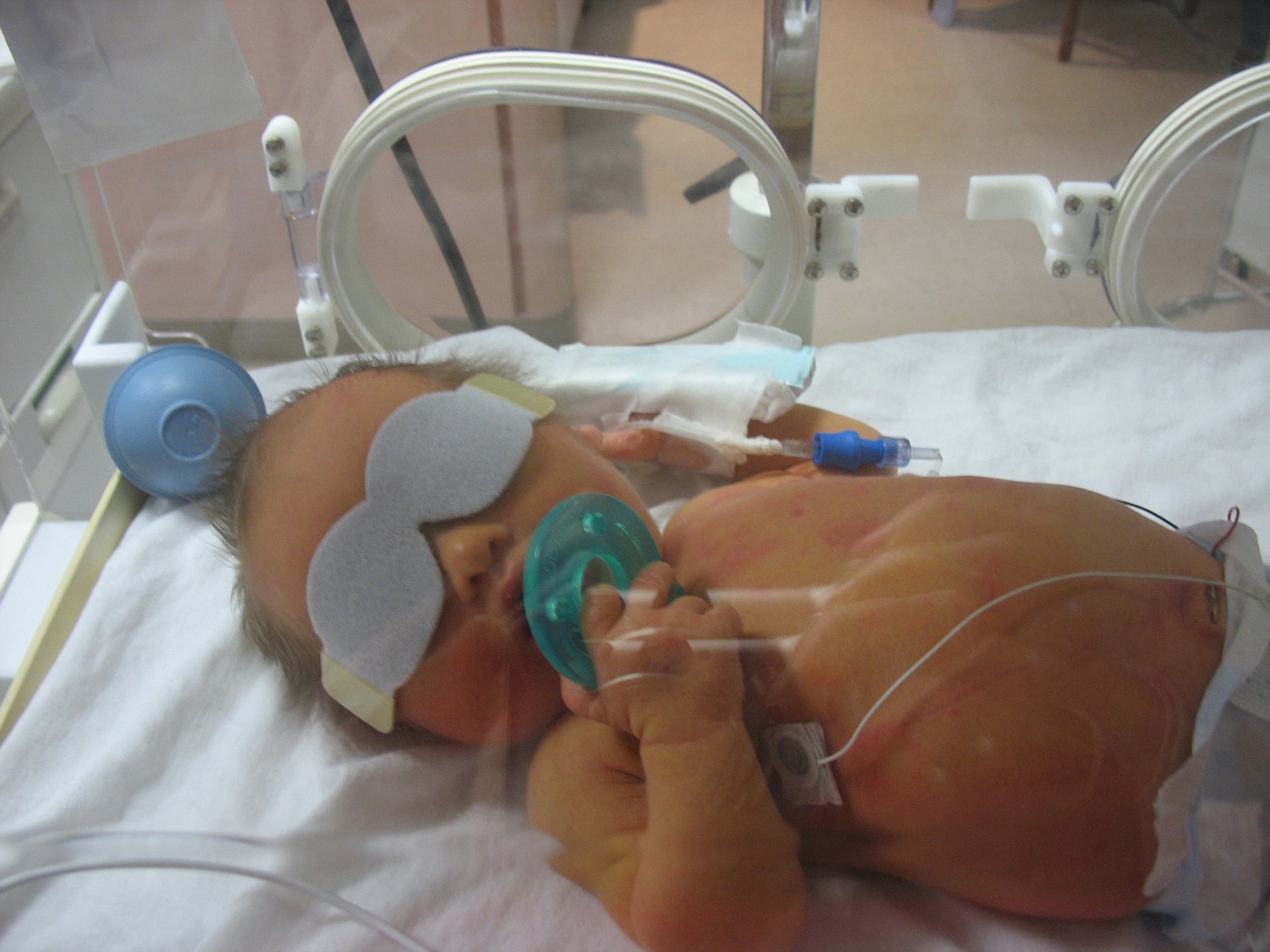
And then two things happened. First, I got to see my son. This picture is actually from a few days later, but he looked more less like this, if also covered in wires and tubes, but real, tangible. There was work to do. Here was a child who needed care. The presence of my son booted me from abstract to real.
Then our community of friends and family, who had spent the hours since my late-night post and the following morning learning about Down syndrome, kicked into gear. In those first bitter hours, among the more trivial of my dark thoughts was that the man we had asked to be Nico’s godfather wouldn’t want to be involved with Down syndrome. I thought that I should let him off the hook. I felt ashamed of my son, of myself, of my thoughts. I wanted to hide. But our friends … including Nico’s godfather … were up to the task.
When they talked to me on the phone, when they came to see us, they said what you would say to any new parent, “Congratulations!”
“Stop it,” I wanted to shout, “there’s nothing to congratulate us about! This is a tragedy. Lives are ruined.”
But they were wiser, and stubborn, and just kept congratulating us. They came to visit laden with flowers and champagne and chocolate cake and presents. They showered us all with love. They told us our baby was beautiful and cooed over him. Together, my son and my friends carried me out of the first shock of grief. They shifted my perception so that I didn't see just a bundle of symptoms and potential problems, didn't just see a diagnosis, but instead saw my wonderful boy.
By the end of the second day, Nicholas successfully latched onto his mother’s breast and nursed. We’d been told he probably wouldn't be able to nurse, that his jaw would be too weak, that he might need a direct tube in his stomach, or to be fed via a tube inserted down his nose, and all sorts of other things. But he nursed. And for the next four days, we’d be back in his room every three hours, providing a kind of rhythm to a life that so quickly became our normality.
I could go on for hours about the first months of Nico’s life, but to do so would be to deviate from my purpose. The key point here is that it was having this boy to care for and to love, and having a community that rallied around us so marvelously, so stubbornly, that brought me from mourning into the joys of parenting. And the joys are immense.
But think back to that moment when my son was born and I heard the words, “Down syndrome.” Grief. Fear. Ignorance. Incapable of rational thought.
Now imagine being given that news over the phone in week 16 of a pregnancy. And it is over the phone, at least the initial "positive" screening result, because that's the only way to do it.
In the pre-natal context, there’s no child to care for, to love, to nurture, and to see as something real. There’s no child around which the community can gather, praise, tickle, focus on. There’s just this diagnosis and a shape on an ultrasound machine for a few minutes to counter the fear and the grief. That shame we felt, the desire to hide, was only countered by our friends showing up at the hospital with their powerful words and love.
How is anyone expected to cope in that moment? Absent powerful support structures – spouses, family, friends, faith, whatever it takes – how is someone supposed to get through that?
This is why community, correct information, and representation matter so much. So that for the expectant mother, her partner if any, and for society, we change the meaning of the words "Down syndrome" from something that's filled with fear and grief, emotions I remember well, to something more like this.
 |
| My son and daughter play in the backyard. |
Sometimes people ask me, or want to ask me, what we would have done with a pre-natal diagnosis of Down syndrome. I tell them that I can't answer that question. There is no way for me to put my mind back into the state of ignorant abstraction prior to meeting Nico. Statistics suggest that I might have advocated for an abortion. Then again, we would have been alone, without community, without concrete knowledge of what life with Down syndrome is really like, good and bad.
That's the goal of this campaign, to let people know that we aren't alone, that the birth of a child with Down syndrome may come with a long list of worries, but also deserves congratulations, and can lead to a laughing boy sliding down a waterslide into the waiting arms of his sister (or whatever your life may bring).
There are no guarantees in life, no matter how many chromosomes you have. We'll have many more obstacles again. Some will make us weep, surely. And yet, we won't be alone.