Showing posts with label disability. Show all posts

Inclusion Pays Off in Vermont / MN Series On Disability and Work

The Star Tribune has a great  five-part series about disability and work, focused on Minnesota, but looking more broadly - Failing the Disabled.

Here's one I like, because it's a positive outcome.
With her zest and ambition, Wollum personifies the remarkable strategy that has made Vermont a leader in the civil rights movement for adults with disabilities. If she lived in Minnesota, Wollum might have been steered into a sheltered workshop or mobile cleaning crew, where thousands of disabled adults perform mundane tasks and have little or no contact with the broader community.
But here, in this state of hardscrabble hillside farms and country roads lined with sugar maples, sheltered workshops are a thing of the past. Disabled adults are expected to take their place each day alongside other working people. In the 16 years since the U.S. Supreme Court ordered states to end the segregation of people with disabilities, few states have carried the flag as boldly as Vermont.
This is achievable everywhere.
Instead, even in Minnesota, a state that prides itself on its commitment to disability justice, we get this:
Though both have Down syndrome, Erin, 26, and Suzanne, 23, have been on starkly different career paths.
Erin makes as little as $2.75 an hour at MRCI, a sheltered workshop operator.
Suzanne makes $10.10 as a breakfast hostess at the Hampton Inn.

While Erin and her cleaning crew are largely hidden from public view, Suzanne’s is the first face that many visitors see each morning in this southern Minnesota town.
Just how Erin and Suzanne wound up on such different trajectories is a case study in the fickle nature of job opportunities for Minnesotans with disabilities.
Jobs have been the big quest for decades now. I'm glad Vermont is showing what's possible.

Cult of Compliance - Linwood Lambert's death

There is new video of the death of Linwood Lambert.

If police want to have TASERs, which they do and they should, then the people who abuse them have to be held accountable.
When three Virginia police officers put Linwood Lambert in a squad car around 5 a.m. on May 4, 2013, they said they were taking him to the ER for medical attention because he was speaking delusionally. Just over an hour later, Lambert died in police custody.

He was never given medical care, though the officers of South Boston, Va. did drive him to the hospital. He was not initially put under arrest, though the officers ultimately arrested him, shackled his hands and legs, and tased him repeatedly. While in custody he was agitated and ran from the officers. Ambulance workers say police later claimed he fought them at a time when videos show he was actually unconscious. Police dispute that account and deny allegations of excessive force.
Repeated tasers are often the pattern in these deaths. Repeated tasering of a restrained individual may be excessive force. We need better protocols and accountability.

Public Lecture on Disability and Police Violence - Harvard School of Public Health

Poster for Different Lenses, One Vision conference. 
Next Wednesday, November 18, I will be offering a public lecture on police violence and disability at the Harvard T.H. Chan School of Public Health for their "Different Lenses, One Vision: A collaborative discussion on 'otherness'" conference.

I argue that the experiences of people with disabilities must be part of our national conversation about police use of force. People with disabilities are frequently targets of police violence. Disability intersects with race, class, gender, sexuality, and other categories of identity, often intensifying risk and degree of marginalization.

The good news is that if we approach this problem the right way, we can build a more just and humane society for everyone.

My talk is at at 5:30 at the Kresge Cafeteria.

You can RSVP for the event here.
Conference Facebook page here.

Location:
677 Huntington Avenue
Boston, MA 02115
(617) 495-1000
www.hsph.harvard.edu/

See you there!

Writing About Murder: Mercy Killing and Killer-Centered Stories

Yesterday 11 Alive News Atlanta wrote a story about the murder of Dustin Hicks with the headline: "Dawsonville mother kills son, self, in possible mercy killing." They followed that with the lede: "Murder-suicide or mercy killing?"

As social media began to comment on the phrase, the headline changed to "Dawsonville mother shoots disabled son, self." Later, they also re-wrote the lede. Here's my blog, with screenshots, on the story. Here's a link to the news item as it stands now.

My motto: write victim-centered stories. The phrase mercy killing, although indeed the murderer may have felt he or she was doing a mercy, is not something that should be blithely tossed about by journalists. Moreover, stories that fixate on the killer and his or her issues, rather than the life taken by the killer, is always the wrong way to go.

Here's another killer-centered story from a mother who murdered her child. This one took place in an Arizona hospital. Whereas the Hicks murder took place in a big house, so at least we can say there wasn't abject poverty, this story is tougher. Still, the coverage immediately leaps into looking to explain motives, using the child's disability to explain.

There is a time and a place for talking about services, about stress on parents, about the need for more community engagement when it comes to caregiving. That time isn't right after a murder. No journalist should imply that killing a person with disabilities is a mercy or justified. 


Wall of Shame: 11Alive News Atlanta refers to murder as "Mercy Killing

A woman murdered her disabled son in Georgia. It's a tragic story. His father discovered when he came to pick up his son for a visitation. This is just brutal:
The boy’s father came to pick him up for regular visitation but when he got there, no one came to the door. And that wasn’t typical.
The sheriff described how the father said those routine visits normally started.
“When he comes to visit, the kid comes to the door and is excited to see him,” Sheriff Tony Wooten said.
Feeling that something was wrong, the father called 911. But once inside, deputies found a devastating scene.
I can't tell you any more about the boy - his likes, his dislikes, his needs, his desires - because the news report focuses on the mother. Worst of all, the headline writer speculated that this murder might be a "mercy killing."

Here's a screenshot from 11:30 AM CST on 11/09/15 (link to the article - UPDATE 6:34 11/9 The news station has removed all references to "mercy killing" but not acknowledged corrections)


The headline reads: Dawsonville mother shoots disabled son, self in possible mercy killing. On the video, it reads, "Police: Mom kills disabled son, then herself." One DEK (a subheadline) read - "Murder-suicide or mercy killing?" Such rhetoric suggests that if she did it to spare the boy suffering, it's not murder.

There was a certain amount of twitter outrage, including from me. 

In fact, I had just spoken about this on Tuesday at Access Living Chicago, when, at a workshop sponsored by Poynter on disability journalism, I talked about the need to write victim-centered stories in these tragic cases. I wrote about that for CNN a year ago after London McCabe was murdered.
Stories about lack of support services position children with disabilities as burdens to their families. They portray the crime as understandable. Such stories perpetuate the idea that it's better to be dead than to be disabled, that life with disability is life without meaning, and that tired, stressed, caregivers have no hope. No wonder, in such a narrative, the parents do such terrible things. The children, or at least their disabilities, become responsible for their death.
Such stories do not just erase the victims, they are also generally inaccurate. In fact, this kind of killing is typically driven not by a lack of services, but by a warped understanding of disability itself.
London McCabe did not want to die. London liked big hats. He liked fuzzy stuffed animals. He made a wish on his cupcake for his sixth birthday. In September, his father wrote, "London is pleased as punch. He lays on our laps and puts our hands together. Last night he made the 'mmmwha!' sound and gave his Mommy a kiss. Then he made the same sound and pushed our faces together. He's all smiles."
I was thinking about that last paragraph, a paragraph that crushed me to write and still hurts to read, as in the description of this latest victim's enthusiasm to see his father. He was a real person. He's been murdered.

And this news station called it a mercy killing. 

Fortunately, the headline has changed. It now reads - "Police: Dawsonville mother shoots disabled son, self."


I'm glad they listened. I've called the station asking for comment and will let you know if I hear anything.

Update 2:58 CST 11/9: It's pointed out in the comments below that the piece still leads with "murder-suicide or mercy killing?" Contact them here.


Cult of Compliance: 77 Year Old Blind Man Beaten by Police; Police Department says "Within Department Policies"

This case is from 2012, but I first noticed it on this DailyKos diary. It's a perfect example of the "cult of compliance," a phrase I've been using since 2013 to link otherwise discrete incidents of police brutality, creeping authoritarianism, and broader examples of cultural discourse that venerate compliance as the greatest of all virtues.

Here's a 77-year-old blind middle class white man beaten by police. It's not knowable how this case would have turned out had he not been disabled, or been black, or been younger, but it's important to mark the ways in which he could resist police narratives of justified use of force, at least in the eyes of a jury. It often takes a "perfect victim" to win any kind of restitutionHe sued and just won $400000. Here's what seems to have happened:
White of Eagle was trying to get back home from a conference on technical advancements to assist the blind. He arrived at the Greyhound station downtown to learn the bus he wanted to get on was full. He says the employee told White he could stay at the station and wait.
Then a security guard told White he was trespassing and called police. The security guard did not tell White the police were on the way. When Officer Kyllion Chafin arrived on scene White asked to see his badge.
"He says how are you going to look at my badge if you're blind?" explained White. "I said I just want to touch your badge. He said you're not touching me."
That's when the incident escalated. Chafin pulled White's arms behind his back and threw him onto the counter, hitting and causing bleeding to White's head.
...
After putting the man in cuffs, Chafin's supervisor Sergeant Robery Wyckoff began to record an interview with White without reading him his Miranda rights.
...
Wyckoff was promoted to Lieutenant last year.
Another article notes: "Bleeding from the head, White was handcuffed and taken to the Denver jail. He was released about eight hours later, near midnight. No criminal charge was filed against White."

Both Chafin - the officer who decided that a blind man asking to touch his badge - and the Lieutenant, are still Denver police officers.
The Denver Police Department did not respond to specific questions but did send the following statement:
"We believe in the judicial process and respect the jury's decision. The Department of Safety and the Denver Office of the Independent Monitor took part in reviewing the incident, and the Denver Police Department found that the officers' actions fell within department policies. We are always looking for ways to improve."
Here we have a civilian, as nonthreatening as could be, asking for a reasonable accommodation to verify the identity of a law enforcement officer (LEO). Instead, the LEO decided that his non-compliance justified force, and slammed him down on a desk (there are pictures of his bloody head, if you're the doubting kind). Notice, though, the chain of the cult of compliance, starting with the bus employees who decided that throwing out an old blind man was the right call.

Here are two principles:

  1. Lack of compliance, on its own, absent other threat indicators, must not be used to justify force. 
  2. Officers who violate principle #1 must be held accountable for their actions by law enforcement itself. If such actions do not violate department policies, change your policies.

Cult of Compliance: Bus Driver Attacks Student with Disabilities for not Obeying.

This is a video of a school bus driver attacking a child with disabilities. It's hard to watch, but worth watching for the following reasons (and maybe more):
  1. The other kids are standing up for their classmate, telling the bus driver he can't do it.
  2. One child was holding the cell phone that caught this video and led to the arrest of the driver. Another child, at about 28 seconds, can be seen pulling out his phone to record the driver.
  3. It's the "cult of compliance" embodied, yet again. The driver gives a command, the student disobeys, and the driver then uses that to justify (to himself and in the aftermath) his use of force. It's the same phenomenon as Spring Valley High and thousands of other incidents (use the tags to track them, though I'm still implementing tags consistently in the first 500 post on the blog). From the local news report:
Johnston police said the driver approached 15-year-old Christian, a student with special needs, after he failed to follow the bus driver’s instructions regarding a seat assignment.

Police said the student directed an inflammatory comment toward the bus driver who grabbed the student's coat, hit the boy in the face and pushed him to the floor.
Here's the video. Obvious warnings apply, though it's more disturbing than graphic.

Sunday Roundup: Four Important Posts on Disability

I finished a major corporate (disability-related) project this week and am hard at work on a major non-profit (disability-related) project now. That, plus teaching, plus the book, has slowed me down in terms of writing for mainstream media, but I trust that the depth of these bigger projects is more than worth it.

In the meantime, though, instead of blogging less, I'm taking ideas that might have made for publishable essays and placed them here. This week featured four posts that I think matter.
  1. How Not to Kill Someone in Mental Health Crisis. This is a video, from the UK, of a person with a machete not being killed by London police. It's instructive and important.
  2. Disability, Trauma, and the Assault at Spring Valley High - If 25% of all American children have experienced trauma, it means we have to rethink fundamental systems in our schools.
  3. Peter Singer's Tells - A controversial philosopher who argues that the correct ethical decision in the case of disability is euthanasia/abortion, reveals that he doesn't think those positions should be such a big deal. To him, they're old news.
  4. Adventures in Universal Design: Handwriting Notes and Take-Home Tests - My approach to universal design for learning. We're learning the wrong thing from the research on handwriting.
Thanks, as always, for reading.

Disability, Trauma, and the Assault at Spring Valley High

Ever since watching the terrible video of a student being pulled from her desk and thrown to the ground, I've been waiting to learn how disability intersected with this case. I assumed it would, because the data shows that the two groups most vulnerable to violence at the hands of school authorities are people of color and students with disabilities. Disabled people of color are multiply marginalized, and thus highly at risk - see my pieces here and here

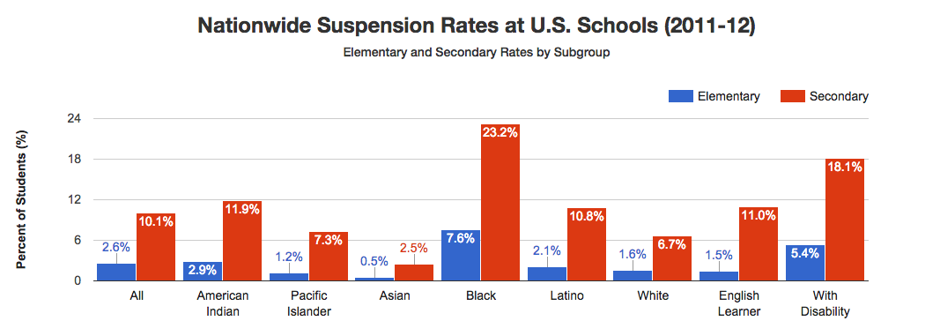
Chart from http://www.citylab.com/crime/2015/10/why-disabled-students-suffer-at-the-hands-of-classroom-cops/412723/
It shows 22.3% of all suspensions are black students. 18.1% are disabled.
Once we learned that school resource officer Ben Fields was known as "Officer Slam," I knew that if we dug into this officer's background, we'd find disabled victims of his bullying. That's just what happened. Here's a story that describes his violent encounter with an autistic student [my emphasis]:
Richland School District Two Superintendent Debbie Hamm admits that "clearly something did not go right," calling it the most upsetting incident she has seen in her 40 years with the district.
"We will be working with the Richland County Sheriff's Office to clarify our expectations about screening and training for school resource officers," said Hamm.
But one parent had a slightly different reaction.
"I saw his face and my first thought was 'Oh my god, that's the same guy,'" said Wendy Johnson, who says her autistic son was in a physical struggle with Fields when he was a freshman.
Photos she took of her son after the altercation reveal his shirt torn and marks on his arms and shoulder.
Notice how the Superintendent characterizes the assault on the video as out of the norm. My guess is that "Officer Slam" does this all the time, it's just now he's being held accountable. The violence is structural. The violence is systemic. This is not an isolated incident.  

Then there's the question of trauma. There's a major class-action lawsuit in California arguing that victims of trauma should be covered under disability law. It has enormous implications for American education, because up to a quarter of all children, according to Susan Ko of the National Center for Child Traumatic Stress, will be victims of trauma. If trauma is so common and if should be treated as a disability (both givens that I believe to be true), it may indeed force us to stop treating disability as a deviation from the norm, as a case of "special" needs, but just as needs. We'll have to move to a system of universal design that requires all interactions with students take the possibility of disability into account.

I don't know whether the student dragged out of her desk was a victim of trauma. I don't need to know. Initial reports was that she was a recent orphan, more recent information is that she is estranged from her mother and living in foster care, and now that narrative has been questioned too. We, as a nation, are overly fond of litigating the character of the victim of state violence as a way of determining whether or not they deserved to be brutalized. Such violence is not determined by whether she was a "good victim" or not, but instead whether she was in fact engaged in threatening behavior that merited escalating use of force. Judging by the videotape, she was not. Case closed.

Her lawyer does say that she's a victim of trauma now, in considerable emotional distress. I believe it. The assault looks traumatizing. Having millions of people view your assault, likewise.

In that classroom, the statistics suggest, there surely were people who had experienced trauma, and who had to observe the violence. That's only going to make matters worse.
Many traumatized students live in a state of constant alarm. Innocent interactions like a bump in the hallway or a request from a teacher can stir anger and bad behavior 
The lawsuit alleges that, in Compton, the schools' reaction to traumatized students was too often punishment — not help. 
"They were repeatedly either sent to another school, expelled or suspended — and this went back to kindergarten," says Marleen Wong, who teaches at the USC School of Social Work and has spent decades studying kids and trauma. "I think we're really doing a terrible disservice to these children." 
The suit argues that trauma is a disability and that schools are required — by federal law — to make accommodations for traumatized students, not expel them. The plaintiffs want Compton Unified to provide teacher training, mental health support for students and to use conflict-mediation before resorting to suspension.
We must get these SROs - School Resource Officers - out of the schools. We cannot respond to the prevalence of trauma with more police officers, more violence, or zero tolerance policies. It's counter-productive. Hopefully, the courts will also decide that it violates the ADA.


Disability Journalism: Rose Eveleth on not writing ableist garbage

Rose Eveleth has become one of my favorite writers on technology. Lately, she's been  focusing specifically on prosthetics. It's an area that technology is rapidly transforming. It's great to have deeply thoughtful journalists reporting on both the science and the social implications.

In this blog post, she reflects on what she's learned on her beat and how not to write "Ableist garbage."

1. No Inspiration Porn. (Here's my intro to that topic and disability journalism). Eveleth writes, in regards to prosthetics: "It can sometimes feel like these stories are not inspiration porn, they don’t fit the mold, but they are all about making able bodied people feel good about the world via the application of technology to a person they assume must be struggling and unhappy."

2. Remember what prosthetics are for. It's not just about cool tech saving the world, but helping people who need them.

3. Talk to amputees. "Often, as science journalists, we get really hung up on a particular kind of expert: the scientist, the doctor, the engineer. These people have expertise, sure, but they only have a certain kind of expertise. The patient has another kind, and a kind that is just as important."

Read the whole post!

Peter Singer's Tells - He thinks his radical opinions on disability are just old news.

Peter Singer came to town to talk about altruism for a humanities festival. Local disability activists (sadly not including me), picketed the event, and the Daily Northwestern covered it. In their interview with Singer, he revealed something new to me.

Singer's extreme utilitarian views has led him to argue many things with which I disagree (i.e. -to be an altruist go work for Wall Street so you can get rich and do more good than if you work for a humanitarian organization; which ignores a culture of Wall Street that undoes whatever good rich individuals who happen to be altruistic do). In my community, though, we fix on his remarks about disability. They are, namely:
  • The correct ethical choice is to terminate pregnancies following a diagnosis of disability, because that maximizes "happiness." 
  • This has led him to claims about denying healthcare for disabled infants, to maximize resources for society.
  • And related claims about euthanasia for disabled adults, especially the elderly, being the correct ethical position.
I lost a friend recently over Singer. I criticized him too broadly, she charged into my mentions to slice and dice my critique, I asked her to stop politely, and it went south. I'd rather not lose any more friends. So let me say ahead of time that I know that both Singer and his defenders would say they aren't actively advocating a Nazi-like murder of the disabled, but just thinking through the problem in a philosophical fashion and that philosophy and ethics should have no conceptual limits.

On the other hand, were he endorsing the elimination of other marginalized segments of the population based on his thought experiments, I am fairly sure he would not be lauded and celebrated around the world as the "most influential" philosopher alive.

One of the criticisms of Singer is that he doesn't know anything about what life with disability is like. He makes assumptions about happiness that don't track with reality, and when confronted with the reality of individuals with disabilities who are happy, he makes them exceptions that prove his theories correct, rather than reconsidering his theories.

That may be changing. From the Daily Northwestern [my emphasis]:
Singer later told The Daily that though protesters don’t confront him often, it has happened before.
“Parents ought to have choices if they give birth to a child with a very severe disability about whether that child lives or not,” he said to Hamilton.
The exchange was similar to one he had in 2001 with former disability rights activist Harriet McBryde Johnson at the College of Charleston, chronicled in a 2003 article in The New York Times magazine. When asked about Johnson, Singer said she helped expand his horizons.
“I accepted that maybe the lives of people with disabilities can be better than I had thought,” he told The Daily. “And certainly I think that Harriet was leading a rich and full life. But it is going to vary a lot with circumstances.”
Singer, who said he stands by his former work, is ready to move on.
“I want to find new and interesting things to say,” he told The Daily. “I wrote about the disability movement in the ’80s. It is a very specific problem that affects a very small number of people. The effective altruism movement has a lot more potential to do good.”
If you're interested in Singer, do go read that New York Times piece. It's amazing.

This little quote reveals a few things. First, that he's actually shifted his thoughts on disability a little. That's news to me.

Second, though, he thinks his ideas from the 80s were so long ago that really people should just leave him alone and let him do his new stuff, and that the disabled are such a small segment of the population that it's really not a big deal he suggested the correct ethical position is termination.

But just last year, on the radio (as detailed by Lawrence Carter-Long at the National Council on Disability), he once again suggested that healthcare laws would be best (because of utilitarianism) if we admitted the "necessity of 'intentionally ending the lives of severely disabled infants.'"

So he has he moved on? I don't think so. He just doesn't think it's a big deal and would like protestors to leave him alone.

I, on the other hand, would like academics to treat him as if ableism were as serious as racism, sexism, or homophobia, and stop inviting him to swanky lectures.

November 14: Joliet Junior College Planetarium Hosts Neurodiverse-Friendly Show

One of my regular twitter correspondents reached out to me recently to discuss his plans for a low-sensory-input planetarium show. He already had all the good ideas, but we chatted and confirmed that this would work, and I'm thrilled he's moved forward with the plan.

Here's the announcement. We're planning to go!
We wanted to host a special event before the holidays get in full swing, and especially take into consideration how certain elements of typical movie theatre presentations are not ideal for children with neurodivergent conditions,” said Morrison. “We are hoping to present a show they will enjoy.”
There will be a 35-minute full dome show for all ages, a brief intermission, and then a 25-minute show for ages 8 and up.
Families who attend the show can expect the following arrangements:
-Some lighting will be kept on in the planetarium throughout the show.
– The sound will be turned down from normal levels.
-Anyone can get up and leave (and then come back) at any time during the show if they need to
– Guides will be available outside the planetarium to direct families to where they need to go
-Families are welcome to bring in their own snacks.
One of the things I really like about this is that while the press release mentions autism and Down syndrome, it's not a diagnosis-specific event. I wrote some time ago about a Seattle event for kids with autism. When I queried the museum why "autism" only, they said it had to do with funding and of course any child with sensory needs is welcome. But such titles send the wrong message (and fall within the medical model).

So great work Joliet Junior College Planetarium, and maybe I'll see some of you there.

Autism Speaks - Is Unity Possible?

I have a new piece up at Al Jazeera America this morning on Autism Speaks.
Autism Speaks is the mega-charity of the autism world. Founded in 2005, it has an annual budget of $60 million, is known for its ubiquitous awareness walks and has a handsome array of celebrity backers. In some quarters of the disability rights movement, however, it has long been reviled for silencing and shaming autistic people.
The organization is criticized for the lack of autistic people on its board of directors and among its senior leadership. Its advertising materials also present autism in the worst possible light. One video portrays autism as a terrifying stalker, saying, “I am autism … I know where you live.” Critics claim it spends hardly any money onactually helping autistic people and that it supports abusive therapies. Worst, its mission calls for a possible cure for autism, which for many autistic people is tantamount to a call for genocide.
Autism Speaks disputes all these characterizations, but well defended by its giant piles of money, the mega-charity is usually able to ignore its critics. However, when best-selling author Steve Silberman recently published a high-profile op-ed in the Los Angeles Times criticizing the group, Autism Speaks responded with a call for unity. Could its willingness to engage suggest that it is on its way to becoming a less divisive member of the disability rights movement?
Let's be clear - I am deeply skeptical. In writing this piece, I went to a number of autistic people for comment and quote them in the piece, all of them focusing on similar issues: Center autistic people in senior-leadership, get past this tragedy language, and, as Lydia Brown said, don't just listen to straight white upper class autistics.

That's really what I thought I'd write about. I also got a comment from Shannon Des Roches Rosa, the parent of an autistic teen and senior editor at Thinking Person's Guide to Autism, in order to show that parents' groups can in fact work beautifully with groups run by and for autistic individuals. Because being a parent is complicated and we DO NEED organizations by and for us too, we just can't let those organizations lose sight of bigger issues. Shannon told me:
The Autistic Self-Advocacy Network and other autistic-led orgs are very clear on such community-wide matters: "Nothing About Us Without Us." I don't think there can be unity until AS incorporates autistic leadership, and changes their mission and funding to prioritize autistic-led goals. There's no halfway on anything, for me, until that happens. What I think many people don't understand -- because of AS's dismissal of autisticadvocates as "not like our children" -- is that autistic advocacy incorporates disability understanding and accommodations, and does a better job of prioritizing the needs of autistic people of all ages and their families than AS is doing now. If we got AS's funding and marketing power behind the messages and services autistic people actually need, I think that would naturally create more unity.
You might note that this quote isn't in the piece, and that's because journalism happened. I did my due diligence. I called for comment. And then I followed up when, surprisingly, I got one.

The last time I went to Autism Speaks for a comment, I got a call promising one, and then nothing. I wrote this for the New York Times, and then a certain amount of drama broke through. Autism Speaks contacted my editor, denouncing me, claiming they had left me a voice mail, and demanding their own column. I still don't know if they called the wrong number, if spokesperson A was lying to his boss, VP B to cover himself for not getting back to me, or if VP B was also lying. I'd like to believe in human error (wrong number) than lies, but since Spokesperson A had successfully called before and had my email, I'm not sure.

Mostly, Autism Speaks has a reputation for ignoring critics. As I said in the paragraphs above - with their bankroll, they can afford to ignore us peons. When autistic people criticize them, they say that such high-functioning people are "not like 'our' children," and then use that as another opportunity to demonize autism as stalker.

But still, I reached out to Autism Speaks, and I got an official comment. It said, among other things, that lots of autistic people work for AS. I asked to speak with one, and got put in touch with Kerry Magro.
Magro is a motivational speaker, author and the social media coordinator for Autism Speaks. He has autism. He got involved with Autism Speaks through awareness walks in college, received an internship from them and eventually accepted a fulltime job offer. He would be delighted to see a person with autism on the board, but is unstinting with his praise. “Everything I've seen with Autism Speaks,” he said, “is a lot of embracing individuals with autism.”
Then I asked Magro about whether he needed to be cured. His response revealed a pathway forward:
For a long time, when I was a kid, when I was having speech difficulties, when I was having trouble making friends, when I was having a lot of communication delays, I always wanted supports to help me progress. Autism Speaks’ mission is to help in the lives of people who have autism. Cure — in the way I’ve always seen it — is just being able to give supports to people [so that they] can live the best lives possible whether it be physical, occupational, speech therapy, etc. I hope that we are able to put supports in place to help our kids progress.
Notice how Magro isn’t arguing against Autism Speaks’ mission, but he also isn’t using the language of epidemic. If Autism Speaks isn’t going to listen to its critics, maybe it could learn to listen to its own employees.
Will it happen? I can't say. But Liz Feld is stepping down as president of Autism Speaks, so there's a moment here for change. It won't be radical change. It won't turn AS into the organization that I wish they were. But it's possible.

And here's my closer.
Every movement has its center and its peripheries. It should come as no surprise that the most privileged elements — white, monied, neurotypical — dominate the center of the autism advocacy movement, or that such do-gooders find it difficult to accept as valid any criticism of their efforts. 
As a white, relatively monied (in that I have a nice house and a reliable income), neurotypical man ... I think about this all the time, trying to be a useful member on the periphery.


Disability Journalism Award - 2015 Winner is ProPublica on School Restraint

Arizona State University hosts the National Center for Disability Journalism, an excellent group doing important work. The NCDJ offers the only annual journalism award for Disability issues - the   Katherine Schneider Journalism Award for Excellence in Reporting on Disability - and have announced the 2015 winners.
A ProPublica story that uncovered the shocking ways children with intellectual disabilities are physically disciplined in schools across the country has won top honors in the 2015 Katherine Schneider Journalism Award for Excellence in Reporting on Disability...
ProPublica reporter Heather Vogell’s first-place story, “Violent and Legal: The Shocking Ways School Kids are Being Pinned Down, Isolated Against Their Will,” profiled Carson Luke, a young boy with autism, who sustained broken bones after educators grabbed him and tried to force him into a “scream room.” The story underscored the common practice of educators secluding and physically restraining uncooperative school children, sometimes with straps, handcuffs, bungee cords or even duct tape, documenting hundreds of thousands of cases a year.
The ProPublica story is, in my opinion, the most important piece of disability journalism of the year. It's the kind of detailed, data-driven, investigative work that we so need, and it's important that it be recognized by awards like this. I read it when it came out and will obviously be referring to its findings in my book, as it's a terrible invocation of the cult of compliance.

I'm also very pleased with the Honorable Mention - on the legacy of Eugenics in North Carolina. This history isn't known well enough and isn't really in the past. Stories of forced sterilizations in prisons and other contexts keep emerging.

I am less thrilled with the second place winner on "Saving Evan." It's typical mom-vs-autism stuff. Moreover, the format - as you scroll pictures scroll up into your view and then away again - is extremely hard on my not-entirely-neurotypical visual processing centers of my brain. Maybe someone with better eye-brain connections can read it more closely and let me know what you think.

(Note: Of course I apply for this award. I don't expect to get it. Properly, they have always given it to full-time journalists rather than people doing commentary like me. I'd vote for full-time journalists too!).


The Oregon Shooting and Disability

I am still not handling my emotional reaction to the Oregon shooting very well. I'm also troubled by the efforts to focus on everything but the guns. Of course, with every such instance, there's a rush to stigmatize mental illness and, in this case, developmental disability.

It turns out that his mother was - as reported by the New York Times - active in online forums talking about 1) guns 2) raising a child with Asperger's.
Ms. Harper, who divorced her husband a decade ago, appears to have been by far the most significant figure in her son’s troubled life; neighbors say he rarely left their apartment. Unlike his father, who said on television that he had no idea Mr. Harper-Mercer cared so deeply about guns, his mother was well aware of his fascination. In fact, she shared it: In a series of online postings over a decade, Ms. Harper, a nurse, said she kept numerous firearms in her home and expressed pride in her knowledge about them, as well as in her son’s expertise on the subject.Photo
She also opened up about her difficulties raising a son who used to bang his head against the wall, and said that both she and her son struggled with Asperger’s syndrome, an autism spectrum disorder. She tried to counsel others whose children faced similar problems. All the while, she expressed hope that her son could lead a successful life in finance or as a filmmaker.
The Gun lobby has blamed this killing, so far, on mental illness, autism, loneliness, absent fathers, lack of heroism from the victims, and surely many other things. I'm going to continue to focus on the guns.

A Day in the Life at Chicago Public Schools - Special Ed

A local story went national yesterday. A mother arrived at school to find her child separated from the other kids and wearing a garbage bag. According to the mother one official defended the practice by saying since there was no rule explicitly against it, it wasn't actionable.

Meanwhile, Chicago Public Schools is cutting vast sums of money from special ed in an unprecedented way (after the school year has already started).

Mark Brown, at Chicago Sun-Times, went to CPS' press conference and wrote that this is a calculated move to push kids out of special ed. Special ed is expensive.

In a Facebook post, quoted with permission, activist and former mayoral candidate Jesus Chuy Campuzano agreed. He posted this picture of a slide which demonstrates how CPS is planning to tear apart their special ed program.


Image Description: Who are our Diverse Learners in CPS?
The majority of students with disabilities in CPS qualify for services
because of a specific learning disability (50.4%). For the most part, these students have
average or above average intellectual ability (IQ) and should
be learning with their peers.

I also have a number of other stories from parents I hope to be sharing in a forthcoming piece. It's not good.

Sunday Roundup - Back on Blogger

Well, my move to Wix was a disaster. I did, however, defeat sunk cost bias and moved back here. I'll be writing more about the lessons of the disaster in the next week or so.

Here's what I wrote this week, even as I continue to work on my book and other long-term projects.
Should be a published piece or two next week. Thanks for reading!

Inspiration Porn at a Chicagoland McDonald's - I'm Hating It.

An act of kindness at a Chicago-area McDonalds has been getting a lot of attention over the last week. A customer, Destiny Carreno, saw an employee decide to close his till and go help a disabled man eat lunch. Carreno  took a picture, placed it on Facebook, and went viral.

Her Facebook post has nearly 400K shares. Buzzfeed’s  coveragehas near 300K. Carreno, who I’m sure is a nice lady, wrote, “Seeing this today brought tears to my eyes! Compassion has NOT gone out of style.”

This is inspiration porn. The disabled man, here, is a prop to reveal the inspirational kindness of the McD's employee. Notice how he vanishes from the story. Notice how his predicament is used, WITHOUT PERMISSION, by Carreno to show off how great the employee is. Inspiration porn strips agency away from people with disabilities, rendering them a tragic situation in which the abled can show off how awesome they are.

Moreover, this story took place in Illinois, where we are experiencing a sustained attack from Bruce Rauner and his allies on community services for people with disabilities. If this man needs assistance to eat lunch, a pretty basic need, where are his supports? 

It's not the employee was to blame. He did the right thing. It's not that Carreno was wrong, although please do not take pictures of disabled people and broadcast them on the internet without permission. It's that such media coverage tells us the wrong lessons.

A just society doesn't revel in an act of kindness from an underpaid employee of a mega corporation, but develops structures to make that act of kindness unnecessary. Inspiration porn works directly against that fight for a more accessible society, simultaneously convincing us that disability is necessarily tragic and that a little compassion is all we need to make everything better.


Call for Stories: Neighbors Trying to Control Your Disabled Child

Yesterday I published a brief post on Flowers v. Gopal, in which some rich California folks are trying to declare a neighboring autistic child a public nuisance. I'll have more to say about the case, including answering the, "but but he wasn't a nice kid!" comments I'm getting (short version: If he didn't have autism and they wanted to sue, they'd use personal injury law or something, not public nuisance. Public nuisance law presupposed it's uncontrollable. Anyway).

I'd like to collect other stories about the ways that neighbors have tried to control your disabled child through the legal system - either lawsuits, calling the police, or calling child protective services or departments of children and family services (or whatever your state has), or trying to get the school to expel your child because of their behavior to other children, etc. 

You can post them in comments (now with Disqus, which hopefully will work better). You can post them on my Facebook threads. You can send them to me over email. If you send them to me over email, I can keep them confidential.

Please share widely.

Inclusion Denied in West Virginia

(Reposted from 9/16/15 on a defunct part of the site)

In West Virginia, a young man with Down syndrome is being told he can't attend the inclusive school near his house

It all started when Roy's parents noticed he was becoming more disinterested in school while attending Magnolia High School during his freshman year.
In Wetzel County students with "severe" special needs are to be placed at Magnolia, regardless of where they live. The Stevens family lives within the territory of Hundred High School, but the school system believes Magnolia is better equipped to deal with students with special needs.
Magnolia is about an hour drive away from the Stevens' home.
Last year Roy's family was granted a temporary reprieve, which allowed him to attend Hundred. At the time, Roy was having trouble getting up early enough to catch the bus to Magnolia. His family said he ended up missing school on quite a few occasions, despite his flexible attendance schedule. Karen would take Roy to school later in the day on some of these occasions, which was two hours round-trip.
While attending Hundred High School, Roy flourished. He attended more than half of regular education classes, performed hands-on work, and joined clubs and activities, including the school band.
"He made so many friends, and now, when he sees people in town, his friends know him, they're not afraid of him, they tell their parents about him, and their parents know him," Karen said. "And as Roy transitions into adulthood, that's the greatest thing for him where he lives."

Every time you read a story about a child being denied a FAPE in LRE (Free and Appropriate Public Education in the Least Restrictive Environment), remember there are lots more people like Roy being denied as well. 

West Virginia - Wetzel County anyway - is structurally designed to make a less independent, less included, adult population. 

We've got to fight that.