Showing posts with label gas tank. Show all posts

Road Trip Refueling a BMW i3 REx

Fill 'Er up!
I know many readers here have spent countless sleepless nights pondering the the age-old question: How long does it take to refuel a BMW i3's tiny gas tank?

Well maybe not, but I have had people argue that driving the i3 REx on an extended trip would be very inconvenient because they would have to stop to fill up the gas tank every 50-60 miles. I've done quite a few road trips with my i3 REx, and stopping once an hour for a couple of minutes to refill the tank never really bothered me much.

I wrote a post last year which detailed a 462 mile round trip I made to Vermont from my home in New Jersey and refueling was one of the topics that many people commented on. On that trip, I had to stop for gas a total of seven times, as I only recharged the car once, which was at my destination. I drove 111 miles on battery, 351 miles on the range extender and used a total of 9.87 gallons of gas, averaging 35.5 mpg.
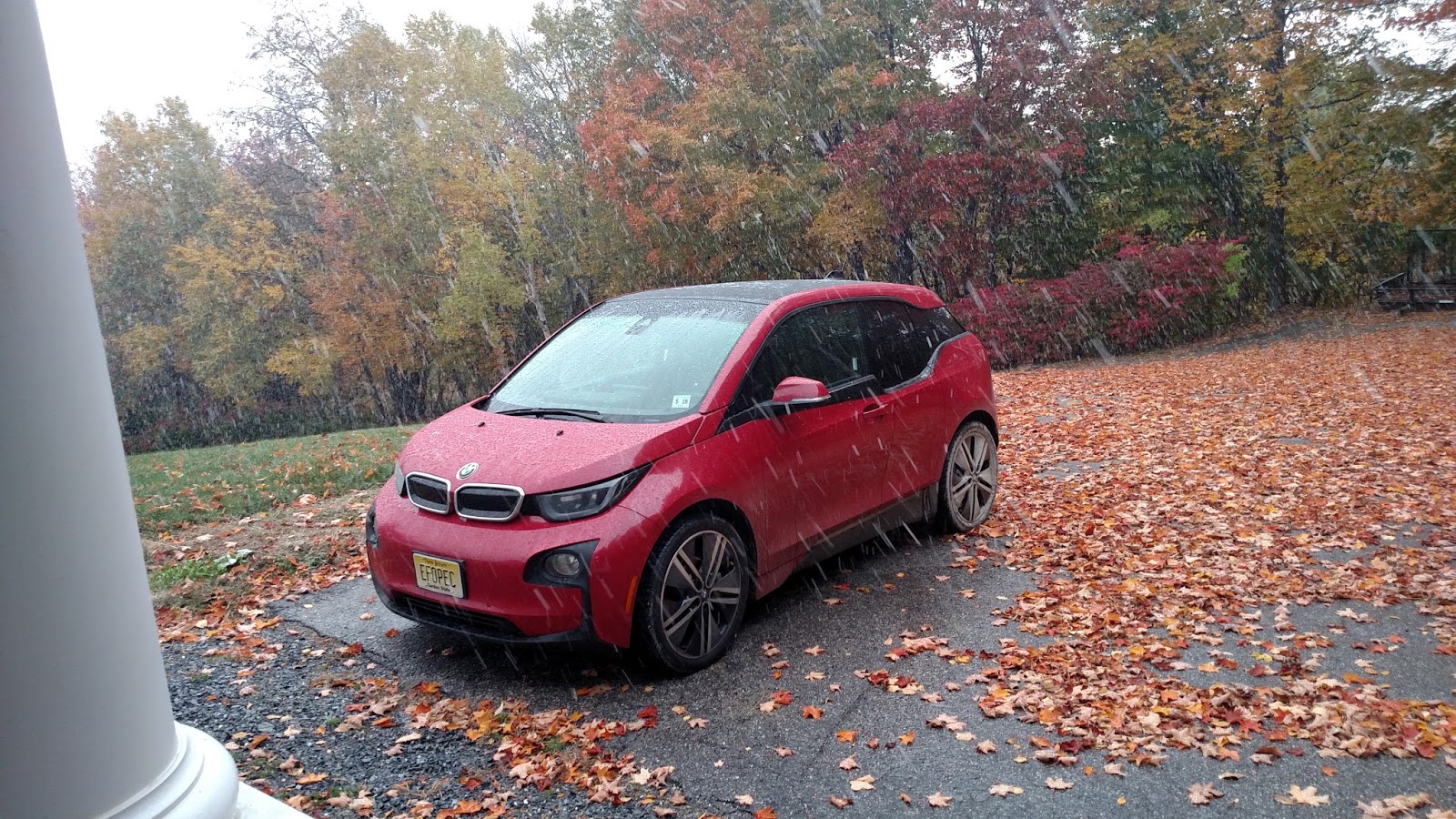
It was snowing in Vermont when we arrived

In that post, I wrote that I found it funny how quickly the gas tank fills because it's only 1.9 gallons. My wife started timing how long it took to stop for gas and we averaged a little over two minutes. I remember wishing we had recorded one of the gas breaks so we could demonstrate just how quick you can pull off the highway, fill up, get back into the car and back out onto the highway. I made a note that the next time we drove back up to Vermont, we would do just that.

So last week we made the Vermont trip again, and as planned we recorded one of the gas stops:


As you can see, I started the stopwatch before we exited the highway, and stopped it when we were back on the highway. I didn't jump out of the car and rush like a NASCAR pit crew filling up. I took my time and even spent a couple extra second topping off so I'd get every drop that I could into that tiny tank and we still did it in under two minutes.

The point of the exercise was to demonstrate that it's really not that inconvenient to make a quick gas break about once every every hour. I will qualify that statement with the fact that here in the Northeast there are gas stations everywhere. It seems that I'm never more than a couple miles from one, so when I'm doing these long drives I can plan the stops at convenient intervals when the tank is nearly empty. While that is the case for many large city and suburban areas throughout the country, there are plenty of rural areas where gas stations aren't as prevalent, and the small gas tank would be a problem. The i3 REx most likely isn't well suited for use in those areas. But hey, BMW calls it a "city car" after all.


As I mentioned above, when I made the trip last year I only did 111 miles on battery and drove 351 on the REx. This year I was able to drive 270 miles on battery, and needed only 184 miles with the range extender maintaining the battery state of charge. This was possible because of the always improving charging infrastructure. I was able to stop twice (once each way) at Prestige BMW in Mahwah, NJ and use their new DC fast chargers. Also, on the way home I stopped for a couple hours at a friend's house who just recently installed a 240v level 2 EVSE in his garage. These stops allowed me to more than double the all-electric miles for the trip, and I only needed 4.9 gallons of gas for the 184 miles I drove with the range extender running, as I averaged 37.5 mpg.
I used the recently installed DC Fast Charger at Prestige BMW on both legs of the trip. 
I now have over 36,000 miles on my i3 after seventeen months of ownership, and only about 1,750 of those miles were on the REx. The range extender has been a great feature and I'm still very happy I got it. It does what it is supposed to; it gets you home without worrying about finding a charging station on the rare days that the electric range isn't enough, and it enables the occasional long road trip. There are limitations though, and extreme hill climbing while the REx is running for prolonged periods at highway speeds, can result in reduced power. Fortunately I've never had that happen to me but I don't really have any big mountains which I need to climb. On my Vermont trips I set the Active Cruise Control to 70 mph and have never had an issue yet, even though there are some prolonged climbs at the end of the trip. I did get the "Reduced Power Possible" warning once though, as the state of charge hit a low point of 2% once. However it held there until I crested the climb and once I was on flat ground the SOC climbed back up to about 6%. I left the cruise at 70 mph because I actually wanted to see at what point it would go into reduced power mode, but it never happened.  
On one climb, I was able to get the SOC down to 2% and at that point the car warns you that reduced power may occur if you continue without altering your driving. Basically it's saying "Slow Down!"
Still, in a perfect world I'd prefer a 150 mile, all-electric-range i3 combined with adequate DC fast charge infrastructure. Personally, I really don't need 250 or 300 miles of range, and I'd rather not pay for it. However, even though the infrastructure is improving, I think 200 miles of range is probably more acceptable until DC fast chargers are ubiquitous. It appears with Nissan and Chevy poised to bring 200 mile EVs to market in the coming year, the "affordable" electric vehicle market is going to get very interesting. BMW's CEO recently announced that the 2017 i3 will have a longer all electric range also, but didn't comment on exactly how much more. That's good news because as much as I like how the REx works, and how quickly I can refill the gas tank, I'd still much prefer going on battery alone. 

Krueger: BMW i3 to Get "Battery Facelift" in 2016

BMW CEO Krueger revealed plans to increase the i3's range in 2016
It's no secret that if BMW wants the i3 to continue to remain relevant they will eventually have to increase its all electric range. In fact, in about a year there will be no less than two electric vehicles available in North America that have double the i3's all electric range and also cost less. Nissan will be launching the second generation LEAF, and Chevrolet will bring the Bolt EV to market by the end of 2016 and they are both rumored to have approximately 200 miles of electric range.

I think it's fair to say most people expected BMW to up the i3's range to stay competitive, but when they would do so was not known. Until now. BMW CEO Harold Krueger in an interview with Die Zeit recently said this about the topic:

“Battery cell technology continues to evolve. The range of the i3 will be increased in 2016. A further technological improvement is to be expected in three or four years: Then you’ll be able to go twice as far on a single charge without any further increase in the weight of the battery."
This is the first time anyone from BMW has offered a clear statement about increasing the range of the current i3. Personally, I didn't expect this yet, but welcome the news. I had always maintained that the i3's range would be linked to the progress made by BMW's battery partner, Samsung SDI. So the news that the MY2017 i3 will have increased range is interesting as well as exciting. It's interesting because Samsung has maintained that they wouldn't be bringing the next generation of large format, automotive grade batteries with increased energy density to market before 2018 - 2019. See timeline produced by Samsung SDI below:
Samsung SDI Battery Technology Roadmap
So the question is: How is BMW increasing the i3 range? Here are some possible explanations:

1) They are sourcing higher energy density batteries from other suppliers. This could very likely be the answer. The i3's 130 kW/Kg battery cells are not nearly as energy dense as the cells Tesla uses for instance. BMW could have a partner to supply them with cells which have considerably higher energy density and accomplished the increased range using the same battery tray as the current i3.

2) Samsung SDI provided BMW with a battery which is incrementally better than the existing cells they provide BWM with, but not quite as energy dense as the cells they plan to have in three or four years, according to their technology roadmap. Again, this would allow BMW to use the current battery tray and not need any major structural re-engineering. 

3) BMW redesigned the battery tray to accommodate more battery modules, or used the area where the range extender goes to add a second, smaller battery pack. Either of these options would have required a lot of engineering, testing and validation. I just don't see BMW doing either of these for a mid-cycle refresh. Certainly when the next generation i3 comes out in 2018 or 2019 there will likely be new redesign of the battery tray area, but not for a refresh, it's just too expensive to do that only two years after the initial launch.

Another benefit of the increased electric range will be increased gas range for the REx i3s in the US. Unlike in Europe, the US i3 must have a shorter range when driving on gasoline than it does on battery alone. This is a complicated issue which is tied to the amount of ZEV credits BMW gets for every i3 they sell, but in short by increasing the i3's all electric range, they can then allow the gas range to increase and still qualify for the maximum ZEV credits they get. The current i3 REx is EPA rated at 72 miles per charge and the range extender's gas tank is software limited to 1.9 US gallons which provides another 70 miles of range. If BMW were to increase the i3's REx's electric range from 72mpc to 92mpc. They could then allow US customers full use of the 2.4 gallon gas tank, and the combined range would go from about 142 miles to roughly 182 miles.

BMW employee working on an i3 battery pack assembly
Krueger was also asked if current i3 owners would have the ability to upgrade their cars with the new batteries and his answer was: "We are currently looking into that." Personally I believe that will be possible, but not economically viable, for now at least. I know current i3 owners will be asking about an upgrade but it just doesn't make sense to replace a battery pack that is two years old for just a little more range. I think it's more likely that in four or five more years when some of the original wave of i3 owners have 120,000 to 150,000 miles on their car they will be looking at the next generation of battery cells which will be available and these "new" battery cells will already be obsolete. I would be surprised if BMW didn't engineer those new cells to fit in the same modules the current i3 uses, so a complete replacement with the upgraded battery cells would then be possible.

What effect this will have on i3 sales from now until this new longer range i3 is available is unknown, but there is at least some comparable data to use. Both the Chevy Volt and the Nissan LEAF launched in late 2010 and are just now releasing upgraded range models. The Volt is a complete redesign and the LEAF is doing more of what BMW is now by keeping basically the same vehicle and offering it with an incremental longer range. The 2nd generation LEAF which will be completely redesigned and offer much more range won't be available for about another year. In both cases these cars experienced greatly reduced monthly sales in their final months as customers waited for the new model with longer range. Like Nissan and Chevrolet, BMW will likely have to offer some favorable financial incentives to clear the remaining 2016 stock once the new battery i3 is nearing availability meaning this should be a good time to pick up an i3 for a great deal.

In any event, this is all great news. It further proves BMW's commitment to electric cars and their willingness to upgrade the i3 as battery technology improves. 

462 Mile REx Road Trip: New Jersey to Vermont

We stopped at the Big Moose Deli in New York for some coffee. It's about ten miles from the Vermont border. 
Perhaps the most discussed topic of the BMW i3 is the implementation of the range extender for the North American market. In an effort to have the vehicle qualify for the California Air Resource Board BMW set restrictions on how and when the range extender can turn on, effectively reducing the utility of the REx. These restrictions are most apparent when attempting to use the car for long journeys which include drastic increases in elevation.

This topic has been covered here and on every other EV site extensively, and recently it was announced that BMW is working on a software update that will allow, under certain conditions,  the range extender to come on much earlier than the 6.5% threshold it currently uses. I am actually beta testing that software for BMW now, having had it installed on my i3 just last week. The new software also includes some other updates that will be standard on 2015 i3s and will be uploaded to current i3 owners sometime early next year.

However this post will detail a New Jersey to Vermont road trip that I took a few weeks ago, just before I had the new software update. My in-laws live in Vermont, and I had been wanting to take this trip with the i3 ever since I got it, but I just haven't had the time. Once I knew I would be getting the new i3 software which would be adjusting how the range extender would work, I knew I needed to make the journey before I had it done, so I could perhaps compare the difference in performance the next time I go.
The Active Cruise Control is awesome. I don't think I'll buy another car that doesn't have it. 
I have taken the car on a few 200+ mile round trips, having the ability to charge up before heading home, but this would be much further, about 250 miles there and about 210 miles back home. The trip there would be longer because we were meeting at a restaurant farther into Vermont before heading back to the house. A couple of years ago I installed a Clipper Creek CS-40 at my in-laws' house, knowing that the day would eventually come when I drove an EV there, but I had never used it until now. My previous EVs (MINI-E and ActiveE) would have just been too much of a hassle to try to make this long of a trip, but the range extender is perfect for an occasional trip like this - or at least I hoped it would be.
Most of the roads in Vermont were covered in ice and snow. My new Blizzak snow tires performed very well and I definitely recommend them for i3 owners who need to drive in the snow.
The truth is, I really didn't know if such a long trip at highway speeds, which would include an overall elevation gain of nearly 1,000 feet would be doable without the car going into the dreaded reduced-power mode, where the vehicle slows down for a while so the REx can replenish the battery a bit. Also, in the final 50 miles of the journey I needed to climb 500 feet before descending 500 feet and then climb about 700 feet to our destination.

My wife and I set out early on a brisk morning with the temperature being only 15 degrees when we left. I didn't precondition the battery or cabin, and the total weight we were carrying was about 450 lbs between me, my wife and the items we were bringing up to her parents'. I topped off the gas tank the night before and left fully charged. The trip is nearly all highway and my plan was to set the cruise control for varying speeds between 70 mph and 75 mph to see how fast we could go with the REx maintaining the state of charge. I would drive the whole way there in Comfort mode and possibly use Eco Pro for the return trip.
A few blocks from our destination we came across some cows.
The combination of the very low temperatures, using the heated seats, cabin heat and  driving 75 mph meant the range extender turned on after only 48 miles. That's the earliest I had ever seen it turn on before. I had barely made it to the New York State border and I was already running on gas. So now I had a little over 200 miles to go and it would be all done on the range extender. I figured I'd need to stop three times so we searched the GPS for gas stations that were directly along the route and at the intervals we needed. I wanted to stop when we had about 10 miles of range left and we were able to pretty much get close to that on all three stops.

I needed to stop three times to fill up on the way there.
We made the first stop right about at the 100 mile mark which was about two hours into the journey. My wife laughed at how quickly the tiny gas tank filled up and we came up with the idea that she would time me on future stops to see how long it took to fill up. She would use the stopwatch app on her phone and we would start it when we exited the highway and stop it when we were back on the highway to see just how long the diversion was. We averaged a little over 2 minutes per stop and the best time was one minute, forty eight seconds. All three stops added a total of about seven minutes to the trip - not exactly much of an inconvenience.
The car looked like I was off-roading all day when we arrived. I finally got to test out the EVSE I installed at my in-laws' house over two years ago. Thankfully it worked.
For most of the trip I had the Active Cruise Control set to 70 mph, but I also spent some time with it set to 73 mph and 75 mph. As I expected, 70 mph seemed to be the sweet spot for holding the SOC. Even with inclines that lasted for a mile or two the car never went into reduced power mode. When I set it to the higher speeds it could maintain the SOC on flat ground, but the inclines had the SOC bar graph getting dangerously close to completely evaporating so I kept it at 70 whenever I was going up any kind of hill. One thing I can say, the Active Cruise Control really rocks for long drives like this. It holds the speed, slows down when the vehicle ahead reduces its speed and maintains a nice safe distance. I used it for virtually the entire trip and it is definitely worth the cost if you do a lot of highway driving.
We arrived after nearly 255 miles. About 207 of those miles was done using the range extender.
So, we made it without ever going into reduced power mode. I guess there is no need to do a comparison trip with the new software since this trip went flawlessly. The only thing I can think of doing is possibly trying the same trip with the ACC set to 75 mph the whole way to see if the new higher REx buffer allows me to maintain the faster speed. As it is now though, 70 mph is definitely the magic number for long distance REx driving. If most of the trip is on relatively flat terrain, the SOC buffer is big enough for sudden bursts of speed for passing and to sustain climbs for a few minutes and a couple of miles. Even though it worked out fine for me, I'm happy that BMW is increasing the battery buffer so longer, sustained mountain climbing will be possible without going into reduced power. I haven't had enough time with the new software to really comment on how well it works yet but I'll do that soon.
The final stats for the trip
The trip home the next day was pretty uneventful. I did precondition this time and drove the first half of the way in Eco Pro mode. It was also about ten degrees warmer. All that combined to allow us to go 15 more miles on battery than we had the day before, giving us a total of 63 miles before the range extender turned on. We arrived home with 462 miles on the trip odometer and an average consumption of 3.4 miles per kWh. I filled up with gas about 1.5 miles from my house so we left and arrived with a full tank. Including the final stop to top off we made seven stops for gas (3 going and 4 returning) and bought a total of 9.87 gallons of gas. We drove 111 miles on battery and 351 miles with the range extender running and averaged 35.5 miles per gallon. That's a little less than what I usually average for the REx, but this was a continuous 70 mph for the vast majority of both legs of the trip so I expected it to be lower than usual. If we had taken our other family car like we usually do for our Vermont trips, we would have needed 19 or 20 gallons of gas or about double what the i3 needed.
Getting ready to leave for the return trip back to NJ
In conclusion, these kinds of journeys are definitely not what the i3 REx was really developed for. The tiny 650cc motorcycle engine isn't really engineered to operate for hundreds of miles at a time and I'm sure if it was subjected to this kind of use every week it would certainly have premature mechanical issues. However using it as I do, for the occasional 10 or 20 miles here and there, or the final 3 miles on some days just to make it home plus a road trip every month or two, it's really a great alternative to spending an additional $20,000 for a battery that's triple the size of the i3's. The range extender model is a good stop-gap measure until there is a decent DC fast charge infrastructure in place, which is really the ultimate goal. BMW has some very good news with regards to DC fast charge infrastructure that they will be announcing very soon, perhaps even at NAIAS in January. They are making a significant investment in this area and I believe the EV faithful will be very happy when the news is announced.
Of course we had to return with some genuine Vermont Maple Syrup. The Maple-Walnut PB was a bonus.

Check Engine Light Mystery Plagues Range Extended i3s In The US

The infamous Check Engine light of the BMW i3 REx
Many people that order the range extender option on the i3 do so because they just aren't comfortable with the BEV i3's 81 mile EPA range rating. Personally I really didn't want it but my driving demands dictated that I really needed it. If the i3 had 15% to 20% more range I would not have ordered the REx and I suspect there are a lot of others that would fall into the same category as me on this. We know it's there and we aren't particularly proud of hauling around the oil, gasoline and the rest of the muck that goes with it. So the last thing we really want is to be constantly reminded that we have a gasoline engine in our shiny, new electric cars. Unfortunately that is exactly what is happening.

The day after a picked up my car the check engine light (CEL) illuminated for a few hours and then shut off. I called my dealer as soon as it went off and was told to bring it in so they could check it out. Then when it turned off I called back and was told to monitor it, but it wasn't necessary to bring it in unless it comes on again. I then dropped my car off to be wrapped so I wouldn't be driving it for a week. During that time other range extended i3s were getting delivered and just like what I observed, within a day many other people were reporting the same thing. Some took their car back to the dealership where they down landed and cleared the fault codes and released the cars. The dealers don't yet have any answers and are basically saying there is nothing wrong with the cars and the light is coming on erroneously. Some people were told that if in fact there was indeed a problem with the engine the CEL would blink, not just light up and stay on as what is happening.

Unfortunately I got a flat tire last week and needed to get towed to my dealer so it was a good time to have the CEL looked at. The service manager said they pulled the codes and reset everything but didn't see any problem. Unfortunately the light didn't go on while they had it, but I doubt that would have made any difference. I've had reports from others that did indeed bring their car in with the light on and the dealer was just as stumped as to the cause. I also find it odd that the car's Check Control reads "All systems OK" even when the light is on. This offers more evidence that there really may not be any physical problem, but perhaps just some software bug that is turning the light on.

This is how I like to see my display: No CEL!
If that's the case, then why haven't we seen this reported for the past five months or so that the i3 REx has been available in Europe? I suppose the cause could be rooted to the fact that the US i3 REx operates differently than the European version, with restrictions on how and when it operates. To complicate things even more, only weeks before the REx was to launch in the US, BMW had to restrict the size of the gas tank from 2.4 gallons to 1.9 gallons. This meant the existing built cars needed to have some kind of retrofit done post-build. Could that work have triggered some kind of software conflict which causes the CEL? That would certainly explain why BMW hadn't seen this issue before and why every i3 REx (that I know of at least) in the US has this issue.

A little black tape will do the trick!
I know for a fact the engineers at BMW of North America are working on this. Hopefully they will get it resolved soon. I expect we'll get a phone call at some time asking us to bring our cars in for a software update, but who knows, maybe there actually is a physical problem it is detecting. However at the moment, nobody from BMW or the dealers seem to be able to provide any real answers. If I don't hear anything soon, I may be forced to just fix it myself!


6/18/14 UPDATE: It seems BMW has identified the problem and is issuing a temporary fix. See the bulletin below:

8 BMW i3 Questions with Brad Berman of Plug In Cars

I was recently interviewed by Brad Berman of Plugincars.com about my initial thoughts on my i3. The interview just went live on the site so I've bought it over here for my followers to read. Please leave your thoughts on my answers in the comments section.
____________________________________________________________________________

Tom Moloughney, long-time EV driver and first owner of a BMW i3 with the range-extender option, answers fundamental questions about the car.

1) How is the BMW i3’s range-extending system different from the Chevrolet Volt and Toyota Prius Plug-in Hybrid?

The range extender on the BMW i3 works differently than systems on plug-in hybrids (that to varying degrees sometimes power the wheels from the engine). The rear-wheel-drive i3 is the only pure series plug-in hybrid currently available. The i3’s two-cylinder range-extender engine never mechanically drives its wheels. The Fisker Karma worked this way, but that vehicle is no longer in production.

2) Under what conditions does the gas engine come on?

In the United States, the range-extender turns on when the state of charge drops below 6 percent. Unlike the European version, the operator cannot manually turn on the engine to maintain a higher level of charge. In Europe, once the state of charge drops below 75 percent, the range extender can be turned on manually.
BMW eliminated this feature on U.S. models, so the i3 would qualify for the California Air Resources Board’s BEVx designation. While BMW never announced why they chose to eliminate the hold feature in favor of getting the BEVx designation, observers believe BMW took the step in order to get more ZEV credits per REx vehicle sold.

3) How does the driving experience change after the gas engine comes on?

So far, I’ve had the opportunity to drive my i3 for about 100 miles in charge sustaining mode. I intentionally didn’t charge it for a couple days so I could fully test the functionality with the range-extender operating. The power is slightly muted. I’d say maybe 85 percent of how it feels with a full charge.
When the range-extender turns on, you cannot hear it at all from inside the car because it initially runs in the lowest of the three power levels. If you continue to drive at speeds higher than 40 miles per hour, it will kick up to the next power level and you can then hear a low hum from inside the car. If you are driving at highway speeds, it will jump up to its highest (28kW) power output, and then you can definitely hear it. It’s nothing that you can’t overcome with the radio.

The REx turns off when you slow down to less than 15 mph, unless your state-of-charge is lower than 3 percent. I’m impressed by how well the little motor can sustain the charge. I’m convinced it can do whatever I need to do, and I will have no problem driving long distances with it running.

On level ground, the car can continuously sustain speeds up to 75 mph for as long as you need to drive. You have plenty of power to pass cars at that speed, and to climb hills that are a few miles long. There really aren’t any mountains in New Jersey where I live, so I haven’t tested driving up long steep inclines, but there is definitely a point where the range extender will not be able to maintain highway speeds.
If you exceed the range extender’s capability, it will slow down to 40 mph. At that speed, it can maintain just about any climb. I will be taking my i3 on a 230-mile trip to Vermont soon. Hopefully I can do some mountain testing there when I do. I haven’t noticed any difference in the handling when the REx running.

4) What's the top speed for the i3 before, and after use of gas engine?

The i3’s top speed in electronically governed at 93 mph. It pulls strongly all the way up there, with or without the range extender running. As noted above, it’s just slightly less powerful in charge sustaining mode.

5) How did BMW make its decisions about the of the i3’s engine and gas tank?

The i3 was not initially designed to have a range-extender. BMW added the feature after the car was more than a year into development. Perhaps that had something to do with what size motor they could fit, but that is just an educated guess.

The size of the gas tank is another thing entirely. In the United States, the i3 REx has a 1.9-gallon tank, and the European version uses a 2.4-gallon tank. The 1.9-gallon tank for the US was announced only weeks before the i3 launch. The reason for the reduced size is probably tied to the BEVx designation that BMW clearly wanted the car to attain. BMW has not confirmed the reason for the reduced tank size.

One of the qualifications of the BEVx certification is the vehicle’s all-electric range must be greater than its gasoline range. Again, this is speculation, but if the i3’s electric range was certified by CARB at lower than BMW expected, that would explain the need to reduce the range when running on gasoline.
Personally, this isn’t an issue for me. I’ll be using the range-extender only on those rare days when my electric range is just slightly insufficient. It’s a good backup strategy, and allows me to not even think about those times when I’m pushing the limit of the car’s range.

6) Should drivers think of the gas engine as a way to extend range to 160 miles—or only as a backup to an 80-mile EV?

I’m not going to tell anyone how to use his or her car. I don’t think there is one simple answer. I believe there will be people that routinely drive their i3 REx 130 to 160 miles and more, and don’t mind filling up frequently when they need to. I can say this about filling up: with such a small tank, you pull in, fill up and pull out of a gas station in about two minutes.

There will be others that see filling up every 50 or 60 miles as too cumbersome. Perhaps the car isn’t the right choice for them. A Volt may be a better PHEV for some people that frequently need to cover hundreds of miles in a day, or live in a mostly mountainous region. For daily driving of less than 150 miles or so, it works great.

7) Given the unique i3 system, how does it affect incentives and perks like carpool access?

The i3 REx, like the Volt, Plug-in Prius and other PHEVs qualifies for California’s Green HOV access sticker, which is currently not available. The 40,000 allocated green stickers PHEVs have been exhausted. However, AB 2013 proposes to make 45,000 more stickers available, and is currently headed to the California Senate for vote.

Washington State recently announced the i3 REx would qualify as a zero emission vehicle and therefore gets exempt from sales tax there. BMW i3 sales in New Jersey were also scheduled to be tax-exempt. But just after BMW began selling the i3 in New Jersey, it was announced that the i3 with range-extender would indeed have to pay sales tax. The BEV i3 doesn’t. That essentially doubles the price of the $3,850 REx option, making it nearly an $8,000 option in New Jersey. That is likely to hurt i3 REx sales in the Garden State.

8) Is the i3 REx approach a stopgap measure, or should it be considered a long-term strategy across the EV market?

I believe other manufacturers will adopt the range-extender approach. However I believe it is a short-term measure. (Maybe 10 years?) As battery chemistry advances and energy density improves, electric vehicles will have continually better electric range.

That, combined with increased DC quick charge stations, will make the range-extender unnecessary. Tesla and Nissan are doing the lion’s share of the work getting these fast charge stations installed. It’s about time some of the other carmakers join in.

The i3 is only the first electric vehicle to emerge from the new BMW i brand. More vehicles are already far along in development. It’s my hope that BMW recognizes the need for DCQC infrastructure, and follows Tesla and Nissan. If the combo-cord fast charge standard has any chance of gaining traction in the US, it will be up to BMW to take the lead. It is the only manufacturer currently selling a serious (not a low-volume compliance-only) electric vehicle that uses the combo cord. In my opinion, the proliferation of DC quick charge is absolutely necessary if we are going to get off petroleum, and make a transition to electrified transportation. A small, efficient range-extender like the i3 will work for many people today. It's a great step until battery range grows and more quick charging is installed.