Showing posts with label gasoline. Show all posts

Road Trip Refueling a BMW i3 REx

Fill 'Er up!
I know many readers here have spent countless sleepless nights pondering the the age-old question: How long does it take to refuel a BMW i3's tiny gas tank?

Well maybe not, but I have had people argue that driving the i3 REx on an extended trip would be very inconvenient because they would have to stop to fill up the gas tank every 50-60 miles. I've done quite a few road trips with my i3 REx, and stopping once an hour for a couple of minutes to refill the tank never really bothered me much.

I wrote a post last year which detailed a 462 mile round trip I made to Vermont from my home in New Jersey and refueling was one of the topics that many people commented on. On that trip, I had to stop for gas a total of seven times, as I only recharged the car once, which was at my destination. I drove 111 miles on battery, 351 miles on the range extender and used a total of 9.87 gallons of gas, averaging 35.5 mpg.
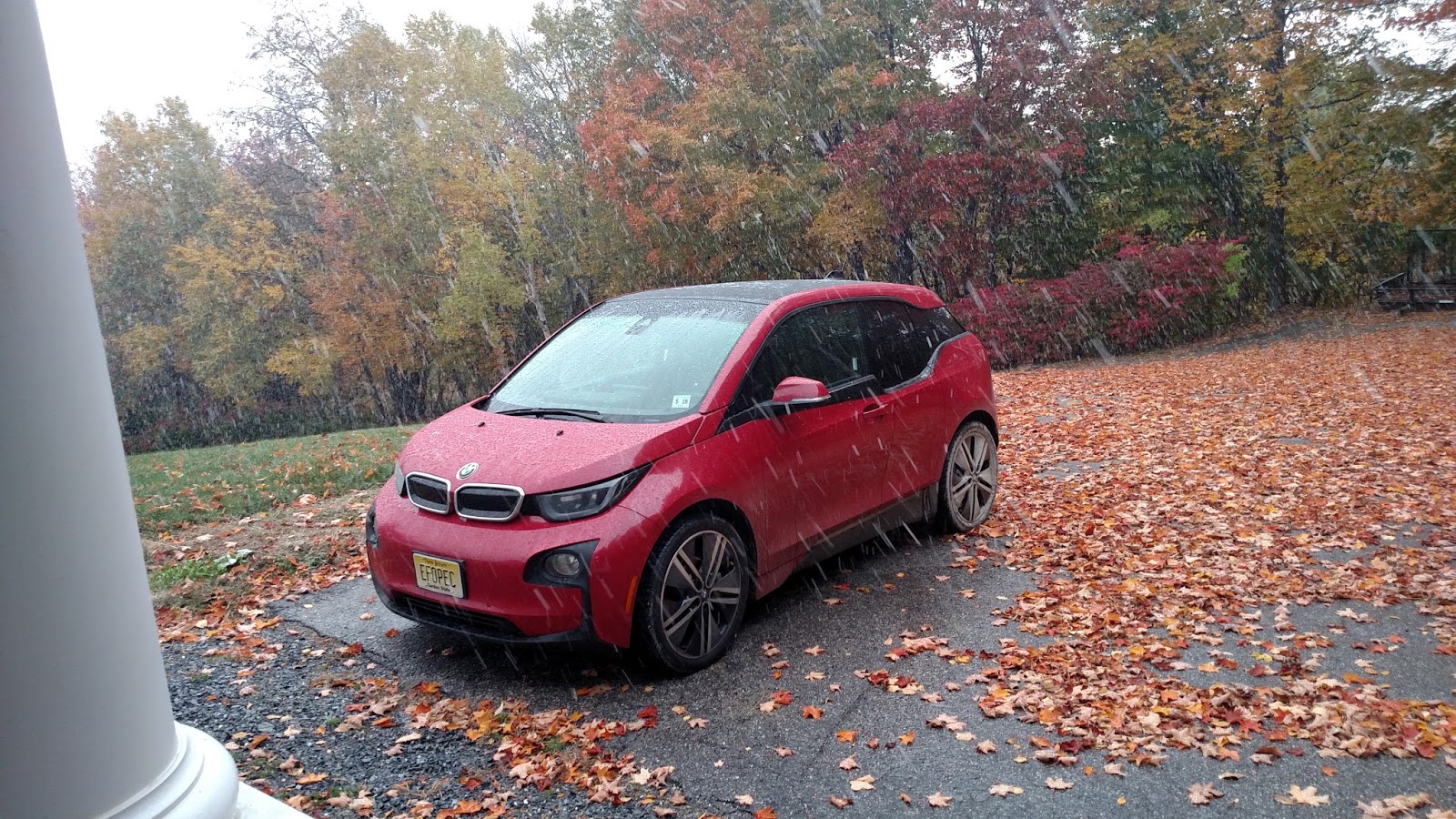
It was snowing in Vermont when we arrived

In that post, I wrote that I found it funny how quickly the gas tank fills because it's only 1.9 gallons. My wife started timing how long it took to stop for gas and we averaged a little over two minutes. I remember wishing we had recorded one of the gas breaks so we could demonstrate just how quick you can pull off the highway, fill up, get back into the car and back out onto the highway. I made a note that the next time we drove back up to Vermont, we would do just that.

So last week we made the Vermont trip again, and as planned we recorded one of the gas stops:


As you can see, I started the stopwatch before we exited the highway, and stopped it when we were back on the highway. I didn't jump out of the car and rush like a NASCAR pit crew filling up. I took my time and even spent a couple extra second topping off so I'd get every drop that I could into that tiny tank and we still did it in under two minutes.

The point of the exercise was to demonstrate that it's really not that inconvenient to make a quick gas break about once every every hour. I will qualify that statement with the fact that here in the Northeast there are gas stations everywhere. It seems that I'm never more than a couple miles from one, so when I'm doing these long drives I can plan the stops at convenient intervals when the tank is nearly empty. While that is the case for many large city and suburban areas throughout the country, there are plenty of rural areas where gas stations aren't as prevalent, and the small gas tank would be a problem. The i3 REx most likely isn't well suited for use in those areas. But hey, BMW calls it a "city car" after all.


As I mentioned above, when I made the trip last year I only did 111 miles on battery and drove 351 on the REx. This year I was able to drive 270 miles on battery, and needed only 184 miles with the range extender maintaining the battery state of charge. This was possible because of the always improving charging infrastructure. I was able to stop twice (once each way) at Prestige BMW in Mahwah, NJ and use their new DC fast chargers. Also, on the way home I stopped for a couple hours at a friend's house who just recently installed a 240v level 2 EVSE in his garage. These stops allowed me to more than double the all-electric miles for the trip, and I only needed 4.9 gallons of gas for the 184 miles I drove with the range extender running, as I averaged 37.5 mpg.
I used the recently installed DC Fast Charger at Prestige BMW on both legs of the trip. 
I now have over 36,000 miles on my i3 after seventeen months of ownership, and only about 1,750 of those miles were on the REx. The range extender has been a great feature and I'm still very happy I got it. It does what it is supposed to; it gets you home without worrying about finding a charging station on the rare days that the electric range isn't enough, and it enables the occasional long road trip. There are limitations though, and extreme hill climbing while the REx is running for prolonged periods at highway speeds, can result in reduced power. Fortunately I've never had that happen to me but I don't really have any big mountains which I need to climb. On my Vermont trips I set the Active Cruise Control to 70 mph and have never had an issue yet, even though there are some prolonged climbs at the end of the trip. I did get the "Reduced Power Possible" warning once though, as the state of charge hit a low point of 2% once. However it held there until I crested the climb and once I was on flat ground the SOC climbed back up to about 6%. I left the cruise at 70 mph because I actually wanted to see at what point it would go into reduced power mode, but it never happened.  
On one climb, I was able to get the SOC down to 2% and at that point the car warns you that reduced power may occur if you continue without altering your driving. Basically it's saying "Slow Down!"
Still, in a perfect world I'd prefer a 150 mile, all-electric-range i3 combined with adequate DC fast charge infrastructure. Personally, I really don't need 250 or 300 miles of range, and I'd rather not pay for it. However, even though the infrastructure is improving, I think 200 miles of range is probably more acceptable until DC fast chargers are ubiquitous. It appears with Nissan and Chevy poised to bring 200 mile EVs to market in the coming year, the "affordable" electric vehicle market is going to get very interesting. BMW's CEO recently announced that the 2017 i3 will have a longer all electric range also, but didn't comment on exactly how much more. That's good news because as much as I like how the REx works, and how quickly I can refill the gas tank, I'd still much prefer going on battery alone. 

157,000 Electric Miles Later: We Are Indeed Getting There


Me & my MINI-E in 2009, my ActiveE in 2012 and my i3 in 2014. Five and a half years and over 157,000 electric miles (252,000 km), mostly powered by solar-generated electricity.

It's been a little over five years since my electric journey began. I couldn't have possibly imagined where this was going back in 2009 when I was accepted in to the MINI-E trial lease program. I knew I was interested in alternative fuel vehicles, and I knew I wanted to reduce my personal consumption of oil, but I really had no idea if I'd like driving electric or if the industry would actually be making and selling electric cars anytime soon.

Sure there were rumors that GM was going to make a plug in car that they were calling the Volt, there was a small start-up car company in California called Tesla selling an electric Lotus conversion for $105,000 and there were also a few new companies like Aptera and Phoenix Motorcars trying to bring electric cars to market, but nothing really seemed certain, and everything seemed many years away. So when I came across the online application to drive an electric MINI Cooper for a year in a small test program for BMW, I jumped at the opportunity and applied. It's now about 66 months since I took delivery of my MINI-E and between that car (73,000 mi) my ActiveE (70,000 mi) and now my i3 (14,000 mi). I've driven over 157,000 electric miles.


I admit I'm impatient and frequently wonder why it's taking "so long" for mass electric vehicle adoption. I wonder why there aren't more EVs from more manufacturers with a wider array of range options and utility. The driving experience of electric cars is simply so much better than that of an internal combustion engine car. In fact, most everybody who buys an electric car seems to agree that they want to continue driving electric from then on, and they don't ever want to go back to the ICE. However, every now and then I'll reflect on the past five years that I've been driving electric and I realize just how far we have come in that time. As I mentioned, back in 2009 the electric options were a $105,000 sports car from an unknown start-up electric car company (Tesla), apply for the MINI-E test program or build your own electric conversion. Today there are about 20 plug in cars available! Granted not all are available in every market in the US, but every couple of months or so a new plug in is introduced. So in reality plug in cars are indeed advancing pretty quickly, even if EV supporters like myself want more plug in options now.

We have indeed come a long way in a relatively short period of time. The automobile industry historically moves slowly and this shift to electrics is happening at a pretty fast pace as far as the OEMs are concerned. The typical gestation period for a totally new car is typically about five to six years, so by industry standards the plug-in revolution is indeed happening rather quickly. In 2009 and 2010 less than 2,000 plug in electric vehicles were sold in the US each year, respectively. In 2011 that number jumped up to about 17,000. In 2012 it more than doubled to over 52,000 and in 2013 there were over 97,000 US plug in sales. This year we are on a pace to sell about 120,000 plug in electric cars. That's nearly 300,000 cars with plugs sold in the US since I first started driving electric back in 2009. I know 300,000 is a very small number compared to the overall amount of vehicles sold in the US during that time, but the number keeps growing every year and with new models being introduced all of the time that trend will likely continue.


I'm more convinced than ever that plug in electric vehicles are here to stay, and that mass adoption is only a few short years away. Battery electric vehicles offer a better driving experience. They are quieter, they drive smoother, they have much less maintenance and the fuel costs much less. They are cleaner and when powered by renewable energy are completely emission free. The electricity supply is getting cleaner every year as more and more renewables are introduced and the old, outdated and worst polluting powerplants are decommissioned. The supply chain of gasoline is going in the opposite direction as it takes more and more energy to find and extract oil so gas is actually getting dirtier and more polluting all the time, even as gas cars become more energy efficient. There are so many reasons why battery electric vehicles are the future it's easy to realize that we'll get passed the challenges faced today as this disruptive technology is being impeded and questioned by the entrenched industry.


The one thing I keep circling back to when people ask whether or not electric vehicles will have staying power or if they are only passing fad is the owner loyalty. The vast majority of electric vehicle owners love their cars and vow to never go back to gas. People love driving electric because it's better. That's the real reason EVs are here to stay. It isn't the governmental incentives, the fact that they are cleaner, or are cheaper to operate. The real reason EVs will win in the long run is that they offer a better driving experience. People love driving them, it's really that simple. The high cost of batteries, the need for a robust fast charge infrastructure and the inertia of the status quo are all just temporary obstacles that will be solved in the coming years.


When I first got my MINI-E, my daily driver was a Toyota Tacoma pick up which I still own. I now only use it to plow my driveway and the parking lot of my restaurant and whenever I need to haul something large. I  only drive it about 1,000 miles a year. The Tacoma averages about 18 miles per gallon so let's say I never went down the electric path and simply kept driving my Tacoma this whole time. Here's a little taste of what I would have had to do:

* I would have needed to buy about 8,600 gallons of gasoline, which would have cost approximately $30,000. The electricity to power my EVs during that period cost about $8,000 if I were paying market rate. However since I mostly charge from my home solar array and have a surplus many months I figure the real out of pocket cost for me was somewhere around $2,000.

* I would have had to have done about 30 oil changes that would have cost about $1,500 and 165 quarts of oil would have needed to be recycled. There would have also been plenty of belts, filters, plugs and other normal wear items on the internal combustion engine that would have needed to be replaced.

* I would have had to stop for gas about 500 times and wasted 60 hours of my life just waiting at a gas station for my tank to fill - and they say plugging in is inconvenient!   

*I would have released at least 100,000 lbs of CO2 into our atmosphere. According to the EPA burning one gallon of gasoline releases 19.64 lbs of CO2. If all of the electricity I used to charge my car came from my solar array then I would have save over 160,000 lbs of CO2, but since I do charge at my restaurant and at some public charging stations I realize it's not possible to offer a perfectly accurate estimate. However I'm certain more than 66% of my energy comes from my solar array. 
The future looks bright indeed. I'm ready for the next 157,000 electric miles!
I'd like to thank the followers of this blog and my previous EV blogs. It's been such a great ride so far, and the support I've gotten from the people here has definitely enriched the experience. Together we really are making a difference!

462 Mile REx Road Trip: New Jersey to Vermont

We stopped at the Big Moose Deli in New York for some coffee. It's about ten miles from the Vermont border. 
Perhaps the most discussed topic of the BMW i3 is the implementation of the range extender for the North American market. In an effort to have the vehicle qualify for the California Air Resource Board BMW set restrictions on how and when the range extender can turn on, effectively reducing the utility of the REx. These restrictions are most apparent when attempting to use the car for long journeys which include drastic increases in elevation.

This topic has been covered here and on every other EV site extensively, and recently it was announced that BMW is working on a software update that will allow, under certain conditions,  the range extender to come on much earlier than the 6.5% threshold it currently uses. I am actually beta testing that software for BMW now, having had it installed on my i3 just last week. The new software also includes some other updates that will be standard on 2015 i3s and will be uploaded to current i3 owners sometime early next year.

However this post will detail a New Jersey to Vermont road trip that I took a few weeks ago, just before I had the new software update. My in-laws live in Vermont, and I had been wanting to take this trip with the i3 ever since I got it, but I just haven't had the time. Once I knew I would be getting the new i3 software which would be adjusting how the range extender would work, I knew I needed to make the journey before I had it done, so I could perhaps compare the difference in performance the next time I go.
The Active Cruise Control is awesome. I don't think I'll buy another car that doesn't have it. 
I have taken the car on a few 200+ mile round trips, having the ability to charge up before heading home, but this would be much further, about 250 miles there and about 210 miles back home. The trip there would be longer because we were meeting at a restaurant farther into Vermont before heading back to the house. A couple of years ago I installed a Clipper Creek CS-40 at my in-laws' house, knowing that the day would eventually come when I drove an EV there, but I had never used it until now. My previous EVs (MINI-E and ActiveE) would have just been too much of a hassle to try to make this long of a trip, but the range extender is perfect for an occasional trip like this - or at least I hoped it would be.
Most of the roads in Vermont were covered in ice and snow. My new Blizzak snow tires performed very well and I definitely recommend them for i3 owners who need to drive in the snow.
The truth is, I really didn't know if such a long trip at highway speeds, which would include an overall elevation gain of nearly 1,000 feet would be doable without the car going into the dreaded reduced-power mode, where the vehicle slows down for a while so the REx can replenish the battery a bit. Also, in the final 50 miles of the journey I needed to climb 500 feet before descending 500 feet and then climb about 700 feet to our destination.

My wife and I set out early on a brisk morning with the temperature being only 15 degrees when we left. I didn't precondition the battery or cabin, and the total weight we were carrying was about 450 lbs between me, my wife and the items we were bringing up to her parents'. I topped off the gas tank the night before and left fully charged. The trip is nearly all highway and my plan was to set the cruise control for varying speeds between 70 mph and 75 mph to see how fast we could go with the REx maintaining the state of charge. I would drive the whole way there in Comfort mode and possibly use Eco Pro for the return trip.
A few blocks from our destination we came across some cows.
The combination of the very low temperatures, using the heated seats, cabin heat and  driving 75 mph meant the range extender turned on after only 48 miles. That's the earliest I had ever seen it turn on before. I had barely made it to the New York State border and I was already running on gas. So now I had a little over 200 miles to go and it would be all done on the range extender. I figured I'd need to stop three times so we searched the GPS for gas stations that were directly along the route and at the intervals we needed. I wanted to stop when we had about 10 miles of range left and we were able to pretty much get close to that on all three stops.

I needed to stop three times to fill up on the way there.
We made the first stop right about at the 100 mile mark which was about two hours into the journey. My wife laughed at how quickly the tiny gas tank filled up and we came up with the idea that she would time me on future stops to see how long it took to fill up. She would use the stopwatch app on her phone and we would start it when we exited the highway and stop it when we were back on the highway to see just how long the diversion was. We averaged a little over 2 minutes per stop and the best time was one minute, forty eight seconds. All three stops added a total of about seven minutes to the trip - not exactly much of an inconvenience.
The car looked like I was off-roading all day when we arrived. I finally got to test out the EVSE I installed at my in-laws' house over two years ago. Thankfully it worked.
For most of the trip I had the Active Cruise Control set to 70 mph, but I also spent some time with it set to 73 mph and 75 mph. As I expected, 70 mph seemed to be the sweet spot for holding the SOC. Even with inclines that lasted for a mile or two the car never went into reduced power mode. When I set it to the higher speeds it could maintain the SOC on flat ground, but the inclines had the SOC bar graph getting dangerously close to completely evaporating so I kept it at 70 whenever I was going up any kind of hill. One thing I can say, the Active Cruise Control really rocks for long drives like this. It holds the speed, slows down when the vehicle ahead reduces its speed and maintains a nice safe distance. I used it for virtually the entire trip and it is definitely worth the cost if you do a lot of highway driving.
We arrived after nearly 255 miles. About 207 of those miles was done using the range extender.
So, we made it without ever going into reduced power mode. I guess there is no need to do a comparison trip with the new software since this trip went flawlessly. The only thing I can think of doing is possibly trying the same trip with the ACC set to 75 mph the whole way to see if the new higher REx buffer allows me to maintain the faster speed. As it is now though, 70 mph is definitely the magic number for long distance REx driving. If most of the trip is on relatively flat terrain, the SOC buffer is big enough for sudden bursts of speed for passing and to sustain climbs for a few minutes and a couple of miles. Even though it worked out fine for me, I'm happy that BMW is increasing the battery buffer so longer, sustained mountain climbing will be possible without going into reduced power. I haven't had enough time with the new software to really comment on how well it works yet but I'll do that soon.
The final stats for the trip
The trip home the next day was pretty uneventful. I did precondition this time and drove the first half of the way in Eco Pro mode. It was also about ten degrees warmer. All that combined to allow us to go 15 more miles on battery than we had the day before, giving us a total of 63 miles before the range extender turned on. We arrived home with 462 miles on the trip odometer and an average consumption of 3.4 miles per kWh. I filled up with gas about 1.5 miles from my house so we left and arrived with a full tank. Including the final stop to top off we made seven stops for gas (3 going and 4 returning) and bought a total of 9.87 gallons of gas. We drove 111 miles on battery and 351 miles with the range extender running and averaged 35.5 miles per gallon. That's a little less than what I usually average for the REx, but this was a continuous 70 mph for the vast majority of both legs of the trip so I expected it to be lower than usual. If we had taken our other family car like we usually do for our Vermont trips, we would have needed 19 or 20 gallons of gas or about double what the i3 needed.
Getting ready to leave for the return trip back to NJ
In conclusion, these kinds of journeys are definitely not what the i3 REx was really developed for. The tiny 650cc motorcycle engine isn't really engineered to operate for hundreds of miles at a time and I'm sure if it was subjected to this kind of use every week it would certainly have premature mechanical issues. However using it as I do, for the occasional 10 or 20 miles here and there, or the final 3 miles on some days just to make it home plus a road trip every month or two, it's really a great alternative to spending an additional $20,000 for a battery that's triple the size of the i3's. The range extender model is a good stop-gap measure until there is a decent DC fast charge infrastructure in place, which is really the ultimate goal. BMW has some very good news with regards to DC fast charge infrastructure that they will be announcing very soon, perhaps even at NAIAS in January. They are making a significant investment in this area and I believe the EV faithful will be very happy when the news is announced.
Of course we had to return with some genuine Vermont Maple Syrup. The Maple-Walnut PB was a bonus.

Lexus Video Attacks the i3. Uses Photoshop to Hide the Truth?


Well I guess you can't blame them for trying. Desperate times call for desperate measures, they say. Lexus is at it again with their anti-EV advertising and this time they made a direct attack on the BMW i3. Still it's a little surprising that they seem so obsessed with pointing out why you don't want to buy an EV, instead of telling you why you would want to buy one of their hybrids. It seem to me that it's kind of like when a politician has nothing good to say about themselves, so they run their entire campaign on spreading FUD about their opponent. Let me recap what has led up to this latest attack.

Back in May Lexus put out some questionable information and videos on their consumer website that was highly criticized for having incorrect content regarding electric vehicles. In fact the information was so outdated and incorrect that it brought about a response from Plug In America:

Hey, Toyota, the 1990s called. They want their outdated anti-EV attack ad back. Plug-in electric vehicles charge while you're sleeping at home, far more convenient than making a trip to a gas station and coming away smelling like carcinogens. Driving on electricity costs about one fifth what it costs to drive the average gas car and about a third what it costs to drive the most efficient hybrid. An electric drive has smooth, instant acceleration which can't be matched by any gasoline engine. If you don't believe me, just ask anyone driving a Toyota RAV4 EV.  (disclosure: I am currently a board member of Plug In America)
Lexus got the message and a company spokesman pulled the incorrect information from their website and issued an apology. However about four months later they ran an ad that showed a lonely EV charging station, alone in a dark parking lot with the 8 steps to driving electric:
 
1) Closely monitor charge status
2) Turn off A/C and radio to conserve power
3) Download app to locate charging stations
4) Get lost searching for charger
5) Experience surge in range anxiety
6) Finally find charger
7) Plug in and wait four hours
8) Repeat

OK, so after it was clear this was a full-on mudslinging campaign, and certainly an indication Lexus was worried about the pressure they were getting from their electric competition. So now they put out this five minute long video, aimed at showing how miserable it would be to take a BMW i3 on a long drive. I'm not arguing the fact that the i3 isn't the perfect road trip vehicle, and using the BEV version would make a 300+ mile trip an adventure of sorts, especially today without the availability of DC quick charge stations. However it's kind of silly to think someone would head off into the desert on a 302 mile trip with an 81 mile EV without thinking about it first. That would be like taking a smart car on a fishing trip up a dirt-road mountain, knowing you have to cross a few streams and rocky passes along the way. Horses for courses, they say. In any event, yes we know the BEV i3 would take a long time to make this 302 mile trip, but how about if the i3 they used had the optional range extender?
It's very hard to see in this screen shot, but the outline of the top of the gas filler door is right behind the guy on the right, about waist high. If you watch the video and pause it at the 4.23 mark, you can see it better.

 *Hat tip to Inside EVs reader Martin B. He was the first one to notice the outline of the gas filler door in the video.

While it still wouldn't be the perfect vehicle for this type of trip, the i3 REx  could have done it much faster than the BEV i3. Yes, they would have had to stop five times to fill up the tiny gas tank, but since it's so small, it only takes about two minutes total (I've timed it!) for a gas station pit stop. So figure about 10 to 20 minutes added to the trip as compared to the Lexus hybrid. However as depicted in the video they took a BEV i3 by mistake, not knowing they'd have to stop to plug it in right? Maybe not. If you watch the video very closely, at the 4.23 mark for a brief moment you can see the top edge of the gas filler door just as one of the actors moves. So Lexus actually used an i3 REx for at least this scene and perhaps the entire video. Could they have used multiple i3's or did they photoshop out the gas filler door for most of the video, but missed it on this one brief scene. To me, that makes it so much more egregious. If the car they were driving in the video actually could have done that road trip without any issue, and Lexus lied about its capabilities, photoshopped out the evidence and presented it as incapable of making the trip in a reasonable time frame then they should be taken to task.
In this picture you can also see the corner of the gas filler door. It is difficult to see here in this low-res picture but when enlarged the corner of the filler door is clear to see.
While Lexus has indeed been spreading electric vehicle FUD for a while now, this is definitely a step up in intensity. Perhaps they took a look at October's sales data and realized for the first time since its launch six months ago, the BMW i3 outsold the CT-200h in the US. How could such a crippled, limited-range car that costs $10,000 more than their hybrid outsell it? Could Toyota actually have been wrong about EV's? Do people actually want them? Whatever the case it's clear Toyota is very concerned and has resorted to scare tactics in an attempt to steer people from buying EV's and lead them to their hybrids. Good luck with that Toyota.

One last comment. I've owned seven Toyotas in my life, and currently own a 1999 Tacoma which I use to plow my driveway and parking lot, and haul large items for my restaurant. However I'm done with them. I can't support a company that has such an anti electric vehicle stance as they do, going as far as lying about them and continuously reciting the rhetoric that nobody wants them. So I have this question for Toyota: If nobody wants them, why are they outselling your hybrids?


First they ignore you, then they laugh at you, then they fight you, then you win.
-Mahatma Gandhi

REx To The Rescue


Those that have followed this blog since before I got my i3 know I toiled a bit over whether to get the range extender option or not. Having lived with pure battery electric vehicles for five years I really didn't like the idea of hauling around an internal combustion engine if I really didn't need to do so, even if it was a very small, efficient one.

Ultimately, the decision was easier than I had hoped. Once it became clear the i3 would have significantly less electric range than the two previous BMW-made electrics that I've been driving (MINI-E and ActiveE) I knew I needed the REx. As much as I love the i3, I'm still disappointed BMW moved backwards with the electric range in every EV they have produced. The MINI-E was good for a reliable 100 miles in moderate temperatures, the ActiveE about 90 miles and the BEV i3 is EPA rated at 81 miles per charge. I drive a lot and 81 miles would just be cutting it too close for me, especially in the winter when the range is negatively effected by the cold weather.

Our Equinox, Tacoma and i3 joined by my old ActiveE before I turned it back in.
So i3 REx it was for me, and fortunately I'm very happy it worked out that way. Without the reassurance of a long range EV like Tesla's offerings, there will indeed be some cases where the limited range of the sub-100 mile EVs require you to alter your plans or make compromises. I accept that because for me the advantages of driving electric far outweigh any small inconveniences that occasionally arise from the limited range or charging times. However the range extender option on the i3 was inciting because I knew I'd be driving on electric for 95% of the time, but still be able to take the car on days that I knew I needed to drive further than the range could accommodate. That has indeed held true because I have a little over 11,000 miles and only about 500 of those miles were with the REx running. However so far the REx was just a convenience, allowing me to take my i3 on days I needed to drive far when I otherwise would have taken one of my gas cars. I hadn't faced a situation where I really needed the extra range, and didn't have any other options, until last weekend.

Plugging the tire
My wife and I have two gas vehicles besides the i3. Meredith drives a Chevy Equinox and I also have a Toyota Tacoma pick up which I use when I need to haul large items like refrigerators for my restaurant, and I also use it to plow my driveway and the parking lot of the shopping plaza that I own and manage. These are our long range cars for trips like when we go to my in-laws in Vermont. So when Meredith needed to go on a company retreat which was 95 miles away in Pennsylvania she naturally planned on taking her Equinox. About a half hour before she was ready to leave, I went out to the garage to give the Equinox a once-over. I always do this when she's going far from home, just to be safe. The first thing I did was a quick visual inspection of the tires and wouldn't you know it, the first tire I looked at had a large screw sticking right into it and in a perfect position for me to see it. OK, there is no time to fix this now so the Equinox is ruled out. No problem, I'll load up her stuff into the Tacoma and she'll use that. It can use a good run anyway since we barely ever drive it. I then remembered that I needed to refill the washer fluid because it was empty the last time I drove it. I popped the hood, filled the fluid and when I closed the hood I heard a loud cracking noise and the hood popped back up. As I lifted the hood I could see the latch that holds it closed was rusted and cracked in half. With no way to secure the hood closed that rules out the Tacoma. There's only one option now, she'll be REx-ing it to the retreat.
The owners of the B&B she stayed were nice enough to let her charge up. They told her their son in law drives a Volt so they weren't totally surprised about a car that needed to plug in.
After a quick REx briefing (I don't think she had ever driven it in REx mode before) she was off. Since the temperature was in the 40's and it was all highway driving, I knew she'd only get about 60-65 miles before the range extender turned on so she'd be driving about 30 miles with it running. I had a full tank of gas so she wouldn't need to stop for gas on the way there, however we didn't know if she could plug in at all once she got there and she may have to drive the whole 95 miles home in charge sustaining mode. I've driven the car enough to know this wouldn't be a problem as long as she kept her speed under 75mph, other than the fact that she'd have to stop for gas twice on the way home. I did a quick check to see if by chance there were any level 2 charging stations near where she was going , but as I expected, there were none. Luckily, the bed and breakfast she stayed at allowed her to plug into an outlet they had on the garage, so she was able to charge at 120v overnight. Since the retreat lasted for four days, she had no problem fully charging even with using the car to run some local errands every day.

So even though I've used the REx a dozen or so times already, this was the first time it was absolutely necessary, and further validates my decision to shell out the additional $3,850 for it. It really makes the car so much more versatile, and allows me to not even think about the range. As others have noted, it really does allow you to drive more electric miles because you can use it for trips you otherwise couldn't with the BEV i3. Obviously, the ultimate goal is for longer range electric vehicles to become more affordable, and infrastructure to mature to the point where public charging and DC fast charge is ubiquitous. However until then, the range extender will play an important role in the adoption of electric vehicles, as it allows for utility that is simply unavailable in the vast majority of today's electric vehicles. 
Trip stats: I was very happy to see 3.7 miles per kWh considering it was about 70% highway driving, with the cabin heat on the entire time.

Stats from the trip:

Going to PA: 61 miles on battery, 34 miles on REx
While there: 49 miles all on battery
Coming home: 65 miles on battery, 30 miles on REx.
Total: 239 miles; 175 miles on battery, 64 miles using range extender
Total gas used: 1.7 gallons (.9 gal refill when she was in PA & .8 gal refill when she was 1.5 miles from home). Averaged 37.65mpg while REx was running.

BMW M Guy Now Drives an i3

Manny and me when I took delivery of my i3 back in May.
Some of you may recognize the name because Manny Antunes was my client advisor for my ActiveE and my i3. He works at JMK BMW in Springfield and has established himself as the go-to guy for BMW i cars in the New Jersey area and has sold more i3s than anybody on the East Coast. Well he just delivered another one, but this time he was not only the client advisor, but also the client!

While Manny has always been a strong supporter of BMW i and the i3, he never let on to me that he would be interested in getting his own i3. He's an ///M specialist (his Twitter name is m5manny) and I don't think even he thought he would get his own i3 until recently. The first hint that he may be interested was the day my i3 was delivered to JMK. It was the first time he saw an i3 in Laurel Grey in person and I could see how he was staring at it. It was a lustful type of a stare and he even made a remark (I can't remember exactly what he said), but it was something like "Now that's an  i3 I could see myself in" and I remember being a little surprised by the comment. Fast forward a couple months and he sends me an email that he's joining the electric life and just ordered his own Laurel Grey i3. I couldn't be happier for him and I'm certain he won't regret the decision. He may not know it yet, but he just took the first step towards leaving gas behind for good. My guess is it won't take him too long to realize he just doesn't need or want it anymore. He thinks he's doing it for the fuel savings. Little does he know he's going to simply like it better after a couple months.

Below is Manny's story, which he provided to BMWBLOG:


Hi, my name is Manny and I’m a BMW M Certified client advisor, and I just bought a BMW i3. Let me clarify one thing, I’m also one of the first BMWi certified client advisors and have been in the BMW EV program since I delivered the very first ActiveE in January of 2011. My heart still lies with the M cars and spending time at the track, but I simply don’t need a track car as a daily driver, what I need is an i3.

Used To Be An “M Guy”

Living in NJ there aren’t many occasions to drive an M5 or the new M3 and M4 to their fullest potential. And honestly driving a track prepared E39 M5 like I did for many years became a chore. Maybe you can chalk that up to old age (I’m 42 now) but driving this beast regularly began to beat me up physically. It was equipped with KW variant 3 coil overs and Dinan sway bars. Stiff is a word commonly used to describe the ride in my M5. That and the full SuperSprint exhaust with X-Pipe became a nuisance to my neighbors when I’d get home late at night from work.


When the opportunity arose for me to represent my BMW Center back in late 2010 for the then upcoming ActiveE field trial I jumped at it. Being a product guy I love learning about anything BMW, plus the opportunity to meet a new demographic of BMW buyers intrigued me. Who would buy an electric 1 Series I thought, well I would soon find out. The clients I would meet were actually car fanatics, much like myself they loved driving their BMWs as much as any other, but they knew something I didn’t yet, the EV fuel free lifestyle and the instant torque. Oh man that torque!

I’d also like to add that EV owners can afford just about any BMW in our lineup, and most certainly the fuel costs associated with some of our V8 offerings. They buy an EV because they love the instant torque, the immediate throttle response and that thing about not spending money on gas. That last part is important because it’s something that really drew me to owning an EV and in particular the i3.

What Has Drawn Me To The BMW i3

So what do I love about the i3? The fact that its “Life Module” is made entirely of carbon fiber produced at BMW’s Moses Lake plant in Washington State which makes it the lightest BMW currently offered for sale. This Life module is mounted on top of the “Drive Module” which holds the 22.8kW battery, much like body on frame construction. Being that the other components of the car such as the body panels are made from thermoplastic the whole package is very light, 2634 lbs for the BEV version and 2799 lbs for the REx.
Could the i3 be a contender for a class win at a future autocross day? We’ll find out in the spring.

The engine, not your typical engine, but nonetheless a fun one. It won’t win any horsepower wars but at 170HP and 184 lb-ft of torque all available from the second you mash the throttle, provides a rush of power similar to driving a silky smooth BMW V12. In fact the i3’s power-to-weight ratio is a very respectable 15.49 lbs/HP. For comparison the 335i rear wheel drive is 11.98 lbs/HP, a 535i rear wheel drive is 13.19 lbs/hp, and a 228i is 13.72 lbs/HP. But it’s all about the torque with the i3, not the horsepower. 

Is The i3 The Perfect Daily Driver?

So let’s boil it down, why did I buy an i3 for a daily driver? Three important aspects:

  • The lowest weight in any BMW making it a very toss-able car in the turns
  • The instant torque allowing for some interesting stop light Grand Prix
  • For my daily commute I wouldn’t have to buy gas.
Care to try it out for yourself? Put in a call to your local BMWi center, a third of the BMW dealerships are currently running a program for an Extended Test Drive on the i3. You get to experience the i3 and all its virtues for 3-4 days. Much like our own Chuck Vossler did and now he’s getting an i3 of his own, while he still owns a E92 M3 and a Porsche 911. There must be a theme here.

The i3 I purchased is an Range Extender REx “Mega world” with the optional 20 inch wheels and a few options like DC Fast Charge and heated seats. Personally I love the Laurel Grey with the BMW i frozen blue trim, it really sets the color combination off. I’ll have another article out soon on the custom bits I created for my i3 such as the custom painted calipers in BMW i blue and a few other touches.
For now I’m just enjoying passing fuel stops that I used to stop at only to hand the attendant $60 every five days.

Yes, the drive is fantastic as well but I can’t get over my fuel savings costs. Now I have more money to save to buy another track car.

Independence Is Empowering. Go EV Now and Claim Yours!


Today's date is July 4th 2014, and here in the US the 4th of July is a national day of celebration. The 4th of July is "Independence Day" and is a federal holiday which commemorates the adoption of the Declaration of Independence on July 4, 1776, declaring our independence from the Kingdom of Great 
Britain. This was of course a great moment in America's history, and one worthy of celebration.

However for me, this date has had a dual meaning over the past five years. I too celebrate the birth of our great nation 238 years ago, but I also have a little extra to celebrate since 2009, because that's when I began driving electric.
My beloved MINI-E and me in 2009. You always remember your first...EV!
Merriam Webster defines independent as follows: "Not subject to control by others; Not requiring or relying on something else," so it's clear why this calendar day has been designated Independence Day in the US. 

I define my personal transportation energy independence as driving an electric car that is powered by sunlight which is captured on my rooftop solar array. Yes, I have a grid tied array and use net metering so I still rely on the utility to provide power when my array isn't producing. However the net benefit is I can drive as much as I want and I'm paying very little for the energy to power my home and drive my car. I am completely isolated from the extreme fluctuations of the cost of gasoline, and I'm not at the mercy of the supply chain of oil. Ask anyone who lives the EV + PV life and they'll tell you it's certainly an empowering feeling, and part of why electrics are indeed the vehicle of the future. 
Me and my second electric vehicle, the BMW ActiveE in 2012
So far I'm averaging a little over 4 miles per kWh in my i3. My solar array produces an average of about 30kWh's every day of the year. That's enough energy to power my i3 about 130 miles. Compare that to a gas car that gets 30mpg, (which is much higher than what the average car delivers) and it would need 4.3 gallons of gas to drive 120 miles. At today's gas prices that would cost about $16.00. Gas prices constantly fluctuate, and are very sensitive to any governmental instability in one of the main Oil Producing and Exporting Countries, but eventually they always go up. Conversely the sun will always be free, and electricity rates from the local utility are mostly stable. Sure, there was an initial investment for the solar array, but with my savings I'll be cash positive in about 8 years and the array's lifespan is about 30 years. 
In 2014 I'm now plugging my BMW i3 into the sun!
Plug into the sun!

So come join me in the electric revolution! Declare your independence from oil and grab a plug instead! There are many ways to generate electricity; many are from clean, renewable sources and some you can even do yourself. You can never make your own gasoline, it will never be clean, and you'll always be dependent on others to provide it to you. There are many reasons to go electric, but energy independence may just be my personal favorite. Have a happy and safe Independence Day everyone!

Check Engine Light Mystery Plagues Range Extended i3s In The US

The infamous Check Engine light of the BMW i3 REx
Many people that order the range extender option on the i3 do so because they just aren't comfortable with the BEV i3's 81 mile EPA range rating. Personally I really didn't want it but my driving demands dictated that I really needed it. If the i3 had 15% to 20% more range I would not have ordered the REx and I suspect there are a lot of others that would fall into the same category as me on this. We know it's there and we aren't particularly proud of hauling around the oil, gasoline and the rest of the muck that goes with it. So the last thing we really want is to be constantly reminded that we have a gasoline engine in our shiny, new electric cars. Unfortunately that is exactly what is happening.

The day after a picked up my car the check engine light (CEL) illuminated for a few hours and then shut off. I called my dealer as soon as it went off and was told to bring it in so they could check it out. Then when it turned off I called back and was told to monitor it, but it wasn't necessary to bring it in unless it comes on again. I then dropped my car off to be wrapped so I wouldn't be driving it for a week. During that time other range extended i3s were getting delivered and just like what I observed, within a day many other people were reporting the same thing. Some took their car back to the dealership where they down landed and cleared the fault codes and released the cars. The dealers don't yet have any answers and are basically saying there is nothing wrong with the cars and the light is coming on erroneously. Some people were told that if in fact there was indeed a problem with the engine the CEL would blink, not just light up and stay on as what is happening.

Unfortunately I got a flat tire last week and needed to get towed to my dealer so it was a good time to have the CEL looked at. The service manager said they pulled the codes and reset everything but didn't see any problem. Unfortunately the light didn't go on while they had it, but I doubt that would have made any difference. I've had reports from others that did indeed bring their car in with the light on and the dealer was just as stumped as to the cause. I also find it odd that the car's Check Control reads "All systems OK" even when the light is on. This offers more evidence that there really may not be any physical problem, but perhaps just some software bug that is turning the light on.

This is how I like to see my display: No CEL!
If that's the case, then why haven't we seen this reported for the past five months or so that the i3 REx has been available in Europe? I suppose the cause could be rooted to the fact that the US i3 REx operates differently than the European version, with restrictions on how and when it operates. To complicate things even more, only weeks before the REx was to launch in the US, BMW had to restrict the size of the gas tank from 2.4 gallons to 1.9 gallons. This meant the existing built cars needed to have some kind of retrofit done post-build. Could that work have triggered some kind of software conflict which causes the CEL? That would certainly explain why BMW hadn't seen this issue before and why every i3 REx (that I know of at least) in the US has this issue.

A little black tape will do the trick!
I know for a fact the engineers at BMW of North America are working on this. Hopefully they will get it resolved soon. I expect we'll get a phone call at some time asking us to bring our cars in for a software update, but who knows, maybe there actually is a physical problem it is detecting. However at the moment, nobody from BMW or the dealers seem to be able to provide any real answers. If I don't hear anything soon, I may be forced to just fix it myself!


6/18/14 UPDATE: It seems BMW has identified the problem and is issuing a temporary fix. See the bulletin below: