Showing posts with label guest post. Show all posts

What do you do when someone tells you they are thinking about suicide?

When someone brings up thoughts of suicide to you, you have already done something right. 

This is a repost with permission. Amy McNally is a musician in Madison and a friend. Please share this. There is someone in your social circle who needs to read this. 

Originally posted by sweetmusic_27 at International Survivors of Suicide Loss Day 2014
November 22 is International Survivors of Suicide Loss Day.


Four years ago, my mother committed suicide. I still struggle coming to terms not only with her death, but with my family's wider history of suicide. My maternal grandfather and great-uncle died by suicide, my sister made an attempt, and I have struggled with depression and suicidal thoughts since puberty.

When I talk about these things, people shy away. It's a frightening subject, but if we want to help people who are suicidal, we need to understand what suicide really means, how it works, and how to respond to people contemplating it. Remember, talking about suicide does not cause someone to be suicidal. If you're worried about someone, it is safe to bring up the topic of suicide.

Suicide is the act of taking one's own life, and suicidality - the tendency toward or risk of suicide - is an illness like any other. Some people have this sickness temporarily, others fight it their whole lives. In my family, it's hereditary. All too often, it's fatal. It takes over your mind and body and you die from it. When that happens, as a society, we tend not to talk about it too much. It’s a very quiet killer, rendered quieter by stigma, taboo, awkwardness, and misconceptions.

Suicide is not selfish. Imagine that your thoughts and emotions make up a house. My mother's mental house faded around the edges. Room by room, the space available to her shrank until she was left a hallway, trapped in a narrow place. It's not that she was thinking of herself; it's that she couldn't think of anyone, anything.

It’s nobody’s fault when this medical condition takes hold. As many as one in six people become seriously suicidal at some point in their lives. While it is not directly caused by depression, anxiety, drug use, or other risk factors, about 90% of suicidal people have mental issues that involve or worsen seriously suicidal thoughts. These issues can be treated.

If someone brings up the topic of suicide with you, don't panic. Don’t lecture, and don’t make demands. Start by listening. Someone reaching out to you is a very good sign. First of all, it means they trust you. Second, if an individual is sharing these thoughts with you, there is something stopping or delaying them from completing suicide. It is safe to ask, "What's stopping you, and how can we focus on that?"

Here are some other “do’s” and “don’ts” for such a conversation. We all need to be ready to support our friends and family.

Do try to have the conversation in private. Don't promise to keep the contents of the conversation private, though. It's important that you be willing to get help if someone you know is in crisis.

Do try to say something, even if it's "wow, I'm sorry," or "well, crap." You don’t have to instantly become a perfect therapist. A friend of mine reached out to some of her friends, and they reacted with silence. "You could have heard a pin drop," she told me. "Nobody said a thing." It made her feel distanced, alone.

If the person you're talking to mentions a certain means of committing suicide, it's safe to bring up ways to remove or limit that means. "Do you want me to keep your gun for a while? Do you keep ammo in the house?" "When you say you're thinking about swallowing pills, are they pills you have? Can you get someone to dose out a week at a time instead of having the whole bottle around?" "You mentioned slitting your wrists. Is looking at knives or razors hard for you? I can come over and help you get those things out of the house for a while. Want to go shopping for an electric shaver together?" Bringing this up is not harmful and will not give anyone ideas. Don't press for action, just let them know there are options.

Later, check back in. Be ready for things not to suddenly be better. The mental issues surrounding suicidality don't go away quickly. If you can, try to communicate that it's okay to still be struggling.

There are many resources for those who are suicidal or talking to people who are considering suicide. America's Suicide Prevention Lifeline is available 24/7 at 1-800-273-TALK (8255) and anyone in crisis can use their online chat to talk to a counselor. Similarly, IMAlive is an online chat-based Hopeline staffed by trained volunteers, and the Kristin Brooks Hope Center's Hopeline phone number is 1-800-442-HOPE (4673).

If you're suicidal, there are people who can help. If you are not, the odds are that somebody in your life will be or has been before, and you can still help by being willing to educate yourself and others, and being willing to say the word "suicide."

When someone brings up thoughts of suicide to you, you have already done something right. You’re the one they trust, you’re the one who feels safe. "Suicide" is a scary word, but talking about it doesn't kill you, and being ready to listen might help someone live.

Every time you share this post or other information on suicide, you help to fight the stigma, break the taboo, and dispel the myths. Feel free to link back to this. Feel free to comment here with other links and resources and stories. Feel free to talk to me about suicide.

The Human Scale: What we miss when we compare disasters like Ebola and the Black Death

This is a guest post written by Ellen Arnold, PhD, 
Assistant Professor of History at Ohio Wesleyan University. 
 
"Perhaps the biggest thing missing from comparisons between Ebola and the bubonic plague, or in fact between any of these large scale tales of epidemic and pandemic disaster, is the human scale."

I am an environmental and cultural historian—I work on the Middle Ages, and one of the classes that I teach on a regular basis is a class on the Black Death that is, at its core, a course in comparative disease and disaster history. In 2009 I started the class with discussions of Swine Flu. In 2013 we began not with the Middle Ages, but with parts of Susan Sontag’s “AIDS and its Metaphors.” We read about cholera, and the flu pandemic, HIV/AIDS and cancer. I ask students to make links across time and across cultures, to think about the ways that humans interact with ecosystems of disease and the ways that human society constructs ideas about illness, how groups and individuals respond to disease, and the role of culture in human/disease interactions. And so I have been following coverage of the recent, devastating Ebola outbreak not only as a concerned citizen, but also as a teacher interested in the ways that people imagine and interpret disease.

The ways that we as moderns understand, interpret, and talk about disease have long and complex history. The history of the way that we frame and interact with diseases has taught us important lessons about both human health and human cultures. And modern disease studies have helped us learn a LOT more about the Black Death. Recent DNA analysis of both human remains and microbes and cemetery excavations have rekindled academic and popular interest in the medieval plague, and have added a lot of nuance to many public discussions of the deadly disease. And so, as I read Mark Perry’s essay using the panic over Ebola to direct readers to that most famous of pandemics, the Black Death, I was hoping for, well, I don’t know.

The article rehashes all the old standard stories about the plague— it was “caused” by Mongol armies using biological warfare; it swept uncontrollably through Europe, was composed of three diseases (here he is wrong), it devastated the economy, led to persecutions and hatred, and, (and here’s the core) killed an unimaginably large number of people. (I could write a whole essay on how misguided and oversimplified these main, predictable stories are, but I won’t.) Instead, I’d like to focus on the ways that we are missing real opportunities to do meaningful historical comparisons when we use death tolls as our primary index for comparison.

National Geographic
The main comparative point that Perry is making is one of death toll—a statistical comparison. Ebola, he argues, “is not nearly as deadly as [the disease] which, well, plagued the world in the 14th century.” He is not alone in this. Despite some more nuanced attempts to compare specific public health policies (see Rebecca Rideal’s take on UK border control efforts and this NPR piece on some recent research), comparisons between the plague and other diseases fixate on the death toll. Ty Burr, writing for the Boston Globe, amidst an interesting essay on cultural expectations of disease, writes: “Some perspective: The Centers for Disease Control estimates that influenza kills 3,300 to 49,000 people in the United States per year; statistics are much debated, but the point is that they’re more. Bubonic plague — the Black Death of the Middle Ages — reached London around Nov. 1, 1348; by February, 200 people were dying per day. The 1918 influenza epidemic that killed 30 to 50 million worldwide landed in Boston at the end of August; by the end of October, 195,000 Americans had died.” A National Geographic article presents this graphically, with lives lost turned into giant lotto-balls (blood-red to signify blood and danger).

Shocking, yes—but helpful? Perhaps the biggest thing missing from comparisons between Ebola and the bubonic plague, or in fact between any of these large scale tales of epidemic and pandemic disaster, is the human scale.

Today we routinely hear disasters quantified and measured against one another. Natural disasters are newsworthy when they are “the worst” or “the highest,” droughts when they are “the most extensive.” Material damages are quantified, to determine if disasters qualify as the “most expensive” (or problematically, expensive enough to merit aid), and human loss of life becomes part of the tally of scale. Given our new record-keeping abilities to assess and compare both scale and impact, and also the reality of increasingly global scales of environmental disasters in the post-Industrial (or anthropocene) world, it is unsurprising that generally only the “worst” medieval and pre-modern disasters are commonly discussed: Pompeii, the Black Death, the diseases of the Columbian exchange, etc.. All disasters, no matter their scale, affect individuals and communities, and leave their traces in communities, families, ecosystems, and human memory.

Source: http://www.andrecarrilho.com/
In August, André Carrilho drew a striking illustration (discussed here and reproduced left) of media response to the Ebola outbreak. What makes this image so powerful, besides the painfully brutal way it throws our racism at us, is the de-individualization of all the sick people. These people are identical (save color) in their identities as suffering bodies. Their personas eclipsed by their identities as victims. They are statistics.

Here is where the premodern can help—can open up conversations about not just mass mortality, but about individual response. Though so many modern accounts of the Black Death focus on gruesome deaths, medieval writers remind us that past the fear and the pain, there was another dimension to the plague—it created absences.

In the wake of the plague, Petrarch wrote an agonized letter:
“Where are our dear friends now? Where are the beloved faces? Where are the affectionate words, the relaxed and enjoyable conversations? What lightning bold devoured them? What earthquake toppled them? What tempest drowned them? What abyss swallowed them? There was a crowed of us, now we are almost alone. We should make new friends—but how, when the human race is almost wiped out; and why, when it looks to me as if the end of the world is at hand? Why pretend? … Look, even as we speak we too are slipping away, vanishing like shadows.” (Petrarch, letter from Parma, tran. In Horrox, The Black Death, 248-249).
Each dot on a map of Ebola victims was a whole person, with a family and a faith and friends—each person killed in this outbreak leaves giant holes in their family, their local economy, and their social networks. Though it is tempting to look to the medieval world and see in it a “there but for the grace of God and penicillin” lesson, it is much more fruitful to see in the voices of long ago reminders that all lives matter, that diseases on all kinds of global scales are about the sickness, susceptibility, salvation, and (one hopes) survival of individuals.

Guest Post: Efficiency or Range? You Can’t Have Both.

The i3 is the most efficient production car available today

Every now and then I have a reader send me an article they wrote and ask if I'd like to post it here. Usually it's not exactly what I'm looking for and politely explain why I won't be posting it and thank them for sending it nonetheless.  Occasionally I'll get something interesting though, like the post below which was sent to me by Robert Kasper. I think it's particularly timely since just last week I posted the Tesla/BMW comparison piece and I think this is an interesting follow up to it.  I hope you enjoy:                    

  Efficiency or Range?  You Can’t Have Both.

…But Advanced Technology Can Help.

By Rob Kasper

In the world of electric vehicles, whether Battery Electric Vehicles (BEVs) or Plug-in Hybrid Electric Vehicles (PHEVs), there is a clear trade off between range and efficiency.  For a given technology, efficiency suffers as range increases due to the weight of not only additional battery capacity, but the increased structure and volume to haul that capacity around.  Now that there are a significant number of plug-in vehicles being manufactured, and a recognized standard to test them, we can identify trends.  Consider Table 1 and Figure 1, a plot of efficiency (as measured in EPA MPGe) vs. range in miles for 2014 plug-in electric vehicles measured by the EPA.  They are grouped into Battery Electric Vehicles (BEVs) and Plug-in Hybrid Electric Vehicles, and further identified as either conventional or advanced technology design and construction.  Conventional technology is generally characterized by a manufacturer’s use of an existing gasoline powered platform modified for battery electric drive, steel frame construction and cladding, and standard battery technology.  Advanced technology is generally characterized by a clean sheet, purpose built EV design, extensive use of aluminum or aluminum plus Carbon Fiber Reinforced Plastic (CFRP) for weight savings, higher energy density lithium ion battery packs, with the bonus of performance equivalent to or exceeding the best of conventional technology plug-in vehicles.

Figure 1: Efficiency vs. Range

Table 1: EPA Electric Range and MPGe

Beyond the obvious observation that the price of greater range is lower efficiency within a given technology, it is important to note the significance of advancing technology.  The ground-up EV design, significantly lighter weight construction, and advanced battery technology of the BMW i3 and Tesla Model S push the blue trend line significantly up and to the right of conventional BEVs’ green trend line.  As significant is the single data point (in purple) representing the only advanced technology PHEV currently available – The BMW i3 REx.  Not only is it capable of greater efficiency and far more range than any conventional PHEV (the red trend line), it is more efficient than all but two conventional BEVs, with only slightly less range than all but the most inefficient conventional BEVs.

It is this outlier of a data point, the BMW i3 REx that might best help illustrate why a smart means of increasing the range of an EV may not necessarily be to add more battery capacity.   Battery energy is clean and well suited for powering vehicles for relatively short-range transportation but due to its weight and lengthy charge times, inefficient and inconvenient for long distances.   On the other hand, the benefits of energy density and convenience make gasoline/diesel energy better suited for longer range transportation with the trade-off being greater well to wheel emissions in many parts of the world.  In the case of the BMW i3 REx, each mile of range requires either 0.15 pounds of gasoline, or 5.7 pounds of battery capacity.  At 37 times the mass specific energy density of battery power, very little gasoline is required to extend range for a given tank size, and that tank can be replenished in minutes nearly anywhere in the well developed fossil fuel infrastructure that currently exists worldwide.  This capability requires a 265 pound increase in the weight3 of the vehicle for the REx engine and associated systems, which imposes a 6% decrease in efficiency, but once set, that efficiency does not appreciably decrease as more energy in the form of gasoline is added to increase range.  Increasing battery capacity cannot increase range as efficiently, as not only must the weight of the battery increase by 37 times the weight of gasoline per mile in the first increment, but by the weight of increased structure and volume, as well as even greater battery capacity to offset the reduction in efficiency resulting from the weight increase.  There comes a point where the sacrifice in efficiency may no longer be worth the additional range to be gained.
See figure 2:

Figure 2: EV Energy Storage (and Generation) Weight vs Range for Advanced Technology EVs


1- EPA testing protocol does not account for approximately 4 miles of range remaining after REx fuel exhaustion when publishing a 72 mile battery powered electric range before REx activation, but does account for it in the total range calculation of 150 miles:  72 electric miles + 1.9 gal x 39 mpg + 4 electric miles = 150 EPA range (76 electric + 74 gasoline).  76 miles of range is also the result of dividing the EPA measured total i3 wall to wheel consumption of 22.0 kWh by the i3 REx EPA measured consumption rate of 0.288 kWh/mile.  This value is further corroborated by the CARB BEVx designation awarded to the i3 REx which requires the electric range not only be at least 75 miles, but that it must exceed the gasoline range, neither of which would be possible without accounting for the ~4 miles of range remaining after REx fuel exhaustion.

2- The EPA’s 95 MPGe rating of the Toyota Prius Plug-In Hybrid includes 0.2 gallons of gasoline operation plus 29 kWh of electric operation per 100 miles.  Subtracting the 10 mile of gasoline operation contribution to the total (0.2 gal X 50 mpg) yields 29 kWh per 90 miles, or 32.2 kWh per 100 miles, which results in 105 MPGe for electric only operation. (MPGe = 33,705 divided by watt hours per mile.)

3- While EPA rated at 87 miles of range in its base form, purchasers of the Mercedes-Benz B-Class can choose to pay an additional $600 for the Range Package, which makes an additional 17 miles of range available.  There is no difference in total battery capacity between the two configurations, only the percentage of SOC made available to the driver.

4- The 8 BMW battery pack modules weigh 55 lbs. each, for a total of 440 lbs.  Reference page 17 of the BMW i3 Service Managers Workshop Participant Guide at http://darrenortiz.com/website_pdfs/BMWi3PG.pdf.

5- 265 lbs for the REx engine and all associated equipment is the difference in weight between the i3 BEV and i3 REx as published on BMW’s spec pages:  http://www.bmwusa.com/Standard/Content/Vehicles/2014/i3/BMWi3/Features_and_Specs/BMWi3Specifications.aspx
http://www.bmwusa.com/Standard/Content/Vehicles/2014/i3/BMWi3RangeExtender/Features_and_Specs/BMWi3RangeExtenderSpecifications.aspx.  Adding the 440 lb. battery weight makes the total energy production and storage weight at 76 mile of range 705 lbs.  This increases by 11.4 lbs. of gasoline for every 74 miles driven beyond 76.

6- Widely quoted in other sources, Car and Driver claims the Telsa Model S 85 kWh battery pack weighs 1323 lbs: http://www.caranddriver.com/reviews/2013-tesla-model-s-test-review.  This is exactly 600 kg, making it appear to be an estimate, but it is the only number we have to work with, as Tesla does not publish the spec.

7- Weight of the 60 kWh Tesla Model S battery pack is estimated from the 85 kWh figure to be 60/85 X 1323 lbs. = 934 lbs.

Born Electric Guest Blogger: Meet Ross from The UK

 
Ross and his new baby in front of  Chatsworth House, Derbyshire
Hello, I'm Ross from The UK and I was Born Electric on Saturday, March 1st, 2014.

Why an i3?

I will start this blog by saying that I am totally obsessed by cars.  I love cars, I always have, and the cars that find their way into our household are usually of the performance variety, ranging from TVRs to Hondas with even the occasional 4x4.  To be perfectly honest, electric cars had never really appeared on my radar.  I was aware of them obviously, but had never considered owning one.  My view was that most of them were slow, couldn’t go very far and generally a bit dull.  


However, one of my favourite websites is Pistonheads, and I happened to read their review of the new BMW i3 back in October.  Wow!  This sounded like one exciting little car.  So, at this point I started doing some more research, reading every i3 review I could find.  At this time, my car was an E92 M3 and my wife was driving a Jeep Grand Cherokee.  This meant that we had two cars that were pretty expensive to run.  Both had annual road tax of £490 and not so great fuel consumption.  So, the i3 was beginning to sound attractive as it was fun, funky and cheap to run.  That the electric only version could be run as a company car with zero benefit-in-kind was the clincher.

So, it came to be that I ordered an electric only i3 without seeing or test driving one - with the proviso that I could cancel my order if I didn’t like it when I test drove it.  I had to wait about 3 weeks till the 16th November before I could get my hands on one.


Is it a real BMW?
I have owned three BMWs previously, an E46 330i (saloon), an E91 335i (touring) and the E92 M3 we have now. My wife had also owned two minis, a Cooper S and a Cooper S JCW. So we had high expectations. Before getting our test drive, we had an opportunity to have a good look around the showroom car. The consensus from all the family was that it was larger than expected and that from the outside the overall appearance was ‘funky’. Inside the i3, it was even better; the interior feels really modern especially with the large central nav screen.


i3 curb.jpgWe were blown away on the test drive.  Putting your foot down just elicits a huge grin.  It is such a hoot to drive.  The instant and rapid acceleration takes a bit of getting used to but is addictive.  Also being able to drive with just one pedal is great and it only takes a few moments to become accustomed to it.  We were sold!

It really does drive like a BMW; the way it handles the road and the feel of the steering all felt familiar.  Since taking delivery of my own i3, I have also taken it to a local sprint circuit.  The circuit is only 600 metres in length but over 3 laps the i3 was great.  It really surprised most of the people there and I was posting times that were quicker than two MX5s, an MR2 and and an E36 328i.  I have also since discovered that the i3 is compatible with the ///M laptimer app.  That said, don’t buy one as a track car!  The range was down to just 43 miles on the day including driving there and back on a dual carriageway.  The M3 is much better suited to track work.


The Options
For anyone considering the purchase of an i3, the options list can be a bit daunting.  I chose laurus (laurel in the US) grey which I am really pleased with and the standard interior because I liked it!  Suite was a consideration but at £2,000 I felt it was too expensive.  I have recently discovered that the mood lighting with colour change is not included with the standard interior - this isn’t mentioned in the brochures or the website.  I was lucky to get the Pro Sat Nav free as I placed my order early and I think everyone should consider this as it really suits the interior of the car.  I ordered the heat pump option as BMW erroneously told me this was required to preheat the vehicle - it isn’t. Supposedly this gives better range in cold weather due to more efficient heating, but as I have nothing to compare it too I have no idea how effective it is. The Harmon Kardon hi-fi option is utterly brilliant and I am really pleased that I added that to my spec. In my opinion the standard wheels are awful, and the 428 alloys I ordered receive very positive comments. The heated seats are the fastest / hottest of any car I’ve owned and therefore a must.

I’ve had the car for just over two weeks and already done more than 900 miles.  Range anxiety really hasn’t been an issue although I have got home a couple of times with only 3 miles left.  It’s a great car and it seems that for the distances we generally travel it is going to meet most of our journey needs. For those occasions when it doesn’t I will just have to put up with that howling V8...
_______________________________________________________________

This makes the seventh Born Electric guest blogger here. The other posts can be viewed here: 

Andy from The UK 
Hil from Holland  
Toni from Belgium 
Jan from Belgium 
Steven from The Netherlands   
Jon from Norway

If you own an i3 and would like to participate here in the Born Electric guest blogger series, email me at: tom.moloughney@gmail.com

BMW i3 Born Electric Guest Blogger: Meet Jan From Belgium

A while ago I announced that I would be starting a new series here called, "I was Born Electric on...". The series will be featuring readers who are i3 owners and who are willing to share their thoughts on the car after owning it for a while. They will begin the post by introducing themselves and stating the date they were Born Electric, which is when they picked up their i3. Andy from the UK kicked off the Born Electric series and we then visited Hil from Holland and Toni from Belgium. We will be staying in Belgium for this next installment as we hear what Jan has to say:

My name is Jan and I was Born Electric on Wednesday, 30th January, 2014. 
How did I get to know the BMW i3?
Well, by coincidence. I saw the small car on the Brussels car show/exhibition (Autosalon) last year in January. It was presented there as concept car which would be available very soon to the audience, as kind of a car of the future which one could buy now. When I saw it I couldn't make up my mind: Did I like this car, or not? It was so special I couldn't turn my eyes off it. I had to see it closer. I asked a salesman if I could enter the closed area to have a look inside. Then was the moment when I fell in love. This car was so unique in a pleasant kind of way. The interior looked like the interior of a small science-fiction spaceship. The exterior was so special yet attractive looking in every kind of way.
I must say I had many questions before starting this adventure. I had never driven an electric vehicle before. The salesman could answer most of my questions. What made me take my decision to consider this BMW i3 as our next second car were not only the unique looks of this car, but also all the advantages which came with it: it was for 120-150% tax reductible, it doesn't spill any CO2 whatsoever, no taxes when the car needs to driven first (it has a name 'inschrijvingtax' 'registration taxes?'), the lowest yearly driving taxes since it is full electric. All this just looked too good to be true.
I came home and told my wife 'Yes! I have found the perfect next car for you!' Yes, this car is for purpose as a second car to us. It is the car my wife uses to drive to her job on a daily base which is only 10km away, and to drive my son to his gym training four times a week which is about 30km far away. So, there really wasn't any real range anxiety to the story either. For long distance driving we have our other bigger family car. All I needed to do now is to convince my wife, which didn't seem to be as hard as I thought. She seemed to like this strange little car on first sight too!
The waiting:
As from this moment I checked out everything what there was to be found on the net about electric driving in general and the BMW i3 in particular. That's when I soon became a big fan of your specialized blog. Already in February I had told the BMW salesmen I showed a big interest in this car and if any news would be still as positive as all that I had read until then, I would like to be one of the first who would drive the full-electric BMW i3 in Belgium. BMW kept me posting on regular intervals. I could download the BMW I electric app on my smartphone and calculate my daily traffic to see there was no need in range anxiety at all. I was invited in an exhibition of the BMW i3 in the summer. Each time I got more convinced I was going to make the right decision. I was kept waiting until end of October to actually register me for a confirmed interest in buying this car, and finally the first week of January I signed the contract and closed the deal. The car would arrive 4-5 weeks after...
I was Born Electric On...
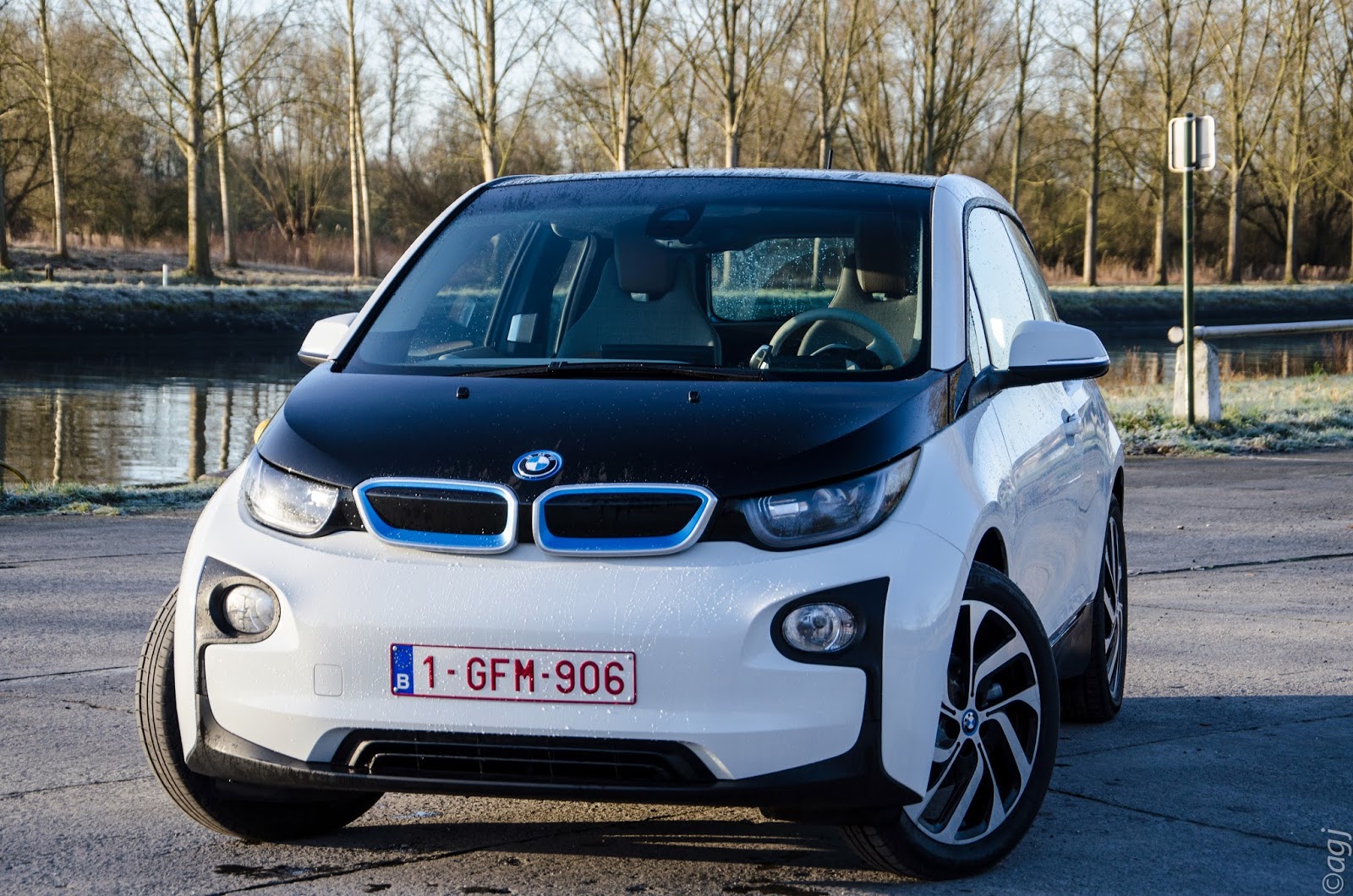
Wednesday 30th of January! Finally the car had arrived. It had taken less time as predicted, but still I am an impatient man. I was very curious of how it would look like, because I had never seen the car in the combination I had ordered it: BMW i3 Advanced in Ionic Blue Silver with Loft interior design. And I must say: I loved the looks! I have been the lucky one to own the first BMW i3 in our state. It all makes it even more special.

I think these colours are just the real deal for this car. It is extra-ordinary looking, special and shiny. It contrasts greatly with the black toppings and with the (electric) blue stripes beneath the doors. (The colour showing here doesn't really add up to it, but there are plenty more better pictures to be found to show the perfect match of this color for this car).
 I am very excited of the choice of my interior: Loft. It just ads up to the uniqueness of this car. It just fits. It makes it so much more space-like and futuristic looking. It is light, spacious looking and yet thrilling due to the electric lines fitting of the car seats and the blue lines which contrast nicely in details. One can tell that a whole team of enthusiastic decorating engineers have worked on this here. 
 The dashboard just like so great! Spacious, nicely shaped. I love the look of the darker dashboard going down under the console. It isn't the eucalyptus wood. That was nice too, but I thought it kind of disturbed the futuristic looks of the dashboard, making it a more ordinary car. Well, everyone has it taste, but I am happy with my decision. The big center screen which one can module along one's taste: here shown with the electric features and the entertainment details with a nice big picture of the song that is playing. 


The supercool startup-close status of the car. When one closes the car with the key, the insides of the car glow blue, the lights in the door handle turn on. This really ads a nice touch to the futuristic space-oddity of the car! (only available if LED packet is taken). You can be sure there are lots of amazed faces when these lights are set on on a public parking lot at night.
Driving experience:
I am really, really impressed by the fun driving experience of this little car. Also my wife, who isn't into cars at all, loves this one all the more. The first time she drove this car together with the kids my daughter said: mom, this thing is propelling like a rocket. She had just left our parking lot and stepped on the pedal; after merely 100 metres she was flying at 60 miles per hour. Which is kind of dangerous, because judging by the quietness in which this car boosts off, you really can't tell how fast you are driving. I love the sound of the car when I give full throttle. It's actually more like an electric train than a car. No roars, just power whistling.
And if you are driving at slow pace, you really can't hear the car is running, not at the inside, neither at the outside. The onboard entertainment system is just great also. Lots of options, lots of possibilities, all pleasantly and clear shown on the big central screen. Another great feature which works great is the full automatic parking. It all adds to the ease of use and to the futuristic impression one gets driving this car. Also the very small turning circle is quite impressive and it makes this car very easy and agile to drive.
About the range anxiety, I have to be honest, that's something I still got to get used to. I always am quite focused on the remaining range, especially when I have taken the highway, since the range goes down quite steadily and fast. Especially if one is driving vividly, it really can be seen on the remaining range. But that's a choice everyone makes for his own. I personally enjoy this car's potential too much for now, to drive it in a real eco pro mode. (But I am sure it will come eventually). I love to stand next to a fast car (yes, mostly BMW or Audi) at the red lights, then step on it when it turns green, and enjoy to see the amazed faces in the rear mirror as my car sprints before them without any effort!
Of course it means that the battery has to be charged more often, and it means also that we - for the first time- have to somewhat plan our trips with this car, because where I liked to use my first car in the past to do the shopping and stuff, I also take this car now because hey - it's cheaper, it's more fun and it's ecologic.
And it means that sometimes we just have to wait and don't take this car because it's not yet charged enough to take the trip. However, I have to be honest that I have not already installed a wallbox and am still charging the car on our regular home electricity network. I have chosen to go for the Wallbox Pro - which is a real supercharger - but it will only be available second trimester of this year. I will surely let you guys know what's the difference with the ability to fastcharge. I am sure we will use the car even more then.
Another not so pleasant thing is that I have been trying to install the Connected Drive system for more than four days now, and it just doesn't want to work. The problem is that my registration to Connected Drive on the net isn't transferred to the car, so I don't get a confirmation code in the car to finish the connection. It's an internet portal problem, they said at the local Connected Drive center in Belgium, so they have to manually fill in an application and send it over to Germany. It will take about a week before it will be solved. Which is kind of disappointing because I really wanted to try out the BMW i Remote app on my smartphone right away. I will keep you posted too when this is installed and working too.
But besides that, it really is a superb car to drive. As an owner of a BMW i3, you will have to get used to all the looks of amazed and sometimes confused faces. I just come back from a restaurant, and while I sit inside, I see people stopping by the car and taking pictures. I have never experienced something strange like this. And returning from a great meal at the restaurant, driving this unique car, fast and agile in total relaxing silence, while playing 'Life's for the Living' of Passenger out loud like you are in a concert hall on the first row; there's only one thing I can say: Sheer pleasure and happiness!
A little about range:
I have been driving the car for about a week now and I come to understand the calculation of the estimated range a little bit better now. I have noticed that the car calculates the maximum range after a night's charging depending on the driving style and circumstances of the last drive. So, when fully charged the maximum distance can vary from about 113km (70 miles) to about 135 km (84 miles)  in comfort mode.
On a morning when fully charged, and when the day before the car had purely driven in the city (meaning lower speeds) the battery indicated 135 km (84 miles) in Comfort mode, 137 km (85 miles) in Eco Pro-mode, and 150 km (93 miles) in Eco Pro+ mode. I think this must be about the real maximum range one can get with this car, stating that the car is driven in the city in an average driving style, lower speed, and frequent stops to recharge the battery while driving. However, if I step on the pedal and drive more sporty (and I must admit it is difficult not to do this, because it's just sooo much fun! ) and certainly if I drive on the highway, meaning speeds of about 130 km/h ( 80 mile per hour), you can't really depend on these figures anymore.
Eco Pro Mode only added 1 mile 
In Comfort mode the range was 84 miles
However Eco Pro+ mode added 9 miles for an estimate of  93 miles
To give an example I have noted precisely a trip I have driven: 
The trip goes from my home to the sportshall where I drop my son off. It's 28 km in total (18 miles), of which about 18 kms (11 miles) on the highway, where I usually drive about 130 km/h (80 miles per hour). After a night charging the range meter shows 113 km (70 miles). So normally when the calculation would be absolute there would still be 85 km (52 miles) left on the counter when I arrive at my destination. However, when I arrived at my destination the counter only showed 53 km (33 miles) left! Which is kind of scary, because a big part of the battery range seemed to be lost there!
However, when I get back in the car to come back to home, it's another story: The meter now shows 59 km (36.5 miles) left. So normally when I arrive at home there should be 31 km (19 miles) left. However when I arrived at home the calculator still showed 33 km (20.5 miles), which was a gain of 2km. So it was actually quite perfectly measured. It seemed to really have taken into account the weather conditions, the road ahead, the driving style, the maximum speed etcetera.
To sumarize: If one drives always into the same pace and always into the city at lower speeds I really think that 130-140 km (80 - 87 miles) is quite a realistic estimation of the effective driving range. However if one like to drive sportive and quite some distance on the highway doing higher speeds, I think 100 km (60 miles) would also be a realistic estimation as the maximum range. 

BMW i3 Born Electric Guest Blogger: Meet Toni From Belgium


A while ago I announced that I would be starting a new series here called, "I was Born Electric on...". The series will be featuring readers who are i3 owners and who are willing to share their thoughts on the car after owning it for a while. They will begin the post by introducing themselves and stating the date they were Born Electric, which is when they picked up their i3. Andy from the UK kicked off the Born Electric series and we then visited Hil from Holland. We'll now be traveling to Belgium to visit with Toni and his new Capparis White i3:  


My name is Toni and I was Born Electric on Monday, 27th January, 2014.

The first time I realized that there was an alternative to fossil fuels for propelling a car was in early 2011, when I came across an electronic brochure about the Opel Ampera, the European sibling of the Volt. The more I read about it, the more I was convinced that my next car had to be an electric one.
The reason why I didn't go for the Ampera back then was stupidly financial : 50.000€ for a car was way above what I was willing/able to pay. 
Of course, there were other more affordable electric cars out there. But maybe I was not ready for the leap of faith into electro-mobility yet. Range anxiety was clearly an issue I had to deal with while I waited for my savings account to be able to take the hit of a new car.

Three years later, things had clearly evolved. Both on the EV market and in my personal situation. In the latter, I had enough spare funds to afford a reasonable down payment on a premium car. Moreover, the extensive immersion into electric car literature helped me to come to the conclusion that I did not really need a range extender since more than 95% of my daily commuting could easily be covered by a BEV. The question was then : which car was going to be the one. Ampera/Volt? No, though it definitely is a fantastic car, it still has a tail pipe and I did not want to buy an end-of-cycle model. Tesla? No, too big and too expensive, I did not want to take out a mortgage for the sake of buying a car.  Nissan Leaf? Er, no.  
The BMW i3? Well ... I must admit that my first impression was negative. Not because of its design; actually I am fond of its looks since the very first concepts that appeared in 2011.  But rather because it is a BMW! I never liked BMW. I always considered that BMW was making cars to suit arrogant petrolhead jerks (with all due respect, of course!).

And then I test-drove it. And fell in love.

Was I ready to overcome my prejudices and become a BMW driver myself?  Definitely. Biases are wrong, the car drives like a breeze, the technology inside is outstanding and I too can be a jerk sometimes. : )

So, in order to do penance for my past biases, I decided to devote this blog post to crushing some preconceptions that have been floating around the i3 in some reviews.  And I'll do that from the authoritative position of being the happy owner of a "Shamu Edition" (Capparis white & black - think Shamu the whale)


It is a city car:
No, it is not. Though the car handles incredibly well in an urban environment, it has nothing to be ashamed of when cruising at highway speed. It is fast and responsive. Steering is precise and forgiving at 130 km/h (80 mph).  Overtaking on motorways is a feast. It is a BMW after all, is it not?

The i3 is particularly noisy at high speed:
No, it is not. My first extended drive of the i3 has been the trip back home after delivery at my iAgent dealership. 50 km (30 mi) from Waterloo (Brussels area) to the Mons area where I live. Since the battery was almost fully charged, I decided that I could afford the luxury of squandering away precious kWh's on the E19 motorway. In addition to discovering the driving dynamics described above, I was also curious to put to the test the recurrent criticism I read about unpleasant airflow noises.  I can confirm that in-cabin noises are like taste; there is no accounting for them. I, for one, was not inconvenienced by the airflow at all. I even enjoyed it.


The trunk is too small and the suicide doors are a hindrance:
The question is : Compared to what? 
I am a small car guy. Before the i3, my car was a Mini Cooper. Before that, I owned a Mercedes A-Class (2004 model). Before that, a (discontinued) Rover 220sdi. I know what a small car is. And the i3 is no small car at all by my standards. The trunk offers enough space to generously accommodate the weekly shopping for a family of four. There is plenty of space for my Victorian longbow, arrows included, or for my eldest son's guitar, amp included. 

As for the coach doors, once again it all depends on where you come from. Compared to the coupé-style doors of my Mini, the i3's "antagonist" doors, as they are called in French, are a major step forward in terms of ease of access and comfort. Or to put it in my youngest son's words : "Sooo cooool!".


Materials used for interior trims do not feel "premium":
That was a tricky one.
As I said, price was an important parameter for me, as it surely is for most of us. Given that I accepted the idea of disbursing 40.000+ € for a car, the outlook of spending my driving time in a sleazy environment was distressing me. Of course, I did have the opportunity to feel, touch, smell the interior materials a couple of times before I ordered the car. But assessing the quality of a dashboard or of a leather upholstery is like testing a spring mattress at the mattress store.  No matter how long you try to figure it out, the only way to be sure is to turn the lights off and literally sleep on it.
Though I have not slept in my car (yet), now, I know. The interior is largely up to the price paid. Comfy, stylish, extremely well finished down to the most minute detail. I am almost ashamed of having doubted.  By the way, my i3 has the Lodge interior (Giga world). 

The i3 is just an overpriced Zoe: (I've been reading this one a lot in the French-speaking press).
For the non-European reader, let me first explain that the Renault Zoe (en.wikipedia.org/wiki/Renault_Zoe) is a sort of cute good looking Nissan Leaf, with a French touch.  Don't get me wrong; I think that the Zoe is a nice little car but, c'me on! 

How can a professional journalist put the i3 and the Zoe on the same footing.  How can you compare the past to the future? A car made of steel to the first mass produced car made of aluminum and carbon fibre?
I wish I were an engineer and be able to explain why and how a car with a CFRP body drives so much better than a conventional one. But I am just a linguist and you'll have to bear with my poor description : in the i3, you're just in control!  

The rigidity of the thing makes you feel that there is nothing the car won't take.  You feel light and super secure at the same time.  If you don't believe me, just arrange your own test drive.

Considering the technology, range is unimpressive:
My take on that may sound unconventional.
More range would have been inconsistent with the concept of “great driving experience in a sustainable way”. If my average daily need is 40, why should I store in my car 4, 6 or even 8 times the energy and resources that are necessary?  

In all fairness though, I must confess that I am still struggling with an instinctual range anxiety.
And this is where technology comes to the rescue. The amount of information that comes through the screens is just impressive. The dynamic range assistant, the Eco-route guidance, the graphics, everything has been thought and designed in order to alleviate whatever range fear that I still could have. And it works. On top of that, the resolution quality of the 10.2" screen (professional nav) is remarkable.

I know that there is a bit of controversy as to why BMW did not include a State Of Charge reading in the i3 as in the ActiveE or the Mini E.  Since I never had the chance to drive an EV with a SOC, I guess that my point of view may be considered as neutral on that.

The i3 is an expensive high-tech toy for tree-hugging geeks:
Yes.
It is.
But it is much more than that at the same time.
It's a car.
With all the features, functionalities, looks, behavior, style, technology and feel of a great car.
And yes, it is electric.

So is my i3 living up to all of its promises?
Not quite all of them, for the moment at least.
In Belgium, some of the much anticipated 360° Electric services have not been fully rolled out yet. The Add-On-Mobility (Access or Alternate Mobility program as it is called on other markets) is still largely undefined and the ConnectedDrive services are having a bumpy debut.  Nevertheless, the local BMWi team is working hard on it.

As far as the actual car is concerned though, I can happily report that I haven't found the least flaw yet.
My i3 is the second BMWi to have been registered in Belgium.
And I am very proud to be among the first owners. 

2/5/14 EDIT:
Toni has had a few people ask him about the range since this post went up so he asked me if I could add these words to the post to cover what he has observed so far:

Hi, thank you all for the the nice words!


As for the range, I haven't pushed it to its limits yet. And I doubt I'll ever try to; I'd rather do away with my range anxiety in a non-traumatic way :)

Apart from the maximum range, I think you have to consider the "comfortable" range the car is giving you. By "comfortable" range, I mean the distance you can cover without ever bothering about modes, driving style or even outside temperature and this includes short highway portions. In the case of the i3 (BEV), my experience of the "comfortable" distance is ~62mi (100 km) on one charge.  Remember that, within this range you can drive the way you want. Of course, this "comfortable" range can be jeopardized by a particularly aggressive and non-responsible driving. But, as far as I know, only anti-EV journalists are capable of driving this way.

If your daily commuting includes larger highway portions and/or represents between 62 and 80 mi (100 to 130 km), then I recommend using ECOPRO. Mind you, ECOPRO is not a sub-standard COMFORT mode. The car behaves much like it does in COMFORT mode with only slight differences. Most of them remain unseen by the driver. The only one you do notice is the max speed capping. This speed capping works much like a speed limiter on a conventional car, i.e. you can adjust it in the settings and override it by pressing the right pedal down to "full throttle" when overtaking or in case of emergency. For Europe, ECOPRO default setting is 110km/h (~68 mph).

If you really need to go much farther than 80 mi (130 km) on one charge in a consistent way, you'll probably have to master hypermiling techniques and accept that the ride may become stressing sometimes :)
In this case, I'd recommend going to for the REx version.

If you own an i3 and would like to participate in the Born Electric series here, you can email me at: tom.moloughney@gmail.com