Showing posts with label history. Show all posts

Getting Refugee Crises Wrong - An American Tradition

The Twitter account @HistOpinion (Curated by historian Peter Schulman), has been posting historical poll data about the refugee crisis of the 1930s. Some examples:

Here's the source for that college student poll:

One could, of course, make the argument that people are SCARED of the Syrians, whereas they just hated the Jews. They didn't see the Jews as threats.
As I said after 9/11, as violence against brown people with head coverings (Muslims, Sikhs, etc.) raged - America always gets these moments wrong. We had plenty of anti-German panic during the World Wars too. Before that, it was Catholics and Chinese. We all know (I hope) about Japanese internment camps.

Large swathes of America are always ready to turn to nativism and hate as core elements of our foreign policy, even as we slap flag decals on our car and chant about freedom and liberty

So here's Ted Cruz, although I could link to any of the GOP presidential candidates and most of the GOP governors for comparably terrible examples (via the New Yorker's Amy Davidson)
President Obama and Hillary Clinton’s idea that we should bring tens of thousands of Syrian Muslim refugees to America—it is nothing less than lunacy,” Ted Cruz said on Fox News, the day after the attacks on Paris. If there are Syrian Muslims who are really being persecuted, he said, they should be sent to “majority-Muslim countries.” Then he reset his eyebrows, which had been angled in a peak of concern, as if he had something pious to say. And he did: “On the other hand,” he added, “Christians who are being targeted for genocide, for persecution, Christians who are being beheaded or crucified, we should be providing safe haven to them. But President Obama refuses to do that.”
The next day, at a middle school in Myrtle Beach, South Carolina, Cruz spoke even more openly about those whom he considers to be the good people in the world. He told reporters that we should accept Christians from Syria, and only Christians, because “There is no meaningful risk of Christians committing acts of terror.” This will come as a profound surprise to the people of Oklahoma City and Charleston, to all parties in Ireland, and to the families of the teen-agers whom Anders Breivik killed in Norway, among many others. The Washington Post noted that Cruz “did not say how he would determine that refugees were Christian or Muslim.” Would he accept baptismal certificates, or notes from pastors? Does he just want to hear the refugees pray?
Racism. Nativism. Fearmongering. These are American traditions as much as, or more than, "Give me your tired, your poor, your huddled masses yearning to breathe free."


Trump and the "F-word" - Rick Perlstein

Rick Perstein, a foremost historian on the rise of the American right, has a long piece on Donald Trump and fascism, comparing his emergence to the politics of other demagogues and fascists throughout the 20th century. It's a thoughtful, detailed, assessment of the risks and the process.

When Trump emerged, many folks started to compare him to Berlusconi, but I continued to suggest that Il Duce was a better model. I stand by that assessment. Here's Perlstein:
Trump has now provided more “specifics” about his immigration plan: a forced population transfer greater than any attempted in history, greater than the French and Spanish expulsions of the Jews in 1308 and 1492; greater than theNabka of approximately 700,000 Palestinian Arabs from British-mandate Palestine; greater than the 1.5 million Stalin consigned to Siberia and the Central Asian republics; greater than Pol Pot’s exile of 2.5 million city-dwellers to the Cambodian countryside, or the scattering of Turkey’s Assyrian Christians, which the scholar Mordechai Zaken says numbers in the millions and required 180 years to complete. Trump has promised to move 12 million Mexicans in under two years––“so fast your head will spin.”
Only then will he start building the wall.
But all Republican politicians say stuff like this, right? They all want a wall, they all want to bury criminals under the jail, they all crave war, even if they’re not quite so explicit about it.
Not quite, actually. Previous Republican leaders were sufficiently frightened by the daemonic anger that energized their constituencies that they avoided surrendering to it completely, even for political advantage. Think of Barry Goldwater, who was so frightened of the racists supporting him that he told Lyndon Johnson he’d drop out of the race if they started making race riots a campaign issue. And Ronald Reagan refusing to back a 1978 ballot initiative to fire gay schoolteachers in California, at a time vigilantes were hunting down gays in the street. Think of George W. Bush guiding Congress toward a comprehensive immigration bill (akin to that proposed by President Obama) until the onslaught of vitriol that talk-radio hosts directed at Republican members of Congress forced him to quit. Think of George W. Bush’s repeated references to Islam as a “religion of peace.”
That's right, W. was the responsible one. Trump is much more dangerous. Trump is also not doctrinally conservative when it comes to economics, but rather has grasped the power of economic demagoguery.
Describe Donald Trump to a mid-century social scientist and he would respond: of course he is in first place. And I’m fairly certain George W. Bush would fully understand that he could have further expanded his own massive grant of post-9/11 power were he only to scapegoat all Muslims. It is to his great credit that he did not. He seemed to have understood something the current crop of Republican candidates chasing after Trump do not—something about Pandora’s Boxes, toothpaste that cannot be put back into tubes, the demiurge. Bush was, unlike Donald Trump, unwilling to say anything.
...
Our notional midcentury social scientist, or better historically informed pundits, wouldn’t be so sanguine. They would recognize the phenomenon that sociologist Pierre van den Berghe in 1967 labeled herrenvolk democracy: a political ideology in which members of the dominant ethnic group enjoy privileged provision from the state, as a function of the economic and civic disenfranchisement of the scapegoated group, to better cement dictatorship. This was why elites feared Huey Long’s promise of a guaranteed income––“Every Man A King.” This was how George Wallace governed Alabama. This was apartheid South Africa.
Read the whole thing. I still can't believe Trump will win the nomination, let alone the election. But a savvier politician, perhaps also a billionaire, will come along who appropriates these pieces and will win. History tells us to be worried about that future.

Bruce Rauner and the Destruction of Illinois History

Say goodbye to the Illinois History Museum. Bruce Rauner has pulled the plug.

There's something populist about museums like this. They tend to be free or cheap, they serve school kids from across the state, and they make our history accessible and interesting.

Naturally, Billionaire Bruce isn't going to permit that sort of thing to continue.

The "Authenticity" Dodge

I met Arthur Chu this summer at a workshop on the problem of misogyny on the internet and we've been corresponding via email and social media a lot since then. Our writing interests overlap when it comes to representation issues in media and games. He interviewed me on the problem of claiming "authenticity" as a way to avoid diversity.

Here's an excerpt:
DP: When you start to create fantasy races and then you make the argument “Oh no people of color, we have to be realistic,” you’ve revealed your cards. You’ve shown that you just don’t want to have a diverse world, that you want to promote this myth of homogeneity, that you want to use historical reality to justify making a choice that makes other people upset.
AC: That’s interesting, because it seems we’re in an upsurge of interest in sword-and-sorcery fantasy–
DP: We sure are, it’s great!

AC: And it seems recently we have this appetite for “old-fashioned” narratives that center the West and reduce the rest of the world to antagonists or scary foreigners, even if it’s in a winking, ironic way. You’ve got the Lord of the Rings films that started the revival of high fantasy in film hewing close to Tolkien’s depictions of the Southrons and the Easterlings as sort of flat enemy races, and then you’ve got Game of Thrones using the Dothraki to bring back the trope of the barbaric Mongols. What do you think is driving this trend of the past ten years or so?
DP: Oh, to me it’s a much longer trend than that. Orientalism is built into 800 years of Western narrative production about the East. That the East is simultaneously more advanced and more decadent and more barbaric and more civilized all at the same time. And I think that the Orientalism of Game of Thrones is the perfect embodiment.

Obergefell v Hodges in the Scope of History

I have a new piece up with The Atlantic on the historic decision legalizing same-sex marriage nationwide. It argues that the history of marriage supports, even mandates, change as societies change.

We're ready. History is with us. Love wins.

Here's the piece, with thanks to Anise Strong and Ruth Karras.

---

UPDATE - Anise Strong gave me permission to repost these comments on Roberts' dissent:
Roberts: "As a result, the Court invalidates the marriage laws of more than half the States and orders the transformation of a social institution that has formed the basis of human society for millennia, for the Kalahari Bushmen and the Han Chinese, the Carthaginians
and the Aztecs. Just who do we think we are?"
Strong Writes:
Just for the record:
The Kalahari !Kung or San people (Bushmen being a frequently pejorative term) practice a limited form of same-sex marriage for inheritance purposes and probably have for tens of thousands of years. Also, their marriages are generally open with regard to sexual intercourse and can be freely and frequently divorced by either party.
The Han Chinese frequently practiced polygynous marriage and the primary functional practical relationship is mostly mother-in-law/daughter-in-law.
We don't know much of anything about the Carthaginian practice of marriage or family life, except that there's increasing evidence that they did sacrifice babies.
Aztec nobles were polygynous; Aztecs may have also practiced a form of same-sex marriage involving third-sex (intersex or "two-spirit)) individuals. Furthermore, Aztec wives had far more property and individual rights than most European and Asian women in the last 5000 years.
Or in other words: do your research.
And that is why I interviewed her for my piece.

The Rise of Neo-Primitivism

I've become increasingly interested in nostalgia, especially when used as political discourse (following the scholarship of my friend Matthew Gabriele (@prof_gabriele), a professor at Virginia Tech).

It reminded me of this recent essay from Andrew Potter, the editor of Ottawa Citizen, on the "Rise of Neo-Primitivism." Potter describes the "neo-primitives" imagined by speculative fiction author William Gibson, and links these fictional people to moderns. He writes:
From the paleo diet to the “ancestral health” craze to the criminals leading the anti-vaccine movement, we live in neoprimitivist times, in precisely the manner sketched by William Gibson. A disturbingly large segment of society has adopted a highly skeptical and antagonistic relationship to the main tributaries of modernity. But as in The Peripheral, these people are not opting out of modernity, going off the grid or deciding to live in caves. Instead, they are volunteering for “another manifestation” of modernity, living in the modern world, without being entirely of it, or even understanding it.
It's an interesting essay throughout, talking about the faux authenticity ascribed to "natural" and "nature" in this modern world, and the consequences.
The philosopher Bertrand Russell once noted that the misfortunes that can befall humanity can be sorted into two broad categories: things that are inflicted by nature, and things that are inflicted by humans. For most of our history, a great deal of suffering was due to natural causes such as famine, disease, and disaster. But as we have developed in knowledge and skill, the class of harms inflicted upon humans by other humans has come to occupy a greater chunk of the total. Put simply, there is less disease but more war, and as a result, we’ve come to believe that “nature” is relatively benign, while “civilization” is increasingly a threat.
Nothing could be further from the truth. Yet we are caught in the grip of a fierce nostalgia, where the thought of contracting a disease like the measles is not something to be feared, but to be welcomed as a sign of our profound connection to nature.
We live in neoprimitivist times. Authenticity seeking wedded to technophobic irrationalism has led us to a bizarre situation where we are increasingly ignorant and suspicious of the scientific and technological underpinnings of our world. It’s like fish deciding that water is their enemy.
I don't know that I agree with all his conclusions - some of the mistrust of technology is learned, rational, behavior. But I like the concept of nostalgic neo-primitivism.


History and Memory: Southern Nationalism and the KKK

For Southern Nationalists, slavery was better than modern taxation and the KKK was just a neighborhood watch. From a Guardian piece:
Kiscaden, who owns a coal mine in Kentucky, had an equally peculiar interpretation of history. He disputed that Forrest was a a founding member of the Klan, which he said played a positive role in bringing about law and order in the south when it was first conceived in the 1860s. (He distinguished the original Klan from the hate group of the same name that, he conceded, orchestrated lynchings.)
“The people in the south – the white people, who were being abused – organised a neighbourhood watch to try to re-establish some order,” he said of the nascent Klan. Slavery in the south was “a bad institution”, he said, but possibly “the mildest, most humane form of slavery ever practiced”.
“If you look at the wealth created by the slaves, in food, clothing, shelter, medical care, care before you’re old enough to work, care until you died, they got 90% of the wealth that they generated,” he said. “I don’t get that. The damn government takes my money to the tune of 50%.”
And this is why teaching history matters. This is why extremists on the right try to take over school boards, textbooks, and fight the AP History standards (which are national).

I'm on my way to a history conference and then have a lot of music gigs all weekend, so I may not be around social media as much.

Ta-Nehisi Coates at Dominican University: Activism and Change

Last night I had the pleasure of watching one our nation's great writers, Ta-Nehisi Coates, give a talk on the case for reparations at my university. The content of the talk was based on his recent major article for The Atlantic, which you should read. His thesis is that for 350 years, in an ongoing fashion, African-Americans can and are being plundered for their labor. Slavery is a major part of that story, the first 250 years, but he talks mostly housing and redlining and its consequences in the mid-20th century.

In the Q&A, he said something very interesting. A professor asked him what he would tell these "young people" in the crowd tonight, and he very important. He told them that none of them were all that likely to see real change, or at least they couldn't predicate their activism on that change.

He said that every time the African-American community had seen change, it had been because of a context that made the change useful to majority white society. Frederick Douglas was a great activist against slavery, but emancipation happened because it became useful to winning the Civil War. Ida B. Wells was a great activist against lynching, but the federal government did nothing. MLK was a great activist against discrimination, but civil rights legislation took place because the South was embarrassing America in the Cold War.

Now these historical statements are naturally reductive - Coates made them quickly and off-the-cuff - but they do speak to the difficulty of change. For 250 years, he said, slaves rebelled, slaves fled, slaves resisted. They brought no change, but they did say, in Coates' words, "Not in my name."

And then he talked about activism and, for him, writing, of telling true stories and trying to undermine myths of history that serve oppression. Speaking out. Rallying. Even implicitly, rebelling against unjust systems. He didn't promise change as a result of activism, but he promised that saying - not in my name - might help you sleep at night or live with yourself.

And to me, it's the telling of true of stories (which is what I try to do) and activism in all its forms, which has the potential to create the context in which change can take place. It's just not predictable and you cannot base your activism on whether or not you see change. You just have to act, however and in whatever ways you can, locally, globally, in art, in prose, on the streets, in the halls of power, in conversations in your local bar, with your fascist uncle at the holiday table, wherever.

And then you hope that you're lucky enough to be present when the context changes.


Christian Holy War - Next on FOX

All the news lately on Bill O'Reilly has focused on his chronic exaggeration of his records as a reporter on war. The short story is that while has has seen violent things here and there, he's not a war reporter, but it's not likely Fox News or their audience will care.

What I don't want is to let O'Reilly and his producers/writers off the hook for this.


After the Graeme Wood ISIS piece came out, O'Reilly used it to declare that we are in a Holy War. Now I know something about Holy Wars, and it's always possible for one side or another to decree that they are in a sanctified battle. Things get really nasty, though, when both sides adopt such rhetoric, and that's exactly what O'Reilly did here.
Fox News host Bill O'Reilly boosted his idea that the U.S. is in a holy war against the Islamic State (also known as ISIS or ISIL), demanding the Obama administration "take the holy war seriously" and urging American clerics to lead the fight.
After the Islamic State's beheading of 21 Egyptian Christians in Libya, O'Reilly claimed that "the holy war is here" on the February 17 edition of his show. O'Reilly later called on "all Christians, Jews, and secularists who love their country" to call the White House and "say enough."
On the February 18 edition of his show, O'Reilly again claimed it is "appropriate to define the worldwide conflict between Muslim fanatics and nearly everybody else" as a "holy war" and demanded President Obama "take the holy war seriously." O'Reilly asserted that the West must come together to eliminate the Islamic State, adding that "if the politicians won't do it, the clergy must lead the way."
What's ironic is that for days before this the right-wing was insisting that Christianity was fundamentally peaceful, while Islam was fundamentally violent.  And yet here he calls on clergy to lead the way.

This is dangerous talk. It's going to lead to further intensification of anti-Islamic sentiment and activity among radical right-wing Christians, it's going to serve ISIS very well in their recruitment efforts, and it wouldn't surprise me if it creates more domestic violence against Muslims.

I care about this much more than whether O'Reilly invented a fantasy of himself as a war correspondent. The fantasy of salvific violence is much more dangerous.

Crusades and Religion - Who Decides What is "True" Crusading

In an earlier post, I talked about crusades and memory, linking to my Guardian piece and talking about the meaning of the violence linked to Crusading. I suggested that historians might debate whether a given battle or moment of violence happened, or whether it happened because of religious hatred for "the other," versus some other kind of motivation (as if there can be only one motivation for a given act), we would generally agree that the Crusades were Christian acts of violence.

I stand by that. One piece getting a lot of play is by my friend, medieval historian and some-time conservative commentator Tom Madden, written here at the National Review. Let's take a look:
According to the president, Christians should avoid mounting their “high horse” when it comes to “faith being twisted and distorted,” since “during the Crusades and Inquisition, people committed terrible deeds in the name of Christ.”
Well, yes. That’s true. But people commit terrible deeds in the name of everything. The question isn’t whether humans can be evil, but whether those acts are consistent with their religious beliefs.
See, we agree it's true. People committed terrible deeds in the name of religion during the Crusades. So one strand of crusade-apologists can now be silent.

Let's work through the rest of the piece, though, as Madden and I seriously disagree with a number of other points. Before that, though, here are my biases as regards Madden, because I think you, dear reader, ought to know (feel free to skip the next few paragraphs if you don't care, and just want to hear my criticism of the piece).

Me and Tom Madden, my mentor.

I know Tom's work probably as well as anyone alive other than him, since Tom and I are just about the only two anglophone medieval historians (there are of course plenty of art historians) who focus on pre-1250 medieval Venice. It's no exaggeration to say that my book wouldn't exist if not for his scholarship and his support of mine - letters of rec for grants, help with the archives, publishing my first article, citing me in Speculum (the highest prestige medieval journal), and now blurbing my book. His scholarship on medieval Venice is impeccable - rooted in intensely careful readings of sources that have either been overlooked or misread, written in a style I find enormously appealing. I've read every article, usually multiple times, combed his footnotes, and have had many a very happy chat about Venice and the Middle Ages. We see Venice very similarly, in large part because his work shaped my entry into the field. My Venice is his Venice. He is one of my mentors.

On the other hand, his politics are conservative where mine are liberal. The great thing is that we have, I hope, a friendship and some similar scholarly agendas, though our public work diverges radically. If there's bias here, I am biased towards Tom.

Me and the Crusades

Moreover, my own scholarship and scholarship I admire has worked hard to resist the simplistic rhetoric of atrocity as applied to the crusades. Critical re-reading of sources is one of the things historians do, and it turns out that there's been a lot of hyperbole applied to the Crusades. So we have to be careful. For example, Jeremy Cohen, in Sanctifying the Name of God, re-examines the core Hebrew texts about the 1096 massacres, looking at the ways in which the authors worked with what surely were horrible events in order to serve contemporary purposes. Horrible massacres definitely took place, but the accounts themselves are written to intensify various agendas.

My work on the Fourth Crusade (buy my book!) in fact more so than Madden's work to date, similarly argues that our main sources about the terrible sack of Constantinople have functions OTHER than to relate what happened. So when Steven Runciman, a great historian who lived through World War II, writes, "There was never a greater crime against humanity than the Fourth Crusade," as historians we simply have to reject such an assessment. The sack of Constantinople was not, based on my reading of the evidence, in fact more terrible than other sacks (which is still terrible, involving murder, rape, and destruction). The rhetoric making it sound like such a great sack is not an objective recounting of truth but rather a crafted narrative to serve various tasks. And now I've summarized the first half of chapter 1 of my book.

That's uncomfortable. It makes it sound like I'm excusing conquest, plunder, murder, and rape. I'm not. I'm reading the sources. I'm assessing them. I'm doing what historians are supposed to do. And I learned a lot of that, as regards the Fourth Crusade, from Tom Madden.

The National Review

Madden's piece troubles me for a number of reasons:

First - historical. Madden writes, "At some point Christianity as a faith and as a culture had to defend itself or else be subsumed by Islam."

That's the core statement that Madden and many other right-wing folks are arguing: That given Muslim aggression, the Crusades were a fully justifiable defensive action.

I don't believe this is correct. In the 1090s, Islam was fractured. In Spain, the Islamic forces were fractured and being pushed back by various Catholic forces. The western Italian city states were now raiding Islamic ports, rather than being pressured by Islamic pirates. The Normans had conquered southern Italy and were, in fact, threatening Byzantium at least as much as the Turks were (due to Norman naval superiority). The Seljuk Turks in Asia Minor were a threat, yes, but they hardly represented "Islam." They were a new regional power looking to expand, one of many in the fractured Islamic polities from Baghdad to Egypt to Anatolia. The notion of Islam around 1100 as an implacable force just doesn't hold up.

 Is it possible that the Turks could have conquered Constantinople in the 1100s rather than the 15th century? I suppose it is possible, because all counter-factuals are possible. But the Seljuks had issues of their own, such as battles with other Turks, and in fact were busy dealing with them as the Crusaders arrived. If you assess the relevant military, political, and economic assets at play in the Mediterranean world around 1090, it's not one in which Islam is going to roll over Christendom - if indeed either of those concepts exist - without Crusader intervention.

Here's my much more serious issue.

After agreeing that people did indeed do bad things in the name of religion, Madden asks whether the acts are consistent with their religious beliefs. He says they are. And then he says:
The work of the Crusader, who put his life at risk and underwent enormous expense, was to save Christian people and restore Christian lands. This was no perversion of Christianity. Christ had commanded his followers to be like the Good Samaritan, hurrying to bind up the wounds of their brother who had been robbed and beaten. This was the same Christ who said, “Greater love hath no man than this, that a man lay down his life for his friends.” That is how Crusaders honestly saw themselves following their Christian faith.
I believe this is true, as far as it goes. Many crusaders did honestly see themselves as Good Samaritans following their Christian faith. Others saw themselves as purifying the land, like Joshua. Still others saw themselves as actors in the final stages of an apocalyptic drama. And others, no doubt, just wanted to fight and loot, or carve out a kingdom. Scholars spend endless amounts of time debating crusader motivation, but let's put that side for now, and just focus on those who "honestly saw themselves following their Christian faith."

For Madden (and Riley-Smith to some extent, before him), the idea that crusading reflects good, Christian, love for one's fellow Christian, seems to be an exculpatory fact.

For me, it's a terrible indictment. 

If we accept this as true, then the violence that ensued during the Crusades is one inherent outcome of the faith. I do, in fact, believe that ideologies defined by a Manichean worldview - us/them, same/other, good/damned - is among the most dangerous forces in world history. I know so many believers working hard to build a more pluralistic future, because they recognize this danger as well. Once you create an other. Once your ideology depends on defending the self from the other. Horrible things can follow.

Because I'm not excusing the atrocities of Muslims made in the name of Islam, whether historically or today, but simply not exempting Christianity from this criticism on the grounds that the crusaders believed themselves to be good people. The belief that one's violent acts are necessary to be good is what we should all fear.

I also note (as others do) that Madden's piece never mentions the anti-Jewish massacres linked to the Crusades. Perhaps he feels they do not reflect this true crusading sentiment he isolates here. I don't think that's sustainable - these acts emerge together, they are part of the fabric of medieval Christian life, as are the people who spoke out against the massacres, who spoke out against the martial aspects of crusading. Extend forward: Christianity served as a sanctifying ideology for those who would enslave the indigenous peoples of the Americas and the Africans they transported there. It also provided sacred justification for those who spoke against mass enslavement.

So I'll say it again: The truth that many crusaders thought themselves to be doing good, serving their brother Christians in acts of love, is precisely what we need to fear from powerful ideologies. 

The Human Scale: What we miss when we compare disasters like Ebola and the Black Death

This is a guest post written by Ellen Arnold, PhD, 
Assistant Professor of History at Ohio Wesleyan University. 
 
"Perhaps the biggest thing missing from comparisons between Ebola and the bubonic plague, or in fact between any of these large scale tales of epidemic and pandemic disaster, is the human scale."

I am an environmental and cultural historian—I work on the Middle Ages, and one of the classes that I teach on a regular basis is a class on the Black Death that is, at its core, a course in comparative disease and disaster history. In 2009 I started the class with discussions of Swine Flu. In 2013 we began not with the Middle Ages, but with parts of Susan Sontag’s “AIDS and its Metaphors.” We read about cholera, and the flu pandemic, HIV/AIDS and cancer. I ask students to make links across time and across cultures, to think about the ways that humans interact with ecosystems of disease and the ways that human society constructs ideas about illness, how groups and individuals respond to disease, and the role of culture in human/disease interactions. And so I have been following coverage of the recent, devastating Ebola outbreak not only as a concerned citizen, but also as a teacher interested in the ways that people imagine and interpret disease.

The ways that we as moderns understand, interpret, and talk about disease have long and complex history. The history of the way that we frame and interact with diseases has taught us important lessons about both human health and human cultures. And modern disease studies have helped us learn a LOT more about the Black Death. Recent DNA analysis of both human remains and microbes and cemetery excavations have rekindled academic and popular interest in the medieval plague, and have added a lot of nuance to many public discussions of the deadly disease. And so, as I read Mark Perry’s essay using the panic over Ebola to direct readers to that most famous of pandemics, the Black Death, I was hoping for, well, I don’t know.

The article rehashes all the old standard stories about the plague— it was “caused” by Mongol armies using biological warfare; it swept uncontrollably through Europe, was composed of three diseases (here he is wrong), it devastated the economy, led to persecutions and hatred, and, (and here’s the core) killed an unimaginably large number of people. (I could write a whole essay on how misguided and oversimplified these main, predictable stories are, but I won’t.) Instead, I’d like to focus on the ways that we are missing real opportunities to do meaningful historical comparisons when we use death tolls as our primary index for comparison.

National Geographic
The main comparative point that Perry is making is one of death toll—a statistical comparison. Ebola, he argues, “is not nearly as deadly as [the disease] which, well, plagued the world in the 14th century.” He is not alone in this. Despite some more nuanced attempts to compare specific public health policies (see Rebecca Rideal’s take on UK border control efforts and this NPR piece on some recent research), comparisons between the plague and other diseases fixate on the death toll. Ty Burr, writing for the Boston Globe, amidst an interesting essay on cultural expectations of disease, writes: “Some perspective: The Centers for Disease Control estimates that influenza kills 3,300 to 49,000 people in the United States per year; statistics are much debated, but the point is that they’re more. Bubonic plague — the Black Death of the Middle Ages — reached London around Nov. 1, 1348; by February, 200 people were dying per day. The 1918 influenza epidemic that killed 30 to 50 million worldwide landed in Boston at the end of August; by the end of October, 195,000 Americans had died.” A National Geographic article presents this graphically, with lives lost turned into giant lotto-balls (blood-red to signify blood and danger).

Shocking, yes—but helpful? Perhaps the biggest thing missing from comparisons between Ebola and the bubonic plague, or in fact between any of these large scale tales of epidemic and pandemic disaster, is the human scale.

Today we routinely hear disasters quantified and measured against one another. Natural disasters are newsworthy when they are “the worst” or “the highest,” droughts when they are “the most extensive.” Material damages are quantified, to determine if disasters qualify as the “most expensive” (or problematically, expensive enough to merit aid), and human loss of life becomes part of the tally of scale. Given our new record-keeping abilities to assess and compare both scale and impact, and also the reality of increasingly global scales of environmental disasters in the post-Industrial (or anthropocene) world, it is unsurprising that generally only the “worst” medieval and pre-modern disasters are commonly discussed: Pompeii, the Black Death, the diseases of the Columbian exchange, etc.. All disasters, no matter their scale, affect individuals and communities, and leave their traces in communities, families, ecosystems, and human memory.

Source: http://www.andrecarrilho.com/
In August, André Carrilho drew a striking illustration (discussed here and reproduced left) of media response to the Ebola outbreak. What makes this image so powerful, besides the painfully brutal way it throws our racism at us, is the de-individualization of all the sick people. These people are identical (save color) in their identities as suffering bodies. Their personas eclipsed by their identities as victims. They are statistics.

Here is where the premodern can help—can open up conversations about not just mass mortality, but about individual response. Though so many modern accounts of the Black Death focus on gruesome deaths, medieval writers remind us that past the fear and the pain, there was another dimension to the plague—it created absences.

In the wake of the plague, Petrarch wrote an agonized letter:
“Where are our dear friends now? Where are the beloved faces? Where are the affectionate words, the relaxed and enjoyable conversations? What lightning bold devoured them? What earthquake toppled them? What tempest drowned them? What abyss swallowed them? There was a crowed of us, now we are almost alone. We should make new friends—but how, when the human race is almost wiped out; and why, when it looks to me as if the end of the world is at hand? Why pretend? … Look, even as we speak we too are slipping away, vanishing like shadows.” (Petrarch, letter from Parma, tran. In Horrox, The Black Death, 248-249).
Each dot on a map of Ebola victims was a whole person, with a family and a faith and friends—each person killed in this outbreak leaves giant holes in their family, their local economy, and their social networks. Though it is tempting to look to the medieval world and see in it a “there but for the grace of God and penicillin” lesson, it is much more fruitful to see in the voices of long ago reminders that all lives matter, that diseases on all kinds of global scales are about the sickness, susceptibility, salvation, and (one hopes) survival of individuals.

Blood Libel in the 21st Century

Medieval art historian Asa Mittman has a new piece in The Conversation on the survival of the Blood Libel myth. He talks about the medieval origins and dissemination of the myth that Jews ritually murder Christian children and use their blood to make their Matzoh (note: they/we don't. They/we never did).

He called it a "zombie lie," unkillable, rising again and again no matter what we do. He discusses a Facebook group dedicated to the Blood Libel, then broadens out to engage with antisemitic myths more broadly. At the end, he writes:
The blood libel is still told and retold, and The Protocols are still read as if they contained truth. We live in a moment when anti-Semitism seems ascendant to many, or is perhaps being revealed after a period when it was largely underground, filling up the anonymous comment threads of the Internet. Now, we see protests in the streets of Europe, and a resurgence of long-dead chants.
Protesters in Belgium and France have revived “Death to the Jews!” while Germans have resurrected “Gas the Jews!” In London, pro-Palestinian protesters have shouted “Heil Hitler.” Rioters have thrown rocks through windows of Jewish-owned businesses, and even burned some down. Newsweek devoted a cover story to the potential exodus of European Jews, some of whom are so concerned with rising anti-Semitism that they are considering leaving their home countries.
Most fictional monsters have bodies. This is how heroes can kill them. But zombie ideas like these are more resilient than their fleshy namesakes – and more dangerous.
Like Asa, I'm a medievalist, and I'm interested in myths. Myths emerge and re-emerge when they serve a function, and it's been troubling to see the medieval western myth of the Blood Libel take root in contemporary anti-Jewish discourse, especially among Palestinian voices.

It is vital to reject the Blood Libel and similar myths, to condemn without hesitation or contingency, and not to try to explain them away in the face of Israeli aggression. There is no place in the modern world for the Blood Libel myth.

As a historian, I want to understand. I want to worm my way into a culture and see how even the darkest ideas emerge, and to do that well, you have to try to get inside. But such a pathway has dangers, because explanations can easily turn into justifications, and some things are simply not justifiable.

The History Wars: The American Right Will Not Surrender Their Myths

As a historian, I study myth and narrative, not events or actions. I believe truth exists - in that I believe people did things and said things and even thought things and that sometimes those things are knowable. I just don't especially find that interesting.

What interests me is how individuals and groups tell stories about themselves, their pasts, and their hopes for the future, and what these narratives and their reception reveal to us about those individuals and groups.

And now, protests and debate over AP History standards in  Colorado:
The College Board, which administers exams to students upon the completion of AP courses, has revised the history curriculum in ways that have angered conservatives, who say it paints a darker picture of the country’s heritage and undervalues concepts such as “American exceptionalism.”
This is a good article, working through the issues well. The question is what is the purpose of American history. The conservative voice, represented by a board member here, have one take:
The school board plans to set up a new committee to review the curriculum with the goal of assuring that courses — in the words of board member Julie Williams — “present positive aspects of the United States and its heritage” and “promote citizenship, patriotism, essentials and benefits of the free enterprise system.”
She's not wrong. Ok, she's wrong. But historically speaking, she's right that this has often and continues to be the function of nationalist history around the world. The emphasis on unearthing silenced voices, on writing counter narratives, even on (the now discredited) mid-century focus on objective truth - these are all very modern. Throughout most of the human past and honestly still today in almost every part of the world including here, people shape their historical narratives in ways that serve their agendas, often their religious, cultural, national agendas. That's what I study in medieval Venice. And that's what's going on here.

For the American Right, a certain view of US history is essential to sustain their ideology. It's not accurate. It's highly biased in favor of certain constituencies (also the groups that vote right-wing). Here are more voices.
On Sept. 19, the Texas State Board of Education went on record against allowing the new AP curriculum framework in state classrooms. Legislators and activists in South Carolina and Tennessee are discussing similar moves. And at its summer meeting in August, the Republican National Committee passed a resolution branding the curriculum “a radically revisionist view of American history that emphasizes negative aspects of our nation’s history while omitting or minimizing positive aspects.”
The new framework also came up at last month’s Value Voters Summit in Washington, a conservative meeting that drew a number of possible 2016 GOP presidential contenders. Ben Carson, a pediatric neurosurgeon who is considering a White House bid, told the gathering that the new AP history framework is so anti-American that “I think most people, when they finish that course, they’d be ready to sign up for ISIS,” the Middle Eastern terrorist group also known as the Islamic State.
So that last is just nonsensical fearmongering.

This is important. As an educator, it's upsetting to see politicians and ideologues trying to control historical discourse.

But it's also totally normal. Myths have power.

Viking Women Warriors and Diversity in Literature

And that no one may wonder that this sex laboured at warfare, I will make a brief digression, in order to give a short account of the estate and character of such women. There were once women among the Danes who dressed themselves to look like men, and devoted almost every instant of their lives to the pursuit of war, that they might not suffer their valour to be unstrung or dulled by the infection of luxury. For they abhorred all dainty living, and used to harden their minds and bodies with toil and endurance. They put away all the softness and lightmindedness of women, and inured their womanish spirit to masculine ruthlessness. They sought, moreover, so zealously to be skilled in warfare, that they might have been thought to have unsexed themselves. Those especially, who had either force of character or tall and comely persons, used to enter on this kind of life. These women, therefore (just as if they had forgotten their natural estate, and preferred sternness to soft words), offered war rather than kisses, and would rather taste blood than busses, and went about the business of arms more than that of amours. They devoted those hands to the lance which they should rather have applied to the loom. They assailed men with their spears whom they could have melted with their looks, they thought of death and not of dalliance. Now I will cease to wander, and will go back to my theme.

Saxo Grammaticus, The History of the Danes, Book 7.

Over the last few days, many people shared a cool link about Viking women warriors that has been circulating lately. It came from Tor.com, the sci-fi/fantasy publisher that has recently launched an excellent online publication. The piece declares, "Half of the Warriors Were Female," based on new archaeological evidence. That title does not actually hold up to a closer reading of the evidence, but the evidence is still really interesting. More below.

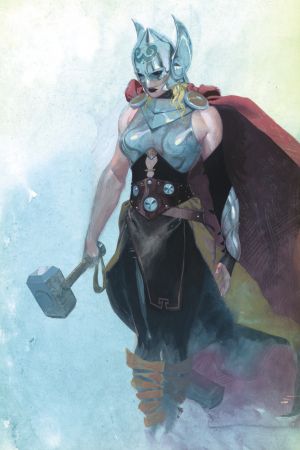
Part of why I'm interested is the backlash to the new female Thor, who looks like this.

THOR! (This is my daughter)

Oh wait, actually more like this.


The article then provided fodder for people wanting to argue not just that female warriors were artistically permissible (because everything is artistically permissible), but supported by historical evidence. It's part of the much bigger conversation about diversity in speculative fiction

Unfortunately, the evidence, which comes from this study (you will need a good library to access it), doesn't support the headline. The blog "Missed in History Class," provides an excellent summary of the actual findings, as does this comment to the original post, and this by Kate Wiles.

Here are the takeaway points, as far as I am concerned.

1. I was skeptical of the Tor article, and thought - I suspect that if I dug into the original evidence, I'd find that we have a better idea of biological sex balance of the overall early Viking population in England, but that the "warrior" claim is not especially supported by available evidence - because that evidence is going to be fragmentary and limited in what it reveals (as is the nature of such archaeological work, as vital as it is).

2. I didn't want to be the grumpy historian mansplaining away Viking women warriors, so I let it go. More importantly ...

3. The actual evidence is REALLY COOL and here are things worth knowing. Common wisdom suggests that the initial wave of Viking invaders of Britain were almost all men. Analysis of the bones (osteoarchaeology) of 13 first-wave Vikings shows 7 men and 6 women. That common wisdom must be questioned, as then must the narrative that the first-wave was a bunch of raiders, rather than colonizers. This is good stuff, well worth thinking about. 

Also, we learn that using grave goods to determine biological sex is bad methodology (archaeologists already knew this, by the way). Bodies with jewelry are not necessarily female. Bodies with weapons are not necessarily male. But in the 19th and early 20th centuries, such assumptions were routinely made. Bones are a much better way of determining biological sex, and there have been women found with weapons. Being buried with a weapon doesn't mean that the woman fought with the weapon, but at least it shows its culturally a possibility.

4. Given the quote with which I opened above, we actually already knew that. There is lots and lots of textual evidence for a tradition of women warriors in pre-Christian Scandinavian culture. Notice that Grammaticus (who lived in the 12th century), who we believe worked for an Archbishop of Denmark, is writing about this as a distant past tradition. 

5. If you have time, you could go read Book 7 and skip down find the word "Alfhild." It's a great story, suitable for Disney, in that we've got a beautiful princess whose parents are so screwed up that her dad locks her in a room with snakes, and when Alf the suitor defeats the snakes, her mom convinced her not to trust Alf. Alfhild runs away and becomes an awesome pirate. Later, Alf's ship and Alfhild's ship encounter each other in battle. Alf is winning, but then Alfhild's helmet gets struck off and so he either - sweeps her into his arms and kisses her and they all live happily ever after; or, he rapes her then marries her and they all live ever after. 

This is not atypical of medieval women-warrior narratives. One of my favorites is the Romance of Silence. Silence is a woman who puts on armor, goes to court, the queen falls in love with the beautiful young warrior, Silence demures, the queen gets mad and talks to the king, and Silence is sent off on a hopeless quest to capture Merlin. Merlin, it is said, "can be defeated by no man" (yes, echoes of Tolkein. He was a medievalist). When Silence meets Merlin, Merlin laughs and laughs and they all head back to court, tell the king about his treacherous wife, and so the king marries Silence instead. Silence ends the story, like Alfhild, in a dress. Gender norms are restored. 

6. I understand the current debates among fiction writers focused on whether the Middle Ages were mostly homogenous or quite diverse. My attitude is that it depends where you look, and that they were both homogenous and diverse. The stakes, though, are whether authors who do not write with characters diverse in race, gender, religion, etc. can say, "I'm just being accurate!" The stakes are whether people who introduce diversity into medieval western settings, which thanks to Tolkein (and now GRRM) is really common, can be criticized for being inaccurate. My attitude is generally this - write whatever story you want, understand that the choices you make about diversity have consequences, and that they are choices. History is not a straitjacket for fantasy.

We can have a conversation about historical fiction another day. 

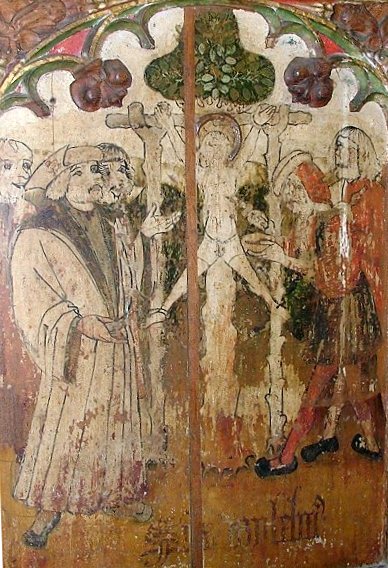
The Blood Libel: Medieval England and Hamas last week.

Crucifixion of William of Norwich,
Holy Trinity church, Loddon, Norfolk
As a historian, I work on narrative, memory, and myth. I'm interested in how people respond to events by creating new stories or re-interpreting old ones, applying a narrative lens to the world around them. I have a specific focus on the 13th-century Mediterranean, but I believe my interest transcends period and place. I think that the stories we tell are at least as important as the things we do, because story shapes action. That's why I'm a historian.

Here's a very grim piece on the "blood libel" myth and how it's being used today.

As detailed in the article, it's a medieval myth that Jews murder children and use their blood to bake into matzoh. It's often been used to justify violence against Jews over the centuries, after it emerged in medieval Norwich. I remember teaching the myth to my students once and their response was, "oh my god, this is true!" I quickly told them no, but somehow it seemed plausible to some. It's had a kind of power that resonates far, far, beyond its original context, being twisted and re-used for each new moment in which hatred of the Jews seems useful.

I was distressed to read the following [my emphasis]:
Last week a video of Hamas spokesman Osama Hamdan emerged in which he claimed that Jews use the blood of non-Jewish children to make matzo for Passover.
The translation of Hamdan’s interview with the Lebanese television station Al-Quds on July 28 reports him as saying:
"We all remember how the Jews used to slaughter Christians, in order to mix their blood in their holy matzos. This is not a figment of imagination or something taken from a film. It is a fact, acknowledged by their own books and by historical evidence. It happened everywhere, here and there."
When confronted about his statements by CNN's Wolf Blitzer on Monday, Hamdan did not retract his claim or distance himself from the blood libel slur. His only defense was that he “has Jewish friends."
So there's the blood libel, presented as simple fact. I wouldn't be surprised if this spokesman is also a Holocaust denier, as that tends to go with the other positions as well, but I don't know.

The thing that is undeniably true in his statement, though, is that many people do remember the blood libel. Memory lies, moves, shifts, warps, twists, reshapes, and emerges again at unexpected moments. People remember and they believe that what they remember must be true. And of course, from "remember" to "fact" on a station called al Quds, the Arabic name for Jerusalem, and today a name that symbolizes the Islamic claim to ownership over the city.

Sure, Hamdan might be lying just to score rhetorical points on Lebanese television, but at least some of the people to whom he speaks will not know that, or will not want to know that. They will believe because believing works for them at this time.

I am very critical of the Israeli assault on Gaza. I don't want that critique, however, to override the awfulness of antisemitism or the way that Hamas, already a organization dedicated to hate, is using this moment to intensify the hatred of the Jews in the region and the world.

These are dangerous times.  Here's what Ross and Baden write:
As Osama al-Baz, an adviser to former Egyptian President Hosni Mubarak, observed in 2013, some “Arab writers and media figures … attack Jews on the basis of … racist fallacies and myths that originated in Europe.”
Hamas may be doing no more than repeating tired cultural clichés and long-debunked slander, but myth and action go together. The history of Europe is a testimony to the devastating power of the blood libel.
People and cultures are defined by the myths they create, but also by the myths they accept and propagate.
From myth to action. Obviously, actions matter a lot. But the stories we tell, the myths we create and spread, they have intense power to motivate us for good and for ill.

And in the story of the blood libel, no one gets out alive.

Something Old, Something New - The Medieval and Modern War on Women


“I respect you very much as a woman for your accomplishments. I even read that you studied medieval history, which I think will come in handy with trying to defend the Republican war on women.”
Liberal Radio Host Stephanie Miller to Carly Fiorina, failed Republican Senate Candiate, on CNN State of the Union, 7/6/2014.

On CNN last Sunday, Stephanie Miller used Fiorina’s degree in medieval history and philosophy from Stanford as an easy way to score a rhetorical point. Miller argued that the Republicans, especially in their views on women, are medieval, and medieval things, as everyone knows, are bad.

This idea that the Middle Ages were especially backwards doesn’t really hold up to close analysis, but it’s a pretty pervasive myth and I’m not surprised to see Miller use it. In fact, Fiorina has used that kind of language as well. In a keynote address in 2000, she labeled ignorant government regulators as medieval and celebrated cutting-edge tech companies as the heroes of the Renaissance.  

This is, of course, nonsense. 

The kinds of regulations to which Fiorina objects are a product of the development the modern state and economy. The heroes of the Renaissance frequently served tyrants in an era of terrible war and strife, though they produce beautiful art in a time of chaos, disease, and religious strife.

Despite this, if we take Miller seriously and think about what the study of the Middle Ages might tell us about gender discrimination, patriarchy, and health care in the wake of the Hobby Lobby decision, we might make two arguments. First, knowing about the past in fact does come in handy when trying to understand the present. Second, one of the things the past reveals is that dangerous parts of the war on women are very modern.

Let’s start with a medieval story about women and healthcare.

14th-c drawing meant to depict "Trotula,"
a female doctor. Miscellanea medica XVIII
Wellcome Library, London. CC-zero
In 1322, the all-male medical faculty of the University of Paris took Jacoba Felice to court for practicing medicine without a license. At trial, witness after witness attested to her skill and denied that she had ever asked for payment. The court nevertheless found her guilty and ordered her to refrain from practicing medicine on pain of fine and excommunication.

On the surface, this looks like a classic example of medieval patriarchy at work.  But if the Middle Ages last from 500 to 1500 or so (and some scholars would end the medieval much earlier), 1322 is actually pretty late in the period. This is important because it shows that the specific issues in 14th-century Paris are new. 

Before that point, the men and women of the city had trusted Felice, investing her with social capital, although that didn’t help her in the face of the law. After this, male doctors increasingly worked to ban women from practicing medicine solely on the basis of their gender. In fact, according to Monica Green,   Professor of History at Arizona State University, Felice’s case may have sparked the physicians’ practice of applying gender-based barriers to the profession, since competency was harder to argue (Felice being supremely competent).

A modern analyst could use the case to inform either right-wing or left-wing arguments. On the one hand, it’s a kind of overreach of regulation that served the vested interests of male physicians who felt threatened by Felice’s competition. On the other, the case features a corporate body (the medical faculty) that used the courts and the church to enforce gender norms and restrict women’s access to quality healthcare. In the wake of the Hobby Lobby decision, that latter analysis does seem especially relevant, even if it’s not one Fiorina would make. 

Beyond the relatively narrow confines of medicine, the story of Felice also says a lot about the power of the state and what happens when that power is leveraged to reinforce gender or religious norms. The “state,” as we know the term, really begins to take shape in what we call the “early modern” period (starting around 1500, more or less), but we can see the roots in moments like the trial of Felice.

On the other hand, at its height, the pre-modern state had nothing like the kind of power that the weakest government can exercise today. The richest men or groups had nothing like the kind of wealth that corporations and plutocrats hold. The medical profession may have achieved power over credentials, but the knowledge and invasive possibilities of medicine today would have seemed largely inconceivable to the pre-modern physician.

At the core, Hobby Lobby’s arguments against providing contraceptive care do reflect older Christian ideas about gender, religion, and power. They are dangerous not because they are old, however, but because of the intrusive power of modern technology to peer into our most intimate lives. They are dangerous because of the control that corporations have over their worker’s health, a truly bizarre accident of 20th-century American labor history. They are especially dangerous because of the vast wealth leveraged by powerful conservative men who want to enshrine their religious views into law.

This is a modern battle as we decide what kind of country we want this to be. We resist the forces behind the Hobby Lobby decision not by mocking them for being antiquated, but through the ballot box, the courts, public opinion, and even the ultra-modern tool of internet-organized consumer boycotts.

On CNN, Miller’s quip suggested that patriarchy, gender repression, and even would-be theocracy are problems of the past, that the “war-on-women” is some kind of throwback to a barbaric and long-past age.

If only that were true.


Sunday Roundup - All the News from Adjunct to Australia

It was a very good writing week for me. I pitched four columns, landed three, one of which came out immediately. I also wrote a first-draft treatment of a book (more on this later once it's ready). Most fun, I did an interview and part of  a call-in show with an Australian radio program! You can listen to it here.

My column was "The Most Interesting Adjunct in the World." The story of the Santa Clara Adjunct got lots of press when it happened. I saw it first here on Rebecca Schuman's blog as it emerged out of adjunct-related chat on Twitter. Within a few hours, the story moved quickly. Here's a piece from Vitae, but there are of other links, many citing my good friend Rick Gooden's tweets on the subject. Yesterday, driving out to a gig at a pub, the great Peter Sagal on Wait-Wait Don't Tell Me used it as a news item for a final question.

For those who missed the story, the short version is:
The posting, for an adjunct-lecturer slot at Santa Clara University, required applicants to have published at least 25 books, through top presses, on highly specific but varied topics; worked as a journalist; hosted radio and TV productions; founded startups; cultivated connections at Oxford University and throughout the Bay Area; and, perhaps most importantly, have some experience as a teacher.
TWENTY FIVE BOOKS. Ok, well, it turns out they were trying to hire a specific person. This is a fairly normal practice, but not usually in Adjunct Land. I was pleased, therefore, to write what I call a "next day" analysis piece (I was, I think, the person who alerted the Santa Clara PR director to the issue, as she was startled when I talked to her on the phone).

Here are some points from the column.

I am not opposed to inside hires in principle. Bifurcated job ads can be, however, a warning sign for a divided department. I wrote:
Tailoring job listings to internal candidates is a well-known practice, and inside hires are not necessarily a bad thing. I hear people complain that this type of hiring leads to departments settling for known quantities instead of pursuing excellence, but that’s not really my sense of things. The pursuit of prestige-laden superstars marks much of what is wrong at the top echelon of academic hiring, in which a few people get marked as geniuses and soak up enormous resources that might be more equitably distributed among many merely brilliant scholars and teachers. My experience is that the academic world is filled with smart scholars and good teachers, and if you have one who is doing a good job with your students, it’s reasonable to hire her. 
What's unusual is to see the language come to adjunct land. It reflects, perhaps, the normalization of adjunct labor as a central component to the higher education landscape, demanding an organized response from all of us, as I have written before. Adjuncts are not "adjunct" to our universities.

Along with my interview, I talked about fatherhood in other contexts. I need to get better about marketing myself as a fatherhood writer, because today is apparently Father's Day and I am not doing anything professional. I did pitch a column that didn't get picked up, which is fine and normal, then did other things. The use of the word "marketing" and "myself" makes me deeply uncomfortable. I am a terrible capitalist.

I wrote about the "Dads are incompetent" theme in our culture and what it says, as well as a longer piece about parenting against the grain, "Just say no to pink." I got plenty of pushback on that one, probably deserved, for coming off as femme-phobic. I'll have to keep working on how to articulate my agenda and using "pink" as metonymy clearly won't work. It distracts rather than helps. Maybe "Princess-culture?"

Other pieces were:

Thanks for reading. Please always point out mistakes I make and other things I might want to read.


Cult of Compliance: Attacking the Breasts of Female Protestors

At New Criticals, Alison Kinney has written a powerful piece comparing police violence against suffragists to the police violence against Occupy activist Cecily McMillan.

She starts with this story:
"Constables and plain-clothes men who were in the crowd passed their arms round me from the back and clutched hold of my breasts in as public a manner as possible, and men in the crowd followed their example...”
 The anonymous woman who reported these acts of police brutality was one of 300 British suffragists peacefully marching before the House of Commons on November 18, 1910. Journalist Henry Noel Brailsford and Dr. Jessie Murray took 135 statements from activists and eyewitnesses describing how police beat the suffragists with batons, punched, kicked, dragged, choked, stripped, and sexually assaulted them...Brailsford and Murray wrote:
“The action of which the most frequent complaint is made is variously described as twisting round, pinching, screwing, nipping, or wringing the breast. This was often done in the most public way so as to inflict the most humiliation…The language used by some of the police while performing this action proves that it was consciously sensual.”
At least two women died because of this six-hour campaign of police brutality, now known as Black Friday.
Kinney moves through other examples and popular reaction  to the suffrage movement, noting sexualized violence from both "the public" and agents of the state, comparing to McMillan's experience, then writing what I think is so important [my emphasis]:
Once a social justice movement, like women’s suffrage, has succeeded in enshrining its goals in law and social acceptance, it is all too easy to dismiss the state violence against it as a relic of less enlightened times. But such violence often looks the same with each recurrence: wildly disproportionate; reifying racial, gender, class, and other biases; and trampling civil liberties. The rhetoric also looks similar, delegitimizing activism as frivolously idealistic, a distraction from “real” issues, and, simultaneously, dangerously irresponsible. The word “violent” has a sneaky way of attaching to protest, even—perhaps especially—when the protesters are the ones being bloodied; state violence, on the other hand, is supposed to be hygienic, orderly, responsible, sane, and necessary.
One of my questions about what I term the cult of compliance is the extent to which it is a product of our historical moment or an indelible aspect of the relationship between the state and its subjects. I'm an optimist, I want to believe that we can improve, that we can make things better. I'm also an historian, though, so it's hard to ignore this kind of evidence as coming out of a fundamental place in the structures of our society in its reactions to protesters in general and women specifically.


I do think there are specific authoritarian strains our society that have intensified since 9/11 and manifest in the compliance activities I chronicle on this site. I also am sure that technology - our easy access to video and photo - means that we record and disseminate events that otherwise would be ignored or turn into one person's word against another (a situation in which the state controls the permanent record of "truth," all too often).

In the meantime, used war gear is flowing to police departments at an unprecedented rate as the war in Afganistan winds down. They're going to want to use this stuff.
The equipment has been added to the armories of police departments that already look and act like military units. Police SWAT teams are now deployed tens of thousands of times each year, increasingly for routine jobs.Masked, heavily armed police officers in Louisiana raided a nightclub in 2006 as part of a liquor inspection. In Florida in 2010, officers in SWAT gear and with guns drawn carried out raids on barbershops that mostly led only to charges of “barbering without a license.”
So, now you can get your haircut safely. Do not, however, try to protest against the government.

Going Public - A Medievalist on CNN.com

I've been at the 49th International Congress on Medieval Studies, held annually at Western Michigan University in Kalamazoo, MI. It's an extraordinary event - over 3000 medievalists come to this small town and lovely campus and, over four days, work on everything from the most micro-specialized topic to giant sweeping questions about the academy and the nature of knowledge. Often followed by merriment and music.

I spoke at a session on writing about the Middle Ages for multiple audiences. Ellen Arnold, Ohio Wesleyan,  spoke about the extraordinarily creative assignments she's given to her students (creating pop-up physical and virtual museums, for example). Matthew Gabriele, Virginia Tech, revealed to us the mysteries of the sub-reddit "Ask Historians." Laura Saetveit Miles, Univ. Bergen, talked about being a feminist and medievalist in future public writing.

I talked about being a medievalist on CNN.com - how it happened and why it mattered. Below is a version of my remarks with some supporting links and some of the images.

-------------------------------------------

GOING PUBLIC

I’m here to talk about my experience writing about the Middle Ages for mass media. I’m not a popular historian – in the sense of writing about my subject field for a general audience. Instead, I write popular essays for places like CNN, the Chronicle and the Atlantic some of which are about the intersections between the Middle Ages and now. I see these intersections everywhere.

I began by writing about the medieval echoes at play in Benedict’s surprise resignation and the intentional medievalism of Pope Francis – I often say to my students that the church is firmly in a 13th-century moment. I’m going to tell you a little bit about how that happened, what I wrote and why, and then shift to current events. But first what I really want to say is this:

As medievalists, as intellectuals, you have authority to weigh into public conversations. To the extent possible, to the extent that you can find a platform, to the extent that you feel safe – I think you should do it.

*

In February of 2013 Pope Benedict retired abruptly. He announced it in Latin, and an Italian Vatican reporter who happened to know Latin broke the news to the world. Go Latin! In general, it caught the media off-guard, media platforms were looking for content, and the content quickly turned to the medieval. Reporters were asking questions about whether Popes had ever retired before, how does papal retirement work, what comes next, what’s the canon law on the subject, and so forth. For a few weeks, medieval history was hot.

A lot of the commentary focused on Pope Gregory XII, who was indeed the last to retire, but who did so in the context of the fifteenth-century Council of Constance as part of a deal to get two anti-popes deposed, Gregory to retire, and a new legitimate Pope elected to unify the church. Hardly analogous to Benedict. I started looking at the late 13th-century canon law on the subject [all before breakfast], much of which was organized by the man who became Boniface VIII. Boniface became pope after his predecessor, Pope Celestine V retired in order to return to a life of contemplation.

Why does this medieval history matter today? Well, Benedict’s statement announcing his retirement echoed Celestine’s own bull of retirement. Benedict visited Celestine’s shrine twice as Pope. Benedict and Celestine are even featured on the wall of the church in L’Aquila.


Given the clear impact that Celestine’s example had provided for Benedict, I had an easy medieval story to write, and I wrote it for CNN.

Over the next few weeks, I kept writing in the run-up to the conclave, after Francis was elected, and even throughout the first few months of his papacy. I felt that a lot of reporters were mis-reading Francis’ early statements. It turns out that my PhD in medieval history makes me a good interpreter of papal texts; go figure.

I used these writing opportunities, as much as possible, to educate readers about the Middle Ages.

Here’s my favorite example – an essay in which I suggested ways to think about the upcoming papal election, but in which I really wanted to say that voting is medieval. Medieval people, as you all know, loved making groups, writing bylaws, and voting for stuff. They did it all the time. The College of Cardinals, no less than a faculty senate, offers a direct continuation of that tradition of medieval voting.

These are the kinds of stories that I think we can, and again as possible, should all write. We all have these moments that we observe a relationship between our scholarly subjects and modern conversations, whether about politics, religion, the environment, or culture. I’ve become an evangelist for writing local op-eds, national pieces, blogging, talking to school groups, participating in library reading groups, anything that might combat myths about the Middle Ages, get our perspective out of academia and into broader discourse.

Here is where current events take over my talk. I had planned to speak about the institutional challenges facing academics who want to do public engagement – namely; that our professions don’t see it as something that counts.

But then something happened that drove me to write a very different kind of piece about the Middle Ages.


There’s Sarah Palin at the 2014 NRA convention. She made an incredible speech. I’ve watched it many many times in whole and in part, and few demagogues in history could do much better. She knows her audience. She owns them.

The minute I heard these words – waterboarding is how we baptize terrorists – I started thinking about forced baptisms in both Visigothic and late medieval Spain, Saxony under Charlemagne, and in the context of massacres after the First Crusade and during the Black Death. I remembered Palin’s invocation of “Blood libel” after Representative Giffords was shot. So here was an extraordinary thing – a modern demagogue claiming the traditions of both Christian persecutor and victim.

I decided that this situation really did call for a medievalist.

This piece was published last Thursday, on May 1. I want to point out a few features of how I wrote about the Middle Ages.

First, I explicitly claimed my authority as an historian.

I quoted an episode on forced baptism from the Chronicle of Mathias of Neuenberg – a reference I actually chose from a Facebook thread I started on forced baptisms in medieval history. And hey, whatever you think of Sarah Palin, getting 14th century German chronicles time on CNN.com is pretty cool, right?

I described the ways she evoked both fear and dominance in her audience, making them afraid on the one hand, claiming absolute moral authority on the other, and assuring them that with the proper weapons, they could safe. In followup blog posts, I would describe her language as a form of militant Christianity.

I then looked back on her use of “blood libel,” which I defined as a medieval myth, as evidence of her consistent pattern of wanting to be both the unjustly victimized Chosen people and the Christian triumphalist. That rhetorical move is very familiar to medievalists who study the Crusades, for example.

I ended with a nod to apocalyptic thought, a subtext I see running throughout her work.

In my reading, Sarah Palin’s medievalism is evident throughout this speech and her speeches and writing over the years. Throughout, she echoes some of the worst moments in medieval history.

*

I’m a little nervous about showing you this, here, at Kalamazoo. More nervous than I was about writing it in some ways, because you are my peers. This is not a political conference and I know many of you won’t agree with my take. Moreover, I’m not just being an educator in this piece. I’m not just revealing the ways in which medieval history informs modern events. I’m not acting as a professor in public. I've left the safe spaces behind.

No, in this piece for CNN I am using my status and knowledge as a medieval historian to make an explicitly political argument that a modern politician is dangerous.

Here’s the thing.

I think she’s dangerous.

Moreover, it is my knowledge of the medieval past that has led me to that conclusion. What is our obligation to society as scholars when we draw such conclusions? What is one to do with such a thought other than to share it?

I’m not here to try to persuade you to adopt my politics, but I am here to say that our historical knowledge gives us a perspective that is valuable and usually missing in public discourse. Our status as academics, for all intellectualism can be derided, gives us entry into local and national conversations.

You have the authority to weigh in.

Please use it responsibly.

Thank you.