Showing posts with label hold mode. Show all posts

SF Bay to Tahoe in an i3 REx: What was learned?

IMG_20141018_151716-M.jpg
Donner Summit is the highest point along Interstate 80 in California at 7,228 feet elevation.
Last week we heard from i3 REx owner John Higham in a post he wrote which detailed his thoughts on the i3's range extender restrictions for the North American market. John certainly didn't mince words and offered his reasoning why he believes the range extender on the i3 should have its artificial restrictions (which are in place to satisfy CARB), relaxed a bit. John also promised to do a road trip which would take him from the San Francisco Bay area up to the 7,228ft Donner Summit in Lake Tahoe and report on the range extender's performance under these strenuous conditions. Below are his findings.

SF Bay to Tahoe by the Numbers, Part 2

Nailed it.  Well, nearly.

In Part 1 of this post about all things REx, I declared that a US spec BMW i3 REx could not make the popular weekend getaway of Lake Tahoe from the San Francisco Bay area without being speed limited within 15 miles of Sacramento. How speed limited depended on the slope of the road as you climbed east into the mountains, but top speed would range from 40 to 55 MPH. The alternative was to fully charge in Sacramento before any significant climbing begins and then again in Colfax about halfway up the hill. This makes such a drive impractical.

I also declared that a European spec’d i3 would make it no problem, so long as one kept the diminutive 1.9 gallon tank filled and the feature known as “Hold Mode” engaged. In fact, European cars have made similar drives into the Alps.

The basis of these declarations is simple physics. In Part 2 we test the physics from Part 1.Twice. First with a U.S. spec BMW i3 REx and then with a European spec i3 REx.

OK, I lied. I don't have a European spec i3. But I do have a US spec i3 that has been modified to behave like its schnitzel eating cousin.
I drive the BMW i3 from my home in Mountain View, California to Donner Memorial Park in Truckee.  The state park is placed at one of the sites where the ill-fated Donner Party settled for the winter in 1846.  The snow that winter was as high as the memorial behind the i3.


A Quick Summary of Part 1

The California Air Resources Board (CARB) developed a class of car called the Battery extended range Electric Vehicle (BEVx). Some say the BEVx was never intended to be a car with mass appeal that can be driven like any ICE-mobile.  But I ask, why not? Actually, what I usually say is “Why the hell not!” while shouting and pounding the table with my fist. I digress.
I believe that the BEVx class of cars represents the bridge from plain ol' Internal Combustion Engine (ICE) cars to pure electric that will finally allow the public to embrace EVs without looking back. Except.

There is one teensy exception and it is what engineers call a "corner case." In this situation the “corner case” refers to those people who require a car to maintain freeway speeds over sustained elevation gains. That’s what this post is all about -- to test how big that corner case actually is.

California's San Francisco Bay Area lies at sea level and the drive east to Lake Tahoe follows the Sacramento river, never gaining significant altitude for about 50 to 100 miles, depending on one's starting location. Continuing east past the capital of Sacramento begins what is at first a gentle climb into Gold Country. Assuming the route is along I-80, the slope increases significantly past Gold Country until Donner Summit (elevation 7,228 feet) is reached 95 miles east of Sacramento.

The i3's APU is sized such that it can maintain freeway speeds, but not to maintain freeway speeds and simultaneously gain significant altitude.  It’s simply not possible to drive from the SF Bay Area to Tahoe in a reasonable amount of time with the US spec’d i3. Of course if you have the patience to charge every 60 to 80 miles, you can drive your i3 from the Bay Area to Tahoe or anywhere else for that matter. But that is impractical, even with with so-called fast chargers.

Since this post comes in two parts, and the test drive to Tahoe also comes in two parts, potential for confusion exists when referring to them.  Let’s dispatch any confusion and call the first test The Apple Pie Test and the second test The Lederhosen Test.

The purpose of these tests isn’t to prove you can drive an i3 to Tahoe by taking logical opportunities to charge. You can. It’s been done. The purpose is to prove the assertions made in Part 1. First, that the US spec’d i3 REx is hobbled as compared to its European counterpart and second (and more importantly) that an i3 REx is more than a great EV; it has potential to be the only car you need.

Oh yeah. No math in this post. I promise.


The Apple Pie Test

The Apple Pie Test is simple: try to “REx it” to Tahoe and see how far you get. (Oh, I’ve made REx a verb, but the Oxford dictionary hasn't caught up yet.) Since this is my test, I get to make up the rules. The rule is simply to take a BMW i3 as CARB intended it to be delivered to the public and drive it along I-80 until the car becomes speed limited, then compare the observed results with the predicted results from Part 1.

To do this test I left the Benicia, California, CCS fast-charger with 90% SOC and a predicted range of 60 miles.  The drive toward the Tahoe region is essentially flat for about 63 miles along I-80, then the road climbs into the Sierra Nevada mountains. I planned this section of the drive to be all electric until such time I hit the foothills. The goal was to set the cruise control to the posted speed limit (65 MPH) and simply keep driving powered by the REx until the car became speed limited.

In Part 1 I calculated that the car would become speed limited at about 725 feet elevation gain and by using the elevation profile in Google Earth, I estimated that would occur about 12 miles east of Sacramento.

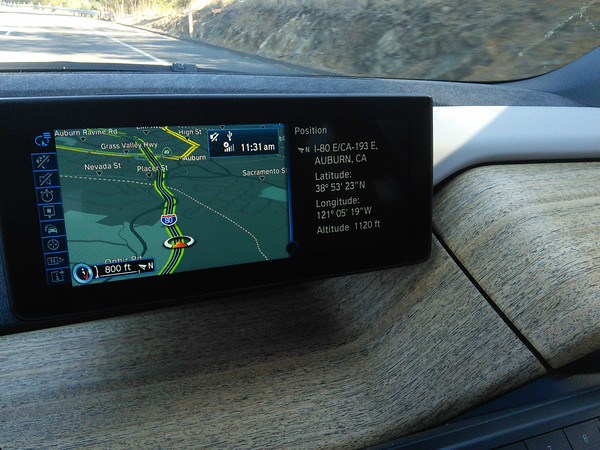
The actual drive didn’t work out exactly like that, but close enough for the rough assumptions that were made. At first the speed limitation was subtle. I started to suspect the car was speed limited at around 800 feet elevation (750 gained), “flooring it" to coerce an increase from 65 MPH with the cruise control set, I achieved about 67 or 68 but no more. But by 950 feet elevation gain the effect was no longer subtle. Not only could I no longer keep pace with traffic, but was feeling very vulnerable and was searching for an exit in earnest. On some of the steeper portions of that section I was under 55 MPH indicated with traffic whizzing past at 70 MPH and above.
IMG_20141018_113048-M.jpg
The BMW i3 was clearly speed limited on this section of road after leaving Sacramento powered solely on the REx

IMG_20141018_113054-M.jpg
This photo was snapped moments after the previous photo

Anyone who has owned a BMW for very long can tell you that the speedometers are optimistic by at least 5%, if not 7%. So, that 58 MPH in the photo is closer to an actual speed of 55 MPH.  In Part 1 of this post I made a table of predicted top speed as a function of the grade of the road. Using the GPS coordinates of the road and Google Earth, I found the grade of the road at the precise point is 3%; the table from Part 1 predicts a top speed of 60 MPH on a 3% grade; close, but some refinement of that table is in order.

In summary, the Apple Pie Test demonstrated that all that analysis, the calculations, graphs and so forth from Part 1 were within the margin of error that could be expected for the rough assumptions that were made.  

More importantly, It proves that you can’t just REx it to Lake Tahoe in an i3. Luckily, there is a CCS charger in Sacramento, so moments after the above photos were taken I turned around and headed straight for it. With the miracle of regeneration the i3 got its SOC back up to a respectable level and I REx’d it all the way back to that CCS charger with no issues.


Hold Mode and Coding

The Lederhosen Test requires the use of a feature known as “Hold Mode”, which is on all Euro-spec i3 equipped with the REx; perhaps even all such cars destined for anywhere in the world outside of North America. What Hold Mode does is engage the REx (or more specifically in CARB-speak the APU) to maintain the battery State of Charge (SOC). Sounds a bit boring and perhaps it is.

The fact of the matter is, US spec’d cars have Hold Mode; the car’s onboard intelligence switches it on automatically when the battery SOC reaches 6.5%. The European version of the car also will switch on Hold Mode automatically when the battery SOC reaches 6.5%, but the European version also allows the driver to manually engage Hold Mode whenever the battery SOC is 75% or less.

The difference in the US spec’d car and its European counterpart is perhaps subtle, but as we shall see, the difference means everything if you require a car to maintain freeways speeds and gain significant elevation simultaneously.

What is important here is to understand that the US-spec cars do in fact have the European-spec Hold Mode programmed into the car.  The menu option that allows the driver to engage Hold Mode manually is simply hidden from the i3’s iDrive menu. For someone skilled in the seedy underbelly of the BMW tuner world known as “coding,” enabling this hidden feature in the iDrive menu is trivial.  To be clear, this practice is most likely frowned upon by both BMW NA and CARB.

To satisfy scientific curiosity, I “coded” my i3 to enable Hold Mode, Euro-style. On to the Lederhosen Test!    (click through this link to read about how to code your i3: Code your i3)


The Lederhosen Test

As noted in the last paragraph of the Apple Pie Test, as soon as I became speed-limited near Auburn, I turned around and returned to Sacramento and specifically to the CCS fast charger there. After plugging in and after i3’s SOC had reached 90%, I once again set out along the same route toward my final destination in Truckee, California, near Lake Tahoe. Hold Mode is only available if the SOC is 75% or less, so after leaving the CCS charger I drove the first 12 or 13 miles all electric.


IMG_20141018_122036-M.jpg
The CCS fast-charger in Sacramento in Sacramento is at an elevation of 50 feet.

The only difference in the two drives was the SOC at the bottom of the hill and manually engaging Hold Mode. This simply means the REx was used in the Apple Pie Test to “hold” a 6.5% SOC but on the Lederhosen Test, it was used to “hold” a 75% SOC.
IMG_20141018_131052-M.jpg
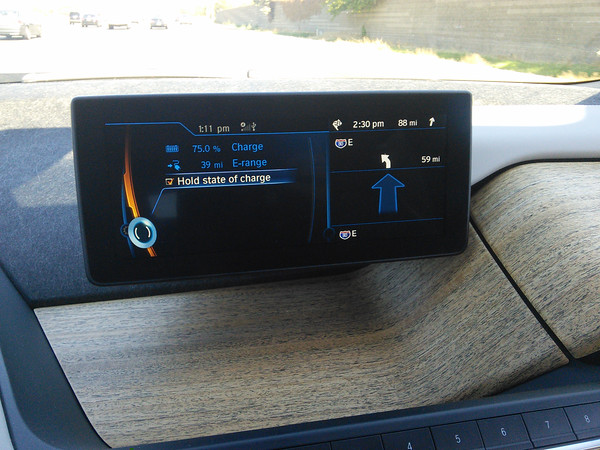
Engaging Hold Mode at 75%.  Note there are 88 miles to my destination, with 39 miles of all-electric range available.  

In Part 1 of this post I calculated that by engaging Hold Mode at 75% SOC the i3 should be able to climb essentially any mountain pass in North America, so long as one keeps the gas tank filled. What isn’t visible in the photo above is that Donner Pass, a 7,228 foot climb, is between me and my destination; it is time to put my hypothesis from Part 1 to the test.

With Hold Mode engaged, as one drives the i3 the REx keeps the battery SOC constant at the level set.  If driving conditions are such that the REx (due to its limited power output) cannot keep the battery SOC maintained, then energy from the battery makes up the difference and the battery SOC falls commensurately.

Soon after leaving the CCS charger in Sacramento and engaging Hold Mode at 75% SOC I found myself once again in Auburn near where I had turned around just 90 minutes earlier during the Apple Pie Test.  It was time for a lunch stop.

IMG_20141018_140702-M.jpg
As expected the battery SOC falls as elevation is gained
The photo above was taken at my lunch stop in Auburn. Note that the SOC has fallen 4% to 71% at 1210 feet elevation (1160 feet of gain).  If I had stopped the car and let the REx run sufficiently long, the SOC would have returned to 75%. But that would have both taken time I didn’t want to spend and defeated the purpose of the Lederhosen Test. So, after a quick bite to eat I got back in the car and re-engaged Hold Mode at 71% SOC.

Leaving Auburn, I resumed toward my destination of Donner Memorial State Park 65 miles away in Truckee, California. The only thing between me and my destination was Donner Pass at 7228 feet, one more stop for gasoline, and the potential to run out of battery. But I had done my homework and was confident that I had plenty of energy left in the battery to complete my drive.

It was the perfect day for such a drive; the sky was a beautiful blue, the temperature was in the mid 70’s, the traffic light and SiriusXM’s Classic Vinyl accompanied me. During the drive I took pictures of the i3’s displays every 1,000 feet of elevation gain, but suffice it to say that the battery SOC slowly dropped in an expected and predictable fashion as I glided up the mountain's slope. After 45 minutes or so I once again stopped to top off the fuel tank.
IMG_20141018_144840-M.jpg
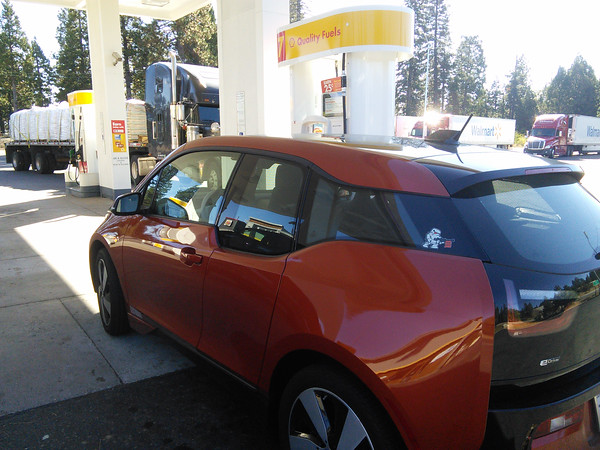
The i3’s other “fast charge” port.  I don’t like to use this method of adding energy, but sometimes a guy’s gotta do what a guy’s gotta do.
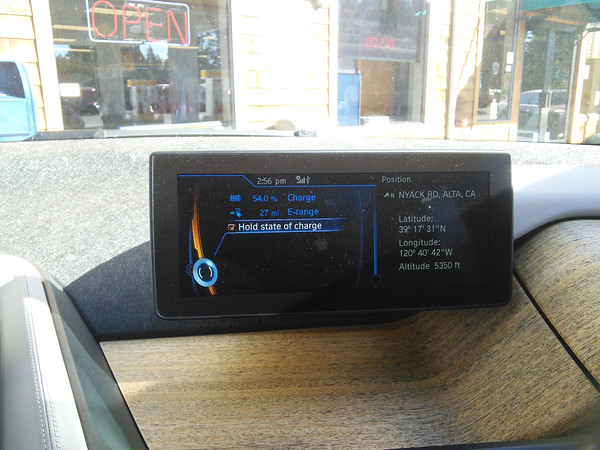
IMG_20141018_145546-M.jpg
The battery SOC has fallen from 75% to 54% after climbing 5300 feet.

After refueling, Donner Summit was less than 30 minutes away. I found myself so absorbed in monitoring the progress of the battery SOC prediction that I nearly blew past the sign marking the summit! 
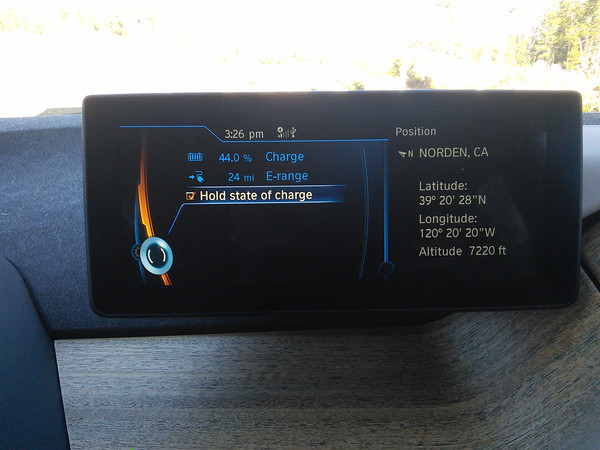
IMG_20141018_152622-M.jpg
The i3, with Hold Mode engaged, used a mere 31% (75% at the bottom of the hill less 44% at the summit) of its SOC to gain nearly 7,200 feet of elevation.  In simple terms, one can think of it as if the REx’s power output is used to propel the car forward, the battery’s power output is used to climb the hill.

By using less than a third of its battery to gain those 7,228 feet, the i3 REx is obviously capable of much more. In Part 1 I asserted that the i3 with the European-style Hold Mode was probably capable of summiting any road in North America. After making the drive over the Sierra Nevada’s I-80, I believe that point has been verified.


Summary

The i3 REx with the European-style Hold Mode is more than capable of conquering Donner Summit simply by engaging the feature at the beginning of the climb and keeping the tank filled.  The US spec i3 REx is not.  But the implications are far greater than this.

The entire thesis of this post and the previous one is much larger in scope than “can BMW’s i3 make the drive to Lake Tahoe.” The thesis is much more than the car or the corporation. It’s about an idea.  A brilliant idea.

It’s about a transitional electric vehicle that the public can embrace without looking back, without asterisks and without range anxiety. The embodiment of that transitional electric vehicle is the BEVx class; to date only one car is made to that standard. It’s a brilliant piece of engineering.  Yet that brilliant piece of engineering is emasculated by regulations imposed by a governing body that should be championing it.

I’m surprised that Sir Isaac Newton hasn’t leapt from his grave and set his hair on fire.

The use case I have been passionately trying to demonstrate, that the i3 is fully capable of, may be an inconsequential corner case for the majority of owners worldwide.  But it is a legitimate use case and one that the many buyers consider. And people buy to the corner case, especially if it is their only means of transportation.

Until such time that adding energy to an EV takes as much thought and effort as adding energy to an ICE-mobile, technologies like the BEVx are going to be required to get the public to embrace electric mobility.

If removing the restriction on the operation of the APU is not made, the genius of the BEVx classification will never bear fruit.  That’s because even though the average driver does less than 40 miles a day, they also want the flexibility to take their car wherever they want, whenever they want. For this reason, PHEVs are about as “electric” as the general public is willing to go.

Once the current limitation of the APU software managing the SOC is understood by the public, the public will eschew the BEVx classification for PHEVs, such as a Volt. While that may be a better choice for the environment than, say, a Camry, the Volt driver will not be able to drive as much on electricity as if he bought a BEVx, such as an i3.

That’s why I’m writing; to beg CARB to Unleash the REx. It’s been said that the PHEV is the gateway drug to a pure BEV. If that is so, the BEVx has the potential to be crack -- instantly addictive. Make it so.


Facts about my trip from Mtn. View -> Truckee -> Mtn. View
Left home with 100% SOC
528.2 miles round trip
246 miles on REx
6.6 gallons of gas purchased
Ended trip with about ½ gallon more gas in the tank then when I left
4.1 mi/kWh
4 CCS charging sessions totaling 62.8 kWh
0 Level 2 charging sessions
Arrived home on the REx (6.5% SOC)

BMW Working on a REx Upgrade to Increase Performance

The 650cc twin cylinder engine used in the i3 is borrowed from BMW's Motorrad division and modified for the REx

From the first word that the North American version of the i3 REx would have restrictions not found on its European counterpart, i3 enthusiasts and customers in the US and Canada have wondered how well it would work under strenuous driving conditions.

In fact, it is by far the topic I now get the most correspondence over. I have probably received over 100 emails through this blog from followers that want to know how well the range extender works and how capable it is. People want to know things like what speed the car can maintain in charge sustaining mode and for how many miles can the car maintain highway speeds on a certain percentage upgrade, and so on. I even have had people ask me if I could conduct specific tests with my car to confirm it can do what they need it to. The reason being is the 34hp REx engine can only deliver about 25kWs (although some reports say BMW upped it to 28kWs) of power. That is plenty of power for nearly all normal driving needs, but not enough for continued high speed or long upgrade driving. The problem then arises if you continue to consume more energy than the REx can deliver.
My i3 when the REx turns on. Notice the tiny little bar of electric reserve to the left of the triangle. That indicates the 6.5% SOC position where the REx initiates and tries to maintain. There isn't a lot of buffer there for strenuous driving conditions.

The root of the problem reverts back to BMW's desire to have the i3 REx certified a BEVx vehicle by the California Air Resource Board. This allows BMW to get the most ZEV credits per vehicle, and also allows the i3 REx to qualify for other perks, like sales tax exemption in New Jersey and Washington State. It also allows the owner to get the full $2,500 California CVRP rebate, unlike all other PHEVs which only get $1,500. However this came with a cost, one that everybody with an i3 REx from every state has to endure. BMW had to restrict the REx use to comply with CARB's BEVx classification. The European i3 REx can be manually turned on any time the state of charge is lower than 75%. This is called a Hold Mode and allows the driver to hold a higher state of charge and keep a higher battery buffer which they may need for continued strenuous driving conditions later in the journey. The North American version has no Hold Mode, and the range extender only comes on when the battery is reduced to a critically low 6.5%. For normal driving that is fine, but when really pressed for continued periods, the car cannot maintain full power.
The European i3 REx has a Hold Mode which allows the driver to manually turn on the range extender if they need to. This feature is disabled for North America and is that is the root of the problem.
This creates a problem when the driver needs to drive for an extended period which demands an energy draw of more than 25kWs. The meager 6.5% battery reserve can quickly deplete in these conditions. When this happens, the car goes into a reduced power mode and can only maintain a speed of about 40mph. To make matters even worse, the driver gets no warning and the car just slows down. This is not what you want happening to you when you are on a highway and cars are whizzing by you at 70mph. This is a real issue, and compounded by the problem that most BMW client advisers didn't know how to communicate this to the customers and sold them the cars without informing them how to properly operate the vehicle in REx mode. I've had people contact me that were completely unaware of how the range extender worked and said they were told by their client adviser that "the car can do anything in range extender mode as it can in all electric mode, it just doesn't have quite as much power." That isn't true, and many early i3 REx customers were disappointed when they found out they couldn't drive up that mountain to their summer home, for example. In fact, one the Born Electric guest bloggers here mentioned an instance where he went into reduced power mode with a car full of friends.  
Don Parsons of Denver, Colorado recently took his i3 REx to the summit of Mt Evans which is the highest elevation with paved road in the US. He did experience the REx reduced power mode, but it didn't stop him from completing the14,000 ft ascent to the summit. This, of course is about as taxing on the range extender as it gets!
All that said, I now have over 10,000 miles on my i3 REx and not once have I ever gone into reduced power mode, and I've actually tried to make it happen! The "problem" I'm having is the highways are relatively flat here in New Jersey and the REx can basically handle anything I give it. The times I have tried to make it happen the flow of traffic wasn't fast enough for me to maintain a speed of over 75mph for a long enough period. 75 mph on relatively flat ground seems to be the upper limit the REx can handle for continued driving. There is plenty of energy to go up and down the hills I routinely drive over, and also to have short bursts of power well past 80 mph for passing if needed in REx mode, so for me the car works perfectly and I really don't need a modification. However my friends in California and other areas of the country that have long, steep inclines to negotiate disagree, and want to see some kind of modification to allow the range extender to turn on at a higher state of charge so the vehicle has a larger electric buffer. In fact, there will soon be a two-part post here by an i3 Rex owner in California that has been obsessing a bit over this very topic. (well, I call it obsessing, he calls it studying - I'll let you be the judge when you read his post next week!)
The Chevy Volt has a much more robust range extender engine and can operate under just about any condition without an issue. However it has about half the electric range as the i3 REx, meaning you will need to use it much more, so it has to be more capable. With a 70-80 mile all electric range, most i3 owners will not need to use the REx frequently.

So now that we understand the problem, what is the solution. Should BMW simply give up the value of the BEVx designation and allow the driver to initiate Hold Mode as the European i3 REx owners can? That isn't happening as far as I can tell. What I do believe is going to happen? Well for starters there will be software updates that include better indicators that the car may be headed to reduced power mode if you don't take action to alleviate it. Perhaps by slowing down 5-10 mph you can completely avoid having a problem at all. I also expect there will be a better state of charge display so the driver has more accurate display of how much power they have left. I would also love if BMW could add a display that would show the actual power draw you are using, so the driver can see if they are drawing more energy than the REx is producing. That would be an awesome tool for the driver to use in these situations and I do hope the BMW engineers consider adding it.. However I'm saving the best for last. It is my belief that BMW is working on an update that will indeed allow the range extender to turn on much earlier than the 6.5% threshold if the car determines you will need the extra power. This will work with the navigation system which accounts for topography. Once a destination is entered, the car will determine how early the REx will need to be turned on so it avoids reduced power while climbing an upgrade at the end of the journey. 
The i3's range extender sits next to the electric motor above the rear axle
While this isn't quite as good as having the ability to manually turn on the range extender, it's pretty close. The bottom line is people just want to be able to get to their destination without worry of a reduced power "slowdown" while driving on the highway. If the modifications that BMW are working on do indeed work, I don't think anyone will complain. In fact, I've privately asked this very question to quite a few current i3 REx owners and every one said as long as it works, and they can use the car to drive up long, sustained inclines at highway speeds, then they'll be very happy. From what I understand the update could be available as early as the first quarter of 2015 and will indeed be available as a software update to existing i3 REx owners.Of course it would have been better if this was available right from the launch, but at least BMW is working quickly (the i3 has only been available for about five months in North America) to correct the problem.

Mountain Climbing With an i3 REx

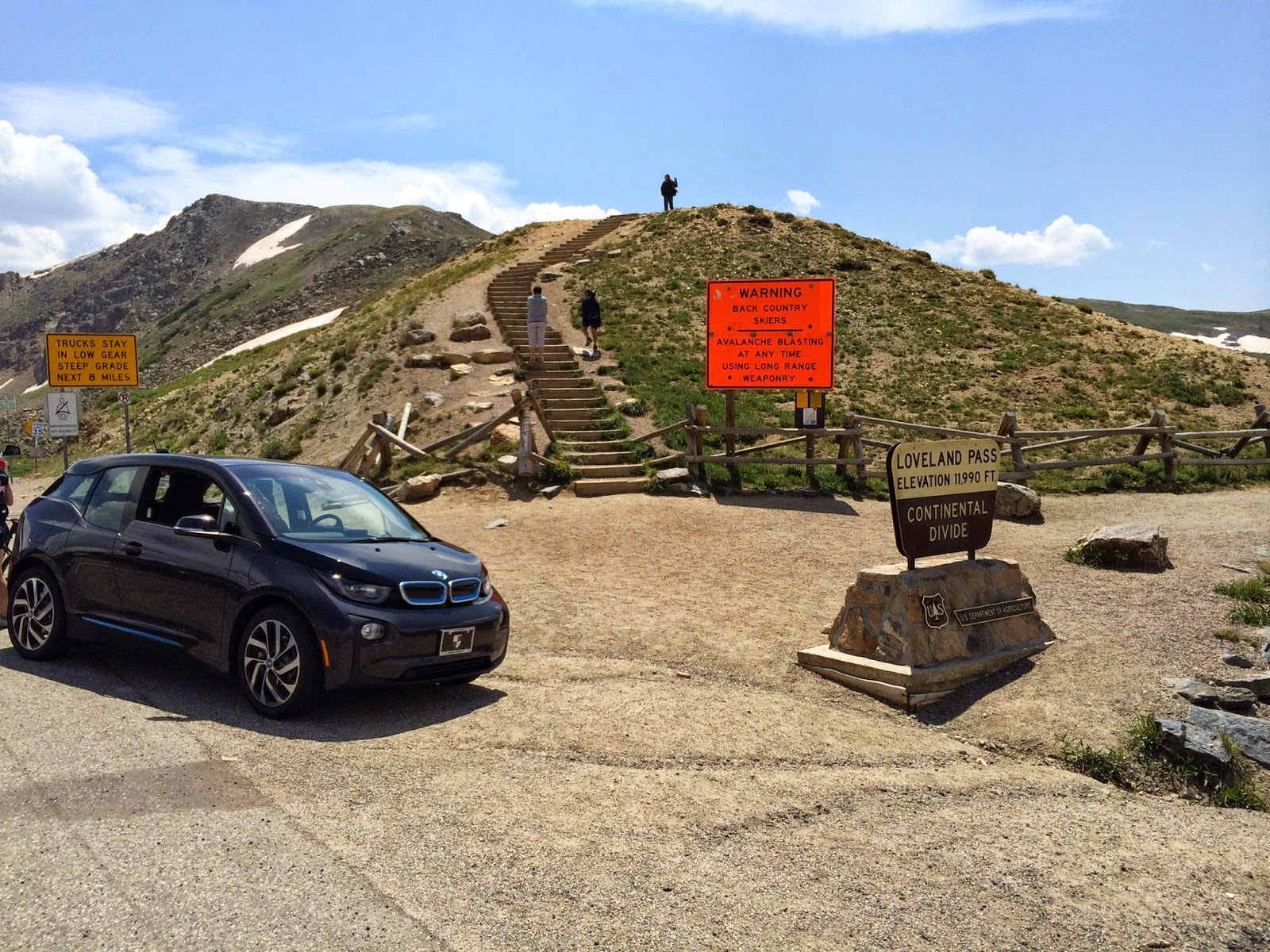
Loveland Pass, Continental Divide, Colorado. Elevation 11,990 ft
A few weeks ago Don Parsons of Denver, Colorado took his i3 REx on a 128 mile road trip from his house to Loveland Pass (Continental Divide, Colorado). On his way up to the 11,990 ft elevation of Loveland Pass he stopped at Beau Jo's Pizza for lunch and to charge on their public ChargePoint EVSE where his i3 REx accepted 8.9kWh's of juice to help with the rest of the climb up the mountain. 

The car showed 18 miles remaining at the top of Loveland Pass, and he nearly made the trip entirely on electricity when 62 miles later the range extender kicked on and he was only 2 miles from his home. 
The trip summary: 
-64 miles each way
-8,960 feet of climbing, 2329 Feet of descending on way out
-2329 feet of climbing, 8,960 feet of descending on way back
Having heard about this Continental Divide conquest, I asked Don if he wanted to write a guest blog post about the trip, but he offered to do one better. His next challenge was to take his i3 REx up to the summit of Mt Evans which is the highest elevation paved road in the US. The trip would take him over 14,000 feet above sea level and would most certainly push the range extender beyond its limit. This was not the kind of road trip BMW envisioned people taking the car on when they designed the REx, but nonetheless they have to expect some people like Don would do just that. So what happened? Read Don's words below to find out:


I’ve had my BMW i3 REx for almost two months now and haven’t really used or tested the REx engine.  Before today, I’d driven about 1750 miles total with only about 10 miles using the engine.  I decided to drive from my house in Denver to the top of Mt. Evans and return without stopping for gas or topping off the charge.  Using the REx engine in the mountains can be tough because the output of the small engine can’t really put out enough power to go both highway speeds and climb uphill.  However, the road to the top of Mt. Evans is pretty narrow, has steep drop-offs, no guardrails and a lot of cyclists sharing the road so you really don’t want to go much faster than 35 mph.  For this reason, I thought the small engine could hopefully handle the climb.
For those that don’t know, Mt. Evans is the highest paved road in North America with an elevation of 14,130 feet above sea level!  I live in Denver which is at 5,280 feet above sea level.  It’s 63.5 miles from my house to the top Mt. Evans.  With some up and down hill climbing, the total ascent is 12,446 feet and the total descent is 3,686 getting to the summit.
I set the car into Eco Pro+ and set out on city streets of Denver, then I-70 west up the mountains to Idaho Springs.  Mt. Evans highway winds its way south from Idaho Springs to the Mt. Evans summit in 28 miles.  When I originally entered the destination into the navigation system, the guess-o-meter said 61 miles of range.  I tried to keep the cruise control set to about 5 miles over the speed limit.


I was surprised to find that the Rex engine didn’t turn on until about 52 miles into the drive (about 10 miles from the summit) with a total trip average mi/kWh of 2.8 when the REx kicked on.  However, about 1 minute after the REx turned on I got a Brake error message that ended up making the brake pedal feel stiff and pretty much unusable.  Fortunately, I was still heading uphill and the regen seemed to be working normally.


I could hear the engine speed up during the straight parts of the switchbacks and as I slowed down for the sharp curves, the engine almost immediately slowed down as well.  I never really wanted to travel faster than 35 mph so I didn’t notice any performance hit until near the summit.  On the last few switchbacks, I put my foot to the floor and couldn’t get the car to travel faster than 26 mph.  At close to 14,000 feet of elevation, the engine was probably severely limited from its usual output at sea-level.  I’ve heard people say that an ICE reduces power output by 5% for each 1,000 feet of elevation.  In any event no other cars were traveling any faster than 25 or 30 mph so I didn’t feel unsafe.
I finally made it to the top at 14,130 feet!  The temperature had gone from 68 degrees in Denver to 35 degrees and quite windy.  This road usually shuts down for the winter sometime in September so they will be expecting snow to start accumulating up there pretty soon!

As I was getting ready to head down, I was worried about whether I would have any use of the brakes since I had turned off the car and walked around the summit for about 5 minutes hoping the error would reset but it didn’t and I still had a stiff brake pedal.  Since it was 35 degrees up there, I was pretty cold and didn’t feel like waiting any longer so I thought I would start to head down and see how well the regen worked to keep the car in control.  You can imagine how happy I was to have such a high regen rate because I felt like I was in complete control all the way back home.

During the descent from the summit down to Idaho Springs I was excited to see that the regen had built up a full 25% of the battery SOC and the guess-o-meter said as high as 28 miles of range on the battery.  I drove home significantly on battery but the REx kicked in a few times where there was some climbing.  It also stayed on once I got out of the mountains but I was easily able to maintain 75 mph on the highway leading east back into the city.

Here's a screenshot of the elevation and speed of the whole trip
Some stats on the whole trip.  I traveled 127.6 miles and averaged 4.9 mi/kWh and average speed was a total of 39.6 mph.  I used a little over a quarter of the rex tank which I think is pretty minimal for traveling almost 130 miles! As you can see from the picture, the brake error was still in place when I arrived home.  However, after being on my EVSE for a little over an hour, everything was cleared out and a quick trip to grab lunch showed that everything was back to normal.

I should point out that I haven’t gotten any software updates yet as I haven’t been able to set aside the time.  Until this trip, the only error I’ve seen from the car is the Check Engine Light, which remains illuminated. There is a software update that will eliminate this waiting for me at my dealer, so I guess it's time to get the car into the shop for the updates.  Hopefully the brake error is related to the 12v battery issues that others have discussed and will also be fixed with the latest software version I'll be getting. 
When I thought about getting the i3 Rex, I figured that I would use the battery over 95% of my driving miles.  So far, it seems like I’m using the battery over 97% of my miles.  That said, I’m still happy to have the Rex as it completely takes away any range anxiety when I’m traveling in the flats of the front range of Colorado.

What about the mountains?  I was concerned about using the i3 REx in the mountains and still believe that having a REx hold mode similar to the European version of the i3 or the Chevy Volt would make this an even more enjoyable car in Colorado.  That said, a couple CCS fast chargers placed strategically off I-70 would go a long way to helping the issue.  Locations in Idaho Springs, Silverthorne (where the 8 Tesla Superchargers are located) Copper Mountain, and Vail would be ideal spots to get a quick top-off and be truly useful in the mountains.  I’ve also kept my 335xi for long distance ski trips since it has all wheel drive and is still a great car. However, even without the fast chargers I was able to make it to the summit and home without a problem.

I’m very happy with the the i3.  The performance, handling, smoothness, and quietness all contribute to a great experience.  Like others have said, it’s hard to go back to a regular internal combustion engine after experiencing electric!

BMW i3 Range Extender: How Robust Will It Be?


There are still many unanswered questions about the i3. What will the EPA range rating be? How will is fare in NHTSA and IICA crash tests, will it cost more to repair, and so on. However there is one particular feature of the i3 that continues to dominate the discussion boards and forums: What can and can't you do with the REx?

Back in June before the i3 was officially introduced, I did a blog post on this very topic which turned out to be very popular. In fact, it's one of my top viewed posts and has been viewed over 5,000 times so  far. We now know a few more details since then so I thought it was a good time to give an update here. While I have driven in REx i3's, unfortunately I haven't had the chance to thoroughly test on while it was in range extender mode. That wasn't a coincidence. BMW has still be fine tuning the software for the REx and hasn't allowed the press access to them for complete testing. However, somehow over in the UK The Telegraph got hold of one and was able to take to for a long drive and use the range extender. Overall the review was pretty favorable and the author gave the i3 four out of five stars. However that's not the whole story. The real "story" within this story is that the author reported this about the range extender and it's caused a but of a stir:

"I thrummed along at 70mph, but it soon became clear that at this kind of speed our comfortable range between fill-ups was more like 40-50 miles. Still, it was impressive how, even when it says it’s flat, the car maintains enough battery power to give an instant shove of torque. Only if you really run it down, which you’ll have to try pretty hard to do (or so I’d been told), would you compromise the performance. Which is what happened next. 


I’d just come through a heavy but localised rain storm on the M20 when the i3 started to slow. It was a gradual process, from motorway cruising speed all the way down to 44mph. By this time I was travelling up a slight incline and had effectively become a slow-moving obstacle. Lorries were catching me with quite frankly terrifying closing speeds. It was three or four minutes - which was long enough to make me consider pulling over - before the i3 recovered; just as slowly as it had lost speed, so it crept up. “It’s not a limp-home mode as such,” a BMW spokesman later told me, “but once the charge runs down to five or six per cent and the range extender cuts in, if you keep driving at 75-80mph it can’t maintain the charge.” Rather than damage the battery by running it completely flat, the i3 had restricted our performance."


This Telegraph video above doesn't mention the difficulty they experienced with the car slowing down at all even though they show it driving along on the M20 while it was raining like they printed version said. That's strange to me since the article seemed to make a big deal out of it. I would have like to have seen video of the car during the explained "slow down" event.

The i3 REx Engine
I've had quite a few conversations with the engineers and product managers at BMW about the range extender and while they are cautious no to over sell it's capabilities, everyone I have talked to promises it's not anything like a "limp mode", and in fact you can do just about anything with it as long as you understand how it works and drive accordingly - I take that as monitoring your speed and if you know you'll be driving up a long steep incline and take it easy for a few minutes before you begin your ascent so the REx can build up a little extra reserve power for the climb. There has been a lot of talk around the fact that in the US, you can't manually engage the range extender once the state of charge is below 75% as you can in Europe. The concern is with the range extender coming on at such a low state of charge (at ~5% SOC) that there may not be a large enough buffer for those instances when the car needs continuous supply of a lot of energy for high speed driving or to climb long, uphill grades at highway speeds.

I don't have the exact answers as to what exactly is possible and what isn't. In fact, I'm not even sure it's possible to offer such a definitive explanation. Sure, the engineers can offer a formula based on total passenger and cargo weight, vehicle speed, head or tail winds, percent of grade you are climbing, etc but who will even understand that let alone be able to transfer that to an actual real world driving situation? There are so many different situations and roads it's just not possible to give a clear black and white definition of what it can and what it can't do and I believe BMW will likely struggle with how to explain this to their customers - maybe that's why they haven't even tried to explain it yet! I have made a request to the program managers to let me drive an i3 REx for a day once one is available. I'll test it in every possible situation I can come up with in the time frame I have including a 220 mile trip to Vermont. Hopefully my request will be accommodated because I believe I can clear the air on this as much as possible, however as I mentioned above there are endless specific driving circumstances so no test will completely satisfy everyone. My advice: Drive one in REx mode to satisfy your concerns before you plunk down your money. I'm sure you can leave a deposit on one and have it refunded if you are not satisfied with the performance once you get the test drive opportunity.

i3 Product manager Oliver Walter
I can say I have spoken with program managers that have driven the i3 REx extensively, and they have assured me that on flat ground, you really have to purposely try to defeat it in order to use more energy than it produces and that it can easily drive along at 70 mph for as long as you need to and still have enough energy for short bursts of power to climb hills along the way. BMW i3 product manager Oliver Walter in particular has assured me the range extender is robust and will be able to power the car in just about any circumstance without the driver even noticing any difference than when it's in pure EV mode. The question becomes how fast can you drive and for how long, up how steep a grade, and right now, we just don't have definitive answers.

So why can't the i3's in the US have the same ability the European i3's have to manually turn on the REx ahead of time, when you know you'll need a lot of energy for demanding driving conditions like climbing a mountain later in your trip? The answer is in the CARB certification of the i3. BMW needs the i3 to be certified as a zero emission vehicle in order to claim the most ZEV credits they can for each i3 sold. However the benefits aren't only for BMW. BMW has been working behind the scenes to make sure that i3 buyers get the same tax credits, tax exemptions and benefits like HOV access that zero emission vehicles get, which in many cases is better than what is offered to PHEV buyers. For example here in NJ, if I buy a zero emission car like a Tesla Model S, I am not required to pay sales tax, but if I buy a Chevy Volt which has a range extender, it's classified as a PHEV and I have to pay sales tax. So if BMW by getting the i3 REx certification approved, manages to get New Jersey to classify the i3 REx as a zero emission vehicle, then I will save about $3,500 in sales tax. To me, that's worth losing the ability to manually turn on the REx early because there will be so few instances that I would ever need to; it's just simply not worth it. This isn't just for NJ though, there are quite a few other States that offer different incentives for ZEV's as compared to PHEV's. However as far as I know, BMW is still working out these details State by State and they haven't announced exactly what the certification will mean in each particular State just yet. As soon as there is more to report on the certification and State benefits I'll have it up here, and hopefully I'll get to report first hand on how the REx performs sometime soon. Happy Holidays everyone!


Of course a robust network of DC quick chargers like the one pictured here would render the range extender irrelevant. But are they coming?