Showing posts with label infrastructure. Show all posts

First Public CCS DC Fast Charger in New Jersey Getting Action

This CCS DC Quick Charge station is located on my property at 148 Valley Road, Montclair, NJ
Back in August I posted an article that announced the opening of the first DC fast charger in the East Coast Express Charging Corridor. That station was installed in Hartford, Connecticut. The Express Charging Corridor when completed will connect Washington, DC to Boston, Massachusetts with CCS DC fast chargers, located no more than 50 miles apart, and is being funded by a joint venture between BMW, Volkswagen and ChargePoint.

About three weeks after the station in Hartford was installed, I installed one on my property in Montclair, NJ. It was the first public CCS station in the state that wasn't installed on BMW property. BMW has had a few CCS fast chargers at their North American headquarters for a few years now, as they have been testing CCS since 2012, when they were using a modified BMW ActiveE with CCS capability as a test mule for the then yet-to-be-released i3.
So far the DCQC station is getting plenty of use from i3 owners
CCS fast charge infrastructure had a slow start, frustrating many i3 owners. It was difficult to watch the Asian standard CHAdeMO stations and Tesla Superchargers continue to proliferate, while CCS stations were as rare as White Rhinos. However the pace of CCS deployment has really picked up, and with the East and West Coast Express Charging Corridors beginning to take shape, it's starting to look like CCS is finally getting some traction.

The station I installed is the smaller of the two that will be used in these corridors. I have the 24kW, CCS only DC fast charger but there is another unit that will also be deployed on many of the direct highway locations. That unit is a dual head, CCS and CHAdeMO station and is capable of delivering up to 50kW. Because of the location on my property (not situated on a highway), and the primary tenant is a restaurant where people typically spend an hour or more, the 24kW unit made more sense, and it costs a LOT less. The lower power draw will also help me to avoid or minimize demand charges from my electric provider.
The eGolf owners were very pleased when they realized the DCQC in my lot was close to the route they planned to take to Massachusetts. They only had to drive a few miles off of their route to stop by and Quick Charge
I installed the station a little over two months ago and it's definitely getting use. I've had at least a couple dozen different i3 owners stop by and use it, and I recently had an eGolf owner who was driving from Delaware to Massachusetts stop by to charge up. I was talking to them about the trip and how long it would take to stop and charge at level 2 stations and how happy there were when they saw my DCQC station pop up on the Plugshare map.

Fast charge infrastructure is monumentally important for the mass adoption of plug in cars. Tesla knew the success of the Model S, and probably even the entire company, would hinge on how quickly they could cover large swaths of the US and other key markets with Supercharger access. They have been installing them at an incredible rate, and have installed more than 500 worldwide in under 3 years.

Nissan has also done their fair share with regards to DC fast charge infrastructure and has subsidized much of the costs of hundreds of CHAdeMO installations. Personally, I'm hoping Volkswagen steps up and commits to installing even more infrastructure than the current plan in light of the current dieselgate scandal. Making a commitment to assisting the proliferation of cleaner electric cars would be a good first step in restoring public confidence at this point.

We are getting there. EV charging infrastructure, both level 2 and DC fast charge, is still really in its infancy, but we're definitely making progress in some areas of the country (mainly the coasts). I remember back to 2009 when I was driving my MINI-E and there wasn't a public charging station within a thousand miles of me. In fact, the closest one may have even been 3,000 miles away in California.  Now there are tens of thousands of them in the US. I can only imagine how things will look in another five or six years.

The Plugshare map on the left shows only CCS DC Fast charge stations on the East Coast. Just a year ago at this time there were none in this view. Within a couple of months, there will be dozens more of them as the Express Charging Corridor locations are finished. The large gap south of my restaurant (the blue dot) will hopefully be closed by year's end. The pace of CCS deployment is definitely picking up, and I believe will only continue to accelerate from here on.

Road Trip Refueling a BMW i3 REx

Fill 'Er up!
I know many readers here have spent countless sleepless nights pondering the the age-old question: How long does it take to refuel a BMW i3's tiny gas tank?

Well maybe not, but I have had people argue that driving the i3 REx on an extended trip would be very inconvenient because they would have to stop to fill up the gas tank every 50-60 miles. I've done quite a few road trips with my i3 REx, and stopping once an hour for a couple of minutes to refill the tank never really bothered me much.

I wrote a post last year which detailed a 462 mile round trip I made to Vermont from my home in New Jersey and refueling was one of the topics that many people commented on. On that trip, I had to stop for gas a total of seven times, as I only recharged the car once, which was at my destination. I drove 111 miles on battery, 351 miles on the range extender and used a total of 9.87 gallons of gas, averaging 35.5 mpg.
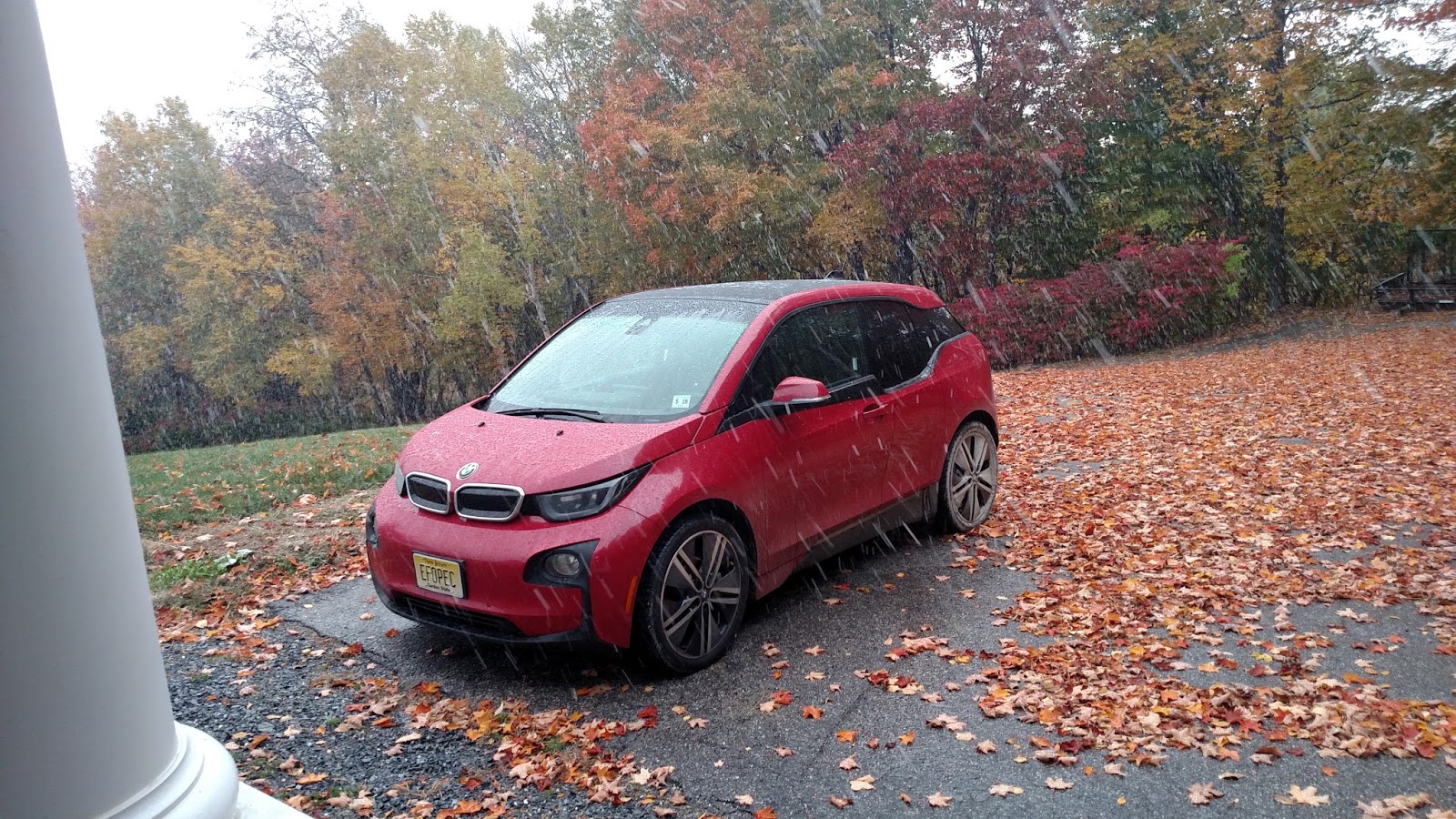
It was snowing in Vermont when we arrived

In that post, I wrote that I found it funny how quickly the gas tank fills because it's only 1.9 gallons. My wife started timing how long it took to stop for gas and we averaged a little over two minutes. I remember wishing we had recorded one of the gas breaks so we could demonstrate just how quick you can pull off the highway, fill up, get back into the car and back out onto the highway. I made a note that the next time we drove back up to Vermont, we would do just that.

So last week we made the Vermont trip again, and as planned we recorded one of the gas stops:


As you can see, I started the stopwatch before we exited the highway, and stopped it when we were back on the highway. I didn't jump out of the car and rush like a NASCAR pit crew filling up. I took my time and even spent a couple extra second topping off so I'd get every drop that I could into that tiny tank and we still did it in under two minutes.

The point of the exercise was to demonstrate that it's really not that inconvenient to make a quick gas break about once every every hour. I will qualify that statement with the fact that here in the Northeast there are gas stations everywhere. It seems that I'm never more than a couple miles from one, so when I'm doing these long drives I can plan the stops at convenient intervals when the tank is nearly empty. While that is the case for many large city and suburban areas throughout the country, there are plenty of rural areas where gas stations aren't as prevalent, and the small gas tank would be a problem. The i3 REx most likely isn't well suited for use in those areas. But hey, BMW calls it a "city car" after all.


As I mentioned above, when I made the trip last year I only did 111 miles on battery and drove 351 on the REx. This year I was able to drive 270 miles on battery, and needed only 184 miles with the range extender maintaining the battery state of charge. This was possible because of the always improving charging infrastructure. I was able to stop twice (once each way) at Prestige BMW in Mahwah, NJ and use their new DC fast chargers. Also, on the way home I stopped for a couple hours at a friend's house who just recently installed a 240v level 2 EVSE in his garage. These stops allowed me to more than double the all-electric miles for the trip, and I only needed 4.9 gallons of gas for the 184 miles I drove with the range extender running, as I averaged 37.5 mpg.
I used the recently installed DC Fast Charger at Prestige BMW on both legs of the trip. 
I now have over 36,000 miles on my i3 after seventeen months of ownership, and only about 1,750 of those miles were on the REx. The range extender has been a great feature and I'm still very happy I got it. It does what it is supposed to; it gets you home without worrying about finding a charging station on the rare days that the electric range isn't enough, and it enables the occasional long road trip. There are limitations though, and extreme hill climbing while the REx is running for prolonged periods at highway speeds, can result in reduced power. Fortunately I've never had that happen to me but I don't really have any big mountains which I need to climb. On my Vermont trips I set the Active Cruise Control to 70 mph and have never had an issue yet, even though there are some prolonged climbs at the end of the trip. I did get the "Reduced Power Possible" warning once though, as the state of charge hit a low point of 2% once. However it held there until I crested the climb and once I was on flat ground the SOC climbed back up to about 6%. I left the cruise at 70 mph because I actually wanted to see at what point it would go into reduced power mode, but it never happened.  
On one climb, I was able to get the SOC down to 2% and at that point the car warns you that reduced power may occur if you continue without altering your driving. Basically it's saying "Slow Down!"
Still, in a perfect world I'd prefer a 150 mile, all-electric-range i3 combined with adequate DC fast charge infrastructure. Personally, I really don't need 250 or 300 miles of range, and I'd rather not pay for it. However, even though the infrastructure is improving, I think 200 miles of range is probably more acceptable until DC fast chargers are ubiquitous. It appears with Nissan and Chevy poised to bring 200 mile EVs to market in the coming year, the "affordable" electric vehicle market is going to get very interesting. BMW's CEO recently announced that the 2017 i3 will have a longer all electric range also, but didn't comment on exactly how much more. That's good news because as much as I like how the REx works, and how quickly I can refill the gas tank, I'd still much prefer going on battery alone. 

Georgia Tax Credit Ending Soon, BMW i3 Owners Rejoice at SAE Combo DCFC Rollout

With the proliferation of electric vehicles like the i3, the absence of a robust fast charge infrastructure becomes more and more difficult to ignore. There are indeed areas of California which are served very well with DC Fast Charge stations, however for many EV owners outside California, Fast charge stations are something they only dream about. Georgia however, has been making some great progress with DCFC. Georgia resident and i3 owner Chris Campbell tells us what's happening with DC Fast Charge in the Peach State.

Chris with his Volt back in 2010
You may remember Chris from a post he made here last year. Chris was the very first Chevy Volt owner in Georgia back in 2010. He authored a guest blog post here telling his story and why he had decided to get a BMW i3 when he turned in his Volt. Many i3 purchases have come from buyers which were early adopters and had leased an early Volt or LEAF. Chris has been active in the Atlanta area's EV scene for a while and maintains a website full of EV information, which can be found here: www.http://electrifyatlanta.com
__________________________________________________________________________


For over a decade, Georgia has offered a generous $5,000 tax credit in support of getting an electric vehicle (EV). But only in the last three to four years has the market offered affordable cars with usable range, and suddenly huge numbers of Georgians have taken advantage of that incentive. In the last session, the state legislature took notice of this growth and killed the tax credit altogether, with it officially ending this month. June 30th is the last day that Georgians can get an EV (purchased or leased) and still be able to claim the credit when filing taxes next year.

So there is now one last mad rush to take advantage of one of the best EV incentives in the country. Potential EV owners are making their final decisions and dealers are scrambling to respond to demand and maintain inventory.

BMW i3 owner "heat map" illustrates Atlanta hot spot
The Nissan Leaf, by far the highest volume EV in the Georgia market, continues to dominate sales, but the BMW i3 has also enjoyed success in the Atlanta market, as illustrated by this "heat map" showing locations where owners voluntarily listed themselves on the i3 owner map. Atlanta is a true hotspot for EV ownership, and has an active i3 owner group!

NRG EVGO station at Mall of Georgia, CHAdeMO only
Besides the state tax credit, however, there has been another factor energizing EV uptake in Georgia: a large and accelerating roll out of DC Fast Charging (DCFC) stations. The first DCFC stations (CHAdeMO for Leafs) arrived in north Georgia in July 2013 via The EV Project (aka Blink), but the CHAdeMO rollout really accelerated in November 2014 when NRG entered the Atlanta market with their EVGO CHAdeMO stations. As of this writing there are now over 30 CHAdeMO stations in the metro Atlanta region, with another dozen expected online in June.
Two competing DCFC plug standards, SAE Combo (left) and CHAdeMO (right)

Of course, as most EV owners know, there is not just one DCFC plug standard -- there are three!  In 2008, before the current wave of EVs, the automakers all (except for Tesla) agreed on a Level 2 standard, the J1772 plug that is now familiar to all EV owners. But they did not come to an agreement on DCFC (sometimes inaccurately called Level 3), and so the EV market split into three camps:

- Nissan and other East Asia automakers: CHAdeMO
- Tesla: Proprietary Supercharger
- Everyone else including BMW, VW, GM:  SAE Combined Combo System (CCS)

Since that market split, the three different camps have proceeded with their respective DCFC station rollouts, with Chademo and Tesla fighting for the lead and SAE Combo in a distant third. However, we have started to see "dual standard" DCFC stations hit the worldwide market, offering both CHAdeMO and SAE Combo. While these stations do not directly support the Tesla interface, Tesla owners can now buy a $450 adapter from Tesla Motors, that lets them charge from CHAdeMO stations. So these dual-standard stations effectively support all three standards. Of course Tesla cars have far larger batteries, offer far more range, and typically take advantage of their own network of ultra-fast DCFC stations.
BMW-branded DCFC unit, SAE Combo only, 24 kW
The SAE Combo flavor of DCFC (compatible with the BMW i3) first appeared in Atlanta in late 2014, with a single dual-standard cabinet at a Georgia Power testing facility, unfortunately accessible during weekday business hours only. In January a second SAE Combo unit appeared at BMW NA's offices, however that BMW-branded unit only offers 24 kW peak power. Obviously with just these two i3-compatible DCFC stations, one with limited access and the other offering low power, and both located in the same side of town, they were of limited utility to i3 owners.

It was not until this week that the true potential of the BMW i3 was realized in the north Georgia market, with a wave of SAE Combo DCFC sites going online.
Georgia Power's first dual-standard DCFC station
Following nearly a year of planning and construction, regional electric utility Georgia Power has now launched their network of DCFC stations, which are DUAL-STANDARD. These new stations offer both CHAdeMO and SAE Combo plugs, and thus are able to charge every DCFC-capable EV in the U.S. (even the Model S via Tesla's new adapter).  Georgia Power's DCFC sites deliver 50 kW and will offer Level 2 charging stations as well. Their network launched in May with pilot stations at 11 Georgia Power locations in 4 cities, and will expand to a total of 60 stations statewide by the end of 2016. The first wave of stations launched temporarily with only CHAdeMO capability, but on June 2nd Georgia Power finally delivered on their promise and brought their first dual-standard station online, with more expected this week.

This is just the first wave. Georgia Power plans to spend 2015 installing 25 more stations at locations around the state, and then another 25 in 2016. Some will be in metro areas, essentially serving commuters, but some will be installed along interstate corridors, serving those EV owners eager to stretch the legs of their new car. Since every one of these stations will offer dual-standard DCFC, these stations will support ALL EV owners. Atlanta-area BMW i3 owners have been straining at the leash for these stations to finally go online, and the day has now arrived.

Pictured at left: NRG's new dual-standard BTC hardware

But Georgia Power is not the only player in the market offering dual-standard charging.  NRG entered the Atlanta market in November 2014 with CHAdeMO-only stations, but recently has been expanding their presence with dual-standard DCFC stations made by BTC Power. Unfortunately, while these BTC stations have internal hardware that supports both CHAdeMO and SAE Combo charging, these new stations have been popping up with the SAE Combo side disabled. It is rumored that NRG (and partner Nissan) have asked BMW to chip in on the cost of these stations. If that is indeed the case, I believe it would be wise for BMW to step up and contribute to this much needed infrastructure.


Signet DCFC cabinet with Greenlots network
A similar situation is playing out with some state-funded stations. The Georgia Environmental Financing Authority (GEFA) is an arm of the state government that normally funds projects like water and sewer improvements, but in 2014 they announced a grant opportunity for GEFA-funded electric car charging stations at municipalities and educational institutions. Following a frenzied application window that reportedly lasted only hours before the funding was all used up, GEFA delivered on those grants in late 2014, and since then stations have been popping up in locations around the state, beyond metro Atlanta. Three of these locations are Athens, Augusta and Columbus, where GEFA-funded DCFC stations went online in April.  These stations launched with only CHAdeMO capability, despite the GEFA grants specifically requiring dual-standard DCFC. Indeed the Signet hardware that was physically installed did include SAE capability, with even the cord and plug installed and ready to go, but the SAE Combo plug was disabled in software (via the Greenlots activation network). Again it appears that Nissan maneuvered to have the stations installed with SAE Combo, but with that capability disabled until BMW chipped in. Local i3 owners raised this concern with BMW via a variety of methods, and in late May, these three locations saw their SAE Combo plugs quietly get enabled. The rumor now is that this solution will soon spread to similar stations that have appeared in the Carolinas, further enabling regional travel by i3 owners. BMW of North America has made no public statements about what is going on at any of these, frustrating local i3 owners.

Table comparing DCFC cabinets seen in Georgia market
Georgia now boasts EIGHT different makes of DCFC station hardware, operating on six different networks (click here for details on the station hardware now operating). Thus, the state now has one of the most heterogenous DCFC station populations in the world, exceeded only by California, and certainly Georgia can be seen as a great market to evaluate DCFC developments and test car compatibility.

All of this DCFC activity, especially the SAE Combo roll out, has delighted local BMW i3 owners, who have been chomping at the bit to go on road trips in their new cars!

Are Megacities Ready For The Megacity Car?


During the i3's development, BMW often used a large city as a backdrop for the concept i3 photo shoots. 
Megacity: A metropolitan area with a total population in excess of ten million people.

BMW has all along told us that the i3 was designed for urban transport, a glimpse at the future of personal mobility in the megacities of the world. Heck, the code name for it was even "The Megacity Car."  However now that the i3 has been available for over a year, BMW is realizing that the Megacity car is selling better outside the city limits.

I've never really accepted that the i3 would do well in the megacity markets, at least in the US, and I've voiced that opinion on many occasions. Having lived with electric cars for the past six years, I've had the experience of driving and charging in the both suburbs and in the city, so I'm intimately aware of the challenges of public charging. I live about 50 miles from New York City and go there frequently. Driving my electric cars to and around the city isn't a problem, however charging it there is. There just aren't enough places to charge your car there to make living with an EV in New York City palatable. There are public parking garages and a few lots that have EVSEs, but finding one that works is one problem. Then, if you're lucky enough to find a lot that has one which is working, you often have to fight with the attendant to make sure they plug you in once you've left your car there.
My car was unplugged after only about 45 minutes of charging. It was sitting right where I left it so they didn't need to move it, someone there just decided to unplug me. With only 28% state of charge, I needed the range extender to get me home. This is a typical EV charging experience in NYC
The last three times I've gone to the City I had nothing but problems getting my car charged. In fact, two of those times I had to drive home using my range extender because the car wasn't charged. Just last week I went to the New York Auto Show and parked at the 9th Avenue Edison Park Fast lot because it had a ChargePoint charging station. When I pulled in I told the attendant I needed to charge for a minimum of three hours and he seemed to understand what I was saying. He said "Oh this is electric? No problem I'll plug you in." I even gave the guy a $5 tip up front with the hopes that he'd take care of me. As I was walking to the Javits Center a few minutes later I checked my BMW i Remote app and saw my car was charging so I figured I was good. I left the car with only 10% state of charge and wanted to be at at least 90% for the trip home, and that would take about three hours of charging. No problem because I planned to be at the show for about six hours. As I was walking back to my car later that day I checked my app just to make sure I was charged and to my surprise I saw I was only at 28% SOC and the car wasn't charging. When I arrived I asked why my car wasn't charged and the attendant only said, "We charged it."  I figured maybe they had to move it for some reason, or maybe another EV came that needed to charge but no, someone just decided to unplug it after about 45 minutes of charging. The car was still parked in front of the EVSE, it wasn't blocking anyone so it hadn't been moved, it was just unplugged hours ago for no apparent reason.
This time in New York I was able to charge up at an underground parking garage, but only after 45 minuted on the phone with ChargePoint trying to get this unprovisioned station operational.
This has happened before to me in New York City, so I wasn't really surprised. I've even had the attendant promise to plug me in and never do it. I now either wait to watch them plug it in or check my app as I'm walking away to make sure someone plugs it in. Luckily I had the REx to bail me out or I'd have been in a real jam, as I needed to be somewhere else in about an hour.
Electric range insufficient. Not what you want to see when you return to your car after leaving it in a public parking lot to charge. Luckily I had the range extender to fall back on. 
I could go on and on about previous difficulties I've had trying to charge in the city, but I think I'll dedicate an entire post to that sometime soon. The point here is charging an EV in the city is difficult at best. Yes, if you live there it is possible to make arrangements with the garage where you keep your car, and install an EVSE for your personal use, but many of the garages don't have the additional electrical capacity for a dedicated 40 amp circuit even if you're willing to pay for the installation and the electric, so the owners are stuck plugging into a simple 120v outlet and slow charging all of the time. Beam Charging network in New York has stations in various parking garages and offers a $98 per month unlimited charging plan, but you still have to find accessible stations and pay the regular parking fee which can be very expensive. It's definitely doable, but not very convenient or inexpensive.

So it was no surprise when I read an article this week by Diana Kurylko of the Automotive News quoting BMW NA CEO Ludwig Willisch saying i3 sales have been weaker than expected in large cities like New York: "The strongholds in this country are parts of California, Texas and southern Florida, rather than large cities, he said" The article further says: "The big urban centers in the Northeast, especially New York City, haven't embraced the i3, Willisch said. Unlike Californians, he said, New Yorkers apparently don't have sustainability and the environment "at the top of minds." I don't think it's a lack of a desire to be sustainable as much as it's difficulty charging the car there. California has a much more mature public charging infrastructure, and most people there live in private residences, unlike New York City. Overall, BMW is pleased with US i3 sales, and they are on pace to sell about 12,000 i3s per year here, they just seem to be a little surprised where the sales are coming from. I'm certainly not surprised, and I even wrote a post about a year ago that said the i3 was better suited for suburban and country life than life in the city, and I listed the reasons why I believe that to be true.

My i3 lives about 50 miles west of New York City... and fits in perfectly
Living in the suburbs or the country means you are usually in control of your energy supply, because most people live in single family homes there. There can be issues if you live in an apartment or condo complex, but you also have the choice to move to another location close by if charging is prohibited in the complex you live in. Living in a private residence allows you to install the home charging equipment you need, so you're not relying on public charging infrastructure as much.

Accessibility to charging is paramount for daily EV life, and in New York the public charging infrastructure has a very long way to go before it becomes convenient enough for many more people to consider an EV if they live there. Life in the big city is tough enough, and fighting on a daily basis for somewhere to charge your car is probably something most New Yorkers aren't willing to deal with. However there is hope that things will get better. Last year New York City passed the "Charger Ready Bill" which requires all new construction in New York City to dedicate 20% of the new parking spaces for EV charging spaces. I actually was asked by Mayor Bloomberg's office to testify in front of the committees on buildings and transportation in favor of the bill, which I did. This law will dramatically increase the amount of public charging locations in New York City, but it will take years before the results are really seen.

So are megacities like New York ready for electric cars? Not really. Not yet, I'm afraid. 

BMW Partners With Volkswagen & ChargePoint. Announces Beginning of Large Scale CCS Fast Charge Rollout in US


Today at the DC Auto Show, BMW announced they have partnered with Volkswagen and ChargePoint to begin what will be the largest roll out of CCS Fast Charge stations in the US. This first phase will consist of the installation of roughly 100 CCS Fast Charge stations, split between the East and West Coasts. 

On the East coast, there will be locations approximately every 50 miles between Washington DC and Boston, and on the West coast the new "CCS Highway" will span from San Diego, CA all the way to Portland OR. All of these locations will feature 50kW dual-head Fast Charge stations, including CHAdeMO charging capabilities as well as CCS. In addition, these locations will have multiple Level 2 ChargePoint EVSE's, allowing the user to "top off" once the vehicle reaches 80% state of charge from the DC fast charger. 

In addition to the "CCS Highway" locations, BMW is also going to install a network of their 24kW DC Fast Chargers at secondary locations which are somewhat off of the main arteries. 

I spoke with BMW infrastructure manager Rob Healey today and he wanted to stress how this announcement signifies only the beginning of the commitment that BMW and their partners have to proliferate the deployment of DC Fast charge infrastructure. He pointed to the fact that the decision to include CHAdeMO on all their 50kW locations on the East & West coast deployment indicates their commitment to the success of overall e-mobility, not just their plug-in offerings. Healey used the phrase that "a rising tide lifts all boats" and in this case I believe he's absolutely correct. 

BMW and their partners are still identifying locations and are working with public and private entities to secure locations that are a maximum of 50 miles apart. There isn't a set time frame on completion of this first phase but the installations have begun on the West Coast and will soon begin on the East. BMW has already installed three 24kW DC stations and four dual-head Level 2 charging stations at their North American Headquarters in Woodcliff Lake, NJ. I was even invited there to test them out with my i3 this week, which I did. All of these stations will be open to the public 24/7 and they already appear on the ChargePoint map. 


I believe this is a great first step for BMW and their partners with regards to DC fast charge, but it's only the first step. There will also be attention paid to the other areas of the country that aren't included in this announcement. It's a big country, and areas like Atlanta which have become EV hot spots aren't going to be ignored, but these two corridors were considered the most important ones to begin with. I also believe we're going to see even more collaboration between the OEMs. It's no secret BMW and Tesla have had discussions in the past, and in my opinion, installing CHAdeMO on all of their locations on the CCS Highway is extending a huge olive branch to Nissan. How great would it be if Nissan then turned around and said they will do the same thing now? This little detail could end up being the biggest thing to come out of the whole announcement...


Full Press release:

Washington, D.C., January 22, 2015At the 2015 Washington Auto Show, two of the top automakers, BMW of North America and Volkswagen of America, together with ChargePoint, the largest electric vehicle charging network, announced an initiative to create express charging corridors along heavily-traveled routes on the East and West Coasts. Designed to increase the number of fast charging locations, the initiative will help meet the large and growing demand for convenient, publicly available electric vehicle fast chargers, including direct current (DC) Fast charging locations, and support the adoption of electric vehicles in the United States. In the initial phase, the aim is to install nearly 100 DC Fast charging ports across both coasts, with plans to expand the program to increase access to fast charging across the country. These newly installed DC Fast chargers will be added to the growing ChargePoint network of more than 20,000 charging spots in North America.

With more than 280,000 electric vehicles sold in the United States, EV owners need more charging flexibility while on the go. The express charging corridors will provide electric vehicle drivers access to DC Fast chargers along the most heavily populated and highly-trafficked regions on Interstate 95 on the east coast, from Boston to Washington, D.C., and on the west coast covering and connecting the metropolitan areas of Portland, San Francisco, Los Angeles, and San Diego. The installations will occur both within and between relevant metro areas, strategically-spaced at a maximum of 50 miles apart, making it even easier to take long road trips in an EV.

“A robust network of conveniently located DC Fast charging stations will go a long way toward increasing electric vehicle adoption and making electric vehicle ownership even more enjoyable,” said Robert Healey, Head of EV Infrastructure at BMW of North America. “The express charging corridors are another important step in the development of the U.S. e-mobility infrastructure that makes longer distance travel a real option for consumers, particularly along the most heavily trafficked portions of both coasts—making the BMW i3 and other electric vehicles even more appealing.”

“Volkswagen believes in a holistic approach to e-mobility in order to create a seamless experience for the consumer,” said Jörg Sommer, vice president, product marketing and strategy, Volkswagen of America. “The investment in the express charging corridor will provide e-Golf and other electric vehicle owners with the added support to travel their day-to-day and popular long distance routes.”

Each fast charging location along the express charging corridors is expected to include up to two 50 kW DC Fast chargers, or 24 kW DC Combo Fast chargers with the SAE Combo connector, used in both BMW and Volkswagen electric vehicles as well as many other electric vehicles that incorporate a DC Fast Charging capability. When charging at a 50 kW station, both the BMW i3 and the Volkswagen e-Golf can charge up to 80 percent in 20 minutes. Both vehicles can charge up to 80 percent in 30 minutes at a 24 kW station. Locations will also include Level 2 chargers, currently the most commonly available public charging stations, which are compatible with all electric vehicles. Level 2 stations can dispense up to 25 miles of range per hour of charging, providing a full charge for the BMW i3 and the VW e-Golf within 3.5 to 4 hours.

The DC Fast charging stations will be part of the ChargePoint network and can be easily accessed with a ChargePoint or ChargeNow card or with the ChargePoint mobile app.

“Our goal at ChargePoint is to get everyone behind the wheel of an EV and provide EV charging everywhere they go,” said Pasquale Romano, ChargePoint CEO. “With strategically-placed stations where drivers need them, these express charging corridors will give EV drivers the freedom to go farther and have an EV as their only car without limitation.”

Installations have already begun on the west coast, with the first location in San Diego County. There is a target of nearly 100 DC Fast charging ports in the first phase, available by the end of 2015. DC Fast chargers along the express charging corridors are expected to be installed in convenient locations such restaurants, shopping centers, rest stops, and more. ChargePoint will leverage its existing customer base and knowledge on usage to pick strategic locations either where drivers currently charge, or to fill in spaces where there is currently a lack of infrastructure.

With the investment, BMW, Volkswagen and ChargePoint are providing drivers with the ability and confidence to enjoy longer distance driving and recharge their electric vehicles quickly, ultimately leading to greater electric vehicle adoption. 


BMW Group In America
BMW of North America, LLC has been present in the United States since 1975.  Rolls-Royce Motor Cars NA, LLC began distributing vehicles in 2003.  The BMW Group in the United States has grown to include marketing, sales, and financial service organizations for the BMW brand of motor vehicles, including motorcycles, the MINI brand, and the Rolls-Royce brand of Motor Cars; DesignworksUSA, a strategic design consultancy in California; a technology office in Silicon Valley and various other operations throughout the country.  BMW Manufacturing Co., LLC in South Carolina is part of BMW Group’s global manufacturing network and is the exclusive manufacturing plant for all X5 and X3 Sports Activity Vehicles and X6 and X4 Sports Activity Coupes.  The BMW Group sales organization is represented in the U.S. through networks of 339 BMW passenger car and BMW Sports Activity Vehicle centers, 147 BMW motorcycle retailers, 122 MINI passenger car dealers, and 35 Rolls-Royce Motor Car dealers.  BMW (US) Holding Corp., the BMW Group’s sales headquarters for North America, is located in Woodcliff Lake, New Jersey.

About Volkswagen of America, Inc.
Founded in 1955, Volkswagen of America, Inc., an operating unit of Volkswagen Group of America, Inc. (VWoA) is headquartered in Herndon, Virginia. It is a subsidiary of Volkswagen AG, headquartered in Wolfsburg, Germany. VWoA’s operations in the United States include research and development, parts and vehicle processing, parts distribution centers, sales, marketing and service offices, financial service centers, and its state-of-the-art manufacturing facility in Chattanooga, Tennessee. The Volkswagen Group is one of the world's largest producers of passenger cars and Europe's largest automaker. VWoA sells the Beetle, Beetle Convertible, CC, Eos, e-Golf, Golf, Golf GTI, Jetta, Jetta SportWagen, Passat, Tiguan, and Touareg vehicles through approximately 651 independent U.S. dealers.

About ChargePoint
ChargePoint operates the world’s largest electric vehicle (EV) charging network, with more than 20,000 spots to plug in and charge. We are transforming the transportation industry by providing the charging stations, mobile apps, analytics and the charging network that allow property owners and drivers to benefit from EV charging. We are also transforming the energy industry by providing intelligent solutions to help people and businesses shift away from fossil fuels and use electricity more efficiently. Our mission is to get all drivers behind the wheel of an EV and provide them a place to charge whether at home, at work, around town or out-of-town. 

Over 165,000,000 gas-free miles have been driven on our network, and our drivers have collectively avoided more than 6.9 million gallons of gasoline and 51 million pounds of COemissions. Real-time network information is available through the ChargePoint app and in many top-selling EVs.

BMW Initiates "Light and Charge" Pilot Program


It seems BMW has been busy developing new ways to charge your i3 or i8 lately. A few months ago I posted information on BMWs new low cost DC Fast charger and I just got word from an i3 owner in California that the first one is already up and will soon be ready for use at Crevier BMW in Santa Ana, California.
A member of the i3 Facebook group posted this picture from Crevier BMW. BMW's new DC fast charge station has just recently been installed there.

The latest news out of Munich is BMW's "Light the Charge" program. BMW has developed LED streetlights that also have built in charging stations. They already have a couple of them in place outside their Munich headquarters, and will soon begin installing them around the city of Munich for a pilot program. The units will be networked and allow the customer to pay with a credit card or by swiping an RFID card from a partner charging network provider. In the US, BMW's charging partner for ChargeNow is ChargePoint.
The European version of BMW's light pole charging station. In Europe, the EV driver carries the cable that plugs into their car as well as the EVSE. Here in the US, the cable is permanently tethered to the EVSE.

The obvious issue with adding charging stations to light poles is available capacity. Will the utilities have to pull new wires to accommodate the added demand or are they already over sized and can handle the additional load? In Europe the standard electrical supply is 230v so there is already more available power than we have here in the US where the basic household supply is 120v. I'd imagine most light poles here are typically 120v, but I'm not 100% certain about that. Pulling new wires and upgrading the lights could prove very costly, more so than even installing stand along charging stations, but I could see how using these on new light pole installations would work.
Charging stations on all these light poles would be great for workplace charging, airports and shopping malls.

Besides street side parking, I could also see how this approach would work well for large parking lots. Instead of having the charging stations all located in one place, which typically is a desirable location close to the buildings, they could be scattered all over the parking area, and each light pole could service the four parking spaces surrounding it.

Whether this idea comes to fruition and becomes a reality beyond the pilot program is unknown at this time, but I like that BMW is really giving thought to how they can improve public charging for their customers. The maturation of the public charging infrastructure is crucial for mass electric vehicle adoption, and I hope BMW continues to explore new ways to help make it ubiquitous.

8 BMW i3 Questions with Brad Berman of Plug In Cars

I was recently interviewed by Brad Berman of Plugincars.com about my initial thoughts on my i3. The interview just went live on the site so I've bought it over here for my followers to read. Please leave your thoughts on my answers in the comments section.
____________________________________________________________________________

Tom Moloughney, long-time EV driver and first owner of a BMW i3 with the range-extender option, answers fundamental questions about the car.

1) How is the BMW i3’s range-extending system different from the Chevrolet Volt and Toyota Prius Plug-in Hybrid?

The range extender on the BMW i3 works differently than systems on plug-in hybrids (that to varying degrees sometimes power the wheels from the engine). The rear-wheel-drive i3 is the only pure series plug-in hybrid currently available. The i3’s two-cylinder range-extender engine never mechanically drives its wheels. The Fisker Karma worked this way, but that vehicle is no longer in production.

2) Under what conditions does the gas engine come on?

In the United States, the range-extender turns on when the state of charge drops below 6 percent. Unlike the European version, the operator cannot manually turn on the engine to maintain a higher level of charge. In Europe, once the state of charge drops below 75 percent, the range extender can be turned on manually.
BMW eliminated this feature on U.S. models, so the i3 would qualify for the California Air Resources Board’s BEVx designation. While BMW never announced why they chose to eliminate the hold feature in favor of getting the BEVx designation, observers believe BMW took the step in order to get more ZEV credits per REx vehicle sold.

3) How does the driving experience change after the gas engine comes on?

So far, I’ve had the opportunity to drive my i3 for about 100 miles in charge sustaining mode. I intentionally didn’t charge it for a couple days so I could fully test the functionality with the range-extender operating. The power is slightly muted. I’d say maybe 85 percent of how it feels with a full charge.
When the range-extender turns on, you cannot hear it at all from inside the car because it initially runs in the lowest of the three power levels. If you continue to drive at speeds higher than 40 miles per hour, it will kick up to the next power level and you can then hear a low hum from inside the car. If you are driving at highway speeds, it will jump up to its highest (28kW) power output, and then you can definitely hear it. It’s nothing that you can’t overcome with the radio.

The REx turns off when you slow down to less than 15 mph, unless your state-of-charge is lower than 3 percent. I’m impressed by how well the little motor can sustain the charge. I’m convinced it can do whatever I need to do, and I will have no problem driving long distances with it running.

On level ground, the car can continuously sustain speeds up to 75 mph for as long as you need to drive. You have plenty of power to pass cars at that speed, and to climb hills that are a few miles long. There really aren’t any mountains in New Jersey where I live, so I haven’t tested driving up long steep inclines, but there is definitely a point where the range extender will not be able to maintain highway speeds.
If you exceed the range extender’s capability, it will slow down to 40 mph. At that speed, it can maintain just about any climb. I will be taking my i3 on a 230-mile trip to Vermont soon. Hopefully I can do some mountain testing there when I do. I haven’t noticed any difference in the handling when the REx running.

4) What's the top speed for the i3 before, and after use of gas engine?

The i3’s top speed in electronically governed at 93 mph. It pulls strongly all the way up there, with or without the range extender running. As noted above, it’s just slightly less powerful in charge sustaining mode.

5) How did BMW make its decisions about the of the i3’s engine and gas tank?

The i3 was not initially designed to have a range-extender. BMW added the feature after the car was more than a year into development. Perhaps that had something to do with what size motor they could fit, but that is just an educated guess.

The size of the gas tank is another thing entirely. In the United States, the i3 REx has a 1.9-gallon tank, and the European version uses a 2.4-gallon tank. The 1.9-gallon tank for the US was announced only weeks before the i3 launch. The reason for the reduced size is probably tied to the BEVx designation that BMW clearly wanted the car to attain. BMW has not confirmed the reason for the reduced tank size.

One of the qualifications of the BEVx certification is the vehicle’s all-electric range must be greater than its gasoline range. Again, this is speculation, but if the i3’s electric range was certified by CARB at lower than BMW expected, that would explain the need to reduce the range when running on gasoline.
Personally, this isn’t an issue for me. I’ll be using the range-extender only on those rare days when my electric range is just slightly insufficient. It’s a good backup strategy, and allows me to not even think about those times when I’m pushing the limit of the car’s range.

6) Should drivers think of the gas engine as a way to extend range to 160 miles—or only as a backup to an 80-mile EV?

I’m not going to tell anyone how to use his or her car. I don’t think there is one simple answer. I believe there will be people that routinely drive their i3 REx 130 to 160 miles and more, and don’t mind filling up frequently when they need to. I can say this about filling up: with such a small tank, you pull in, fill up and pull out of a gas station in about two minutes.

There will be others that see filling up every 50 or 60 miles as too cumbersome. Perhaps the car isn’t the right choice for them. A Volt may be a better PHEV for some people that frequently need to cover hundreds of miles in a day, or live in a mostly mountainous region. For daily driving of less than 150 miles or so, it works great.

7) Given the unique i3 system, how does it affect incentives and perks like carpool access?

The i3 REx, like the Volt, Plug-in Prius and other PHEVs qualifies for California’s Green HOV access sticker, which is currently not available. The 40,000 allocated green stickers PHEVs have been exhausted. However, AB 2013 proposes to make 45,000 more stickers available, and is currently headed to the California Senate for vote.

Washington State recently announced the i3 REx would qualify as a zero emission vehicle and therefore gets exempt from sales tax there. BMW i3 sales in New Jersey were also scheduled to be tax-exempt. But just after BMW began selling the i3 in New Jersey, it was announced that the i3 with range-extender would indeed have to pay sales tax. The BEV i3 doesn’t. That essentially doubles the price of the $3,850 REx option, making it nearly an $8,000 option in New Jersey. That is likely to hurt i3 REx sales in the Garden State.

8) Is the i3 REx approach a stopgap measure, or should it be considered a long-term strategy across the EV market?

I believe other manufacturers will adopt the range-extender approach. However I believe it is a short-term measure. (Maybe 10 years?) As battery chemistry advances and energy density improves, electric vehicles will have continually better electric range.

That, combined with increased DC quick charge stations, will make the range-extender unnecessary. Tesla and Nissan are doing the lion’s share of the work getting these fast charge stations installed. It’s about time some of the other carmakers join in.

The i3 is only the first electric vehicle to emerge from the new BMW i brand. More vehicles are already far along in development. It’s my hope that BMW recognizes the need for DCQC infrastructure, and follows Tesla and Nissan. If the combo-cord fast charge standard has any chance of gaining traction in the US, it will be up to BMW to take the lead. It is the only manufacturer currently selling a serious (not a low-volume compliance-only) electric vehicle that uses the combo cord. In my opinion, the proliferation of DC quick charge is absolutely necessary if we are going to get off petroleum, and make a transition to electrified transportation. A small, efficient range-extender like the i3 will work for many people today. It's a great step until battery range grows and more quick charging is installed.

First i3 REx Road Trip: Hotels, BMW Dealerships & Wraps

Charging up at Hampton Inn in Turnersville... but for how long?
Ever since the i3 colors were announced, I had thought about doing a custom color wrap for my i3. The colors offered just weren't very inspiring and other than the Solar Orange, they were all white and shades of grey or silver. I chose the Laurel Grey because I liked how it made the car look more like one solid color. It minimized the "Black Hand" design that BMW used to try to give the appearance that the i3 is slimmer than it actually is.  It's a short car that is tall, and definitely has unusual lines and BMW believed that using black on the top surfaces would make it look less "chunky".  I also liked the idea of having a custom color so my car would be easily identifiable in pictures. I'll be writing i3 reviews for quite a few websites, and having my car a distinct color will let the readers know immediately that it's my car they are looking at.

Once I got to see my car in person I realized how much I really do like the Laurel Grey
That being said, once I got my car I realized how great the Laurel Grey looks, especially with the Frozen Blue accents and I started having second thoughts about doing the wrap. I decided to go through with it anyway because I really like the idea of having a distinctive color that no other i3 has. Plus, when I take it off it will feel like I got a new car again because the wrap protects the paint perfectly underneath. Since I'm wrapping a new car the paint will remain pristine and in a year or so when I decide to take it off I'll be able to enjoy the Laurel Grey with Frozen Blue color scheme.

After doing some research I decided to get the wrap done at Designer Wraps in Millville, NJ. It's about a 130 mile trip from my house and while there are closer wrap shops, I want to get it done somewhere that has a great reputation and has been doing wraps for a long time and Designer Wraps fit the bill. So I plotted the trip and since the wrap takes 3 or 4 days to complete, I told my wife I'd need her to drive down with me separately so I could drop off the car and we'd drive back together. The funny thing about it is she initially said, "How long will that take? Is there a charging station along the route where you can stop and charge?" She momentarily forgot I have the range extender on the i3 so she was thinking this would be an all day road trip. After driving pure EVs for five years now, she had been conditioned to think a long trip meant 80 miles or so of driving, and then four or five hours of charging in order to continue. After staring at her and smiling for a few seconds, she realized her error and we just laughed. Only two days of ownership in and the REx is immediately a game changer.

Then I realized I had also overlooked something, but not anything with regards to the car though. We were planning on driving down early on the morning of Saturday, May 24th, and that turned out to be the Saturday of Memorial Day weekend. If you live in New Jersey, you know how bad traffic is going south on the Parkway or the Turnpike during either Memorial Day or Labor Day weekends, as tens of thousands of people migrate to the Jersey Shore for these two weekends that bookend the summer. A two and a half hour drive could easily take five hours under these traffic conditions. So we came up with plan B. We would drive about 100 miles late Friday night which would get us passed the major traffic areas, stay in a hotel and continue on the next morning.

Since we would be spending the night, I figured I might as well find a hotel that would let me plug in 120v while we were there. After all, the goal is to drive on electric as much as possible, even with the REx and an overnight stay would give me enough range to make the final 40 miles or so without the REx kicking on. After making some calls, I found an Hampton Inn in Turnersville, NJ that said I could plug in and it was just about perfectly along our planned route.  The hotel was about 100 miles into the trip and we would then be 40 miles from Designer Wraps. An overnight charge would give me just enough to complete the trip the next day without the range extender. If I really wanted to, I could have probably found a hotel that was only halfway there, and tried to complete the entire trip without the REx, but then I would have needed to find a L2 240v EVSE, as overnight charging on 120v wouldn't have been enough to fully replenish an empty battery. It just wasn't worth the trouble, and if everything worked out, the 140 mile trip would end up with me using only a little more than a half a gallon of gas and without any inconvenience.

I drove nearly 90 miles before the REx came on
It was raining heavily for most of the drive there so I wasn't expecting to beat the car's predicted 75 mile electric range but I did. I was shocked when I drove 89 miles, mostly at speeds of 60 to 65 mph but occasionally faster, before the range extender turned on to hold the battery charge for the final 9 miles. There was traffic so we did occasionally drive for a while at about 50 to 55 mph and I did activate Eco Pro mode about halfway into the trip. I didn't really do so to extend my range because driving at constant highway speeds requires a certain amount of energy regardless of what mode you are in and I don't think Eco Pro will really help out much at all with this kind of driving. I really just wanted to see if there was any noticeable difference in the driving behavior and found out something very interesting that I haven't seen reported anywhere before. When driving in Eco Pro mode the car tries to keep you from driving faster than 75 mph. If you are in Eco Pro and accelerating, when you hit 75 mph the car holds at 75 mph momentarily, and in order to go faster you need to really push the accelerator further than you would normally have to in order to continue accelerating. It's kind of like the car is coaching you to not exceed 75 mph because of how inefficient it is to drive at that speed. Once you continue to push the pedal further, it realizes you really do want to go faster and it takes off with a bit of a surge. I then tried this in Eco Pro+ mode and found out it does that same thing at 55 mph in that mode. This is a nice feature to "remind" you that driving faster will consume more energy than you may want to. This only happens in Eco Pro and Eco Pro+, and not in the default Comfort driving mode.

We arrived at the Hampton Inn around 1:00am with 98.1 miles on the trip odometer, and only the last 9 with the range extender in operation. The gas gauge barely moved and looked like I only used about 1/12 of the tank. The gas gauge showed 62 miles of range remaining and if that held true, then I would have had 160 mile range total; 89 on pure electric and 71 on gas.


Plugged in at Hampton Inn
After checking in and confirming it was OK with the front desk attendant I went outside and pulled my car to the front door where there were two brand new 120V outlets, one on each side of the front entrance. I checked around the rest of the building and didn't see any other outlets that were assessable. I'd prefer not to be plugged in right in front and draw attention, but it was the only outlet available and I was able to pull over to the side and well passed the entrance so the car wasn't in anyone's way.  I got up around 7:30am and checked my app to see the state of charge and noticed the SOC was at 30% but that the car was no longer charging and had a "charging error" at 5:07am. I went out to the car and saw it was unplugged from the wall so I plugged it back in and went to the front desk to ask if there was a problem. It was a different person than when we checked in and she told me the owner came in and unplugged the car. I explained to her that I called ahead to ask if I could plug in and was told it wouldn't be a problem and that I told the person the night before that if there was indeed any problem to please call my room. I also asked if I could speak to the owner was was told no, I could not. With that I told her that I plugged the car back in and if the owner has a problem with it to please call my room as I would like to discuss this with them.

After about 15 minutes my smartphone app notified me that the car had another charging error so I went back down to try to straighten out the situation one more time. Again the car was unplugged so I went to the desk to ask to speak to the owner and again was told they are unavailable. So there was nobody that would even address the situation with me. I then very politely informed the person at the desk that I'd be contesting the charge on my credit card and refusing to pay for the one night stay as well as contacting Hampton Inn customer service. Hampton Inn boasts the "100% Hampton Guarantee" that promises "If you are not satisfied, we don't expect you to pay". Honestly, if someone would have just talked to me and given me any reason, even if it wasn't a valid reason like "Due to insurance concerns we can't let you charge" or "Other guests were complaining that you are getting free fuel but they aren't" I would have accepted it and agreed to pay my bill. While I wouldn't be happy and would likely write to Hampton Inn asking them to consider changing policy, I wouldn't have evoked the Hampton Guarantee and told them I will be writing customer service and asking to be refunded. The fact that nobody there had the decency to even talk to me about it, or call my room to explain that they needed to unplug my car tells me they don't care about offering acceptable hospitality. If you don't fit into the box of what services they expect to provide for their typical guest, then you are out of luck and they won't even discuss the issue with you, and that's very unfortunate. I understand this is new territory for many hotels, and that I shouldn't feel entitled to charge my car wherever I want to. However I did ask first and I did make it clear that if there was a problem to please call my room to discuss it with me. I would never lose my temper or get confrontational with anyone in this kind of situation. I believe the early adopters need to be ambassadors for plug in cars, paving the way for the rest and we need to do our best to educate the uninformed as to why this is indeed a better path for us all. I will certainly be in touch with Hampton Inn's customer service this week, and try to encourage them to proactively adopt a charging-friendly policy for all of their locations. So perhaps something good will come us this unfortunate incident.
Will Hampton Inn honor their guarantee? I'll find out soon
Charging at Camden County College
Realizing I didn't have enough charge to make the final 40 miles to Designer Wraps, I pulled out my phone and looked up the charging stations in the area. I found that Camden Community College was only a few miles away and they had two level 2 EVSEs. So we headed over there, found the two Blink stations, plugged in and went out for a bite to eat. After breakfast we went back to the hotel, got our belongings and went to check out. By then there was a new person at the desk and when they asked if everything during our stay was OK I told them it wasn't and explained the charging issue. She seemed a bit confused about what to do but didn't offer any help or even to get a manager so I just thanked her and informed her that we'd be contacting Hampton's customer service to take up the issue with them.

Giving a quick i3 seminar!
We headed back to get my car and when we arrived we were greeted by a security guard who was checking it out. He loved it and wanted to know all about it. After giving him the basic i3 101 lesson, we were off to complete the mission. By this time I was about 60% charged and had plenty of juice to complete the final 42 miles. The whole trip was 140 miles and I finished with a consumption rate of 4.2 mi/kWh. I dropped the car off, was told it will be ready by next weekend and headed home. I know I've only had the car three days, but I've driven it nearly 400 miles already and have loved every mile. I'm really glad I decided to get the range extender, it makes the car immensely more versatile, especially for high mileage drivers like me. I know I only needed to use it for 9 miles out of this 140 mile journey, but just knowing it's there in case I do need it will allow me to take trips I normally wouldn't have with it.
Final stats of the trip
There is one more note to make about the trip. Knowing that I would be very close to a BMW dealership while we stayed at the hotel, I contacted BMW of Turnersville the day before to see if I could plug in to their EVSE overnight so I'd be fully charged the next morning. The receptionist answered the phone and I then said this to her: "Hello. I'm going to ask you a question that I bet nobody has ever asked you before, but I promise you that will will hear it a lot in the coming months and years".  She laughed a bit and I then told her I was driving my electric BMW i3 to the area from Northern NJ and I needed to charge it. I wanted to know if I could plug into the charger at their dealership. She replied that I was correct, and nobody had ever asked her that and that she'll have to ask someone about this. She put me on hold for awhile and then another person picked up from the service department. They had no idea what I was talking about. Even after explaining that I just bought a brand new BMW i3 and that it was electric, they had no clue about the car or if they had the means to charge it there. I assume if the dealership had a charging station the service department would likely know about it, so just as I was about to say thanks anyway and hang up the person said they would transfer me to a manager. So on hold again for awhile and then the phone rang and was picked up by a voice mail system that said they were not available and to leave a message. Since I already confirmed that I could plug in at the hotel, I just hung up at that point. This is really inexcusable as far as I'm concerned. I know the i3 is a new vehicle and perhaps this particular dealership didn't even get on in stock yet, but BMW has known for four years now that these cars would be in showrooms by mid 2014. How is it that the people at this dealership weren't prepared to even answer a simply question about charging? It was as if I was speaking a different language. <Sigh> There's a lot of work to do folks.