Showing posts with label regenerative braking. Show all posts

BMW i3 Overactive-Active Cruise Control

When activated, the ACC displays an icon of a car on the road ahead of you. That means you are locked onto a vehicle in your path.
One of the coolest features on the i3 is the Active Cruise Control. The Parking Assistant is cool tech also, but honestly I can't see myself ever using it except to show it off to friends. I can park the car just fine on my own, and faster than the Parking Assistant can. The ACC on the other hand is not only really cool, but very useful.

Whether I'm stuck in slow moving traffic or driving long distance on the highway I'm finding myself using the ACC more and more. It's kind of like locking onto the car in front of you with a tractor beam from some sci-fi show and letting it pull you along. However there is one thing that needs to be improved upon with the i3's ACC. It will occasionally disengage by itself without warning. Yes, it does post a notice on the center display screen that it has deactivated, but unfortunately that is already after it shut off so it's not any real help. In traditionally powered cars, this is less of an issue because the i3 has such strong regenerative braking. When the ACC disengages in a gas car, it will go into a freewheel coast and be barely noticeable, other than the fact that it is gradually slowing down. In the i3, when the ACC disengages the car immediately goes into full regenerative braking mode and abruptly decelerates. It actually quite startling and certainly a safety issue because if someone happens to be tailgating you they could easily run into the back of your car.
The ACC seems to have difficulty driving when you are driving into direct sunlight

Knowing this, many of the existing i3 owners and I are always ready with our foot at the accelerator in case the ACC disengages, so we can quickly restore power to the motor and stop the vehicle from decelerating. It's something that you quickly adjust to, but if you aren't ready for it at the very least it's scary, and at worst a huge safety issue. It seems to happen much more when it's raining, and when the sun is low in the sky and you are driving directly into it. These things must confuse the cameras used for the system. I've also noticed that by driving under some low overpasses the system will shut off on occasion. Perhaps the system gets confused thinking the bridge is an obstruction in the roadway. BMW has advised keeping the windshield clean so the system can see clearly outward, but that is never an issue with me as I always keep my windshield clear.
It was raining when it disengaged this time

I believe the answer to this issue would be for BMW to change the software so the car freewheels like a conventional BMW if the ACC disengages by itself. The free wheeling could last for 4 or 5 seconds which could then be followed by the regenerative braking slowly gaining strength. This would prevent the abrupt deceleration that currently occurs when this happens and give the driver a few seconds to realize what just happened and act accordingly. Of course the ultimate goal would be to eliminate the self-disengaging of the system, but that will never be 100%. There will always be circumstances where the system gets "confused" and need to turn control back over to the driver.

I'll continue to use the ACC because it's really a great feature, but I'm always "at the ready" while using it. I wanted to write this post for the new i3 owners out there that follow here just in case you weren't aware of this issue. I was actually inspired by a follower of this blog who recently got an i3 and sent me an email asking about this. He was concerned that it was a problem with his particular car. So if you are new to the i3 and the ACC feature, just be ready at all times to respond with some throttle and you'll have nothing to worry about. I'm sure BMW is aware of this and already working on a solution. I don't believe it can stay like this without some kind of update to eliminate or minimize the abrupt deceleration following deactivation. At some point, it will cause an accident if not addressed.

Born Electric Guest Blogger: Meet Scott From California


Hi, my name is Scott Lawson and I was Born Electric on August 11, 2014.

I confess: I am not a ‘car guy’. For me, cars are dirty explosion factories full of toxic liquids and endless grime. Oil changes, frequent fill ups, dusty air filters, and a noisy engine seemed to be an unnecessary evil. If I was to get an EV, I wanted it to be 100% electric, no engine, no gas, no oil, no going back! At times, I have even thought that if I lived in the city I would outsource my transportation to taxis, buses, and trains. But living in the so-called mega-city of SoCal (from San Diego to Santa Barbara) with inadequate public transportation options, a car is required. And since I am confessing, I should say I love traveling fast and zipping around in a driver’s car. Over the years BMWs have fit my needs well but were still powered by gas. I considered the LEAF for a fleeting moment and the Tesla Model S seemed like a car for executives or super models! And costs twice as much as any car I have ever owned.

My i3 in the mountains
BMW decided several years ago to create the BMW “i” sub brand and delve into creating a new kind of transport which they call ‘sustainable mobility’. More than just making an electric car, BMW is looking to change how personal transportation is defined. When the i3 hit the market I was excited to learn more; and the more I learned, the more I felt one with the design principles and philosophy. I am a system architect and strive to make technology useful to people and efficient for business. As I discovered more about the BMW i project and their first product, the all electric i3, I appreciated the innovative use of technology both in the machine and for the consumer.

At the San Antonio dam
The i3 driving machine’s body is made of carbon fiber reinforced plastic (CFRP) including fibers from the Kenaf plant (Hibiscus cannabinus), a form of hemp, for the interior. The manufacturing of the car is computer-controlled and ultra clean using robots, clean rooms, heat-activated glue welds, an all aluminum body, and powered by wind and hydroelectric power. As I read how BMW designed the car as ‘electric first’, I appreciated the lack of a large front hood, the use of tall skinny tires for less rolling resistance, that the ultra-light CFRP and aluminum construction allowed more efficient range. The opposing doors are possible because of the structural integrity of the material and the short overhangs on the front and rear help parking the car in a busy city. All of this adds us to a futuristic design not only in looks but in function. All of the thought that was put into the sustainability and design impressed me even before the first torque-filled test drive.


As an explorer of new technology I was impressed with the consumer technology built into the car. Integrated sensors and computers help in safety and convenience from the door locks to the theft protection to active cruise control to the integration with internet applications. The maps not only have traffic, but charging stations, mass transit stations and other points of interest. The i3 can listen to you with voice commands and read news and social media updates. The iDrive controller even has one-finger handwriting recognition so you can spell destinations or peoples names. The 20 GB music storage is fast and you can even play video from a directly connected USB drive (while parked, of course!). All of this adds up to the i3 being more than just the ultimate driving machine and turns it into the ultimate transportation machine. I feel it can transport me in time by delivering information to keep me efficiently connected to my social circle and work activities.
Up at Mt. Baldy
This is a new way of thinking. Just as cloud computing and mobile have changed the way we think about file storage, applications, installing software, and upgrades, the i3 alters the way we think about driving. It is something you have to not only experience, but something you have to work with and adapt to. It is a new way of driving. The “one pedal” experience is awkward at first, almost annoying, until you get the feel of it and think about electric propulsion. Driving one pedal is the best way to accelerate and decelerate and you begin to think about gliding to a stop and working with the force of the car. Your right foot is always active but never leaves the main accelerator pedal.

You have to change your thinking about “fuel” and trip planning. You can charge in your garage with a ‘level 2’ 240v charging station. While it relieves you of having to get gas, you do have to remember to plug the car in when you get home. This behavior is becoming familiar as many, if not all, i3 owners will have some form of mobile phone or mobile device that they plug in everyday. When it comes to trip planning, that requires a deeper shift in thinking. With an EV you just cannot ignore this aspect. Most technological shifts require new modes: you have to plan to record your show if you want to watch without commercials, you have to sync your laptop files if you want to work on them while on a flight, you have to schedule a PC virus check at night to avoid malware. Going on a trip up a mountain in the i3, you need to plan to see if there are charging stations, what kind they are (to make sure you are able to charge on them), and to figure the most efficient path there. The i3 itself helps with this by warning you on your state of charge (SOC) and showing you charging locations near you. But with only 25 miles of range to every 1 hour of charge, this is a slow process. More ‘level 3’ charging stations (also called DC Fast Charge) are coming and the i3 can be configured to use them to get charged up in 20-30 minutes. Unfortunately only in some places in the world today have a large enough concentration of DCFC stations to make longer trip travel carefree.
Cooling off in the shade for a bit
To get the most out of the i3, subtle shifts in thinking make all the difference. To save your potential range you can pre-condition the cabin for comfort while it is plugged in. To save on electricity you can set it to charge when your electricity rate is low. To more easily find your destination you can search online at your desk and send the address to the car via the internet. How you navigate these subtle shifts in thinking is the key to success in the modern EV world.

The i3 has taught me that driving an EV is not just changing how your vehicle is powered. It requires that you accept a new type of mobility and adjust how you approach your car. Many people will say an internet news site is just an electronic newspaper or that Google is just an electronic yellow pages, or that cloud file storage is just a “hard drive in the sky”. All of these ways of thinking miss the point that new paradigms like the i3 are a leap into something new. James May of Top Gear recently wrote this about the i3: “Being a car is just one of its apps”. A famous petrolhead, he sees the paradigm shift, too. You have to challenge yourself and think different. And owning an i3 will help you do just that.


I'd like to thank Scott for sharing his i3 story here. One last thing I'd like to point out is that Scott created a BMW i3 Owners map. You can enter your location and add yourself to the map HERE.  I'm going to do a dedicated post on this soon though because it was a great idea and something I think other i3 owners will enjoy. 

Scott is the tenth Born Electric guest blogger I've featured here and I appreciate the time everyone has spent to tell the readers about their i3 experience. Previous Born Electric posts can be found below:

Andy from The UK
Hil from Holland 
Toni from Belgium 
Jan from Belgium 
Steven from The Netherlands
Jon from Norway  
Ross from The UK

If you own an i3 and would like to participate here in the Born Electric guest blogger series, email me at: tom.moloughney@gmail.com

Mountain Climbing With an i3 REx

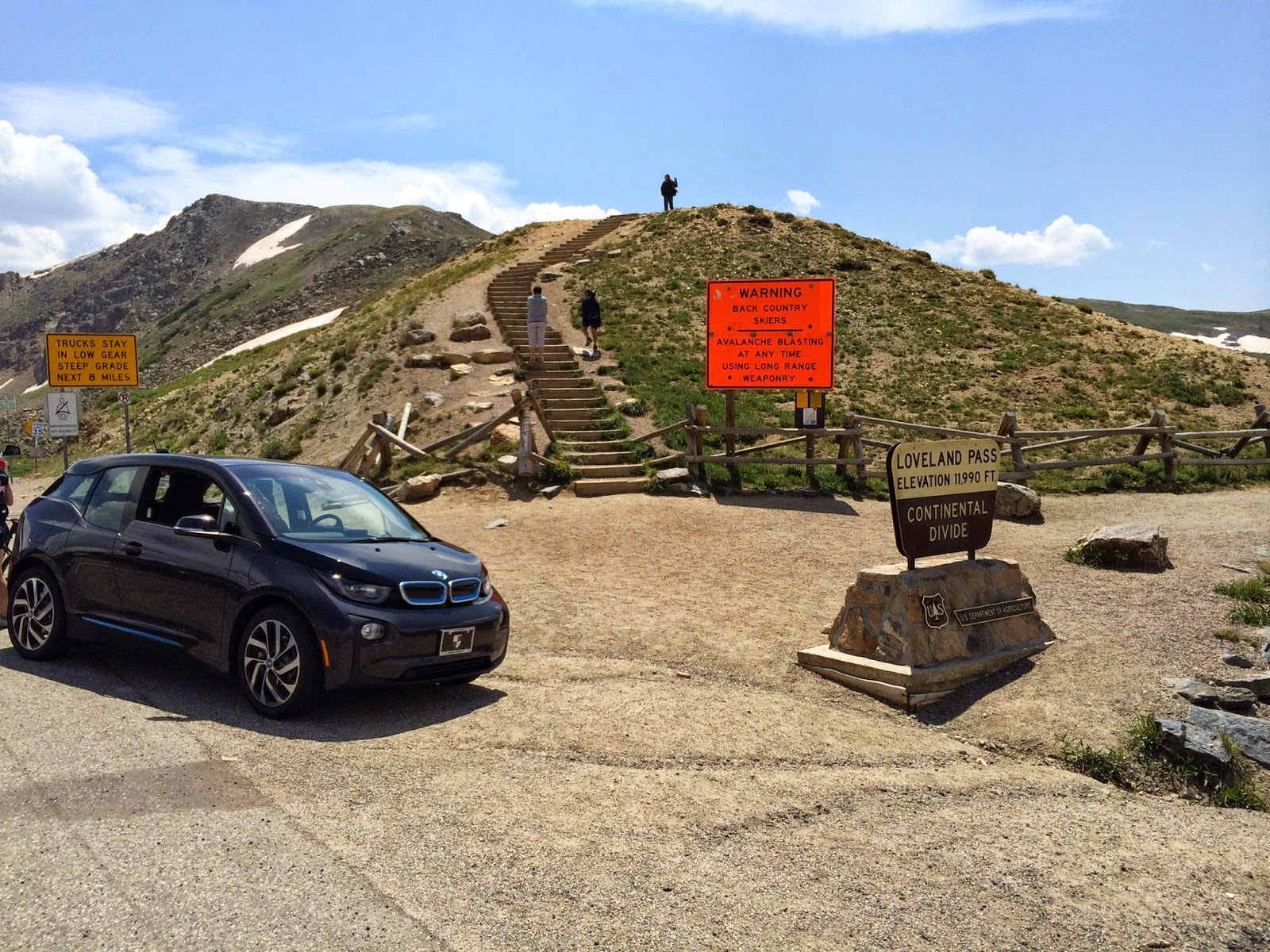
Loveland Pass, Continental Divide, Colorado. Elevation 11,990 ft
A few weeks ago Don Parsons of Denver, Colorado took his i3 REx on a 128 mile road trip from his house to Loveland Pass (Continental Divide, Colorado). On his way up to the 11,990 ft elevation of Loveland Pass he stopped at Beau Jo's Pizza for lunch and to charge on their public ChargePoint EVSE where his i3 REx accepted 8.9kWh's of juice to help with the rest of the climb up the mountain. 

The car showed 18 miles remaining at the top of Loveland Pass, and he nearly made the trip entirely on electricity when 62 miles later the range extender kicked on and he was only 2 miles from his home. 
The trip summary: 
-64 miles each way
-8,960 feet of climbing, 2329 Feet of descending on way out
-2329 feet of climbing, 8,960 feet of descending on way back
Having heard about this Continental Divide conquest, I asked Don if he wanted to write a guest blog post about the trip, but he offered to do one better. His next challenge was to take his i3 REx up to the summit of Mt Evans which is the highest elevation paved road in the US. The trip would take him over 14,000 feet above sea level and would most certainly push the range extender beyond its limit. This was not the kind of road trip BMW envisioned people taking the car on when they designed the REx, but nonetheless they have to expect some people like Don would do just that. So what happened? Read Don's words below to find out:


I’ve had my BMW i3 REx for almost two months now and haven’t really used or tested the REx engine.  Before today, I’d driven about 1750 miles total with only about 10 miles using the engine.  I decided to drive from my house in Denver to the top of Mt. Evans and return without stopping for gas or topping off the charge.  Using the REx engine in the mountains can be tough because the output of the small engine can’t really put out enough power to go both highway speeds and climb uphill.  However, the road to the top of Mt. Evans is pretty narrow, has steep drop-offs, no guardrails and a lot of cyclists sharing the road so you really don’t want to go much faster than 35 mph.  For this reason, I thought the small engine could hopefully handle the climb.
For those that don’t know, Mt. Evans is the highest paved road in North America with an elevation of 14,130 feet above sea level!  I live in Denver which is at 5,280 feet above sea level.  It’s 63.5 miles from my house to the top Mt. Evans.  With some up and down hill climbing, the total ascent is 12,446 feet and the total descent is 3,686 getting to the summit.
I set the car into Eco Pro+ and set out on city streets of Denver, then I-70 west up the mountains to Idaho Springs.  Mt. Evans highway winds its way south from Idaho Springs to the Mt. Evans summit in 28 miles.  When I originally entered the destination into the navigation system, the guess-o-meter said 61 miles of range.  I tried to keep the cruise control set to about 5 miles over the speed limit.


I was surprised to find that the Rex engine didn’t turn on until about 52 miles into the drive (about 10 miles from the summit) with a total trip average mi/kWh of 2.8 when the REx kicked on.  However, about 1 minute after the REx turned on I got a Brake error message that ended up making the brake pedal feel stiff and pretty much unusable.  Fortunately, I was still heading uphill and the regen seemed to be working normally.


I could hear the engine speed up during the straight parts of the switchbacks and as I slowed down for the sharp curves, the engine almost immediately slowed down as well.  I never really wanted to travel faster than 35 mph so I didn’t notice any performance hit until near the summit.  On the last few switchbacks, I put my foot to the floor and couldn’t get the car to travel faster than 26 mph.  At close to 14,000 feet of elevation, the engine was probably severely limited from its usual output at sea-level.  I’ve heard people say that an ICE reduces power output by 5% for each 1,000 feet of elevation.  In any event no other cars were traveling any faster than 25 or 30 mph so I didn’t feel unsafe.
I finally made it to the top at 14,130 feet!  The temperature had gone from 68 degrees in Denver to 35 degrees and quite windy.  This road usually shuts down for the winter sometime in September so they will be expecting snow to start accumulating up there pretty soon!

As I was getting ready to head down, I was worried about whether I would have any use of the brakes since I had turned off the car and walked around the summit for about 5 minutes hoping the error would reset but it didn’t and I still had a stiff brake pedal.  Since it was 35 degrees up there, I was pretty cold and didn’t feel like waiting any longer so I thought I would start to head down and see how well the regen worked to keep the car in control.  You can imagine how happy I was to have such a high regen rate because I felt like I was in complete control all the way back home.

During the descent from the summit down to Idaho Springs I was excited to see that the regen had built up a full 25% of the battery SOC and the guess-o-meter said as high as 28 miles of range on the battery.  I drove home significantly on battery but the REx kicked in a few times where there was some climbing.  It also stayed on once I got out of the mountains but I was easily able to maintain 75 mph on the highway leading east back into the city.

Here's a screenshot of the elevation and speed of the whole trip
Some stats on the whole trip.  I traveled 127.6 miles and averaged 4.9 mi/kWh and average speed was a total of 39.6 mph.  I used a little over a quarter of the rex tank which I think is pretty minimal for traveling almost 130 miles! As you can see from the picture, the brake error was still in place when I arrived home.  However, after being on my EVSE for a little over an hour, everything was cleared out and a quick trip to grab lunch showed that everything was back to normal.

I should point out that I haven’t gotten any software updates yet as I haven’t been able to set aside the time.  Until this trip, the only error I’ve seen from the car is the Check Engine Light, which remains illuminated. There is a software update that will eliminate this waiting for me at my dealer, so I guess it's time to get the car into the shop for the updates.  Hopefully the brake error is related to the 12v battery issues that others have discussed and will also be fixed with the latest software version I'll be getting. 
When I thought about getting the i3 Rex, I figured that I would use the battery over 95% of my driving miles.  So far, it seems like I’m using the battery over 97% of my miles.  That said, I’m still happy to have the Rex as it completely takes away any range anxiety when I’m traveling in the flats of the front range of Colorado.

What about the mountains?  I was concerned about using the i3 REx in the mountains and still believe that having a REx hold mode similar to the European version of the i3 or the Chevy Volt would make this an even more enjoyable car in Colorado.  That said, a couple CCS fast chargers placed strategically off I-70 would go a long way to helping the issue.  Locations in Idaho Springs, Silverthorne (where the 8 Tesla Superchargers are located) Copper Mountain, and Vail would be ideal spots to get a quick top-off and be truly useful in the mountains.  I’ve also kept my 335xi for long distance ski trips since it has all wheel drive and is still a great car. However, even without the fast chargers I was able to make it to the summit and home without a problem.

I’m very happy with the the i3.  The performance, handling, smoothness, and quietness all contribute to a great experience.  Like others have said, it’s hard to go back to a regular internal combustion engine after experiencing electric!

BMW i3 REx vs Chevy Volt: My Take

The Challenge

Last week I was contacted by High Gear Media Senior Editor, John Voelcker and asked if I had interest in doing a head to head comparison piece between my i3 REx and a Chevy Volt. Green Car Reports contributor David Noland (who happens to own a Volt and a Model S) wanted to pit the Volt against an i3 REx and asked John to reach out to me and find out if I was up for it.

I liked the idea of swapping cars and driving side by side for a few hours and that met David's needs as well. David wanted to do an efficiency test and measure the miles per kWh's used driving 15 to 20 miles in a city environment, and then do the same thing at highway speeds of 65 to 75mph. Going in, David expected the i3 to be more efficient in the city driving test, but the Volt to be more efficient on the highway test where weight plays a lesser role and aerodynamics are more important. The i3 is tall, has a large front area and is a bit boxy compared to the Volt. This creates a much higher CdA which will lower the i3's efficiency at high speeds. Having driven my i3 for a while now, I knew it would be more efficient in the city cycle, but I figured it would probably tie the Volt on the highway leg of the test. My i3's life time efficiency so far is 4.5 miles per kWh and I do at least 50% of my driving at highway speeds.
David averaged 4.1 miles per kWh over a 46 mile drive at highway speeds. This was driving about 15 miles in charge depleting mode and another 31 miles with the range extender running.  The display only shows an average speed of 56.7mph, but much of the trip was done at 70+ mph
David was also very interested to find out how the range extender performed. In my opinion, the i3's range extender is largely misunderstood. Even months after the launch, few people really understand how it works, what it can and cannot do. It has been called everything from a "limp mode" to an "emergency use only" option, and quite honestly BMW hasn't done itself any favors by not fully explaining how it works and how to use it properly. I promised David he could drive it as he wished, and even purposefully overwhelm the REx by driving fast enough to use more energy than the range extender could produce, should he desire to do so. At one point he even asked if I minded if he did just that, but due to the other traffic we couldn't really sustain a speed much over 70mph for long and we were not going up and long, steep inclines so the REx was able to put out enough power to maintain the SOC between about 4% and 6%. In short, we couldn't overwhelm it without driving in a an unsafe manner.
Getting ready to take off from Nauna's Bella Casa in Montclair

There aren't many long climbs in my area and I've driven with the range extender on quite a bit. I haven't found any condition where it isn't perfectly capable of allowing me to drive as long as I needed to, including hundreds of miles if I really wanted. However I know the REx has its limits, unlike the Volt. I have heard stories of people not being able to maintain highway speeds as the car drops to 45 mph suddenly. That's a problem that BMW needs to address. I think they need to make a better effort to communicate to the customers what the limits are, and I also believe the customer needs to be cognizant of the limits and keep an eye on the SOC under high speed driving up long inclines. It's not a do-all-under-any-condition vehicle. The range extender has limits but I definitely believe that for the vast majority of people it will do just about anything they need. Also, since the i3's electric range is double that of the Volt, the range extender will be used much less, so it's reasonable to understand why it is less robust.

People are surprised when they see the i3 next to other EVs. It is larger than I believe many people think it is.
On the Road
 
I felt very comfortable behind the wheel of the Volt as I've driven many of them and have always liked the driving experience that they offer. However, this was the first time I've driven a Volt since getting my i3 REx three months and about 6,500 miles ago. The two cars definitely feel very different. The much heavier Volt absorbs road irregularities better and is quieter at high speeds, where the boxy i3 has noticeable wind noise. The i3 is much quicker, especially at higher speeds and has better braking and handling. The i3's steering is more direct and sensitive and the Volt's brakes seemed a little spongy or squishy compared to what I'm used to in the i3. The i3 is clearly more of a performance car, while the Volt offers a more supple, softer ride. The regenerative braking on the i3 is much stronger than the Volt's, even in Sport mode and low driving gear. I'm sure I would adjust to it if I had a Volt for awhile, but I just couldn't get myself to stop for traffic lights without needing to depress the friction brake pedal every time. I almost never use the friction brake pedal on my i3 unless it's an emergency situation where I need to slow down unexpectedly. I really love this on the i3, and haven't found any other EV to have a regen system that matches it. It's definitely one thing that BMW got right. I know the Volt blends regen with friction braking so I suspect most of the time I depressed the brake pedal I wasn't even using the friction brakes, but I've really grown fond of the one-pedal driving of my i3 that anything else now seems sub-standard.
The interior of the Volt
The interior of the i3


I found both cars comparable in seating comfort and room, with the Volt having a larger cargo area. Because the e-drive motor and range extender are under the deck behind the rear seats, the i3's cargo deck is higher, which cuts down on the cargo space, but it also doesn't have a tailgate lip so you can slide objects in and out without having to pick them up over the lip to remove them as is the case with the Volt, which my bad back appreciates. Personally I like the uncluttered, modern interior look of the i3 better, and the large center display probably is the nicest I've seen in any car besides the Model S. However the exterior styling of the i3 is definitely unconventional and I'm sure many people will say they like the look of the Volt better, but styling is subjective so I'm not really going to get too caught up appearance here. One thing I really do like in my i3 is how the absence of a center transmission tunnel (battery tunnel on the Volt) provides a much more open, spacious feel in the cockpit. In fact, this makes it quite easy to slide across from the drivers seat and exit from the passengers door if you want to.  
The Volt has a larger cargo capacity, but with the rear seats folded flat, the i3's cargo space is definitely adequate for my needs.
Efficiency

David really wanted to focus on the efficiency of the cars so we did roughly 15 miles of city driving, followed by 15 miles of highway driving at 60 -70 mph. There were a few occasions we got up to 75 or so to pass other vehicles but for the most part we drove in the middle lane and averaged a little under 70mph. In the city cycle the i3 averaged a 5 miles per kWh used compared to the Volts 4.5. The Volt did better than I expected in this part of the test though, which I am happy to report. On the highway test the i3 delivered  4 miles per kWh used and the Volt averaged 3.5 mi/kWh. David and I were both surprised that the i3 actually had a larger advantage on highway driving than it did in city driving, but was 14% on the highway. I suspect if we drove faster, and averaged over 70 mph, the Volt would have caught the i3 in efficiency. The test also isn't perfectly controlled, since David and I aren't the exact same drivers. However, we are both very experienced electric vehicle drivers, and understand perfectly well how to maximize efficiency with the use of regenerative braking and limiting jack-rabbit style take offs. We drove with the climate controls set to 72 degrees and the windows closed.

During the city driving test. I jumped out of the Volt at a red light to grab this picture.
Conclusions

Having had quite a bit of previous experience driving Volts, there were really no surprises for me. I have always liked the Volt, and nothing from this experience has changed that. It's a very capable extended range electric car that offers a good ride, decent performance and nice styling. It is a better choice for long range driving (over 200 miles) and definitely if you live in a mountainous area. I can't even count how many people I've recommended the Volt to; and many have stopped back to my restaurant weeks or months later to show me that they took my advice. With a starting price of $34,999 it's a really a great deal. The i3 REx on the other hand starts at $46,125 which is $11,000 more. Yes, you do get a more nicely optioned vehicle but it's very hard to ignore the $11,000 difference. If price is a big consideration then it's hard not to pocket the eleven grand and take home a Volt.

However buying a car isn't always a rational decision, and there are indeed emotions involved. If that weren't the case we'd all be driving $15,000 Honda Fits. There are a lot of reasons why the i3 REx is a better EV for me than the Volt. First off, I drive about 33,000 per year, and the 38 mile AER of the Volt would mean I'd be driving on gas about as much as I drove on electric. The i3 REx will allow me to drive on electric over 90% of the time. For me to increase that 100% I'd need to jump up to Model S-type range because the times I have needed the REx were usually 150 to 200 driving mile days and there are no other current production electric vehicles capable of doing that without using a robust DCQC network which doesn't yet exist in the Northast. Another consideration is the 3.3kW onboard charger that the Volt has. I'd find it very hard to buy any EV that was limited to 3.3kW charging. My i3 can actually charge faster from zero to full an a level 2 EVSE than a Volt can, yet it has twice the electric range. GM absolutely needs to upgrade the onboard charger to a minimum of 6.6kW for the next generation Volt in my opinion.

I've read many comments on various online forums regarding the size of the i3's gas tank and I can say I categorically disagree with the notion that the car needs a larger gas tank. In fact, I'd be fine with a smaller one. If you think you need a bigger gas tank on the i3, then what you really need is a Volt because you're buying it for a use that it's not really intended for. The i3 REx is fine for driving in range extender mode for short distances, and I think it's really a great car for trips up to 150 miles or so, but if you really need to frequently drive more than that, it just may not be the best fit. If you need to go further once a month or so, then sure that shouldn't be a problem as long as you don't mind the 2-3 minute stop to refill the tiny tank, but frequent long distance driving just isn't the car's best use.

I also put a big emphasis on the driving experience and the i3 is really a blast to drive. The Volt is fun in its own right, and it is certainly no slouch by any means, but the i3 is noticeably faster and has a much more direct steering feel. I also love the fact that the i3 is all carbon fiber reinforced plastic and aluminum, the open cockpit and simple dashboard with the large center display. It was indeed the better choice for me, but honestly, I would be very happy driving a Volt also, especially if I drove less than the 90 miles a day that I do now. I don't think you can lose with either of these extended range EVs. Just pick the one that fits your budget, needs and desires and you'll be happy with whichever you choose.

You can read David's thoughts on his Green Car Reports article here.

After 2,000 Miles Part Two: Dislikes


I have to say that overall I am very pleased with my i3. It's living up to what I had hoped it would be, and after a month of ownership I'm convinced it was the right electric vehicle choice for me. However that doesn't mean it's perfect. In fact it's far from perfect, but so is every other car out there. As much as I really love my i3, I can probably list a couple dozen things that I would have done differently. Listed below are some of the top things that I'm not particularly fond of.

I took this picture from an i3 display at the LA Auto Show. Somehow 100 miles turned into 82 miles once the production i3 was revealed.
The Range. So let's just get this out of the way now. I'm disappointed that BMW didn't deliver a real "100 mile" electric vehicle as they had been promising. The 81 mile EPA range on the BEV i3 and the 72 mile rating for the REx, falls a little short in my opinion. If the BEV i3 had an EPA range of 95 miles per charge or greater then I wouldn't have ordered the REx, and I think a lot of others share that opinion. I hope I'm wrong, but I believe this is going to hold back BEV i3 sales significantly. I think 82 miles falls just short of what many US customers will find acceptable for a premium electric vehicle.
Looks like the battery is 3 & 3/16th's out of 4 bars full. Wonderful.

No Proper State of Charge Gauge. When I first found out that the i3 wouldn't display the state of charge in numeric form, I was dumbfounded. Instead, the i3 state of charge display is just four bars that slowly erode as the range diminishes, and it displays the predicted amount of miles the car "thinks" you can travel. In other words, a Guess O Meter. When Nissan initially offered the LEAF, this is basically the same way they displayed the state of charge. Their customers complained so much, that after a couple years Nissan finally realized they made a mistake and added a proper state of charge display. I dedicated an entire blog post to this back in December of last year when it was revealed that the i3 wouldn't display the SOC. Still to this day I am in denial and refuse to believe it's not coming in a future software update. There is absolutely no logical reason for omitting it. It was simply a mistake on BMW's part and like Nissan they will indeed realize that and add it to the display at some point. I'm not saying they need to eliminate the bar system they have, just give us both and let the customer decide which they prefer to rely on.

Like the MINI-E before it, the ActiveE had a clear state of charge and battery temperature display. It's puzzling why both of these important features were omitted on the i3.

No Battery Temperature Readout. Like the state of charge gauge but to a lessor degree, this is a little puzzling. Maybe the majority of i3 owners might not really care what their battery temperature is, but I do and I know quite a few others who do too. It's further puzzling because both of BMW's beta test cars that I drove, the MINI-E and the ActiveE, had battery temperature displays. I like to see how well the thermal management system is performing, how hot the battery may have gotten while baking in the direct sun of a parking lot for a few hours, or how cold the cells are after parking outside overnight in the dead of winter. Knowing the battery temperature helps me know what to expect of the car performance-wise and can also help me to keep the cells from getting too hot in certain circumstances. The car knows the battery temperature, just provide that somewhere on a screen buried in iDrive somewhere and I guarantee many i3 owners will appreciate it.
When you are in "Glide Mode" the white bar is in the position it is shown here. As you use power the bar moves to the right (ePower) and if you are recuperating energy with regenerative braking, the bar moves to the left (Charge) of center.

Glide Position Difficult to Achieve and Maintain. BMW describes the i3's glide feature as such: "The BMW i3’s accelerator has a distinct “neutral” position; i.e. rather than switching straight to energy recuperation when the driver eases off the accelerator, the electric motor uses zero torque control to decouple from the drivetrain and deploy only the available kinetic energy for propulsion. In this mode, the BMW i3 glides along using virtually no energy at all." I've only had the car for a month, but it seems more difficult to find the glide (or coasting) position and then hold it, than it was on the ActiveE. A few years ago I was talking with a BMW engineer about this and I suggested there be a switch to turn off regen completely if the driver wished. I would prefer to do this on long, high speed highway driving where I want to coast as much as possible. I was told that they probably wouldn't offer such a switch to disable it because they would be worried the driver would forget they deactivated the regen, and possibly have an accident because they expected  it to engage later on. I still think this would be a good solution for maximizing efficiency by coasting at higher speeds.  

The kenaf deck in direct sunlight
You can see the reflection of the dash


Windshield Glare. The majority of the top deck of the dashboard is made of compressed kenaf fibers. The use of this material has garnered some criticism because some people think it looks cheap, and not worthy of being in a car made by a premium automaker. I actually like the look of it but what I don't like is that in direct sunlight I can see the reflection of the entire dashboard up on the windshield. After a few weeks I'm getting used to it and it isn't as annoying as it was when I first noticed it, but it definitely isn't ideal. The shiny kenaf surface does cast a pretty clear reflection on bright, sunny days.

No AM Radio. I like to listen to AM talk radio and I am a Mets fan (unfortunately). Mets games are only broadcast on AM so I was disappointed to find out that i3 doesn't have an AM radio. BMW spokesman Dave Buchko recently told Jim Motavalli the reasoning for excluding the AM radio was primarily due to interference from the electric motor: “We learned from our experience with MINI E and BMW ActiveE that the electric motor causes interference with the AM signal. Rather than frustrate customers with inferior reception, the decision was made to leave it off. HD Radio is standard on the i3 and through multi-casting, many traditional AM stations in key markets are available on secondary and tertiary HD signals.” I admit the AM radio in the MINI-E had really bad interference, so much so that I rarely listened to it, but it wasn't bad on the ActiveE. Other electric cars have AM radios and they don't seem to be all that bad. This is a little bit of a head-scratcher to me. I'm learning to live without it, but why should I have to?

Grooves like this in the pavement can be felt more in the i3 than in other cars. I believe it's because of the vehicles light weight combined with its narrow tires.
The Thin Tires Can Get Caught in Pavement Grooves. When roads are paved, unless they are narrow secondary or tertiary roads, they are usually done in multiple strips. This also allows the street to remain open with one lane of traffic flow at a time during the paving process. The problem is, the line where the two sections of the new pavement meet has tiny gaps and over time the road degrades with the help of water and ice and a groove develops. The i3's tires are so thin that they are effected by these grooves and uneven pavement more so than most cars that are heavier and have wider tires. It doesn't present a safety problem; the car doesn't lose any control, you just have to be cognizant of this and make sure you have a grip on the steering wheel when one wheel dips into pavement grooves - which is a good idea in any event. I also believe the very sensitive steering of the i3 adds to this sensation that the grooves are trying to steer the car for you. The i3 has very tight and sensitive steering. You only need to slightly lean in one direction or the other to make a turn, and it is something that takes a week or so to get used to. It has by far the most sensitive steering I have ever experienced on any car. The turning radius is also a freakishly-short 32.3 feet.
The Key FOB will open the front trunk, but not the rear hatch.

Key FOB Doesn't Open the Hatch. This is a minor complaint, and since my i3 has comfort access I can open the locked hatch just by grabbing the hatch handle as long as I have the key in my pocket. I would still prefer to have a button on the FOB that remotely opens the hatch. There is a button that opens the front trunk, which I will rarely ever need to open, I don't know why BMW didn't use that button for the rear hatch, or just add a button and have one for both.

Regen Braking is Less Aggressive. Before I start complaining, let me say that I've driven just about every modern electric vehicle and plug-in-hybrid and I believe the i3 has absolutely the very best regenerative braking system on the market. Telsa probably comes in second and the Volt, when driven in low mode, is right behind the Model S. BMW dialed back the regen on the i3 a bit, probably in the vicinity of about 10% when compared to the ActiveE. People who never drove the ActiveE or MINI-E won't understand what I'm complaining about because the i3's regenerative braking is still strong and very smooth. It can bring the car to a stop without using the friction brakes faster than any regenerative braking system on any other EV will. Still, I liked it stronger like it was on the ActiveE and MINI-E. I guess regenerative braking is like coffee. Some will prefer the Blonde Roast with cream while others want the Dark Roast served black. Give me my regen as strong as possible please. I recommended to BMW that they offer different regen settings and let the customer decide how strong they like it, but that didn't come to pass on the i3. It's still very good, and integrates seamlessly when decelerating, I would just prefer it a bit stronger.

When the car is locked the connector will not release, even when charging is finished

Locking Connector. While charging, the connector is locked to the car as long as the vehicle is locked. The connector cannot be released unless you unlock the doors, even when the charging session is complete. I've found this very annoying and so have many other i3 owners. The ability to lock the connector to the car should be configurable in iDrive, giving the owner options like "Unlock when charge is complete" and "Do not lock connector". Allow the owner to decide what works best for them. Many people like to share chargers, especially in EV-friendly California. These people will leave a note on their dashboard telling others it's OK to unplug them and use the EVSE once they have finished charging or after a specific time. The locking connector prevents any charger sharing unless you leave your vehicle unlocked, which is not a viable option in most circumstances. I can understand this locking feature would be necessary in Europe because the charging cables are not tethered to the EVSE like they are here in the US and this prevents theft. It seems BMW may have built the i3 for the European charging process and didn't consider the inconvenience it would cause for US customers. This is another feature I believe we'll see changed in a software update at some point in the future.

When I navigate this bend in the road by my house, the regenerative braking disengages. Since the road is also downgrade I find I have to use the friction brakes to keep from accelerating down the  hill. I didn't have to do that in the past while driving my MINI-E or ActiveE as both would allow the regenerative braking system to hold back the car during turns like this.

Regen Braking Disengages During Hard Turns. I'm a little surprised with the second complaint I have with the regenerative braking. While negotiating turns, the regen sometimes disengages which will give the sensation that the car is actually speeding up. Of course it isn't (unless you are going downhill), but when you are in full regen and it suddenly disengages, it does feel like the car is accelerating when if fact it just isn't being slowed down by the regenerative braking. During the MINI-E and ActiveE programs, I personally spoke to dozens of people who contacted me asking if my car ever suddenly surged ahead. What was happening with those cars was different though. If the regenerative braking system was operating and the car hit a pothole or a bump that caused the wheels to lose traction, the traction control would disengage the regen in an attempt to prevent the loss of control. When this happened, it would give the driver the sensation of sudden acceleration, especially when driving downhill. This was unsettling if you didn't understand what was happening and typically when this happened the owner would take the car to the dealer for service. The dealer would look it over and find nothing wrong and give it back to them. Frustrated, many of the drivers then contacted me to ask if anyone else had complained of this sudden acceleration problem. After explaining what was actually happening to them they understood what was going on. I would also caution them to always have their foot ready to press the friction brake when they were using regen to slow the car down, especially if they were approaching the car in front of them as they were decelerating.

BMW has indeed improved the whole traction control/regenerative braking system communication and the i3 performs much better than the MINI-E or ActiveE did when the tires lose traction during regenerative braking. However it now disengages during cornering, and neither of its predecessors ever did this. I can tell by how it's working that it isn't a flaw in my system, it was intentionally designed to do this, perhaps to prevent the thin tires from losing traction while negotiating hard turns. Again, it's not a problem as long as you know it's going to happen and you are ready to use the friction brakes if necessary. I've found it mostly happens while I'm taking a highway off-ramp that circles down under the highway overpass. It seems the speed I'm traveling combined with the sharp, constant turn is too much and the traction control preemptively disengages the regen in an attempt to prevent the loss of traction. I believe this is something the dealers need to communicate to the customer. It can be a safety issue if new i3 owners aren't prepared for it. Just like with the MINI-E and ActiveE, I'm certain there will be customers that believe there is something wrong with their car and will take it to the dealer for service. And just as I'm sure that will happen, I'm sure the service departments won't have a clue what the customers are talking about and will tell them they checked it out and car is fine. Unless the service manager happens to read this post ;)


I haven't had this happen to me, but a couple people have reported it.
Software Bugs and Various Glitches. There have been a number of various software bugs and other issues reported since the car launched here in the US about two months ago. For example, all of the i3s with the range extender option have had their check engine light (CEL) come on sporadically. Evidently there is nothing actually wrong with the engine, it's just a software bug and BMW has just released a patch to stop the light from coming on, but it's still not something you want to see on a new car. I've also heard of a couple people have their onboard charger fail, and a few others report that the car flashed a "Drivetrain Malfunction" warning. In the cases I've heard about, it just cleared itself and the owner was able to take it to the dealer to be checked and there was no problem found. Honestly I did expect there would be some initial glitches, and it's really too early to tell if these are isolated cases or if it's an indication that there are indeed going to be more problems to come. Other than the phantom CEL warning, my car has been perfect so far, but I'll be watching it closely and reporting on what I experience as well as what I hear from other i3 owners as time passes.

Minor Annoyances:
There are a few things that really don't bother me that much, but I know other i3 owners who have complained about these things:
The dangling plastic charge port cap seen here isn't really too high on my list of annoyances, but I have heard quite a few other i3 owners complain about it. I even know a couple that have cut it off.

1) Charge port plastic caps. After you open the watertight charge port door you need to remove a plastic cap before you plug the car in. It really doesn't bother me, but I agree it isn't the best solution. a spring loaded cover that flips over and snaps in place like the ActiveE had would be better. Is this really even needed though?

2) The adaptive cruise control system will sometimes disengage for no apparent reason. When it works, it's really a great feature, but it does have a tendency to disengage by itself. It seems like driving in the rain, in direct sunlight and going under overpasses give it the most trouble. I have used it a couple dozen times now and it has disengaged four times by itself. Not a big issue, but one that BMW will hopefully improve.

3) The "Door Ajar" warning light is very sensitive. If you don't close the doors pretty hard, the door ajar warning light will come on while you are driving. The doors aren't in any danger of opening, I just think the warning trigger is just too sensitive.

4) BMW advertises that for home charging "a maximum charging power of 7.4 kW can be reached".  I have yet to be able to crack 7kW's and usually see my charge rate at around 6.7 kW to 6.9 kW. Sure, this is a minor complaint, but my supply is more than adequate to accommodate at least 7.2 kW, so why won't the car pull it? I've talked to other i3 owners about this also, and 6.9 kW is about the most anybody has seen the car pull.

5) No programmable button on the key FOB to initiate battery and cabin preconditioning. The European i3s have this feature, but for some reason it was left off the US i3s. You can still initiate cabin and battery preconditioning via the smartphone app, but having it on the key FOB is easier. Some people (you know who you are!) have told me it was a deal breaker and wouldn't buy an i3 without it.    

I'm sure I'll come up with more dislikes as time goes on, and I'll continue to post them here. Even considering everything I've detailed here, I'm thoroughly enjoying my i3. I drove it a total of 162 miles today and less than 2 miles was with the REx running. The range extender allows me to really push the range limit without worrying if I'll make my destination. Oh yeah, that reminds me of one more complaint. I want the ability to turn the range extender off if I know I'll make my destination. Twice so far the range extender turned on when I was less than a 1/4 mile from my house and once it turned on while I was pulling up my driveway! I believe the European i3s do allow the operator to turn it off manually, so that's just another feature (sunroof, programmable key FOB, REx hold mode) that we don't get here in the States. Yeah, I know... first world problems. :)