Showing posts with label science. Show all posts

Hacks in Human Evolution: Menstruation

This was by far the most interesting thing I read yesterday: Menstruation as a Hack by science-writer Suzanne Sadedin.

She goes through the whole process by which human fetuses operate as parasites on their mothers (as opposed to in other mammals where the mother's control the process), thanks to the "ravenous hemochorial placenta." Therefore, she continues, mother's body needs more control over whether she gets pregnant, so has created an endometrium as a "lethal testing-ground which only the toughest embryos survive. The longer the female can delay that placenta reaching her bloodstream, the longer she has to decide if she wants to dispose of this embryo without significant cost."
The solution, for higher primates, was to slough off the whole superficial endometrium – dying embryos and all – after every ovulation that didn't result in a healthy pregnancy. It's not exactly brilliant, but it works, and most importantly, it's easily achieved by making some alterations to a chemical pathway normally used by the fetus during pregnancy. In other words, it's just the kind of effect natural selection is renowned for: odd, hackish solutions that work to solve proximate problems. 
 And like most hacks, my friend N. said, trying to deal with the kludge has caused so many more problems than if we had just fixed it in the first place!

So much for intelligent design.
There is No Autism Epidemic

How we talk about disability matters. For example, I have often criticized Autism Speaks and anti-vax groups (not the same - AS is not AntiVax, they have other problems) for the way they talk about autism as a disease needing a cure. I assure you, my autistic friends are not diseased. Moreover, it's absolutely clear that autism rates - in terms of numbers of diagnoses - are skyrocketing. The question is why. Antivax folks say it's because of vaccinations (N.B. It's not). Autism Speaks says, I believe, that they don't know why the "epidemic" is happening and they need to study it and stop it.

Meanwhile, the counter-argument is that there is no autism epidemic, we are just diagnosing it more accurately and have expanded the definitions.

Here's a new large-scale study from Sweden. It took ten years and nearly 20,000 twins (190 with autism) and all children in Sweden (over a million, 4000 with autism) and concluded this:
The prevalence of the autism symptom phenotype has remained stable in children in Sweden while the official prevalence for registered, clinically diagnosed, autism spectrum disorder has increased substantially. This suggests that administrative changes, affecting the registered prevalence, rather than secular factors affecting the pathogenesis, are important for the increase in reported prevalence of autism spectrum disorder.
We are diagnosis autism differently as our understanding of the neurological condition has developed. Many, many, more people are being diagnosed as on the spectrum, and this is a good thing, as it enables neurotypical society to become more accepting and more inclusive of a wider range of behaviors. For autistic people who benefit from various kinds of therapies, and some certainly do (this is a controversial issue I'll save for another post), a diagnosis enables a therapist to work with them correctly.

So let me say it again:

1) More accurate diagnosis of autism is a good thing.
2) There is no autism epidemic


Women and Science: Harassment and Dropping Out

A few weeks ago, I wrote a well-read blog post about girls and science. Apparently, we're still debating whether it's nuture or nature that drives women to choose professions other than science.

Two recent pieces in the national media provide more evidence for the ways that women get driven out of the scientific profession, as well as the continued questions of the meaning of that evidence.

First, from the New York Times, a piece on harassment in science. It begins with the author relating her experience (a senior prof booking a hotel room with only one bed for the two of them), then continues:
I’d forgotten about this experience from two decades ago until I read a report published July 16 in the journal PLOS One. Kathryn Clancy, an anthropologist at the University of Illinois at Urbana-Champaign, and three colleagues used email and social media to invite scientists to fill out an online questionnaire about their experiences with harassment and assault at field sites; they received 666 responses, three quarters of them from women, from 32 disciplines, including anthropology, archaeology, biology and geology.

Almost two-thirds of the respondents said they had been sexually harassed in the field. More than 20 percent reported being sexually assaulted. Students or postdoctoral scholars, and women were most likely to report being victimized by superiors. Very few respondents said their field site had a code of conduct or sexual harassment policy, and of the 78 who had dared to report incidents, fewer than 20 percent were satisfied with the outcome.
Fieldwork, it is clear, is a dangerous place to be a woman. It's also where you make your break your career and take your first steps. The piece ends with a powerful call for clear standards, pre-emptive anti-harassment policies, and most of all, people to be willing to call out their friends and colleagues. We cannot rely on the victim of harassment to challenge the system herself.

And yet, I suspect many people will not heed the call. NPR has a new piece on women in engineering.
Over the course of three years Nadya Fouad, a psychologist at the University of Wisconsin-Milwaukee, surveyed 5,300 women who earned engineering degrees within the past six decades in order to figure out why so few stayed in engineering. Fouad reported that only 62 percent of respondents were currently working in engineering. Those who left the field provided their reasons for doing so in the survey.

"It's the climate, stupid!" she said during her presentation, referring to the "old-boys club" workplaces that she says still exist in many engineering organizations.
Respondents in her study reflected her sentiments, with many calling the engineering workplace unfriendly and even hostile to women. They also said that they felt many of these companies did not provide opportunities for women like them to advance and develop.
"Women's departure from engineering is not just an issue of 'leaning in.' " said Fouad, lead researcher of the study. "It's about changing the work environment."
Changing the work environment, not just individual women taking action. What I thought was especially important, if depressing, was this response to her work:
Not everyone agrees with Fouad's findings.
"Women aren't leaving engineering to go and hide in a corner. They are leaving for many reasons which a study like this may not find," said Elizabeth Bierman, president of the Society of Women Engineers and an aerospace engineer for 20 years. "The work environment may be one reason but for the majority it is not the case."
Her organization recently conducted its own retention study and found that although women do leave the engineering workplace faster than men, they do so for a variety of reasons. Many of those reasons, such as lack of a work/life balance, also resonate with men, Bierman said.
The bigger problem facing women and engineering, she said, is getting more women into the engineering pipeline. Bierman says companies looking to retain both women and men should improve their work/life balance policies.
"We've found that women stay in engineering because they want to make sure they are making a difference," she says. "If women feel they are making that difference, retention levels will be higher."
Yes, make a difference. And how do they make a difference?

Well, first we have to change the climate so that women's work is valued, women are protected from harassment (oh, the stories I have heard from a few aerospace engineer friends, now all working in other fields), and we change the culture.

Choice is fine. Choice is stressed by everyone defending the lack of women in sciences. But when the pressure is coming at women through harassment, through bias, through diminishing women's work, through all the factors we know that run rampant in our patriarchal society, there is no real choice. You either go with the flow and find something else to do, or spend your life spitting into the wind (warning, mixing metaphors!). It's no surprise so many women drop out.

To end on a good note, for the first time in 80 years, the winner of the Fields Medal in mathematics, the "Nobel prize" for the discipline, is a woman! May there be so many more that it's no longer news.

Girls and Science - Makers vs a Scientific American Blogger

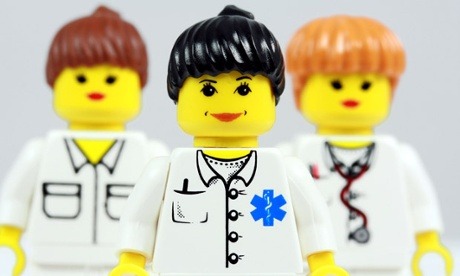
So Verizon and Makers teamed up to make a great new video about the insidious ways that we push girls away from science.


I am always suspicious of corporations getting involved in social causes, as they tend to be followers rather than leaders. Still, Makers is pretty great and I think the video highlights some typical ways that we push girls away from science, math, and so forth.

The takeaway is that starting very early, mostly without meaning to, our society (and especially parents, but surely friends and school and media and commerce and so forth) lets girls know that their place is NOT in the lab or the workshop or the field. It's socially constructed, it may well not be intentional, but it works.

This conversation matters because, much to my surprise, the fundamental premises are still subject to debate. This morning I was alerted to a post on Scientific American blogs, in which a psychology doctoral student named Chris Martin wants you to know that women are just naturally not so scientific, at least not when we're talking about the super-duper-smart people. He invests in the Larry Summers argument because he wants to debunk Neil DeGrasse Tyson, who when asked about women in science, gave a smart answer about race and science by way of analogy.

Martin writes, with intense disciplinary snobbery to my reading:
Neil deGrasse Tyson responded to the question quite well, but since he’s not a social scientist, he wasn’t able to draw on psychological research on gender differences. His answer focused on stereotyping and self-fulfilling prophecy effect. I don’t blame him the slightest for lacking expertise in an area outside his specialty, but I do think people who only watch that video could come away with a misconception about the impact of stereotyping. I’m not going to discuss self-fulfilling prophecies here—they have a weak effect—but I will talk about how recent research has addressed this question.
Yes, Martin argues, there might be a weak effect of stereotyping, but really it's not such a big deal. The key, he argues, is that there are plenty of women in science, but they tend to be in biology and psych, and most of them do not "choose" to go into academic careers. Martin wonders why.

I am not going to quote more fully. At the end, he nods to the notion that stereotyping might have a tiny bit to do with why women don't become scientists, but mostly he makes claims that in the context of the Larry Summers debate have been well discredited. Yes, it's not impossible that there are evolutionary factors that have a tiny effect on career choice. It's not impossible. But as said on twitter (quoted with permission):
We've been through this before.

There's a place for a smartly argued thoughtfully nuanced piece on the ways that evolution may in fact shape certain kinds of gender difference. This is not that piece. This makes these bold confident truthy statements claiming that the matter is resolved, and this man will tell how it really is.

It wouldn't matter. Except that it is on Scientific American's blogs, a major forum, and I suspect it reflects the beliefs of countless people in positions of authority, people who hire, people who train, people who run labs.

Here's the deal I'll make.

Let's get rid of all the stereotyping, all the micro-aggressions that drive girls and women out of science, the social messaging that women who nurture are the only real women, that pretty matters more than smart. The phrases in the video are real, I hear them, I see them in our media. Let's beat those back, and then we can see where the evolutionary gender differences really take us.

Because these stereotypes run deep. Sometimes, I feel them coming out of my own mouth, directed at my daughter. She'll be wearing a pretty dress, she'll be heading for the mud, she'll be doing something that might be a bit dangerous, and I'll find my words telling her to stop. And I'll be appalled at myself.

Then, even if my daughter's wearing a pretty dress, I hand her a shovel and we go out and dig for worms. I would dig out the science kit and do an experiment with her, but it turns out ... her mother is a scientist.

I leave the hard science to mom.