Possibly the First Ever BMW i3 Street Race!

The BMW Car Club of America is a large organization that is well known for their extreme enthusiasm for BMW automobiles, particularly the ones that are fast or modded to be so. It's unknown how many of the existing members feel about the i3, but my guess is they will be hard pressed to accept it into the family of "performance" cars, unless of course they have the chance to drive in one.

Such was the case for Satch Carlson, BMW CCA member. Satch posted his story called "Satch Meets the i3" on the CCA website recently and described how he was converted from an electric drive doubter to a believer in one short ride.

He starts the post off with saying: "Okay, I liked it a hell of a lot more than I expected to". Satch goes on to tell the story of how he was riding in an i3 when a journalist driving a MINI Cooper S pulled up next to them and challenged them to a race. The i3 with at least two passengers beat the Cooper S much to the surprise and enjoyment of Satch. He commented on the torque and how much fun it was to ride in, and summed up his experience by saying "the fact is that this here little hot rod is ludicrous fun".

This is what I've been saying for four years now. These cars are FUN! The instant torque is really addictive and driving electric electric quickly becomes the drivers preferred method of propulsion for many people once they have had a reasonable amount of time behind the wheel of one, especially one with power. The i3's 0-60 time is about seven seconds. That's not M3 power by any means, but what it does have is instant neck-snapping torque at speeds up to 60mph, and makes it a blast to drive at these speeds. Yes, the power dips off at higher speeds, but for stoplight to stoplight fun, it's really hard to beat.

I understand there will be apprehension from the BMW loyalists that are so conditioned to hearing the rumble of the exhaust and equating that to power and fun, but they'll eventually come around. We just need to get them to drive the i3 for a while and like Satch, they'll find themselves with an "EV grin".
Is the i3's performance good enough for CCA mambers to welcome it into the family?
the fact is that this here little hot rod is ludicrous fun. - See more at: http://www.bmwcca.org/node/6424#sthash.RWYTmLD8.dpuf

Okay, I liked it a hell of a lot more than I expected to. - See more at: http://www.bmwcca.org/node/6424#sthash.RWYTmLD8.dpuf

i3 REx in US Spec Spotted at Pebble Beach

You can tell this is a US spec i3 by the red and orange reflectors on the edge of the wheel wells. Look at the previous pictures on this blog and you won't see the reflectors there because they were all European spec pre-production i3's
I've had people ask me if I had any high resolution pictures on an i3 in Laural Grey already but till now I didn't. there were a couple pictures out there of i3's with the partial camouflage in Laurus Grey but none since all the wraps have come off. So when I came across these pictures posted on Bimmerpost taken a couple days ago at the Pebble Beach Auto Show in California I grabbed them and figured I'd put them up here for those that want to see this color on a real car and not just on the online Visualizer.
The only thing I'm thinking about with this color is the details get hidden because everything looks nearly black. Another reason I need to see it on a car in person.
I happen to like this color a lot. In fact it may have escalated up to the top of my want list now but I still need to see all the colors on cars in person. Another thing people have asked me about is the blue stripe below the side doors. Can it be ordered in different colors? The answer is no it can't. All of the cars will have the "BMW i Blue" accent there, as well as on the inside of the double kidney faux grill in the front of the car with the exception of i3's ordered in Solar Metallic Orange. The accent color on Solar Orange is called "Frozen Grey Metallic". Unfortunately you cannot mix and match. I suppose the only option you'd have is to customize it yourself and have the pieces painted after you purchase the car if it really bothers you.

You can see the blue trim piece here below the carbon fiber door sill. It's much more visible when you open the door
The BMW i Blue grill really stands out when it's on a Laural Grey i3.

So if you really don't like the standard accent color on your i3 your only options are to repaint it or possibly apply a vinyl wrap - at your expense. I happen to think the trim colors look good, but that is obviously subjective. Actually, if I were to complain at all about the exterior colors, I'd wonder why BMW stuck so much grey scale. Other than the Solar Orange all the other colors are a shade of white to black with slivers and greys in between. The Solar Orange is the only real bold color and I think they could have been a little more creative there. How about borrowing a cool color from the M division?

The Frozen Grey Metallic accent on the Solar Orange i3's will look less prominent than the BMW i Blue will on the other cars in my opinion since it's not as bright of an accent


BMW i3 Wins Two Next Green Car Awards


Winners of the 2013  Next Green Car Awards winners were announced yesterday and the BMW i3 claimed the top prize in two of the eight categories. The Next Green Car Awards are said to be the most scientifically-based Green Car Awards in the UK.


Courtesy Gerald Belton
The i3 won  the "2013 Supermini Award" for being "set to change what we expect and demand of an electric urban vehicle; one that maximizes electrification, connectivity, quality and driving performance.” It was won the "2013 City-Car" award. Of that, Suzanne Grey, General Manager BMW i said: "We believe the BMW i3 is a real game changing vehicle because it has been born electric. Being designed from the ground up to be an electric vehicle has resulted in a number of benefits in terms of weight, packaging, range, emissions and driving dynamics."

Other winners included the Nissan LEAF which took home the "Small Family Award", The Tesla Model S (Executive Award), the Volkswagen e-Up! (Next Generation Award) and the Volvo 360 Plug in Hybrid (The Large Family Award).

Dr. Ben Lane, Managing Editor of Next Green Car said: "The 2013 winners reflect two key elements underlying current green car development: drive-train electrification and continuing improvements in fuel efficiency. While all the winners are highly distinctive in the innovations they employ, they all excel at using new technologies to enhance the driver experience."

I have a feeling these won't be the last awards handed out the the i3. It will be interesting to see how the i3 is received when the big automotive news outlets hold their annual "Car of the Year" contests. The Tesla Model S swept many of these awards last year. While I don't expect the i3 to claim as much hardware as the Model S did, I do believe it will score very well up against the other new cars introduced this year.

Sources: Autoevolution.com, insideevs.com

i3 Modifications, a Sport Version and Fun

I found this photoshopped i3 on Bimmerpost. It looks to me like the creator has the right idea!
Now that we've seen the production i3 and BMW has revealed most of the specifications, I'm ready to begin the modifications! Evidently someone on the Bimmerpost forums is ready also because he used his photoshop skills and went to work on creating his own autocross-ready i3. I like it! It's even in the Laural Gray that I'm leaning towards so that made it all the better.

So this gets me wondering if BMW even realizes there are people out there that will want to modify their i3. BMW has already said there won't be an M version of the i3 and I conformed that with a program manager recently, but that doesn't mean they won't offer modification parts for those interested. After all, BMW cars are some of the most modified of any manufacturer. I hope they aren't under the assumption that just because i3 customers are concerned with things like sustainability, environmental issues, energy policies or just like driving electric that they won't share the same enthusiasm for driving as their combustion car customers do.

I'll take it one step further. Even if they don't cross pollinate the i and M brands, they could still make an i3 Sport version. Give it a special interior, offer it in a unique, bold exterior color, beef up the suspension, put on some real tires and give it a little more torque and HP(I'm sure they can do that with the same motor they have with very little tweaking) and you'll have a 6 second 0-60 car that will have better handling than 90% of all the sports cars out there. Sure it will probably cut 10 miles or so off the range but I think there are many of us out there willing to make that sacrifice.

I know BMW knows the market, and they know people want fun. Even if they are driving a "futuristic, sustainably manufactured" car. All that's great, but it's nothing if it's not fun. :)

The Silence of The Cars

Well Clarice, can you still hear the sounds of the engine screaming in your dreams?
There has been a lot of discussion about adding artificial noise to electric cars to serve as pedestrian alerts. I've been driving electric for over four years now and have driven over 120,000 miles, and I say they are simply not necessary. However as much as I wish it were true, I know the discussion doesn't begin and end with my opinion on this. Personally I'm all in favor for a backup beeper, which I actually think should be on all cars regardless of the type of fuel they use. But artificial noise when the vehicle is moving forward is silly and simply unnecessary. The quietness of the EV is something to celebrate, not shun.

Electric cars are quieter than gas cars, but only while driving at very low speeds (like under 10 mph) is there much of a difference. At speeds higher than that you can hear the tires on the pavement and the whine of the electric motor. Automakers are spending tons of money to make their gas cars quieter, and most cars - especially premium brands are extraordinarily quiet unless they are under heavy acceleration. In situations where pedestrians are most likely to have an issue, say crossing the street, cars are usually rolling along at lower speeds, coasting much of the time and much of the noise you hear anyway is the tire noise on the pavement. Plus, I think a bigger issue here is simply getting people to pay attention. Get off the cell phone, pull the Earbuds out and pay attention when you are crossing the street! And drivers need to stop texting and just drive the car. Look it's your responsibility not to run people over, it's not their responsibility to hear you coming and jump out of the way just so you can send "lol" to your bff! This is a sore subject for me because I was hit while crossing the street by a person texting three years ago and even needed surgery. I heard the car coming (a gas car!) just before it hit me and couldn't manage to get out of the way in time anyway.

Unfortunately our opinions may not eventually matter because our government may very well mandate a solution to a problem we don't have. The National Highway Traffic Safety Administration has proposed a new rule requiring hybrid and electric cars to make sounds to alert pedestrians. Even though our friends across the pond have actually done studies and come to the conclusion that these artificial noises are not necessary. Still, We'll likely rush to legislate something we don't have actual data on. In the UK, a study commissioned by the Department for Transport came up with these findings: "At low speeds of 7-8 kmh (5mph) electric cars were just one decibel quieter than petrol cars. When speeds were increased to more than 20 kmh (12mph), the noise levels were "similar", with tyre noise dominating. "There does not appear to be any significant difference in the acoustic nature of [internal combustion engine] vehicles and [electric and hybrid] vehicles, and as such nothing suggests a pedestrian would clearly be able to differentiate between vehicle types,"

Anyway as I said I'm just one opinion. I want to know your opinion on this issue. Automakers are struggling with this. They are conflicted because they aren't clear exactly what the consumer wants and they are also not sure themselves if it is actually needed. I know because I've talked with people from various OEM's about this very subject and they have asked me what I think about it. Some believe that while hardened EV supporters like me don't think it's necessary, that people new to electric vehicles may believe it is. That may be true in fact. So I'm putting up a poll here and asking people to vote how they would like to see their EV deal with this issue. Please vote, I can assure you this blog is monitored by every major OEM, and nearly on a daily basis. You never know who's listening. The poll is at the top of the right sidebar. Let your opinion be heard! By the way, all cars already have a pedestrian alert, it's called a horn!

How CARB May Make The i3's Range Extender Less Attractive

The range extender engine for the i3 is seen here to the left of the electric motor

According to the UK price list for the i3 the range extender will automatically come on when the state of charge falls to 18%. I've been guessing that will happen at about 20% so I was pretty close. It will then attempt to maintain the battery SOC at 18%, while allowing the car to continue to drive along relatively uninhibited. The only time there will be a problem is if your driving is demanding a high level of energy output for a prolonged period of time.

For instance, driving along at 60 mph on a flat surface you may only need 10 or 11 kW's to sustain the charge because that's about all you'll be consuming. That's no problem for the REx because it can provide up to 25kW's of constant supply. However if you need to drive up a steep grade at highway speeds for 10 continuous miles or so you may have a problem because the car will likely draw more than 25kW's under these strenuous conditions. The 18% buffer combined with the REx pumping out it's maximum output will allow the drive to continue for quite some time, but after a while of using more energy then it is capable of replacing, it will eventually need to reduce power output. What happens then is unclear but I would imagine the car would slow down to a speed it can maintain power for. Again, this should not happen on flat land, as the energy consumption should be able to be replace by the REx. It will also have plenty of power for most hills and bursts of speed when needed. I'm talking about long, extended drives up steep inclines that happen at the end of your journey after you've already depleated the battery and the range extender has come on. Personally I have a situation where this could come into play myself. My in laws live in Vermont and the last 10 to 15 miles to their house is mostly uphill. I'd already have the range extender on by the time I get to this final leg of the journey so I'm curious if I'll have a problem making it. I could stop along the way and charge for a while if necessary but I'd prefer just driving nonstop. After all, that's why I'd get the range extender; so I don't have to stop to charge along the way of a trip.

So what can be done to alleviate this? The Chevy Volt has a "Hold Mode" that the driver can initiate at any time. This manually turns on the range extender without waiting for it to automatically turn on when the battery is depleted and holds the battery state of charge at the level it was when you turned it on. Sounds like a great idea, so is BMW going to do the same thing? Yes, and maybe no. If you look at page 8 of the UK price list that I provided the link to above, you'll see it says: "Manually activated when the vehicle is below 80%". Brilliant! So if you buy an i3 in the UK, you can turn on the range extender once the state of charge drops below 80%. Therefore if you know you'll be driving up a long, steep hill or mountain at the end of your journey, you can turn on the range extender and "hold" the charge so when you arrive at the mountain you'll have plenty of charge to complete the journey. Perfect, so US customers will get this feature also, right? Unfortunately, maybe not.

CARB's restrictions may hinder the REx
California is the #1 market for electric vehicles in the US and one of the reasons they sell so well there is zero emission vehicles are allowed carpool lane access regardless of the amount of passengers. This is a highly sought after perk in California and cars that qualify for it usually sell very well. The all electric i3 will definitely qualify, but the under the new more strict rules for PHEV's, an EV with a range extender will only qualify for the valuable HOV access sticker if it operates this way: "engine operation cannot occur until the battery charge has been depleted to the charge-sustaining lower limit". So that means the range extender cannot be manually turned on at 80% and still qualify for HOV access in California.

It's clear to me BMW will make the i3 conform with CARB's rules so it will have HOV access is California, but will they do this to all the US cars, or just for the ones shipped to California? I don't have the answer. I tried to get clarity on this at the i3 Premier but nobody wanted to confirm it one way or the other. Hopefully that means a decision hasn't been made on this yet and there is hope for the rest of us. If so and the powers to be at BMW find their way to read this blog post, please consider offering the same ability to manually turn on the REx for US customers outside of California. The vast majority of customers in the US don't need carpool access, why should they have their range extender neutered so people in California can have it? This is a simple software change. It's available in the UK and probably for the rest of Europe so it's not like it will cost BMW anything to develop. Let's hope BMW does the right thing and makes this feature available to US customers outside of California. It really makes the range extender a more useful asset, this shouldn't be a hard decision to make.

The i3 World Premier: What was Learned?

Photo by Hugo Becker of BMWBLOG
The much anticipated World Premier of the i3 has come and gone, so now it's time to look at what was learned. There was a lot of information released and I'll try to touch on as much as I can here, but I also recommend reading the full press release I posted on my post yesterday.

With the range extender - pretty tight!

I had a chance to talk at length with Oliver Walter, Head of Product Management for the i3. We discussed many things, but what stuck out in my mind the most was our discussion about the performance of the range extender. During the day it seemed to me that when reporters asked some of the speakers about the performance of the range extender, they never got a clear answer. So while I had Oliver all to myself I asked him directly if the i3's performance will be drastically reduced as many speculated. When I mentioned the term limp-mode, he looked at me like he was surprised I would even ask that and quickly said "No this is absolutely not a limp mode". He further went on to say the car will actually behave pretty
Without the range extender
normal and that the drive can continue to drive along - even at highway speeds, just as they were before. It will have slightly less power, but still be capable of driving normally in most conditions. Evidently BMW has designed it to come on while the car still has a reasonable amount of battery charge left, so there is enough of a buffer to allow the car to reach back and get the extra energy needed for bursts of speed and to climb long hills. So this also means the car will have a shorter all electric range with the range extender because you'll only have access to the first 80% or so of your battery power before the REx turns on. However I did find out that the driver can turn the REx off so it never comes on if they know they'll make their destination without needing the range extender. Therefore, you can have access to 100% of the fully charged battery as long as you can make it to the next plug without needing the REx to help out. I really like this feature and think users will also. However you cannot turn the REx on manually, before it turns on itself, like you can with a Chevy Volt's "Mountain Mode" This mode allows you to use the generator early in your travels so you save the battery charge for later when you may need the extra energy to drive up very steep hills or mountains. The i3 will have difficulty in these rare situations. If you drive it until the Rex comes on and you then need to drive up very steep inclines for a long time - like 10 miles or so, the REx may not be able to keep up with the energy output the electric motor needs after a while and will likely slow down at that point. This is a complex topic and I suspect the only way to really determine exactly what conditions will be too much for the REx will be once people start driving it. However in most normal driving circumstances, it appears the REx will be able to allow the driver to continue along without any issues for as long as they need to. The range extender option costs $3,850 and which brings the cost up to $45,200 without any other options.We also learned the US i3's will come standard with all LED exterior lighting but the European versions will have halogen lights standard and LED's optional.


There are three trim levels that can be ordered. They are named Mega World (the standard trim level) with Giga World and Tera World available as options and here is what each consists of: (US pricing for options has not been announced)

 Mega World ($41,350; $45,200 w/REx)
  • BMW Navigation
  • BMW ConnectedDrive with eCall
  • BMW i Remote
  • Alarm
  • Bright, lightweight Sensatec and sustainable cloth made from recycled materials
  • Leather trimmed steering wheel
  • Grained dash trim
Giga World
  • All Mega World features, plus:
  • Interior wrapped in leather and wool cloth
  • Universal garage door opener
  • Comfort Access
  • Sunroof
  • Satellite radio
  • Leather-trimmed steering with contrasting stitching
Tera World
  • All Giga World features, plus:
  • Luxurious full leather
  • Olive leaf-tanned interior, with textile accents and contrasting stitching
  • Anthracite floors mats.
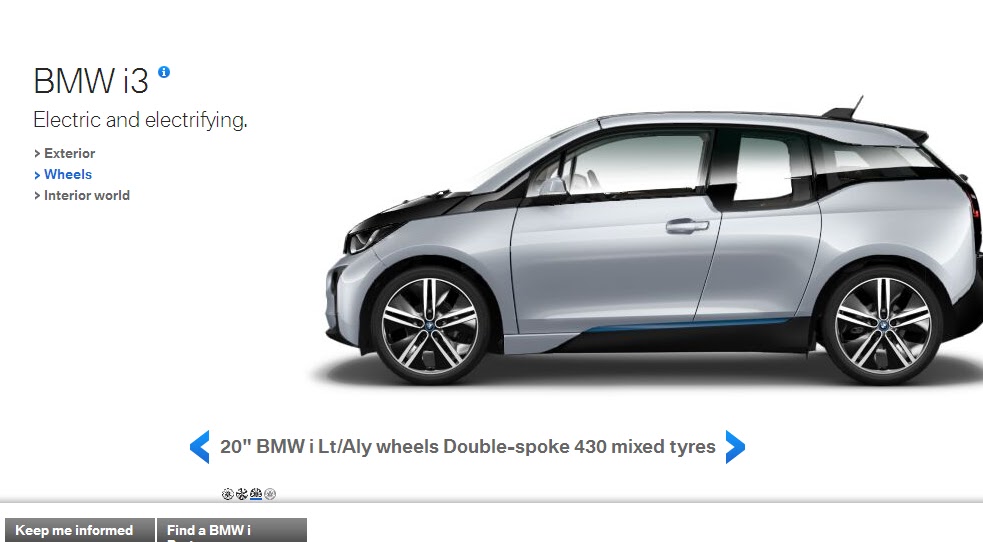
An i3 in Solar Orange with the optional 20 inch "Double Spoke" wheels
The 19 inch "Turbine" wheels
However the BMW i3 online Visualizer offers four different interior design styles called Antelier, Lodge, Loft & Suite. I am not entirely clear yet how these fit into the different "World" trim levels, but I'll get that cleared up soon. If you want to go to the i3 Visualizer you can from this link. Each World trim level comes with a different 19" wheel and all are visual upgrades from the standard wheel in my opinion. However to me the best wheel is the optional 20" one that also has wider and lower profile tires then the 19" wheels. These will undoubtedly provide better performance but will likely shave a couple miles off the range of the car because of higher rolling resistance and greater weight.

Ionic Silver with the 20" wheels
My previous post over two weeks ago was 100% correct about the color options. The only thing I didn't have was the official color names. They are "Ionic Silver" which is silver blue, "Andesite Silver" which I called basic silver, "Arravani Gray" which I called dark gray, "Laurel Gray" which I called basic gray, "Capparis White" which I simply called white and I did have the Solar Metallic Orange correct. I expect the Solar Metallic Orange to be a very popular color choice as most people I ask seem to like that the best. It's really the only bold color that "pops". I haven't decided which color I'll choose and I'll wait till I see them all in person. That being said I think the only colors that are out of the running for me are the Capparis White and Andesite Silver, they just aren't for me.

BMW also released the performance figures. It's important to note that the i3 with the range extender will be slightly slower because it weighs 260 more pounds. Here are the performance figures for the i3 without the REx option:

0-35 mph     3.5 Sec.
0-60 mph     7.0 Sec.
50-75 mph   5.4 Sec.
Top Speed   93 mph (electronically governed)

Without the need for engine cooling, the i3's "double kidney" grill is solid to improve aerodynamics. The small grill under the license plate provides all the air flow needed for the thermal management system.


BMW i3 Visualizer Goes Live


Thanks to follower CDspeed for posting the link to the new BMW i3 vehicle configurer or Visualizer as they call it for the US market. Here you can check out the different interior and exterior options, wheel choices and colors Pricing isn't available yet as it is on the German BMW i3 site, but it is nice to see the car in various colors and wheel combinations so you can decide which one you need to start saving for!

Here's the link to the site: BMW i3 Visualizer

For those interested in pricing options for the German market you can download the list here

Ning Outage

Check here for updates on the Ning outage producing the 500 errors.

http://status.ning.com

BMW i3 World Premier!


I was fortunate to be invited to the BMW i3 World Premier today. BMW held three simultaneous World Premier events in three different "Megacities". I was at the New York event, the other locations were London, England and Beijing, China.I don't have the time to do a full post today because of all the events today (and work gets in the way!) but will do so tomorrow. For now I'm just posting some pictures and the BMW press release. Please ask any questions and I'll answer all of them and address them in my post tomorrow.


Worldwide debut of the all-new BMW i3.

The Ultimate Driving Machine in a new era of Individual Urban Mobility
Woodcliff Lake, N.J. – July 29, 2013… BMW today introduced the all-new BMW i3 electric car, constructed in a revolutionary way from next-generation materials. The BMW i3 will go on sale in the US market in the second quarter of 2014, and starts with a base MSRP of $41,350, before any federal or state incentives, and before Destination & Handling fee (currently $925).

Contents:

1. Highlights & Quick-References: The All-New BMW i3.
2. The Ultimate Driving Machine: Driving Dynamics Worthy of BMW.
3. The Future of Urban Mobility
4. Design. Aesthetic Appeal with Elegant, Renewable Interior.
5. Explore the Worlds (Vehicle Trim Levels).
6. BMW ConnectedDrive. Mobility services and new driver assistance.
7. 360 Electric. Support and Convenience for Electric Mobility.
8. Safety: Always a true BMW.
1. Highlights: The All-New BMW i3:
The new all-electric BMW i3 is a landmark in BMW’s mission to provide a completely sustainable, electric vehicle that still stays true to the Ultimate Driving Machine moniker. The BMW i3 is the first product of the new BMW i sub-brand, and is a truly purpose built electric car. It’s a new era for electro mobility at BMW.
The vehicle concept behind the BMW i3 was designed from the outset to incorporate an all-electric drive system. This has numerous advantages over “conversion” vehicles, in which the original combustion engine is swapped for an electric motor. The engineers can design whatever works best, in terms of construction, dimensions and configuration of the electric drive system’s components. The car’s development is dictated by the characteristics designed into the car by the development team and not by the constraints imposed by a pre-existing vehicle design. For example, the space in a conversion vehicle set aside for the fuel tank or exhaust system cannot be used. In the BMW i3 there is no need for this kind of compromise.
This leads to the LifeDrive architecture concept, which was purpose-built specifically for the BMW i3. It is comprised of two modules; the Life Module, and the Drive Module. Think of the Life Module as the passenger cabin, or greenhouse. It is the first-ever mass produced Carbon Fiber Reinforced Plastic (CFRP) passenger cell in the automotive business, and is a big factor in the cars efficiency. Carbon Fiber Reinforced Plastic is equally as strong as steel, while being 50% lighter, and 30% lighter than aluminum. The result is an electric car that weighs about 2,700 lbs (preliminary US figures).
Due to the lightweight, high tensile strength of CFRP, the passenger cell has added protection, and the battery has less work to do, which allows for the use of a smaller, lighter battery that saves even more weight, reduces charging time and increases range. The light weight design of the Life Module also lowers the BMW i3’s center of gravity, making it a more engaging and dynamic car to drive.
The Drive Module, which is constructed out of 100% aluminum, consists of the 22-kWh, 450 lb. lithium-ion battery, electric drive train, MacPherson strut and 5-link rear suspension system and structural and crash components. The battery mounted in the rear, close to the drive wheels, gives impressive performance characteristics while also providing better traction.
Another benefit of the LifeDrive architecture concept is that there is no space-consuming transmission tunnel running through the center of the car, like in most internal combustion powered cars, because of the separate Drive Module. This gives the BMW i3 the interior space of the BMW 3 Series, while only having the footprint of the much smaller BMW 1 Series.
Even the vehicle’s key is sustainably manufactured. The source material of the new bio-polymer key is based on castor oil pressed from castor seeds. The owner’s manual is also made from renewable resources.
The interior is made using high quality renewable sources and recycled materials. The BMW i3 has the Next Premium interior, which blends sustainable resources with a premium feel for the same interior quality as the BMW 5 Series Sedan. 25% of the plastics in the interior and 25% of the thermoplastic parts on the exterior are made from either recycled materials or renewable sources.
According to studies carried out as part of BMW’s Project i, involving more than 1,000 participants and conducted over some 12.5 million miles, it was revealed that the average daily distance covered was around 30 miles. The BMW i3 will be able to travel 80 to 100 miles on a single charge. This can be increased by up to approximately 12% in ECO PRO mode and by the same amount again in ECO PRO+ mode. It is able to recharge in only 3 hours with the use of a 220V Level 2, 32-amp J1772 charger. The SAE DC Combo Fast Charging, which charges the BMW i3 up to 80% in 20 minutes, and 100% in 30, can be had as an option.
In order to reduce range anxiety, a rear-mounted 650cc, 34 hp, two-cylinder, gasoline-powered Range Extender generator is available, which roughly doubles the vehicle’s range. When the battery gets to a certain level, the Range Extender starts and maintains the battery’s current state of charge. The Range Extender never directly drives the vehicle’s wheels. The Range Extender adds roughly 330 lbs. to the vehicle curb weight and has a fuel capacity of 2.4 gallons.
Since 1999 according to the DOE, average gasoline prices in America have increased from approximately $1.136 to $3.618, or about a 218%. In the same time, the pricing of electricity has increased from 6.6 cents to 9.9 cents, a change of only 50%, making electricity a far more attractive commodity from a pricing standpoint.
BMW i3 Quick-Reference Highlights.
  • Pricing (before federal or local incentives) starts at $41,350; $45,200 for Range Extender model. Destination & Handling Fee not included.
  • On Sale: Q2 of 2014 in the USA.
  • BMW’s 360 Electric electro mobility services.
  • BMW i Remote app, which connects with the car.
  • BMW Navigation is standard.
  • BMW Intelligent Emergency Call (‘eCall”), Anti theft alarm and Rear Parking Distance Control are standard.
Driving.
  • 170-hp, 184 lb-ft hybrid-synchronous electric motor with max. revs of 11,400 rpm.
  • 80-100 mile real-world EV range.
  • 22-kWh lithium-ion battery, which weighs 450 lbs.
  • 650cc gasoline powered Range Extender optional; holds charge, doesn’t power wheels.
  • 0-30mph in 3.5 seconds, 0-60mph in approximately 7.0 seconds (preliminary).
  • Top speed of 93 mph, electronically limited to preserve efficiency.
  • BMW’s signature, near-perfect 50-50 weight distribution.
  • Ultra-tight turning radius (32.3 ft), which is ideal for city driving.
  • Macpherson strut front and 5-link rear suspension set up.
  • Single Pedal Driving Concept with Brake Energy Regeneration, which feeds power back into battery.
  • 3 drive modes: Comfort, ECO PRO and ECO PRO+.
  • 3 hour 220 V @32 amps charging time.
  • Optional SAE DC Combo Fast Charging allows for 80% charge in 20mins; 100% in 30 mins.
Chassis and Body.
  • Purpose built construction. World’s first mass-produced CFRP-constructed electric vehicle.
  • Built on innovative LifeDrive architecture composed of two parts: Life Module and Drive Module.
  • Life Module is essentially the cabin, constructed from Carbon Fiber Reinforced Plastic (CFRP).
  • Drive Module is where all of the powertrain components are housed.
  • Drive Module is made from 100% aluminum.
  • Magnesium cross-member for instrument panel saves 20% weight vs. steel.
  • BMW 1 Series external footprint with BMW 3 Series interior space.
  • Adaptive Full LED headlights and LED taillights (standard in US market).
  • Weighs in at roughly 2,700 lbs.
  • No space-consuming transmission tunnel dividing car’s interior.
  • Pillar-less design with rear coach doors allow for easy entry and exit to rear seats.
  • Driver-oriented super-ergonomic controls.
  • Three vehicle Worlds (trim levels): Mega (standard in US), Giga, and Tera.
  • Standard 19-inch light alloy wheels with unique 155/70 all-season tires. 20-inch light alloy wheels optional.
  • No transmission tunnel and low console allows for Slide-through Experience, which benefits urban driving by the ability to exit from the passenger side.
Sustainability.
  • Made with sustainable, renewable materials.Dashboard wood trim crafted from responsibly-forested eucalyptus.
    • Instrument panel surround and door trim use fibers from Kenaf plant.
    • Carbon fiber reinforced plastic (CFRP) roof panel is made partially with recycled CFRP from manufacturing process of other components
    • 25% of plastic used in interior comprised of recycled materials.

  • CFRP components are sustainably produced in Moses Lake, WA, USA, where the factory uses hydroelectric power.
  • The Leipzig, Germany assembly plant uses wind-generated electricity.
  • Olive-leaf extract is used to tan interior leather surfaces.
2. The Ultimate Drive Machine®.
BMW makes the Ultimate Driving Machine, and that holds true for the BMW i3. The hybrid synchronous electric motor, which weighs only 110 lbs., is developed and produced specially by the BMW Group for use in the BMW i3, with maximum revs of 11,400 rpm, generates an output of 170 hp and outputs maximum torque of 184 lb-ft on tap from the moment the car pulls away. That’s propels the 2,700 lb car from 0-30mph in 3.5 seconds, 0-60mph in approximately 7.2 seconds, and to an electronically limited top speed of 93 mph (preliminary USA figures). Much like engine braking with a manual transmission, but even more effective, the accelerator pedal also acts as a brake when the driver lifts off the accelerator.
The BMW i3 features Brake Energy Regeneration, which, when the driver lifts off, the motor acts as a generator and converts the kinetic energy into electricity, which is fed back into the battery for a range gain. This Regeneration is speed-sensitive, which means that the car “coasts” for added efficiency at high speeds, and generates the strong braking effect at lower speeds.
The BMW i3’s accelerator pedal has a distinct “neutral” position. Rather than switching straight to energy Regeneration when the driver eases off the accelerator, the electric motor uses zero torque control to separate from the drivetrain and deploy only the available kinetic energy for propulsion. In this mode, the BMW i3 cruises using virtually no energy at all. This is another way anticipatory driving can preserve energy and increase the car’s range.
The impressive electric motor, small turning circle of 32.3 feet, – a major benefit to driving in the city – BMW’s near-perfect 50-50 weight distribution, precise electric power steering and the stable suspension set-up help to make the i3 as satisfying to drive as every other BMW.
The BMW i3’s tires are a unique 155/70/19 size on 19-inch light-alloy wheels, but the contact patch is the same of that of a more conventional 16-inch tire. To improve efficiency, they have low rolling resistance, and the narrow section width is a key factor in the BMW i3’s super-tight turning radius.
The BMW i3 uses the BMW eDrive rear-wheel drive powertrain previously found on the BMW ActiveE. eDrive offers driving dynamics worthy of the Ultimate Driving Machine name and offers zero tailpipe emission driving. Beyond the traditional immediacy of response offered by electric motors when pulling away, power development in the BMW i3 also remains unbroken through higher speeds. Power is sent to the rear wheels through a single-speed transmission, allowing the BMW i3 to accelerate with an uninterrupted flow of power up to its top speed.
3. City Friendly: The Future of Urban Mobility.
The BMW i3 marks the introduction of a new type of megacity vehicle. Its small size allows it to easily maneuver and park on city streets, while the car’s short front and rear overhangs make parking in tight spaces much easier. Its sharp turning radius and nimble handling are the perfect match for city driving. In the front, the Slide Through Experience allows the driver to slide through the car and exit on the passenger side, to avoid exiting into a busy city street. This is made possible because of the absence of the transmission tunnel. The coach doors make getting into and out of the car much more practical by eliminating the B pillar and creating one large opening to enter and exit.
Not having to fill up on gas is a big advantage while living in the city due to the lack of gas stations. Since electricity is so readily available, recharging is possible almost anywhere, and practically gives the BMW i3 unlimited range due to being able to charge at any and every stop.
Emission-free driving is also a plus in the city. Cities are so congested with cars idling at red lights or stop and go traffic, so having a car that runs on electricity that doesn’t pollute is another way that the BMW i3 benefits the environment, and its owner.
On a similar note, the navigation system can take traffic conditions into consideration and help route around any areas of large congestion, which is a huge benefit when living in a city with a lot of traffic. It can help maximize efficiency and cut down commute times in order to save you time.
The same navigation system also remembers the owners driving style and can judge by that and the amount of charge left if a route is too long or if a recharge is necessary for the return journey.
4. Design: Aesthetic Appeal with Elegant, Renewable Interior.
The BMW i3 is stretching the definitive envelope of what a conventional car can be and how it should look. Its striking appearance is unique to the BMW i sub-brand while still remaining unmistakably a BMW.
Black Band.
The front end has a clear and simple design. BMW’s iconic kidney grilles headlines the front end with the BMW i blue background. Under the kidney grille, silver layers sculpt the front apron. Contrasting black surfaces identify the functional load compartment under the hood and air inlets. Aerodynamic Air Curtains give an aggressive appearance to the BMW i3, while also helping to increase the range by minimizing air resistance and drag. U-shaped, LED headlights, give a fresh take on the BMW light design and give the car character.
At the rear end, the large rear window gives great visibility and easy access to the trunk. The roof lines are optimized to give as much interior space as possible. The LED U-shaped taillights are housed in the rear window and appear to be floating there.
Stream flow.
The rear diffuser is the lowest point on the car and lends to its aerodynamics. Outlined in blue (not available with Solar Orange Metallic exterior color), the diffuser is shaped to show the BMW i3’s powerful stance.
Thanks to its LifeDrive architecture, the BMW i3 is a new canvas for BMW interior designers. There is no center tunnel taking up space, which creates an open, roomy cabin. The front and rear bench seats allow for easy movement inside the vehicle and even allow the driver to exit through the passenger door if necessary.
All driving controls are ergonomically placed for easy access to the driver. The instrument panel stretches through the whole interior from the air vents next to the steering wheel to just before the passenger door. It encompasses the radio and climate controls as well.The freestanding steering column is a distinctive element in the light interior. All of the driving controls, such as the instrument cluster, start/stop button and gear shift selector can be found there.
The interior, which is put together using a technique known as layering, – which is the utilization of space through the structuring of lines and surfaces into layers – features Next Premium. It is made of high quality renewable raw materials, in the name of sustainability. The driver’s seat is located in a semi-command driving position, set-up higher for a better view of the road. Certain parts of the instrument panel and door panels are made using southern Asia’s Kenaf plant natural fibers to save about 10% weight, while the interior leather is tanned using a natural process that uses olive leaf extract to provide protection against fading and wear while giving a unique look.
Using a magnesium supporting structure for the instrument panel saves weight in two ways. Superior material attributes over conventional sheet steel results in a weight reduction of 20%. Also, the high composite rigidity of the magnesium supporting structure allows a reduction in components and lowers weight by a further 10%.
The wood trim used in the dashboard is crafted from eucalyptus which is grown in Europe and certified as 100% sourced from responsible forestry. As the eucalyptus ages, it darkens and changes color. The location of the crafting was selected carefully to ensure short delivery routes to the production stages.
The Carbon Fiber Reinforced Plastic (CFRP), which is produced near Moses Lake, Washington, is made primarily with the use of hydroelectric power, harvested nearby. This is done to minimize the effect that BMW i3 production has on the environment. Since more than 10% of the carbon fiber needed to manufacture the BMW i3 is made from recycled materials, it is another way the BMW i3 is completely sustainable. The roof is made of CFRP scraps to help recycle left over material from other parts.
5. Explore the World: Vehicle Trim Levels.
Due to the unfamiliarity of electric mobility technology in the United States, buying an EV can be a daunting experience for the average customer. BMW sought to make this process as simple as possible in the new BMW i3. The BMW i3 comes in three different worlds: Mega, Giga and Tera, all of which come equipped with a very high level of standard equipment.
The base Mega World comes standard with 19-inch extra-efficient forged aluminum wheels, BMW Navigation, BMW ConnectedDrive with eCall, the BMW i Remote, an alarm, 7.4 kW on board charger and LED headlights, DRLs and tail lights. The interior is donned in bright, lightweight Sensatec and sustainable cloth, which is made from recycled materials. It also features a leather trimmed steering wheel and grained dash trim.
The next level, Giga World, has all the features of the Mega World but with the addition of distinct Giga-specific 19-inch wheels and an interior wrapped in leather and wool cloth. A universal garage door opener is included for easy access to the i3’s BMW i Charging Station, which is usually mounted in the garage. It also has Comfort Access, a sunroof, and satellite radio. The leather-trimmed steering wears contrasting stitching to give a classy, sporty look.
The top-of-the-line Tera World, adds unique 19-inch wheels, a luxurious full leather, olive leaf-tanned interior, with textile accents and contrasting stitching, and anthracite floors mats.
Available for every world is the Technology and Driving assist, and the Parking assist packages. The Technology and Driving Assist package adds a host of convenience and safety technologies to the BMW i3. It includes the wide-screen Navigation Professional with advanced real-time traffic and the new touch pad, Traffic Jam Assist, BMW Assist with Enhanced Bluetooth and USB with BMW Apps, Online Information services, Deceleration Assistant, ACC Stop & Go, Speed Limit info, BMW ConnectedDrive services, Forward Collision Warning, Pedestrian Protection and City Collision Mitigation. The Parking Assist package is ideal for living in the city and includes a rearview camera, Park Assistant, which helps take advantage of tight parallel parking opportunities, and Front Auto Park Distance Control.
The BMW i3 full options list for USA will be released Fall 2013.
6. BMW ConnectedDrive. Mobility services and new driver assistance systems.
BMW ConnectedDrive is the interface between the customer, their car, 360 Electric, and the Premium Mobility Service. Connected mobility is the embodiment of an individual, sustainable, efficient and convenient form of urban mobility. It is a crucial part of the BMW i and urban lifestyle.
An embedded SIM card in the BMW i3 is the key that unlocks the BMW ConnectedDrive services, available to the new electric model. A feature of BMW ConnectedDrive is BMW i Navigation, which can search for a nearby charging station, which should give the driver piece of mind, knowing that there is a station nearby. It can also give a real world range estimate and visualization of the estimate with the SpiderMap, Real Time Traffic Information and plan a route that avoids the traffic as best as possible.
The customer has access to personal assistance from a BMW ConnectedDrive agent at any time of the day or night. Concierge Service can help answer almost any of the driver’s questions. They can recommend restaurants, give information on destinations or guide the driver to the nearest charging station, among other things.
In the unfortunate situation when an accident occurs, Intelligent Emergency Call (“eCall”) sends information like location, number of front-seat occupants, and even crash severity data to the BMW ConnectedDrive Call Center, which quickly informs the appropriate 911-dispatch center.
BMW ConnectedDrive can also connect directly with your iPhone with an original Apple cable that connects to the car and built-in BMW Apps.
The optionally available Driving Assistant Plus for the BMW i3 comprises Collision Warning with brake priming function, which is activated at speeds up to about 35 mph (60 km/h) and is able to respond to both moving and stationary vehicles ahead, as well as to pedestrians. It also comes with Active Cruise Control including Stop & Go function. In addition to visual and audible warnings, the system is capable of braking the vehicle by itself, if required, with up to maximum stopping power. The Parking Assistant can also be found on the option list and performs the steering maneuvers at the same time as controlling accelerator, brake and gear selection, enabling fully automated parallel parking. Another handy optional extra is the Traffic Jam Assistant that allows drivers to delegate the tasks of pulling away, braking and steering to keep the vehicle in lane. Meanwhile, the Speed Limit Info system is also offered.
7. 360 Electric: Support and Convenience for Electric Mobility.
Electric cars differ drastically from their gas-powered counterparts, and the 360 Electric features further that differential. All of the 360 Electric features help to ensure convenient electro mobility in most situations.
If the BMW i3 buyer has a private parking space at their home, BMW i will offer a home charging station, which includes a BMW i charging station for convenient charging. They will even send a representative to install it to any specific need. 360 Electric will also help with public charging by locating the nearest station.
As part of 360 Electric, the BMW i Remote app links to your car and can monitor its battery level, charging status and other charging-related functions, such as heating and air conditioning. The app can also give the cars location, lock or unlock the doors, honk the horn, or flash the lights.
Before driving away in the BMW i3, it is recommended to precondition that battery to the preferred operating temperature of between 60 – 70 degrees Fahrenheit to optimize range. Battery temperature may be monitored through the iDrive system. The battery liquid cooling system keeps the battery at the ideal operating temperature which increases performance and life expectancy. Battery condition is controlled and operated in harmony by the intelligent energy management system. This, combined with Brake Energy Regeneration system extends the vehicle’s range while enhancing its performance.
The Range Assistant is engaged both for route planning and during journeys already under way. Topographical mapping technology helps find the most efficient route to your destination by calculating distance, elevation and other factors, in order to get the best range from your BMW i3. If the destination is beyond the cars range, it can suggest switching to ECO PRO or ECO PRO+ to get more from the battery’s charge.
In the unlikely circumstance of a breakdown, the BMW Assist Safety Plan provides contact with a Response Specialist at the touch of a button.
BMW Assist also introduces Navigation services specially-developed to enhance electric mobility alongside familiar features including the Concierge Services information facility and the intelligent BMW Assist eCall. Moreover, drivers may use the BMW i Remote app to share information with their car using a smartphone. The pedestrian navigation function guides the driver from parking place to their final destination and back.
8. Safety: Always a true BMW.
From an efficiency standpoint, the body of the BMW i3 needs to be not only strong but, above all, light. However, from a safety point of view, it has to be not only light but, above all, strong. This apparent conflict of interests highlights the engineers’ pioneering work in developing the vehicle architecture of the BMW i3. Here, there is no contradiction between lightweight construction and safety. Quite the opposite, in fact: the LifeDrive concept of the BMW i3, with its combination of aluminum and carbon-fiber-reinforced plastic (CFRP), is on a par with other structures and even performs better in some areas of crash testing despite its lightweight design. The use of CFRP essentially allows the construction of extremely lightweight bodies. Moreover, CFRP possesses an impressive ability to absorb energy and is extremely damage-tolerant. CFRP is the lightest material that can be used in the construction of car bodies without compromising on safety.
The LifeDrive concept is based around two horizontally separate independent modules. The Drive module – the aluminum chassis – gives the car its high-strength foundations and integrates the battery and drive system into a single structure. The Life module, meanwhile, consists principally of a high-strength and extremely lightweight passenger compartment made from CFRP. With this innovative concept, the BMW Group takes the combination of lightweight design, vehicle architecture and crash safety to an entirely new dimension.
LifeDrive module offers tremendous safety.
The crash requirements in automotive manufacture are very strict. Numerous impact criteria stipulated by the stringent guidelines of global consumer protection organizations and legislators have to be taken into account. During the development of the BMW i3 concept, there was close consultation with the international crash test institutes on the innovative car body and safety concept of the BMW i models.
The high-strength passenger compartment teams up with the intelligent distribution of forces within the LifeDrive module to provide the cornerstones for optimum occupant protection. Even after the structurally-debilitating offset front crash at 64 km/h (40 mph), the extremely rigid material maintains an intact survival space for passengers. The crash-activated aluminum structures at the front and rear end of the Drive module provide additional safety, so that less body deformation occurs compared with comparable steel bodies. Furthermore, the “cocoon effect” of the CFRP car body ensures that the doors can be opened without any problem and the interior remains largely free of any intrusions.
Even rescue scenarios have been worked through and checked. In standard cutting tests, the process of rescuing occupants from a BMW i3 involved in an accident was comparable to that for a conventional vehicle. In some respects, indeed, it was more straightforward since the lighter components can be more easily cut than high-strength steels, for example.
Impressive rigidity, combined with its ability to absorb an enormous amount of energy, makes CFRP extremely damage-tolerant. Even at high impact speeds it displays barely any deformation. As in a Formula One cockpit, this exceptionally stiff material provides an extremely strong survival space. Furthermore, the body remains intact in a front or rear-on impact, and the doors still open without a problem after a crash.
In its dry, resin-free state CFRP can be worked almost like a textile, and as such allows a high degree of flexibility in how it is shaped. The composite only gains its rigid, final form after the resin injected into the lattice has hardened. This makes it at least as durable as steel, but it is much more lightweight.
The high tear resistance along the length of the fibers also allows CFRP components to be given a high-strength design by following their direction of loading. To this end, the fibers are arranged within the component according to their load characteristics. By overlaying the fiber alignment, components can also be strengthened against load in several different directions. In this way, the components can be given a significantly more efficient and effective design than is possible with any other material that is equally durable in all directions – such as metal. This, in turn, allows further reductions in terms of both material use and weight, leading to another new wave of savings potential. The lower accelerated mass in the event of a crash means that energy-absorbing structures can be scaled back, cutting the weight of the vehicle.
Superior protection in a side impact.
The ability of CFRP to absorb energy is truly extraordinary. Pole impacts and side-on collisions both highlight the impressive safety-enhancing properties of CFRP. Despite the heavy, in some cases concentrated forces, the material barely sustains a dent, and passengers enjoy nearly unbeatable protection. All of which makes CFRP perfectly suited for use in a vehicle’s flanks, where every centimeter of undamaged interior is invaluable. However, there are limits to what CFRP can endure. If the forces applied go beyond the limits of the material’s strength, the composite of fibers breaks up into its individual components in a controlled process.
In the Euro NCAP side impact test, in which a pole strikes the side of the vehicle dead-center at 32 km/h (20 mph), the carbon fiber composite also demonstrates its extraordinary energy-absorbing capacity. The Life module absorbs the entire impact with minimal deformation, guaranteeing optimum passenger protection. Even as CFRP dissipates energy, danger to passengers or other road users is substantially mitigated.
The best of both worlds: combining aluminum and CFRP.
The new Drive module has also been carefully designed and structured with these exacting crash requirements in mind. Crash-active aluminum structures in the front and rear sections of the vehicle provide additional safety. In a front or rear-on collision, these absorb a large proportion of the energy generated. The battery, meanwhile, is mounted in the underbody section of the car to give it the best possible degree of protection. Statistically, this is the area that absorbs the least energy in the event of a crash, and the vehicle shows barely any deformation here as a result. Moreover, positioning the battery in the underbody allows the BMW Group development engineers to give the vehicle an ideal low center of gravity, which makes it extremely agile and unlikely to roll over.
The high-voltage battery also benefits from the excellent deformation properties of the CFRP Life module. In the side crash test, the pole does not penetrate as far as the battery. The mix of materials used and the intelligent power distribution in the LifeDrive module ensure that the high-voltage battery is optimally protected even in the side sill area.
All in all, the high-strength CFRP passenger cell teams up with the intelligent distribution of forces in the LifeDrive module to lay the foundations for optimum occupant protection.
Post-crash notification.
In the unfortunate situation when an accident occurs, Intelligent Emergency Call (“eCall”) sends information like location, number of front-seat occupants, and even crash severity data to the BMW ConnectedDrive Call Center, which quickly informs the appropriate 911-dispatch center.
Lithium-ion batteries are safe even in the event of a fire.
Safety is a key criterion in the development of the BMW i models. A range of systems and measures have been implemented in the vehicle that ensure safety in normal operation and in the event of accidental fires. The high-voltage system is designed to cope with accidents beyond the legal requirements, with the high-voltage battery including features that ensure its safe reaction even in situations such as this.
The latest series of tests conducted by the renowned DEKRA E-Mobility Competence Center were extremely extensive – ranging from how a car might catch fire, how the flames might spread and what would be required to extinguish the fire, to the pollution caused by run-off of the water used for fighting the fire. The experts concluded that electric and hybrid cars with lithium-ion drive system batteries are at least as safe as vehicles with conventional drive systems in the event of fire.
To ensure maximum safety in such a crash scenario, the high-voltage battery is disconnected from the high-voltage system and the connected components discharged when the passenger restraint systems are triggered. This safely prevents the possibility of a short circuit, which could lead to electric shocks or cause a fire.

Live Streaming Video of the BMW i3 World Premier


                        Scheduled to begin 8:15am EDT, Monday, June 29th 2013

BMW i3 Teaser Video Released

BMW Press released a teaser video of the production i3. We get to see the real production i3 in action for the first time. Enjoy!


What's The Delay?

On July 22nd, tucked nicely at the end of a press release for the i3, were the words,“It will arrive in US showrooms in the second quarter of 2014.”

That means US i3 customers will have to wait a bit longer than expected. Although BMW has never made an official announcement on when US sales would begin, about four months ago BMW's North American president Ludwig Willisch told the Automotive News that the first batch of i3s arriving in the US would have the range extender option and would arrive in the US late this year, but that significant numbers of them wouldn't be delivered until early 2014.

So somehow late 2013 to early 2014 has been moved to 2nd quarter of 2014. It's only a delay of a few months but it has people wondering what was the cause of the delay. To add to the mystery is the fact that the European launch seems to remain on schedule and is still set for November of this year.

There are a couple possible reasons that I can imagine:

1) BMW is having some last minute manufacturing issues so they will need longer than expected to ramp up to the volume they'll need for the US launch. Everything about the production process for the i3 is different than a conventional car so it wouldn't be surprising to find that they are discovering some manufacturing snafus that will need a little extra time to iron out. This happens with conventional cars so one would imagine BMW will certainly experience issues refining the assembly line for the i3.

2) The range extender isn't ready. BMW expects that as much as 80% of the US i3 orders will have the range extender option. What if it's not ready yet, and will take a few months longer? It's conceivable that they begin sales in Europe without the range extender option available and add it a few months later, right before the car launches in the US. A long shot, but possible. If the range extender is available for order at the European launch then this theory is proven wrong.

3) BMW has experienced a higher than expected interest in reservations in Europe, and won't be able to have an adequate supply for the European launch and still begin US deliveries only two months later. Perhaps they will need a couple of months to get the Leipzig plant up to full capacity and satisfy the initial European demand.

4) There really is no delay. Since BMW really never announced an official release date and the only reference ever made was from the Automotive News story where they interviewed Willisch. If you read the article (link above) you see the part where they talk about when the cars will start arriving in the US they aren't quoting Willisch, so it is possible they just used bad information and Willisch actually didn't tell them the car would launch then. Perhaps Willisch was referring to when i3s with range extenders would arrive in the US to be used for training and marketing purposes and the plan all along was to start selling them a couple of months later.

If I had to put money on it, I'd probably go with dealing with manufacturing issues combined with heavier than planned demand in Europe. Perhaps we'll get some clarity on this at the i3 formal introduction on Monday.

I'll have the press conference streaming live here on this site, so tune in at 8:00am this Monday, July 29th.