If police want to have TASERs, which they do and they should, then the people who abuse them have to be held accountable.
When three Virginia police officers put Linwood Lambert in a squad car around 5 a.m. on May 4, 2013, they said they were taking him to the ER for medical attention because he was speaking delusionally. Just over an hour later, Lambert died in police custody.
He was never given medical care, though the officers of South Boston, Va. did drive him to the hospital. He was not initially put under arrest, though the officers ultimately arrested him, shackled his hands and legs, and tased him repeatedly. While in custody he was agitated and ran from the officers. Ambulance workers say police later claimed he fought them at a time when videos show he was actually unconscious. Police dispute that account and deny allegations of excessive force.
Repeated tasers are often the pattern in these deaths. Repeated tasering of a restrained individual may be excessive force. We need better protocols and accountability.
I argue that the experiences of people with disabilities must be part of our national conversation about police use of force. People with disabilities are frequently targets of police violence. Disability intersects with race, class, gender, sexuality, and other categories of identity, often intensifying risk and degree of marginalization.
The good news is that if we approach this problem the right way, we can build a more just and humane society for everyone.
Yesterday 11 Alive News Atlanta wrote a story about the murder of Dustin Hicks with the headline: "Dawsonville mother kills son, self, in possible mercy killing." They followed that with the lede: "Murder-suicide or mercy killing?"
My motto: write victim-centered stories. The phrase mercy killing, although indeed the murderer may have felt he or she was doing a mercy, is not something that should be blithely tossed about by journalists. Moreover, stories that fixate on the killer and his or her issues, rather than the life taken by the killer, is always the wrong way to go.
Here's another killer-centered story from a mother who murdered her child. This one took place in an Arizona hospital. Whereas the Hicks murder took place in a big house, so at least we can say there wasn't abject poverty, this story is tougher. Still, the coverage immediately leaps into looking to explain motives, using the child's disability to explain.
There is a time and a place for talking about services, about stress on parents, about the need for more community engagement when it comes to caregiving. That time isn't right after a murder. No journalist should imply that killing a person with disabilities is a mercy or justified.
This CCS DC Quick Charge station is located on my property at 148 Valley Road, Montclair, NJ
Back in August I posted an article that announced the opening of the first DC fast charger in the East Coast Express Charging Corridor. That station was installed in Hartford, Connecticut. The Express Charging Corridor when completed will connect Washington, DC to Boston, Massachusetts with CCS DC fast chargers, located no more than 50 miles apart, and is being funded by a joint venture between BMW, Volkswagen and ChargePoint.
About three weeks after the station in Hartford was installed, I installed one on my property in Montclair, NJ. It was the first public CCS station in the state that wasn't installed on BMW property. BMW has had a few CCS fast chargers at their North American headquarters for a few years now, as they have been testing CCS since 2012, when they were using a modified BMW ActiveE with CCS capability as a test mule for the then yet-to-be-released i3.
So far the DCQC station is getting plenty of use from i3 owners
CCS fast charge infrastructure had a slow start, frustrating many i3 owners. It was difficult to watch the Asian standard CHAdeMO stations and Tesla Superchargers continue to proliferate, while CCS stations were as rare as White Rhinos. However the pace of CCS deployment has really picked up, and with the East and West Coast Express Charging Corridors beginning to take shape, it's starting to look like CCS is finally getting some traction.
The station I installed is the smaller of the two that will be used in these corridors. I have the 24kW, CCS only DC fast charger but there is another unit that will also be deployed on many of the direct highway locations. That unit is a dual head, CCS and CHAdeMO station and is capable of delivering up to 50kW. Because of the location on my property (not situated on a highway), and the primary tenant is a restaurant where people typically spend an hour or more, the 24kW unit made more sense, and it costs a LOT less. The lower power draw will also help me to avoid or minimize demand charges from my electric provider.
The eGolf owners were very pleased when they realized the DCQC in my lot was close to the route they planned to take to Massachusetts. They only had to drive a few miles off of their route to stop by and Quick Charge
I installed the station a little over two months ago and it's definitely getting use. I've had at least a couple dozen different i3 owners stop by and use it, and I recently had an eGolf owner who was driving from Delaware to Massachusetts stop by to charge up. I was talking to them about the trip and how long it would take to stop and charge at level 2 stations and how happy there were when they saw my DCQC station pop up on the Plugshare map.
Fast charge infrastructure is monumentally important for the mass adoption of plug in cars. Tesla knew the success of the Model S, and probably even the entire company, would hinge on how quickly they could cover large swaths of the US and other key markets with Supercharger access. They have been installing them at an incredible rate, and have installed more than 500 worldwide in under 3 years.
We are getting there. EV charging infrastructure, both level 2 and DC fast charge, is still really in its infancy, but we're definitely making progress in some areas of the country (mainly the coasts). I remember back to 2009 when I was driving my MINI-E and there wasn't a public charging station within a thousand miles of me. In fact, the closest one may have even been 3,000 miles away in California. Now there are tens of thousands of them in the US. I can only imagine how things will look in another five or six years.
The Plugshare map on the left shows only CCS DC Fast charge stations on the East Coast. Just a year ago at this time there were none in this view. Within a couple of months, there will be dozens more of them as the Express Charging Corridor locations are finished. The large gap south of my restaurant (the blue dot) will hopefully be closed by year's end. The pace of CCS deployment is definitely picking up, and I believe will only continue to accelerate from here on.
A woman murdered her disabled son in Georgia. It's a tragic story. His father discovered when he came to pick up his son for a visitation. This is just brutal:
The boy’s father came to pick him up for regular visitation but when he got there, no one came to the door. And that wasn’t typical. The sheriff described how the father said those routine visits normally started. “When he comes to visit, the kid comes to the door and is excited to see him,” Sheriff Tony Wooten said. Feeling that something was wrong, the father called 911. But once inside, deputies found a devastating scene.
I can't tell you any more about the boy - his likes, his dislikes, his needs, his desires - because the news report focuses on the mother. Worst of all, the headline writer speculated that this murder might be a "mercy killing."
Here's a screenshot from 11:30 AM CST on 11/09/15 (link to the article - UPDATE 6:34 11/9 The news station has removed all references to "mercy killing" but not acknowledged corrections)
The headline reads: Dawsonville mother shoots disabled son, self in possible mercy killing. On the video, it reads, "Police: Mom kills disabled son, then herself." One DEK (a subheadline) read - "Murder-suicide or mercy killing?" Such rhetoric suggests that if she did it to spare the boy suffering, it's not murder.
There was a certain amount of twitter outrage, including from me.
Hey journalists - when a disabled person is murdered, the word you use is murdered. Not "mercy killing."
Stories about lack of support services position children with disabilities as burdens to their families. They portray the crime as understandable. Such stories perpetuate the idea that it's better to be dead than to be disabled, that life with disability is life without meaning, and that tired, stressed, caregivers have no hope. No wonder, in such a narrative, the parents do such terrible things. The children, or at least their disabilities, become responsible for their death. Such stories do not just erase the victims, they are also generally inaccurate. In fact, this kind of killing is typically driven not by a lack of services, but by a warped understanding of disability itself. London McCabe did not want to die. London liked big hats. He liked fuzzy stuffed animals. He made a wish on his cupcake for his sixth birthday. In September, his father wrote, "London is pleased as punch. He lays on our laps and puts our hands together. Last night he made the 'mmmwha!' sound and gave his Mommy a kiss. Then he made the same sound and pushed our faces together. He's all smiles."
I was thinking about that last paragraph, a paragraph that crushed me to write and still hurts to read, as in the description of this latest victim's enthusiasm to see his father. He was a real person. He's been murdered.
And this news station called it a mercy killing.
Fortunately, the headline has changed. It now reads - "Police: Dawsonville mother shoots disabled son, self."
I'm glad they listened. I've called the station asking for comment and will let you know if I hear anything.
Update 2:58 CST 11/9: It's pointed out in the comments below that the piece still leads with "murder-suicide or mercy killing?" Contact them here.
Elsevier, the giant journal-publishing monster, has always sounded to me like something out of Tolkein, a fallen Elvish city now inhabited only by ghouls and barrow wights, maybe. Yes, I'm a nerd (though not an exceptionally good Tolkein nerd; I never finished The Silmarillion). Here's a new article that argues academic journal "impact factors" are basically fraudulent, with no or little basis in reality.
Of course, open access, too, is frequently a disaster, extracting thousands of dollars from faculty for the privilege of being hosted on some website with a shiny layout and a promise that it will be around forever. That's fine if you're at a rich university with money to pay for it, but most of us aren't, so we dip into our own pocket or stick with the closed access journal.
The only way to win is not to play, except that people need jobs, and our imaginary prestige economy claims that these imaginary factors mean things.
My basic theory: Nearly everyone is doing outstanding work nearly all the time and our rankings are meaningless.
This was a pretty special week. I participated in a Poynter Workshop on Disability Journalism with some outstanding local reporters and the great Joe Shapiro, of NPR fame. Truly an honor. Later in the week, I spoke to educators and folks from the corporate world about disability and diversity. Meanwhile, though the semester's labor is thick upon us, I wrote some blogs:
Attention Atlanta Drivers!!!! According to vox.com, I-285 was ranked the deadliest interstate in America
Georgia DOT is reporting that the number of roadway fatalities climbed to 1,166 in 2015, compared to 989 in 2014. Georgia is on pace to see its first increase in traffic-related deaths in 9 years.
Top 10 Deadliest Interstates in America:
1. Interstate 285, Georgia
2. Interstate 710, California
3. Interstate 240, Oklahoma
4. Interstate 495, Delaware
5. Interstate 240, Tennessee
6. Interstate 295, Florida
7. Interstate 410, Texas
8. Interstate 610, Texas
9. Interstate 4, Florida
10. Interstate 215, California
To address a startling increase in fatalities on Georgia’s roadways in 2015, Georgia DOT launched DriveAlert ArriveAlive. The goal of this statewide safety campaign is to educate drivers about how making simple changes in their driving behavior can prevent crashes and save lives. The campaign is a partnership between Georgia DOT, the Governor's Office of Highway Safety and the Department of Public Safety.
Please join Georgia DOT Commissioner Russell McMurry, by adding your name to the list of people who pledge to DriveAlert ArriveAlive.
Yesterday at The Conversation, Cecilia Gaposhkin, a medieval historian at Dartmouth, wrote a piece arguing that STEM are not distinct or in competition with the liberal arts. They are the same thing.
The idea that STEM is something separate and different than the liberal arts is damaging to both the sciences and their sister disciplines in the humanities and social sciences.
Pro-STEM attitudes assume that the liberal arts are quaint, impractical, often elitist, and always self-indulgent, while STEM fields are practical, technical, and represent at once “the future” and “proper earning potential.”
First, let’s be clear: This is a false and misleading dichotomy. STEM disciplines are a part of the liberal arts. Math and science are liberal arts...
Advocates of STEM are missing the point. The value of a liberal arts education is not in the content that is taught, but rather in the mode of teaching and in the intellectual skills that are gained by learning how to think systematically and rigorously.
Gaposhkin concludes with a discussion of the specific ways in which a liberal arts education is necessary for an engineer or doctor to truly thrive.
There is a different unifying principle for most non-STEM disciplines -- among them English, history, politics and civics, languages and literatures, education, the arts, philosophy, psychology and sociology -- which I call the human disciplines. All of the subjects within human disciplines are fundamentally interested in people and with subjectivity. Our disciplines not only illustrate esoteric questions of the meaning and purpose of life but are also uniquely well suited to explore questions of how to live and work with other people. In practical terms, if the job requires being able to work with and understand people -- particularly those different from yourself -- these degrees can, and should, make you better suited for it. They promote empathy, and require students to regard problems, and people, with complexity and the understanding that no single answer is right.
These kinds of jobs exist in all walks of life and include CEOs, kindergarten teachers, judges, advertisers, curators, coaches, social workers and many others. They form the linchpin of our society. They not only drive our economy but also make our country a better place to live by having good, well-trained people doing these jobs.
In my heart, I fear that making instrumental arguments about the humanities is a losing game. If we try to play the "gets you a better job" - even if it's true, which it is! - we're going to lose the rhetorical fight to defend the humanities. People - from Barack Obama to the random parent who comes looking at my college - just don't believe it.
But it is true. People who learn a set of technical skills without the critical thinking, intellectual curiosity, and systematic analysis to expand those skills as circumstances change, are merely being trained for yesterday's job. I'm so pleased to see two colleagues making that case in public.
Steve Silberman, author of Neurotribes, has won the Samuel Johnson prize for non-fiction, a prestigious U.K. award. It's the latest of many prizes, glowing reviews, and appearances high on best-seller lists for this magnificent work on the history and meaning of autism. It directly challenges all the pity and tragedy narratives, without erasing lived experiences of difficulty by autistic people or family members. It's deeply rooted in the social model of disability, emphasizing the ways in which people become disabled by a society geared only towards the typical. It's widespread readership and visibility has the potential to shake how people only casually linked to the disability world perceive autism, perhaps shifting the flow of dollars and celebrity support away from "cures" to acceptance and accommodation.
I read the book this summer and had planned to review it, but instead got caught up in the Autism Speaks tangle, and interviewed Silberman for this piece, and by the time my writing log had cleared, the book was well launched. It's an amazing piece of research and writing, not the least because Silberman negotiates a challenge that I face as well: He's not autistic.
Neurotribes is a masterful work of allyship. Silberman is thoughtful and intentional in terms of how he represents autistic people, and I know he holds himself accountable to the group he's trying to represent. Autism Speaks is worried, and while I've heard plenty of grumbling that the mega-charity only cares because a famous neurotypical author has weighed in, none of that grumbling has been directed at Silberman (to my knowledge. I'm sure there are exceptions. There are always exceptions).
A book like this can have enormous impact on a paradigm. It has to come at the right moment, when society is ready for its message. It has to build on years and years of work by people inside the movement. This is a problem. It shouldn't take an elite voice like this to get people to listen, but when you're competing with Autism Speaks and their 60 million dollar a year budget, it's hard to get a counter-message through. Neurotribes is, at least in some circles, providing a hefty counter-weight to the tragedy/epidemic narrative of autism.
On Sunday, Ford Motor Company hosted its “Culture Collabs”campaign in Venice Beach. The event included an audiovisual collaboration by iconic musicproducer Alchemist and artistic crew The Seventh Letter, a DJ set by director, designer and DJ Vashtie Kola, and s surprise performance by singer-songwriter Jhené Aiko. “Culture Collabs” is an extension of Ford’s “By Design” ad campaign that debuted in October, spotlighting the latest lineup of Ford vehicles. The campaign aligns with the new overall brand expression – highlighted by an energy and cultural relevance that is critical to Ford.
On Saturday, Ford launched “By Design” with an installation in Detroit; the murals there can be seen at Gratiot Avenue and Brush Street. The Venice Beach installation is located at Ocean Front Walk and 19th Avenue. Ford will unveil the San Francisco installation on Wednesday.
Each market collaborates with key influencers – including Alchemist, Vashtie Kola, The SeventhLetter, TRUE San Francisco’s Michael Brown and widely sought artist Naturel. “By Design” features a broad range of Ford cars, from Focus Electric to Ford GT, and highlights the passion and innovation that goes into the company’s entire lineup of cars – by design.
Check out the installations by following the hashtag #FordByDesign
This case is from 2012, but I first noticed it on this DailyKos diary. It's a perfect example of the "cult of compliance," a phrase I've been using since 2013 to link otherwise discrete incidents of police brutality, creeping authoritarianism, and broader examples of cultural discourse that venerate compliance as the greatest of all virtues.
Here's a 77-year-old blind middle class white man beaten by police. It's not knowable how this case would have turned out had he not been disabled, or been black, or been younger, but it's important to mark the ways in which he could resist police narratives of justified use of force, at least in the eyes of a jury. It often takes a "perfect victim" to win any kind of restitution. He sued and just won $400000. Here's what seems to have happened:
White of Eagle was trying to get back home from a conference on technical advancements to assist the blind. He arrived at the Greyhound station downtown to learn the bus he wanted to get on was full. He says the employee told White he could stay at the station and wait.
Then a security guard told White he was trespassing and called police. The security guard did not tell White the police were on the way. When Officer Kyllion Chafin arrived on scene White asked to see his badge. "He says how are you going to look at my badge if you're blind?" explained White. "I said I just want to touch your badge. He said you're not touching me." That's when the incident escalated. Chafin pulled White's arms behind his back and threw him onto the counter, hitting and causing bleeding to White's head. ... After putting the man in cuffs, Chafin's supervisor Sergeant Robery Wyckoff began to record an interview with White without reading him his Miranda rights. ... Wyckoff was promoted to Lieutenant last year.
Another article notes: "Bleeding from the head, White was handcuffed and taken to the Denver jail. He was released about eight hours later, near midnight. No criminal charge was filed against White."
Both Chafin - the officer who decided that a blind man asking to touch his badge - and the Lieutenant, are still Denver police officers.
The Denver Police Department did not respond to specific questions but did send the following statement: "We believe in the judicial process and respect the jury's decision. The Department of Safety and the Denver Office of the Independent Monitor took part in reviewing the incident, and the Denver Police Department found that the officers' actions fell within department policies. We are always looking for ways to improve."
Here we have a civilian, as nonthreatening as could be, asking for a reasonable accommodation to verify the identity of a law enforcement officer (LEO). Instead, the LEO decided that his non-compliance justified force, and slammed him down on a desk (there are pictures of his bloody head, if you're the doubting kind). Notice, though, the chain of the cult of compliance, starting with the bus employees who decided that throwing out an old blind man was the right call.
Here are two principles:
Lack of compliance, on its own, absent other threat indicators, must not be used to justify force.
Officers who violate principle #1 must be held accountable for their actions by law enforcement itself. If such actions do not violate department policies, change your policies.
A McCormick Specialized Reporting Institute The Poynter Institute, Access Living and ADA 25 Chicago invite reporters from all media to apply for a two-day in-depth workshop “Disability Reports: Fresh Angles — Covering Disability within Education, Employment, Healthcare and Housing”
Later I get to be on a panel with some outstanding Chicago reporters and NPR's Joe Shapiro. And yes, I am bringing my copy of No Pity for him to sign. I'm not proud.
I know many readers here have spent countless sleepless nights pondering the the age-old question: How long does it take to refuel a BMW i3's tiny gas tank?
Well maybe not, but I have had people argue that driving the i3 REx on an extended trip would be very inconvenient because they would have to stop to fill up the gas tank every 50-60 miles. I've done quite a few road trips with my i3 REx, and stopping once an hour for a couple of minutes to refill the tank never really bothered me much.
I wrote a post last year which detailed a 462 mile round trip I made to Vermont from my home in New Jersey and refueling was one of the topics that many people commented on. On that trip, I had to stop for gas a total of seven times, as I only recharged the car once, which was at my destination. I drove 111 miles on battery, 351 miles on the range extender and used a total of 9.87 gallons of gas, averaging 35.5 mpg.
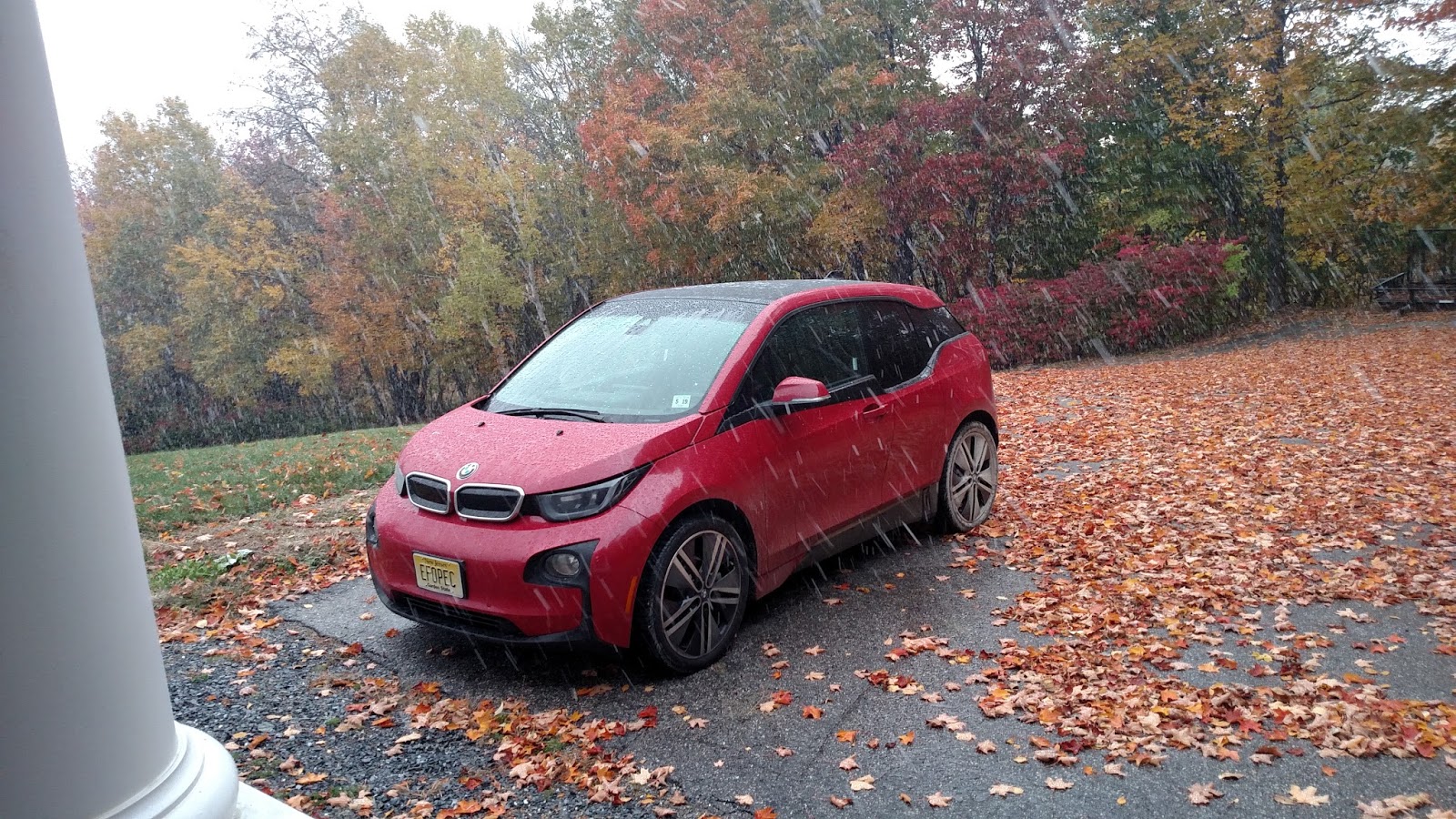
It was snowing in Vermont when we arrived
In that post, I wrote that I found it funny how quickly the gas tank fills because it's only 1.9 gallons. My wife started timing how long it took to stop for gas and we averaged a little over two minutes. I remember wishing we had recorded one of the gas breaks so we could demonstrate just how quick you can pull off the highway, fill up, get back into the car and back out onto the highway. I made a note that the next time we drove back up to Vermont, we would do just that.
So last week we made the Vermont trip again, and as planned we recorded one of the gas stops:
As you can see, I started the stopwatch before we exited the highway, and stopped it when we were back on the highway. I didn't jump out of the car and rush like a NASCAR pit crew filling up. I took my time and even spent a couple extra second topping off so I'd get every drop that I could into that tiny tank and we still did it in under two minutes.
The point of the exercise was to demonstrate that it's really not that inconvenient to make a quick gas break about once every every hour. I will qualify that statement with the fact that here in the Northeast there are gas stations everywhere. It seems that I'm never more than a couple miles from one, so when I'm doing these long drives I can plan the stops at convenient intervals when the tank is nearly empty. While that is the case for many large city and suburban areas throughout the country, there are plenty of rural areas where gas stations aren't as prevalent, and the small gas tank would be a problem. The i3 REx most likely isn't well suited for use in those areas. But hey, BMW calls it a "city car" after all.
As I mentioned above, when I made the trip last year I only did 111 miles on battery and drove 351 on the REx. This year I was able to drive 270 miles on battery, and needed only 184 miles with the range extender maintaining the battery state of charge. This was possible because of the always improving charging infrastructure. I was able to stop twice (once each way) at Prestige BMW in Mahwah, NJ and use their new DC fast chargers. Also, on the way home I stopped for a couple hours at a friend's house who just recently installed a 240v level 2 EVSE in his garage. These stops allowed me to more than double the all-electric miles for the trip, and I only needed 4.9 gallons of gas for the 184 miles I drove with the range extender running, as I averaged 37.5 mpg.
I used the recently installed DC Fast Charger at Prestige BMW on both legs of the trip.
I now have over 36,000 miles on my i3 after seventeen months of ownership, and only about 1,750 of those miles were on the REx. The range extender has been a great feature and I'm still very happy I got it. It does what it is supposed to; it gets you home without worrying about finding a charging station on the rare days that the electric range isn't enough, and it enables the occasional long road trip. There are limitations though, and extreme hill climbing while the REx is running for prolonged periods at highway speeds, can result in reduced power. Fortunately I've never had that happen to me but I don't really have any big mountains which I need to climb. On my Vermont trips I set the Active Cruise Control to 70 mph and have never had an issue yet, even though there are some prolonged climbs at the end of the trip. I did get the "Reduced Power Possible" warning once though, as the state of charge hit a low point of 2% once. However it held there until I crested the climb and once I was on flat ground the SOC climbed back up to about 6%. I left the cruise at 70 mph because I actually wanted to see at what point it would go into reduced power mode, but it never happened.
On one climb, I was able to get the SOC down to 2% and at that point the car warns you that reduced power may occur if you continue without altering your driving. Basically it's saying "Slow Down!"
Still, in a perfect world I'd prefer a 150 mile, all-electric-range i3 combined with adequate DC fast charge infrastructure. Personally, I really don't need 250 or 300 miles of range, and I'd rather not pay for it. However, even though the infrastructure is improving, I think 200 miles of range is probably more acceptable until DC fast chargers are ubiquitous. It appears with Nissan and Chevy poised to bring 200 mile EVs to market in the coming year, the "affordable" electric vehicle market is going to get very interesting. BMW's CEO recently announced that the 2017 i3 will have a longer all electric range also, but didn't comment on exactly how much more. That's good news because as much as I like how the REx works, and how quickly I can refill the gas tank, I'd still much prefer going on battery alone.
This is a video of a school bus driver attacking a child with disabilities. It's hard to watch, but worth watching for the following reasons (and maybe more):
The other kids are standing up for their classmate, telling the bus driver he can't do it.
One child was holding the cell phone that caught this video and led to the arrest of the driver. Another child, at about 28 seconds, can be seen pulling out his phone to record the driver.
It's the "cult of compliance" embodied, yet again. The driver gives a command, the student disobeys, and the driver then uses that to justify (to himself and in the aftermath) his use of force. It's the same phenomenon as Spring Valley High and thousands of other incidents (use the tags to track them, though I'm still implementing tags consistently in the first 500 post on the blog). From the local news report:
Johnston police said the driver approached 15-year-old Christian, a student with special needs, after he failed to follow the bus driver’s instructions regarding a seat assignment.
Police said the student directed an inflammatory comment toward the bus driver who grabbed the student's coat, hit the boy in the face and pushed him to the floor.
Here's the video. Obvious warnings apply, though it's more disturbing than graphic.
I finished a major corporate (disability-related) project this week and am hard at work on a major non-profit (disability-related) project now. That, plus teaching, plus the book, has slowed me down in terms of writing for mainstream media, but I trust that the depth of these bigger projects is more than worth it.
In the meantime, though, instead of blogging less, I'm taking ideas that might have made for publishable essays and placed them here. This week featured four posts that I think matter.
Peter Singer's Tells - A controversial philosopher who argues that the correct ethical decision in the case of disability is euthanasia/abortion, reveals that he doesn't think those positions should be such a big deal. To him, they're old news.