Work is Work!

On International May Day I wrote a little hymn. I wrote:
Teaching is work. Programming is work. Scholarship is work. Science is work. Grading is work. Committee service is work.
Today Chronicle Vitae published a column on academic work as labor, as work.

It's a linked column to this first piece on the language of adjunct labor. In that piece, I worked through a number of different ways in which adjunct advocates speak about their work, using the language of slave, sharecropper, or migrant laborer. I think this language is mistaken. But here's how I finished the piece.
The issue here is not that writers are loosely deploying hyperbolic metaphors. The real problem is that adjuncts and their advocates believe the rest of us aren’t on their side.
We tut-tut and say it’s too bad, but then throw up our hands, blame the budgets, and let the system continue. Civil rights, slavery, sharecropping, migrant laborers—these are terms that evoke sympathy and demand action within the neoliberal world of higher education in ways that just calling adjuncts “temps” does not.
So let’s not be too quick to blame adjunct advocates for invoking historical inequities when trying to change the system. Instead, let’s question why such metaphors seem necessary. I propose that the plight of the adjunct lies squarely alongside that of a long-recognized historically oppressed group: the working class. Why are faculty so resistant to seeing themselves as labor who need to act in solidarity with the exploited adjuncts?
In my next column, I’ll look at what happens when we put all these metaphors aside and just look at adjunctification as a basic labor issue, one in which we all have a stake.
In today's piece, I really just want to make a simple argument.

Work is work.

As academics, we know a lot about the nature of labor, the ebb and flow of power mostly up to management, but not always. We read about the changing nature of the workforce across the country, but for those enough of us lucky - and let's be clear that luck is a huge part of it, there is no meritocracy - to be on the tenure-stream side of things, it's hard to apply such lenses to ourselves.

I find it hard. Maybe you don't. But plenty of other people see little connection between the plight of the adjunct and their own labor situation.

Work is work.

You are paid for your work. You should be paid for your work. Let's apply the lens of "labor" to what we do in academia, to think of administration as management - maybe nice management, maybe trusted management, but management none the less.

I am very lucky in my job and my bosses. I trust them. But they are still my bosses (some of them read my blog! Hi there!). There's nothing wrong with having a boss, but we need to remember that there is a power dynamic here. And once you bring power into the equation, well, we're back to the labor movement.

I finish today's piece with the following:
We need to recognize that what’s happening to our universities is happening across the North American labor market (and beyond), and that we’re not special. Other highly-trained, specialized industries have turned to contingency work. Higher ed is no different. In fact, we could learn from the industries that increasingly argue that one must treat contingent workers as full members of the community.
Why not embrace the pressures that are falling on the university? Be proud of being laborers, identify with your fellow workers, and organize across the tenure-adjunct divide. Ultimately, it’s the only thing that’s going to improve the situation.
Best of all, it’s the right thing to do.
It really is the right thing to do.
The First US i3 REx Delivery Goes To Me!

My client adviser, Manny Antunes and I with my i3
This afternoon I took delivery of the first i3 REx in the US. BMW of North America was kind enough to arrange it so I'd have the very first one delivered in North America, and I would like to thank them for that. It's been a long, fantastic journey for me. Five years in BMW's e-mobility trial lease program and over 140,000 electric miles driven on my MINI-E and ActiveE has led up to me finally getting the first real production EV from BMW. This has been a long time coming and I'm very anxious to see how the i3 performs and report on it here and on other websites. I'm sure there will be things I feel need improvement, but I do expect to thoroughly enjoy the car for what it is.

BMW NA CEO Ludwig Willisch handing me the keys to the first all electric BMW in company history.             January 13th, 2011
Manny Antunes, my client adviser at JMK BMW delivered the first i3 BEV in the state of New Jersey a couple of weeks ago and now he can add the first i3 REx customer delivery in the US to his resume. Manny was also my ActiveE client adviser when I took delivery of the very first ActiveE, back in January 2011. That was a historic event because I was the very first customer in BMW history to take delivery of a 100% electric BMW, something I am very proud of. As BMW slowly transitions to more and more electric vehicles in their lineup, I'll always know I was the person who got the very first one, and that's pretty cool.

I'm sure the frequency of my posts here will increase now, and I'll also be writing about my i3 experiences for a number of EV websites including InsideEVs, Green Car Reports, Plug in Cars and of course BMWBLOG where I'll have a regular column there reporting on my experiences and all other i3 news.

I just wanted to do a quick post now to make the announcement. I'll be putting up another post soon about my initial impressions. Stay tuned!

Awww, What a Good Father

In my Chronicle piece on being a father, I wrote:
No one has ever questioned my work ethic to my face because I’m a father. In fact, one day I was so tired from caring for my two children—at the time a 2-year-old boy and a 3-month-old baby girl with colic—that I simply lost my ability to speak coherently in front of my colleagues. I stood up to talk at a very important meeting and nothing came out. I invoked my exhausted state, apologized, and went home. There were no consequences. If anything, my role as a working dad raised my profile within my institution, even before I started writing about those issues for CNN.
Thinking some more, I wrote the following:


First of all, I chatted with my dean this morning about various things. He does not remember this and I'm not surprised. I also believe, very strongly, that my institution is such that if a mother had a similar moment, she would be treated very well. But we are an institution founded by nuns and infused with their culture even as their numbers decline; I'm very lucky to be in this special place.

I've been talking about academic parenting for a long time now and have heard hundreds of stories. My sense is that few feel their institutions would be so supportive; moreover, few women would have felt safe enough to say such a thing.  Likely, our hypothetical tired mother would have just sat silently, knowing herself to be exhausted, unable to risk speaking, and so her voice would be silenced.

This is male privilege - to escape consequence even after you screw up. Awww, what a good father, they say. And you know what? I try really hard to be a good father. What a good father is the right answer! The question is how do we create space so that reaction tracks across genders.

The point isn't that I got away with something; I was doing my best. It was a moment of failed work/life integration, but one of my lessons about work/life issues is that it's ok to let a ball drop sometimes.

The point is that the consequences track with privilege.

Trigger Warnings Continued

I have a new piece up on CNN on Trigger Warnings in the Classroom. I make two arguments.

1. Psychological disability involving trauma is serious and should never be dismissed. However, we have a mandate through the ADA to provide reasonable accommodations for students with disabilities. Let's increasingly support, fund, and use those services, make them more robust.

2. Let's practice good teaching. Good teaching involves preparing students for their homework, not springing things on them. All the people who study reading and learning focus on scaffolding (as one metaphor) so that students know what they are reading for. It definitely helps my students.

I write:
I would never want my students to be surprised by something horrific in their reading, whether the "Red Wedding" on "Game of Thrones" or the rape of Philomena in Ovid. Instead, I want them ready to work with challenging texts so they learn. Spoilers might be bad for entertainment, but they are good for education.
Once most students know what they are likely to encounter in their work, the surprise factor in triggering situations ought to be mitigated.
So I am coming out against mandatory trigger warning policies, but I also think that some of the demand for trigger warnings might be alleviated by scaffolding readings in advance. Why try and shock your students?

I see the issue linked to multiple factors, including the corporatization of the academy. It makes universities and faculty risk adverse, turning the syllabus into a EULA, and worried about being sued. In that context, a warning label on Shakespeare makes sense, so that if a student is upset, you can say, "warned you! Can't sue!" This is not good teaching, like so much else linked to the arrival of a corporate mentality in higher education.

That said, I really do not like the language that equates requests for trigger warnings with fragility, with being "special snowflakes," with "helicopter parenting." I put a big list of resources on trigger warnings in the classroom here. Both in some of the published pieces and in lots of academic conversation, I sense some scorn for students asking for these policies.

We can argue against trigger warning policies without dismissing the students asking for such policies. Instead, think about what they are really asking for and how, in responding, we might focus on learning.

Ultimately, when as academics we ask - what is the best decision we can make to enhance the opportunities for learning? - we usually make good choices.

Working Dad

I have a new piece in the Chronicle today on being a "working dad," a phrase I intend to own and explicate a lot over the next year. It ends:
Academic dads operate with the privilege of separating their home life from their work life in ways unavailable to women. We get to be silent if we want to. We feel no need to attend sessions on the challenges of parenting—even though surely we encounter those same challenges—because they are perceived as "mommy issues." That perception is untrue yet remains a root cause of persistent gender discrimination. Female faculty members have been advocating for change for a long time; they still need more allies.
The discussion of caregiving must move beyond the discussion of motherhood. Fathers, too, need to advocate for paid parental leave, child-care assistance, flexible tenure clocks, and a culture that accepts the notion of male caregiving as normal. And they need to advocate loudly, using their privileged position as a lever to move the structures of our profession and lead the way in the broader culture.
I suggest we start by embracing the term "working dad."
I've been writing and speaking about these issues awhile now. Here's a post I wrote about the first day of the school year. It was a busy day, beginning with my wife leaving town at 4 AM and packed with so many details to work on before 8:30! At the end of the litany, I wrote:
This quotidian litany is in no way spectacular. But somehow we still live in a society in which men cleaning, parenting, cooking, etc. is not quite masculine. It's odd. I get a lot of praise for it, often couched in the terms of "my husband never ..." or "I wish my husband would ..."

This is what masculinity looks like. For me, anyway, on this Monday.
That post got the attention of the Northwestern Work/Life Office in HR and the Northwestern Women's Center, where I gave a talk. You can see a clip from it and some of my major themes at the link.

There's lots more work to do: First, to move parenting out of the conversation of motherhood. Then, to move caregiving out of the conversation on parenting. I want to be clear that this isn't a "not all men" or a "but what about men" post or theme. It's that patriarchs have to get involves to tear down patriarchy. One tiny incremental move at a time.

Resources: Trigger Warnings in the Classroom

The issue of trigger warnings in the classroom, whether they are useful, attack academic freedom, are to protect our helicopter-parented elite students, or what, has become a fairly important topic in higher ed circles. I'm writing an essay on it now.

Here is a list of resources. Please recommend additional materials.

  • Start with Amanda Marcotte (one of my absolute favorite feminist writers) on "The Year of the Trigger Warning." It's from the end of 2013, which suggests that the mainstreaming of trigger-warning is, in fact, relatively new. I always wonder if I've just missed it when a new idea suddenly seems everywhere to me, as the "TW" discussion now does.
But what happens when a student is trapped in a classroom where a discussion brings up terrible and traumatic memories? How can a student easily and subtly remove herself from that moment?
I have thought about prefacing our discussions with a trigger warning introduction to the class but I question how effective that would be. By saying that we are going to discuss topics of a sensitive nature that may make some people uncomfortable and offering students the chance to leave, aren't the very students meant to be spared then singled out and isolated in front of the entire class? While well intentioned, that offer seems useless at best and marginalizing at worst.
The other option? Steering clear of volatile topics in the classroom and playing it safe. But by not talking about harassment, the sorry state of gender equality, and the heroic efforts put forth by activists seems akin to throwing the baby out with the bathwater. There has to be a better way. But how does one work trigger warnings into the classroom lesson plan? How does a teacher effectively and sensitively negotiate topics that require trigger warnings and how are escape options presented in a sensitive and appropriate manner to students whose past traumas follow them into the classroom?
That's what I have so far on the "origin" of the Trigger Warning - Higher Ed debate. You can also read these Shakesville threads for a general defense of Trigger Warnings: here and here.

Things changed when the media started covering student-driven efforts to mandate trigger warnings in syllabi.

  • The earliest piece I have comes from March, in The New Republic. The author, Jenny Jarvie, culled lots of information from student newspapers. I'd be interested to know if anyone has anything earlier?
  • Scott McLemee, on Inside Higher Ed, worked through teaching a book about rape in the era of the trigger warning. I'm a little confused by this piece, as it seems to conclude that triggering trauma is real then says, nah, no need for warnings as they don't do much good. Am I reading it wrong?
What interesting pieces as I missing?

Finally, here's a piece on "Exposure Therapy" - a treatment for PTSD on encounter, not avoidance, of trauma. I offer it just as a counter-model to avoidance. Is all trauma that has triggering episodes a form of PTSD? I think so, but am not an expert. Are you?

Updates:
In the UK, professor of English at University College London John Mullan said the issue had "never come up, as far as I know".
"I think academics talk quite a lot about how particular literary texts might play to or provoke particular sensitivities – we do talk about that privately. But once we have taken the decision about courses and reading lists, we do not put health warnings on. Essentially literature is full of every kind of upsetting, provoking, awkward-making, saddening, embarrassing stuff you could ever think of. That's what it is like. [And] the time you would start labelling it with warnings – it seems to me that that way madness lies," said Mullan.
"What do you decide is upsetting, and what actions does it leave you open to [if you get it wrong]? It's treating people as if they are babies, and studying literature is for grownups at university. You might as well put a label on English literature saying: warning – bad stuff happens here.
Dismissive. Professors, we can do better!

"Monroney Hold" Has Hundreds of Range Extended i3s in Limbo

i3s lined up at the port in New Jersey
For a little over a month now, cargo ships from Bremerhaven, Germany have been arriving weekly at the port in New Jersey to unload anywhere from dozens to hundreds of shiny new i3s. My i3 arrived last week on the Fedora, which left Germany back on April 30th. Back when I learned it was booked on the Fedora and would arrive here on  May 15th, I assumed that by the 20th or 21st of May, I'd be at the dealer signing the paperwork and driving my i3 home. I was wrong.

The BEV i3s Monroney label
I now have no idea when I'll be getting my car, and neither do the hundreds of other people that ordered an i3 with the range extender and whose cars are currently here in the US sitting at a port somewhere. Officially the holdup is a "Monroney Hold" - the fact that the EPA certification has not been completed so BMW doesn't have a Monroney label (window sticker) to post in the window before the car leaves the port, which is required by law. The range extender option changes (shortens) the car's electric range, and also requires an official MPG rating so BMW couldn't use the same Monroney label as they did for the all electric i3. The i3 REx would need to be fully tested and certified as a completely different car. To make matters worse, the majority of i3's sold in the US have the range extender option. For example, my client adviser Manny Antunes of JMK BMW has sold thirteen i3s so far and only two of them are the BEV version. Eleven of the thirteen have the range extender and his clients are beginning to call him frequently now, wondering when they can expect delivery. He has no information to offer other than he'll contact them as soon as he hears something from BMW - or a truck somehow magically pulls up to the dealer with a load of i3s with range extenders!

Where's mine?
BMW is indeed delivering i3s to customers now, but all of them sold so far have been the fully electric BEV i3. The i3 RExs keep arriving in the US alongside their BEV brothers, but they cannot be released and trucked to the dealerships until they have the EPA Monroney label. BMW isn't communicating the exact reason for the lack of EPA certification, but it appears to be a combination of BMW providing the EPA with the required information a little late, and the fact  that the i3 REx is different than anything the EPA has certified before so they are taking their time to make sure they get the certification right. The closest thing to the i3 REx would be the Chevy Volt, which for most of the time the gasoline engine is running is a series hybrid and only charges the battery. However under certain conditions the gasoline engine of the Volt does indeed directly power the wheels, and in those conditions it is a parallel hybrid, like a Toyota Prius. The i3 REx is the first (second actually. The Fisker Karma was also a series hybrid - thanks to reader Andrew Chiang for pointing that out to me. Fact is, I've tried to block out all memory of the Karma!) true series hybrid the EPA has ever certified and the range extender will only serve to charge the battery. I don't see why that would be a problem because to me it seems like the Volt would have been even harder to certify because it is both a series and a parallel hybrid depending on the driving conditions. In any event, BMW claims to have furnished the EPA with everything they need for certification and are cooperating with the EPA in an effort to get this issue resolved as quickly as possible.

Battery log sheet courtesy George B
This is clearly an example of a "first world problem," but those who have been waiting patiently for their car are growing anxious as the days pass and their car is simply sitting at the port and waiting for the label. Some have even wondered what the state of charge of the cars are, and if by sitting so long (some have been sitting at the port for over a month now!), have the "vampire loads" reduced the charge level to dangerously low levels? Personally I don't believe this is an issue, and I'm sure BMW is monitoring them. BMW ships the cars with only about 25% state of charge and charges them up at the port. All of the cars used for test drives had a battery log sheet in the glove box which shows BMW is certainly monitoring the SOC of all the cars from manufacture to delivery. Plus, if the i3 is anything like the ActiveE, then the car will hold the SOC very well when not in use. My ActiveE would only lose about one percent per week when sitting unused. I doubt sitting for a month or so will have any noticeable reduction in charge and unless the cars arrived with less than 10% SOC and weren't monitored and charged I doubt there is anything to worry about. However, let's hope this "Monroney Hold" gets resolved soon and BMW can begin deliveries of the i3 REx cars that are already here and waiting - and mine in particular!

Ford's Warriors In Pink honors Tracy Nicole


Ford Motor Company and its Warriors in Pink campaign kicks off its 20th year of support in the fight against breast cancer by issuing a strong call to action encouraging women to drive more conversations on breast health. Over the past 20 years, Warriors in Pink has observed how informed conversations can drive awareness and inspire women to be proactive about their breast health.

A relentless change agent in the fight against breast cancer, Warriors in Pink has embraced its role as a catalyst to inspire honest conversations among women. A recent national survey conducted by Ford Warriors in Pink shows that despite being a leading health concern for women, important breast health conversations are not happening enough – particularly between mothers and daughters.

In addition to Ford’s support via Warriors in Pink, the company has chosen “Models of Courage” One of Atlanta’s Models of Courage is Tracy Nicole.


Tracy is 39 years old and was diagnosed in 2012 with DCIS (Ductal Carcinoma In Situ) Breast Cancer. She is a fighter with two little girls and a fashion designer and writer. 


Sunday Roundup!

Yesterday I spent the day with the Op-Ed Project, thinking more about this new craft (it's been over a year, but it still feels very new) of public writing. It was an inspiring day and I left it even more committed to developing my public voice and, even more importantly, working to amplify the voices of others.

Speaking of which, last Sunday I published my remarks from a conference on "Going Public: A Medievalist on CNN." Thank you all for reading and sharing, as I think it's important. My question - what do we owe society when we reach an important conclusion? - dovetails nicely with the mission of the Op-Ed Project.

I wrote two other pieces on writing. Hyperscribal Society rambles through some of the implications of all the writing we do now. More importantly, I've been asked for Advice for Writers lately. I have no real advice, but I do have some advice to readers - share. And share from the least visible to the most visible.

On Monday, I wrote about a lawsuit involving an Arab man from Dearborn, MI, beaten by police. He has a psychological disability. I wrote:
In the wake of Ethan Saylor's death, some advocates suggested developing a universal "I'm disabled" hand-signal or even a t-shirt so that police will know not to beat people who are disabled for being non-compliant.
But I have a better idea.
Don't beat people for being non-compliant.
I stand by that radical idea.

I also linked to a great set of videos about disability and inclusive society. I like that they acknowledge that inclusion can be tricky and awkward, but also that you can get past that awkwardness pretty easily.

Finally, I wrote about the layered nature of privilege (thinking about the Princeton boy who has no white privilege) in There Is No Meritocracy and then revealed the exciting news that McDonald's Solves Gender Norming with Hot Pink Purse.

It's been a good writing week. Next week the Chronicle is publishing my next essay, and this one is a big one as I think it's the precis of a book. I'll be interested in hearing your thoughts. 

Awkwardness and Inclusion

I'm off to a workshop today, but wanted to offer a few quick thoughts on a great series of videos.

Scope, a British advocacy group, has made an outstanding series of videos that are fundamentally about inclusive society - how to you shake a hand that's not there, how do you talk to people in a wheelchair, etc. What I like about it is that it acknowledges that inclusion is hard and disability often makes social norms confusing. Ok, they all say, now you've been awkward, now what?

The answer turns out to be - acknowledge the awkward, then change it and do better.

You can see the videos at the link above, but Vox has a nice write-up and a few addendums on language.

Videos below. What do you think? Using humor is always dangerous, but my gut reaction is that these hit the marks pretty well.


Hyperscribal Society

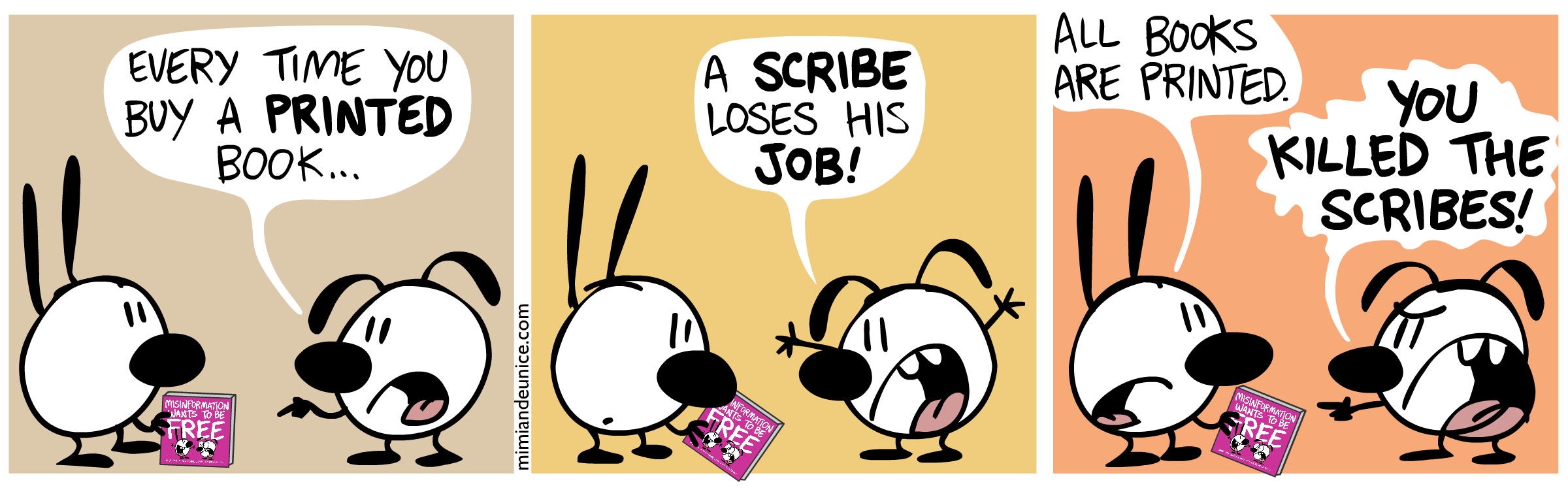
From http://mimiandeunice.com/2011/01/05/killer-of-scribes/
A week or so ago, on Twitter, Virginia Heffernan introduced me to the word "hyperlexic" in the context of her piece on the speed-reading app Spritz (which Bogost has addressed here). She talked about the way we  generally valorize certain kinds of reading, like novels, and dismiss others, like texts or Facebook.

However one assigns value, there's no question we are a hyperlexic society. More people are reading more words than has ever happened in human history, and that's interesting.

The flip side of hyperlexic is hyperscribal (or hyperscriptoral to use the analogous Latin form to "lex," I think).

We're all writing. I don't even mean the kinds of performative writing on blogs and beyond, but that we have become a society that communicates via the written word. It started with letter writing, email spurring a rebirth of epistolary arts, but now extends throughout society, from the flip OMW to the urgent TORNADO WARNING on our ubiquitous devices

I grew up in Nashville, moving there when I was 10. It's an interesting town for a lot of reasons, but one of them is that it's filled with poets. Throughout the city, the people you meet seem "normal," but late at night they are sitting in their apartments and houses, holding guitars, trying to find rhymes and rhythms to talk about love, loss, substance abuse, desire, and identity (Thank God I'm A Country Boy). Throughout the city, you find people embedded in careers across class lines, though concentrated in service industries, who are writing songs, performing when they can find the courage, looking for that break.

You might say this of New York and L.A. too, but those are giant metropolises in a way that Nashville is not. In "The Thing Called Love," a 1993 Boganovich film about Nashville, there's a moment in which Trisha Yearwood is in a police station, and the police officer (played by Fred Thompson) is singing at her trying to pitch a song to her as she's going in to fill out her paperwork.. It's totally realistic.

Poetry and music, much of it cliched and commercial to be sure, infuses the city and changes its culture.

I offer this anecdote about Nashville not because I'm a booster - I haven't been back since I was 21 or so - or to boost my country music career (I play driving Tennessee Irish music though in my two bands: The Tooles and Mulligan Stew). For me, thinking about Nashville helps me process what I see going on in society.

We're all writing. We're all trying to communicate important things via written word over spoken word. sure, a lot of it is "bad" writing, it's cliched, it's unexamined, it's "Do you like me, check yes or no?" But it's writing and its ubiquitous. That has to have an impact on society. Maybe, like Bogost suggests, reading is already dead. Maybe, like Heffernan offers, reading is reading is reading.

Here's what I know - As a teacher, I'm going to skew optimistic and try to level the hyperscribal and hyperlexic elements of society to improve learning, to whatever extent possible. 

As a teacher, I constantly think about how to leverage our students "natural" social media use, their natural writing, their natural forms of communication - and I use nature in the context of things they are likely to do without being instructed to do so by the teacher.

Here, for example, is an essay on using Facebook in the Classroom. I expect it to work for about another 3 years, tops. If I taught art history, you bet I've have an instagram account and try to get students to follow it. I giggle about snapchat (folks, your lecture notes will be on for the next 5 minutes), but surely a more creative teacher than I has figured out a way to leverage its temporary nature to try and enhance learning. Twitter is a natural tool for forming pathways of communication in a large class (here's a piece by my grad advisor and some students on its use in a World History class).

All of this is to say that if students are reading more and writing more, we can "Go where they are," my motto, and try to move them to where they want to be. We don't have to say that all writing and all reading is good writing and reading. But it is, if you'll excuse the tautology, writing and reading. And it's new.

I have more say on this topic, especially about the way that medievalists and early modernists, people straddling the emergence of print culture in the West, can help us understand what's going on in our society and what these changes might mean for the future of reading and writing.

But having written 800 words before breakfast, I need to go make some food then get to work on my "real" writing. I'm "writing" a "talk" on narratives about objects across the Medieval-Renaissance divide in Venice.

Being hyperscribal is hard on the carpals but good for the brain.


Meet the 2015 Honda Fit


On Wednesday May 14th I got an up-close look at the all-new 2015 Honda Fit. The new Fit features a sleek modern exterior, sporty, fun-to-drive handling and plenty of forward-thinking technology

Here’s what you can expect:

Aggressive new styling
  • Aerodynamic body constructed from high-tensile steel
  • Striking new grille and headlights
  • Available 16-inch, alloy wheels
Interior evolution
  • 52.7 cubic feet of cargo space[1] with the Honda-exclusive Magic Seat®
  • Increased passenger volume and rear legroom
  • Available leather-trimmed seats
Performance machine
  • i-VTEC® engine with Earth Dreams Technology generates 130-horsepower (SAE net) at 6600 rpm and 114 lb.-ft of torque at 4600 rpm
  • 6-speed manual or available Continuously Variable Transmission (CVT)
  • Revised, sport-tuned suspension
Packed with technology
  • Standard Bluetooth® connectivity[2], rearview camera and Expanded View Driver’s Mirror
  • Available Smart Entry with push button start, Honda LaneWatch™[3] and 7-inch Display Audio touch-screen
  • Advanced Compatibility Engineering™ (ACE™) II Body Structure


Advice to Writers; Advice to Readers

In the last two weeks, I have received a half dozen requests for advice from newish writers looking to expand their readership or break into more formal publication. They all ask me roughly the same questions - how did you do it? Does blogging help?

Unfortunately to those seeking my advice, the true answer is that I have nothing useful to tell you.

I have no advice on how to break in, how to get your word out there, whether blogging helps, whether you need a twitter account, whether instagram is better than pinterest, whether Facebook is dead, how to pitch, how to get paid, how to get noticed, how to get on TV, how to get published, how to make a living, or how to not die as a writer.

I stumbled into writing, driven by irrational overconfidence typical to my set that my opinions would matter, first placing a few op-eds, exploiting the randomness of a global event relevant to my medieval expertise, then starting this blog.

Did blogging help? Has it worked to make me a more successful writer? More importantly, will it help you?

I have no idea.

My only advice for aspiring writers is this - if you blog, make sure the blogging itself sustains you even if no one is listening. Make sure that when you blog, you are writing things that you want to write, that you want to get better at writing, so that the iterative process of homing in on your core arguments makes you better at them. The blogging must satisfy you because surely, you will write brilliant essays that you love, and but 25 people will read it, or 10, or 5, or no one.

If the writing feeds you, sharpens you, gets you ready to say the things you want to say more effectively, then blog. If you find yourself writing only to get readers or make money of advertisements, well, I have no objection to commercializing your prose, I wish I were better at it, but you're doing something very different than I (I have a great day job; I have privilege) and I can't tell you whether blogging is a good idea.

So for writers, I have no real advice.

But for you, dear reader, I do have some advice. Share Good Work.

Every RT, every Facebook share, every email - these things make all the difference to writers, especially small timers like me, and even more to people just starting out. If you read something you like, share it.

I get around 100 views per post. That's nothing in the world of social media. But when about 10 people RT or share on Facebook, I get around 200 readers. Double! You have a huge impact for a writer like me.

Now think about the blog that has only a few dozen readers and the kind of impact you can have? The blogs of these fascinating people seeking me out for advice sound wonderful, but to grow they'll need readers who share.

There's a problem in charitable giving in which people are too ready to give to the big ticket players. Big donors like to give to Harvard, but a fraction of the money at a smaller school would transform lives. Big donors like to give to the mega museums or even, dare I say, symphonies (my sister is the concertmaster of the Omaha symphony. Everyone should give it money!) - rather than to smaller arts institutions. Whereas a few thousand dollars might save a small institution or endow a scholarship, such money just vanishes into the vast pool at the huge place. There's no impact for the small or medium donor, but still they give.

I see some of the same forces at work with media. Think of whatever giants in the blogging world that you like, people with tens of thousands of readers a day. They probably write good stuff and it's good to RT good work, but spreading the word of a blog so that a piece gets 10,020 readers instead of 10,000 isn't such a big deal. But raise a post from 200 to 220, well, that's significant.

Sharing, of course, is not like giving money. You could share 20 posts just as easily as you could 1. But my sense is that most people don't. Most people don't want to spam their friends with lots of links in a given day, but maybe just post one or two to Facebook, maybe tweet something every hour. People treat sharing as something they have to budget - and they probably do. Think about spending some of that budget by sharing someone just starting, someone just finding their voice.

Comment, too, if you can. Most new writers (me for sure) love comments, even just a "great piece!" Let us know you at least scrolled to the end.

What I'm saying is this - if you read a post you like, seriously consider sharing it. Share from the least visible up. I think about the voices of women, people of color, the disabled, or writers who are LGBTQ. Share the people who amplify such voices (that's what I try to do). Share people with fewer readers instead of those with more.

But mostly, just share.

And then maybe I can tell writers that yes, blogging is a good use of their time.


Layered Privileges - There Is No Meritocracy

There have been two debates about privilege recently.

One was Tal Fortang's barbaric yop that he, Princeton undergrad, is not privileged by his whiteness, because his family was persecuted by the Nazis. The second was a Thought Catalog essay on female privilege.

The first essay demonstrated two key facts:


  1. Tal Fortgang does not understand the concept of privilege.
  2. American Media works likes this: Conservative white boy feels oppressed by liberals? How interesting! Let's give him a forum to air his many grievances. This reaction was not just limited to Fox News, a place of naked partisanship, but much more widely. I think it has a lot to do with the white media also feeling that they worked damn hard for their achievements and being suspicious of the whole privilege debate. Also, it's good for ratings.
The second, less well reported but still circling through my social media circles, was a snarky list of 18 types of female privilege.

I'm not linking to it because I think it's basically clickbait and trying to sell a book about women and sex. Moreover, it's mostly typical male grievance discourse. I've dealt with it before. To the extent that these grievances are legitimate, which some of them are, the solution to the problem is more feminism.

On the bright side, in reaction to Fortang, the New Yorker just published an interview with Peggy McIntosh, the Wellesey academic who first developed the term "white privilege" as a way of explaining structural advantages experienced by white people. In the interview she offers a very useful short-hand for thinking about layered privilege.

Here is McIntosh's original paper from 1988, "“White Privilege and Male Privilege: A Personal Account of Coming to See Correspondences Through Work in Women’s Studies.”

It's a great piece. One of the main criticisms is that it's a little blind to class privilege (she's highly aware of gender privilege, in general), but it started a conversation that sometimes is really useful. Here's how she responded to the Fortgang piece [my emphasis]:
When Tal Fortgang was told, “Check your privilege”—which is a flip, get-with-it kind of statement—it infuriated him, because he didn’t want to see himself systematically. But what I believe is that everybody has a combination of unearned advantage and unearned disadvantage in life. Whiteness is just one of the many variables that one can look at, starting with, for example, one’s place in the birth order, or your body type, or your athletic abilities, or your relationship to written and spoken words, or your parents’ places of origin, or your parents’ relationship to education and to English, or what is projected onto your religious or ethnic background. We’re all put ahead and behind by the circumstances of our birth. We all have a combination of both. And it changes minute by minute, depending on where we are, who we’re seeing, or what we’re required to do.
That's useful language - that there are many variables that create structural advantages and disadvantages. It's worth thinking about which ones are at play in any given situation.

In particular, this subject matters to me in the context of undermining the myth of a meritocratic society. I write this in regards to higher education all the time, but it's a much bigger problem. By default, the people with the power to change society peacefully are those who succeeded. Those people who succeeded impede structural change because they know they worked hard and they believe in their own merit. Therefore, those who do not succeed must have done something wrong or otherwise have less merit.

I work very hard. I know, however, that my success in school, my success in work, and my ability to leverage my work into media access cannot be divorced from my class, my gender, and my race. That doesn't mean that I have to feel guilty, but I also can't feel smug and deserving.

Identifying the layers of privilege at work in my life has been good for me. It's given me a sense of purpose in my writing and freed me to take different kinds of stands. It's helped me figure out when to speak and when to listen (always a problem for us talkative white guys, and still something I'm working on). It's pushed me to focus as much class as on race and gender, to push new variables into the equations of privilege.

Here's my main take-away: recognizing privilege means working to undermine it. An equal society is not one in which everyone is, in fact, equal, but in which there is an equality of opportunity.

Will an Optional "High Power" Battery For the i3 Be Available Soon?


I was tipped off by an anonymous follower here that the Spanish i3 online configurer has a not-yet-available option called "Bateria de mayor potencia" which Google Translate will tell you means "battery more powerful" in English. There isn't a picture for the option and you can't order it - yet. I checked the other BMW models on the site to make sure this wasn't just some kind of phantom option or mistake that was listed on all the BMW cars on the site and it isn't. It was in fact only listed on the i3 options page.

An inside look of  i3 Battery module
So I reached out to a contact I have in Spain that is well connected in the electric vehicle community there to look into this and see what they can uncover. Could the Spanish BMW site have inadvertently tipped us off as to what will soon be available? Maybe this is as innocuous as an optional, more powerful 12v battery? However I've never heard of an optional 12v battery being offered in any i3 market yet and I'm not sure why would they would need it? The 12v battery doesn't need to do very much on the i3 the first place. The car is already equipped with a cold weather package in cold-climate markets and there is no mention of a more powerful battery in that package. I would think if BMW thought the standard 12v battery was insufficient they would have just made all the cars standard with the more powerful one in the first place.

i3 Battery pack
There have been rumors that BMW is already field testing higher density batteries and that they will be available in the not-too-distant future. BMW has always maintained that the i3's battery pack is easily replaceable and that it's likely down the road when a customer determines it's time to replace their pack the replacement pack will be more robust, allowing for a greater range than the original battery did when it was new. Could that be available sooner than we anticipated?

Battery tech is constantly evolving. Tesla for example is rumored to be replacing the current batteries they use with higher density cells in the very near future and will soon open the Gigafactory(s) to manufacture them. Over in the BMW ActiveE Facebook group we recently had a fellow ActiveE driver say he had the opportunity to ride in a test MINI-E at BMW's Technology Center that was fitted with BMW's next generation of batteries and the car had about a 200 mile range. This cannot be confirmed but I have no reason to doubt his claim.

So this may be nothing, a simple mistake or misunderstanding on the BMW i3s Spanish website. Or maybe not...

McDonald's Solves Gender Norming with Hot Pink Purse

A few weeks ago McDonald's toys and gender norms zoomed into the zeitgeist, with all kinds of interesting articles, complaints, and even positive corporate response. I blogged about it here.

I was pleased that McDonald's had resolved to change the norms so that kids & parents wouldn't be asked for boys' toys or girls' toys but the "car" or the "pony" or whatever. I also wrote:
So that's nice. I suspect the toys will still emerge in pink and passive vs colorful and active. Why can't we have a pink ninja robot? A bright blue lipstick with lightning bolts? There's room for variety here.
Still, small victories are victories. Good work Ayres-Brown
Small victories ARE victories. That said, this one felt a little bit Pyrrhic when pictures of the new spiderman toys were released.


Chris Sims over at Comics Alliance dealt with this in a piece called: "McDonald’s Offers Up Gendered ‘The Amazing Spider-Man 2′ Happy Meal Toys, So You Can Finally Have That Hot Pink Spidey Purse You Wanted."

Now first of all, I know a lot of people who might really like a hot pink Spidey purse or headband. If these are the toys they want, then that's fine. Sims, though, points out a bigger problem [my emphasis]:
That said, there’s a pretty big problem that you can see just from looking at the toys that goes beyond just the stereotypes at play. Boys get cars and girls get fashion, yes, but while girls get Spider-Man themed purses, bracelets and stickers, boys get the Spider-Man mask. The subtle — or maybe not so subtle, considering how much this comes up in this industry — is that girls can like superheroes, but boys can be superheroes.
It’s worth noting that the TV commercial for the ASM 2 Happy Meals features a boy and girl boy both equally web-swinging and stealing each other’s food (which is weird, Happy Meals are like four bucks, you can just get two), but the toys don’t really reinforce that. Instead, they drop kids into those same limiting stereotypes that show up everywhere.
The bolded line is so important. If we divide into boys and girls, even unstated, and only the boys get to BE spiderman, we've got a problem.

Working against gender norming is hard. You have to parent against the grain (this link goes to a picture of my daughter dressed as batgirl). Our children are pressured by society into picking the pink or blue, the passive or active.

To resist this you can't just present choices and think your work is done; you have to find ways to suggest that the non-normative choice is superior, without going all totally nuts and giving them a complex about it (i.e. pink needs to be an option, just try to get your daughters to pick blue pretty often, because their peers, marketing, etc. are all pushing towards pink).

Comics do and don't matter, much like toys. They are just one locus of much bigger problems, but they are a place where kids learn and imagine and act and play. They are male dominated and are continually an emerging site for us to work on these issues. When comic artist Janelle Asselin took apart a terrible new cover for Teen Titans, focusing quite a bit on Wonder Girl's massive and fake breasts (this is a teenage superhero, remember), she started getting rape threats.

We can do better.

I asked my daughter who was her favorite superhero. She said, "Elsa, because she has the same powers as me." Then she raised her hands in the air and made freezing superpower sounds.

One point for Disney, I guess.