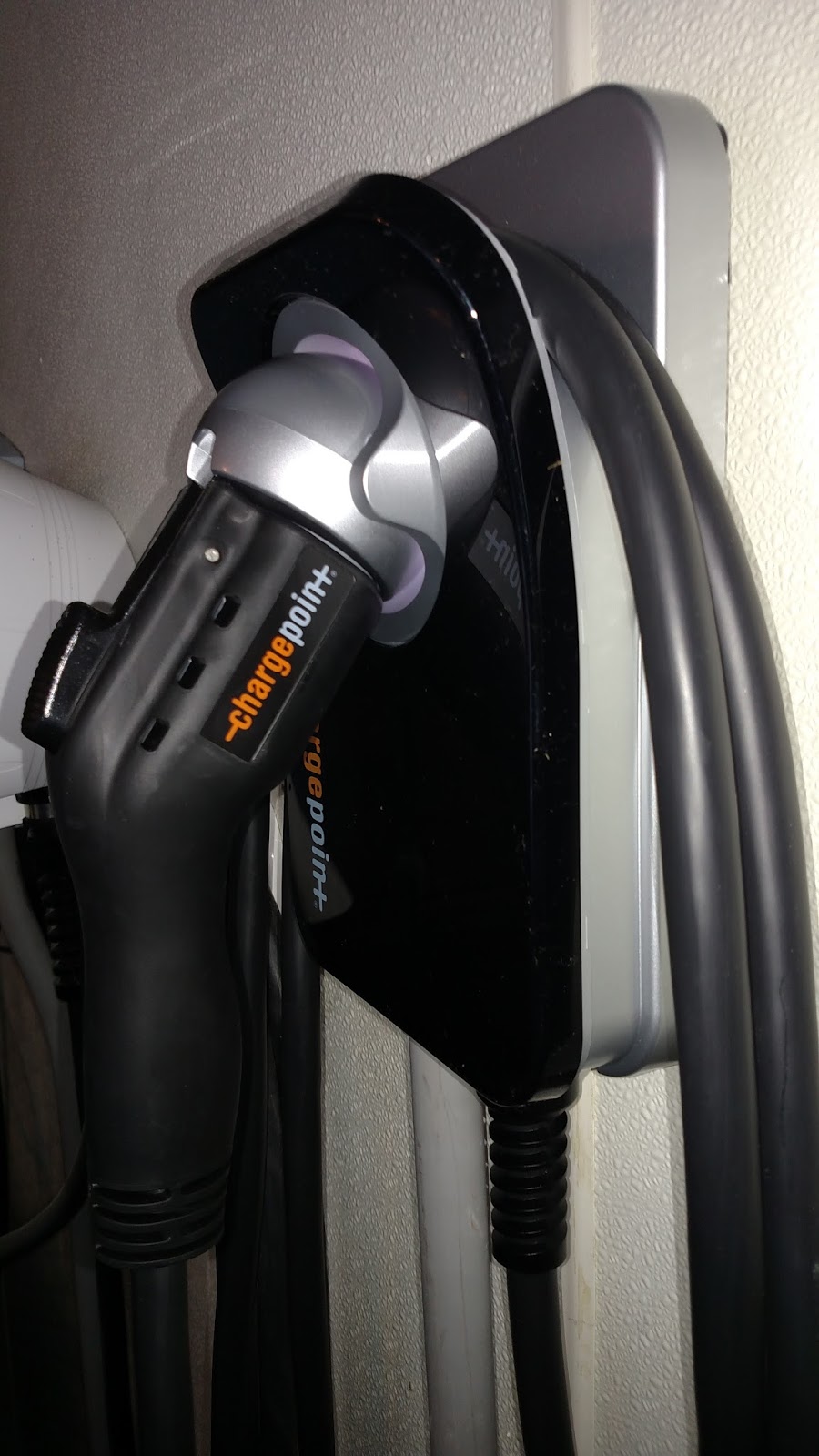
The ChargePoint Home 25 EVSE is the latest addition to my EVSE collection
When most electric vehicle owners think of ChargePoint, they likely are thinking about public charging infrastructure. That's because for the past five years, ChargePoint's focus has been on installing and maintaining the largest network of public EVSEs in the US, with well over 20,000 locations currently in use.
Back in 2012, ChargePoint did release an EVSE for home charging, the CT500 made by Coulomb Technologies, but it was priced a bit above the market at $2,495. At the time, it was the only home EVSE that was networked, so that was a major advantage. However, the price was prohibitively high and competitive units were selling for half of that, so the CT500 never sold in any serious volume.
That won't be the case with ChargePoint Home, ChargePoint's new entry in the home EVSE market. I've had the opportunity to test this product for a month now, before the official launch and I've been really impressed.
Options
There are two power levels offered, a 16 amp unit (The ChargePoint Home 12) and one which can deliver up to 32 amps (The ChargePoint Home 25). If you're wondering why "12" and "25" are used in the product names it is because ChargePoint is advertising that the 16 amp unit is capable of adding 12 miles of range per hour to the typical EV, and 25 miles of range per hour for the 32 amp unit. I'm not particularly fond of using that method to name them, since every EV is capable of achieving different levels of efficiency. Plus, I think it may confuse some people who think the number is the amps the EVSE is capable delivering. However, this is only the name so it's not really a big consideration.
Since I'm discussing the power delivery, this brings me to one of the few criticism I have for the new ChargePoint Home. While 32 amps is above the maximum charging limit for any currently-offered electric vehicle that isn't a Tesla or that uses a Tesla onboard charger (Mercedes B-Class ED), some of the competition is now offering 40 amp and 50 amp home charging solutions. These would be attractive for Tesla owners, and perhaps someone who wanted to future-proof their garage. I suspect ChargePoint would be ready to offer a higher powered version in the future if there are any new electric vehicles offered that can accept more than 32 amps. However, considering the current electric vehicle offerings, 32 amps is fine.
I got the optional 25' cord
After selecting whether you want the 16 amp or 32 amp EVSE, you then have the option of choosing a hard wired unit or one that plugs in. The 16 amp plug-in version uses a NEMA 6-20 outlet and the 32 amp plug-in EVSE uses a NEMA 6-50 outlet. Once that is decided you can choose the length of cable you want, but that's only if you buy the 32 amp version. For some reason, the 16 amp version only comes with a 12' cord, you cannot order it with one longer. That could be a deal breaker for some people whose garage is set up in a way that twelve feet of cable won't reach their charge port. On the other hand, the 32 amp unit comes standard with an 18' cord, and has an optional 25' cord for an additional $50. It's a bit puzzling why the lower powered unit isn't available with a longer cord, and I believe this will steer many potential customers to the higher powered EVSE, even if they originally considered the lower powered unit (maybe that's the plan!). I did reach out to ChargePoint about this and was told that a customer can order a replacement cord of either 18' or 25' length and replace the 12' standard cord that comes with the 16 amp EVSE. I didn't get the pricing, but I assume it will cost considerably more than the $50 up-charge when you upgrade from an 18' cord to the 25'cord on a ChargePoint Home 25 (32 amp). The rep also told me that if there is demand for longer cords on the 16 amp unit, then ChargePoint will consider offering it at a later date.
Installation
Drill bit & nut driver
If you choose to go with one of the plug-in versions, you'll need to have an electrician install the appropriate outlet in your garage. The 16 amp unit requires a 20 amp, 240v dedicated circuit with a NEMA 6-20 outlet and the 32 amp EVSE requires a 40 amp circuit with a NEMA 6-50 outlet. I chose the 32 amp hard wired one, with a 25 foot cord. Since I was replacing one of my older EVSEs with the Home unit, it was an extremely simple process, and that wasn't by accident. ChargePoint made every effort to make installing the Home EVSE as easy as possible, especially if the owner was swapping out an older EVSE for the new Home unit. In that case, it's so easy to do that the average person can probably complete the installation in less than an hour. I had mine installed in about 30 minutes. A drill bit and nut driver for the supplied wall mounting screws are even included. One aspect of the installation I found curious is that all three mounting screws run down the center of the unit, as opposed to the four corners. This could possibly cause the EVSE to rock a bit from side to side if the wall it's mounted on isn't flat. I'd prefer if the mounting screws were in the four corners, which would provide for a more secure mount on uneven surfaces.
ChargePoint Home installation video
Another great feature is how compact, lightweight and portable the ChargePoint Home is. At only 11.2" by 7" it's stylish and not bulky. It has a back-lit connector holster which swivels up and down and that helps to make returning the connector to the base easy, even in the dark. If you choose the plug in version, you can easily take this EVSE with you for charging away from home. All you would need is the appropriate outlet at your destination. The ChargePoint Home is indoor and outdoor rated and is UL listed.
The ChargePoint app displays useful charging information such as current and cumulative energy draw. You can also set a "Remind Me to Plug in" notification, so you never wake up to an uncharged EV.
Connected Perhaps the best feature of ChargePoint Home is that it can be integrated with your ChargePoint account which allows the user access to information from the ChargePoint mobile app. This includes viewing information on the current charging session, remotely start and schedule charging, set notification reminders so you don't forget to plug in, review data on past charging sessions, and it even works with Nest thermostat products which can help save energy.
ChargePoint Home EVSE pricing starts at $499 for the Home 12 hard wired station and goes up to $749 for the Home 25 plug in station with a 25 foot cord. Full pricing details are below. ChargePoint Home has a three year warranty and is available through Amazon.
ChargePoint Home 12: 16A Hardwire station with 12' cord
$499
ChargePoint Home 12: 16A Plug station with 12' cord
$549
ChargePoint Home 25: 32A Hardwire station with 18' cord
$649
ChargePoint Home 25: 32A Plug station with 18' cord
$699
ChargePoint Home 25: 32A Hardwire station with 25' cord
$699
ChargePoint Home 25: 32A Plug station with 25' cord
$749
Slim, compact design
I've been using my ChargePoint Home 25 for a few weeks now and I really like it. ChargePoint has a winner with this EVSE, and I predict it will sell very well. I've been driving electric for over six years now, and I've seen the evolution of EVSE products. It's good to see the products continue to improve just as the prices continue to go down. The ChargePoint Home delivers on size, portability, quality and ease of installation. It's stylish, competitively priced, and best of all connected to the ChargePoint Network which allows the user mobile access to effective tools which can enhance their electric lifestyle. This all adds up to great news for EV owners.
Note: I received for free, one ChargePoint Home 25 EVSE from ChargePoint for testing, feedback and product review publication before the consumer launch. No other compensation was made.
The latest addition to my EVSE obsession collection is the JuiceBox Pro 40, seen here charging my i3
One of the first things many first time electric car owners ask once they've bought (or are about to buy) their new car is what home charging solution should they choose. Other than asking for advice on specific plug-in cars, it's the most popular question I get from readers here.
Luckily, there are some really good choices on the market now, and the prices for home EVSEs are considerably less than they were when I first started driving electric in 2009. Back then, the only level 2 home EVSEs that I would recommend were from Clipper Creek. Clipper Creek still makes very good products, and I still recommend them, but the competition is getting better all of the time, and one company in particular, eMotorWerks has been gaining momentum in this competitive market.
Before I get into the review, I'd first like to explain some basic EV charging levels and terminology. This applies to charging in North America, as electric supply is different for most European countries.
EVSE: Electric Vehicle Supply Equipment. These are quite often called "chargers" or "charging stations." That really isn't the correct terminology though, because they don't actually charge the car. They really just safely supply the electricity from the power source to the vehicle. The actual charging equipment is built into the electric cars. Some EVSEs are portable, while others are hard wired and permanently installed.
Level 1: Every electric car sold or leased in the US that isn't a Tesla comes with a Level 1 portable EVSE. Some manufacturers, like BMW, call it an "occasional use charger." Level 1 EVSEs can be plugged into a simple 120 volt household outlet and typically charge at 6, 8 or 12 amps. Tesla doesn't bother with Level 1, 120 volt EVSEs because their vehicles have such large batteries that they would take very long to slow charge on 120 volts. For that reason, every Tesla comes standard with a portable 240 volt EVSE for more robust charging at home or on the road.
Level 2: Level 2 EVSEs charge at 240 volts and most of the time are permanently installed in a garage or public parking lot. However, recently some manufacturers have been selling portable 240 volt EVSEs, allowing the owner the flexibility of using the equipment at home as well as on the road, provided they can find a 240 volt outlet that they can plug into. The JuiceBox Pro 40 which I'll be reviewing here today is one of those newer units, and comes with a NEMA 14-50 plug instead of requiring the owner to hard wire it to their home.
DCQC / DCFC: DC Quick Charge or DC Fast Charge. DC fast charge allows rapid charging of electric vehicles, enabling long distance travel with little inconvenience. DC Quick Charge stations can charge many EVs up to 80% full in about 30 minutes, but are not something an individual would buy for home use because of the cost and required 480 volt electric supply. These units are very expensive and are only just beginning to really proliferate. Unlike Level 1 and 2 charging, there are multiple connectors used by different manufacturers, as a single standard hasn't been established yet.
Some people live fine with their EV, charging solely with the supplied 120 volt portable EVSE. However most owners will prefer using a 240 volt EVSE, so that they can charge much faster, enabling the vehicle to be driven more miles if needed. For example, a basic 120 volt EVSE will replenish about 4 to 5 miles of range per hour, while a standard, 30 amp 240 volt unit will add 20 to 30 miles of range per hour to the typical EV. That can make the difference of being able to use the car or not on some days.
JuiceBox Pro 40 EVSE
I think I've charged my EVs on every brand of EVSE on the market today, and I have a host of EVSEs in the garage at my house which I use for various testing and when I have visitors that also have cars that plug in. I had been reading a lot about how eMotorWerks has been expanding lately, and how they recently sold their 3,500th JuiceBox EVSE. So when the opportunity came for me to test out the latest offering from eMotorWerks, the JuiceBox Pro 40, I happily accepted. I want to make it clear I did receive the EVSE free of charge, however I wasn't paid to do the review, and there were no conditions or promises on what I would write. In other words, if I didn't like it, I would say so, or perhaps not even write a review.
First, I'd like to point out the JuiceBox Pro 40 can deliver up to 40 amps of power. The vast majority of Level 2 EVSEs currently on the market are limited to delivering 30 amps of power. There are a few other companies like Clipper Creek for instance, that do offer a 40 amp EVSE, but for the most part, the industry norm is 30 amps and even less in many cases. When buying any EVSE, make sure you find out what the maximum power the unit can deliver before purchasing it. I know more than one EV owner who bought an EVSE and didn't know it could only deliver 16 or 20 amps until they installed it. Why does 40 amps matter as compared to 30 amps? Well, for most EVs today, it doesn't. Only Tesla makes on board charging equipment that can accept more than 30 amps from a level 2 source, however that is going to change. I like to recommend future-proofing your garage, and if you're investing in a home charging solution which you may be using for ten or more years, why limit the charging supply to today's norm when home charging will only get faster as EV adoption increases? If your home has the capacity to add a dedicated 50 amp circuit (a 50 amp circuit is required for a continuous 40 amp load), then I say pay the few extra dollars today so you don't have to go back and upgrade in the future.
Voltage, amperage and kW draw displayed
Switch between Amperage or kW draw screens
The feature I love the most about the JuiceBox Pro 40 is that is has built in WiFi and connects to eMotorWerks servers. This allows for real time charging monitoring which includes voltage and current measurement accurate to 0.2%. This is the only EVSE I know of currently available which allows you to monitor this kind of charging data. I know a lot of EV owners, and one of the things that keeps coming up is people asking how they can find out what the car is drawing during charging. ChargePoint allows the current measurement to be viewed on their app if you are charging on one of their networked EVSEs, and they used to offer a home EVSE (CT-500) which allowed the same, but that has been discontinued. Having the ability to monitor your vehicle's electric draw is particularly useful to BMW i3 owners like myself. The original i3s shipped with faulty onboard chargers, causing many of them to fail. This resulted in the car charging at half the speed than it was supposed to (15 amps instead of 30 amps). To make matters worse, while BMW engineered a new onboard charger, the dealers were instructed to de-rate the i3's current charging capabilities to about 24 amps, in an effort to keep the charger from failing. Many i3 owners didn't know if their car was de-rated, if their charger had failed or if they were charging at the full 30 amp rate. Without a way to really measure the energy the car was accepting, many were left in the dark for a few months while BMW built and installed the new, modified onboard chargers. If they had an EVSE that had the capability of displaying the rate the car was charging at, they would never have to wonder what the car was capable of drawing since they could simply look at the app when they plugged in.
If you're wondering if you can mount and use the JuiceBox outdoors, this video demonstration should satisfy any concern you have.
The connector has a cover
As mentioned above, the JuiceBox Pro 40 doesn't need to be hardwired. Instead, it comes with a NEMA 14-50 connector. This allows the owner to take the EVSE with them, all they need to do is find a NEMA 14-50 receptacle and they can plug in. The 14-50 outlet is commonly used by RVs and thousands of RV parks across the country have 14-50 receptacles where you can plug in on the road if needed. But in my opinion, the real beauty of having a portable, plug-in EVSE is you can install 14-50 receptacles in places like your parents or friends home, or even work, and take the EVSE with you and charge at your destination. This is much less expensive than installing EVSEs in locations you may need to occasionally charge at. The JuiceBox is small and light enough to take with you when needed. You can see this on the photo above compared to the other EVSEs I have mounted on my garage wall. The connector also has a rubber cap if you do mount or use it outdoors.
The app is very easy to set up, and should take you less than ten minutes to complete. There is also a web portal which you can log into for past history charging info (it stores data from your last 20 charging sessions) and soon you'll be able to set up notifications from the site. eMotorWerks also offers 60 amp, as well as 30 amp EVSEs, with and without WiFi connectivity. The JuiceBox Pro 40 with WiFi currently costs $599.00 which is $100 more than the basic JuiceBox 40. Personally, the WiFi feature is well worth the upcharge and I highly recommend getting it. You'll really appreciate the ability to look at your past charging sessions and energy consumption and it definitely helps you to see exactly how much energy your EV car uses because you'll have a true "wall to wheels" measurement, which includes charging losses. The in-car energy use calculators don't include charging losses or the energy used from battery or cabin preconditioning while charging, but this does. The difference can be significant, especially during the winter months when the battery may needs to be warmed while charging. The JuiceBox Pro 40 comes with a 24 foot cable which is a little longer than most standard EVSE cables. The extra few feet of cable can make the difference of having to back into your garage or pull straight in, and possibly allow you to park on either side of the garage in any position and still have enough cable to plug in.
Don't let the plain, metal box look fool you. This is a seriously good EVSE
The EVSE market is getting better all the time. The products available today are more powerful, lighter, some are portable and overall less expensive than the products available only a few years ago, and this is welcome news to EV owners. eMotor Werks is a relative new comer to the field of EVSE manufacturers, which is mostly dominated by larger, well established companies. However, the people there seem to understand what the EV owner is looking for in an EVSE, and they have delivered it with the JuiceBox Pro 40, which is why I recommend it. The price is right, the size is right, it's powerful and portable. About the only thing you can criticize is the plain-looking metal case which houses the electronics. If that really bothers you, you can always paint it, or apply a vinyl wrap or sticker to add some pizzazz. :)