History and Memory: Crusades Imagery


Wow. "Crusade" continues to evoke such a powerful set of memorializing impulses around the Judeo-Christian-Islamic world.

Update: Mustafa was kind enough to translate for me.

Be Not Afraid (Liberal Professor)

I haven't had time to write about the Vox piece of "Liberal professor scared of liberal students." But I'm pleased to say that Amanda Taub, at Vox, has rebutted the piece published by Vox.

Big websites like Vox are formed of independent turfs, with lots of people having access to the "publish" button (with a process going through edits and fact checks and so forth). So maybe whoever cleared the first piece (I'm not linking to it. Go read Amanda's first, then go back to it if you've missed it).

I find Taub's argument entirely convincing. It echoes my own about the real meaning of student complaints. I also find her critique of the first piece effective: lack of evidence and lack of understanding both drag down the viral first essay.

So why publish it? Who at VOX gave the go ahead? Did they not notice the flaws?


Reading Inspiration Porn Through the Social Model of Disability

I have a new piece out at Al Jazeera America on the concept of inspiration porn.
Inspiration porn still dominates depictions of disability in the news, so her work continues. In the last few weeks, three stories about disability have gone viral. A high school quarterback in Pennsylvania took a girl with Down syndrome to prom, fulfilling a promise he made to her when they were in the fourth grade. A Qdoba employee in Kentucky was filmed feeding a customer with physical disabilities. Madeline Stuart, an Australian woman with Down syndrome, lost weight and became a model.
Each of these stories has been reproduced on news outlets and shared on social media around the world in multiple languages. They all feature people doing good things. There’s nothing necessarily wrong with the content of these stories, of course, but the way they’re told conceals the real issues faced by the disability community. We need stories that illuminate instead.
I talk about Stella Young, the terrible idea that TEDxSydney had to honor her (and now they've flubbed the apology too - READ THIS), and three inspiration porn stories making the rounds lately. At the end, and the part I really like, I re-read the three stories through the lens of the social model of disability.
At its core, inspiration porn demonstrates the need for a broader engagement with the social model of disability. People typically view disability through the medical model, in which diagnosed conditions present obstacles to be cured or overcome. But according the social model, while many people may have all kinds of medical conditions, people are disabled by the lack of accessibility in our society.
Reread these three stories through the lens of the social model. Moser and Lapkowicz are news because stigma makes it hard for people with disabilities to have close friends, especially with someone as iconic as a high school quarterback. The stigma disables.
Stuart is an exception to the social norms that view disabled bodies as unattractive, and she gets to be that exception only by conforming to specific body norms. The perception of disabled bodies as nonsexy is disabling, not the bodies themselves. The anonymous woman in Qdoba is disabled not by her wheelchair but by restaurants that lack automated doors and a society that doesn’t provide sufficient community-supported assistance.
I think this is a useful approach and I'm going to use it when I address such stories in the future. When you see an inspiration porn story, ask yourself - what would the social model say about this?

All-new 2016 Nissan Maxima on sale now


The wait is over. After its buzz-generating debut at the recent New York International Auto Show, the 2016 Maxima has arrived at Nissan dealerships nationwide. As Nissan's flagship sedan, the all-new eighth-generation design takes the company's best-known nameplate into new territory with its boldest styling, most powerful engine and highest level of available safety and connected technology features yet.


"Following on the highly successful launch of the all-new Nissan Murano, the new 2016 Maxima is hitting showrooms with tremendous momentum," said Fred Diaz, senior vice president, Sales & Marketing, Parts & Service, U.S.A, Nissan North America, Inc. "With its winning combination of style, technology and driving excitement, we see it appealing to both the large number of previous Maxima owners and buyers considering vehicles from luxury brands. We've proven Maxima can go tire-to-tire on the track. We think we can do it in the showroom as well."


All 2016 Maximas feature a revised 300-horsepower 3.5-liter VQ-series V6 engine and new performance-oriented Xtronic transmission. The comprehensive re-engineering effort also results in a 15 percent increase (over the previous generation Maxima) in highway fuel economy to 30 miles per gallon.

Maxima's next-generation technology features include standard NissanConnectSM with navigation and available 11-speaker Bose® premium audio system, NissanConnectSM Services powered by SiriusXM® (SiriusXM subscription required, sold separately) and Around View® Monitor (AVM) with Moving Object Detection (MOD)

The new Maxima starts with a Manufacturer's Suggested Retail Prices (MSRP) of $32,410 for Maxima S. The Maxima SV is $34,390, while the Maxima SL is $36,890. The sporty Maxima SR is priced at $37,670 and the top-of-the-line Maxima Platinum is $39,860.

The new BMW X1. Urban all-rounder delivers boundless driving pleasure


The new BMW X1 – the successor to the model that blazed the trail for this class of car – treats the premium compact segment to an even more potent shot of Sports Activity Vehicle DNA. The second generation of this successful model, more than 730,000 units of which have now been sold, takes to the stage with a body design straight out of the BMW X model mould. The interior of the new BMW X1, meanwhile, offers significantly more space for passengers and luggage, a cutting-edge premium ambience and functionality grounded in solid engineering. Four-cylinder engines from the BMW Group’s latest generation of power units, an efficiency-optimized version of the BMW xDrive intelligent all-wheel-drive system and newly developed chassis technology all help to palpably enhance sporting ability and ride comfort compared to the outgoing model – with fuel consumption and emissions reduced by up to 17 per cent, model-on-model.

Alongside its market-leading dynamics and efficiency, a host of innovative equipment features also help to secure the new BMW X1 its stand-out position in the segment. Among the items on the options list are full-LED headlights, Dynamic Damper Control, the BMW Head-Up Display and the Driving Assistant Plus system.


New generation of engines, efficiency-optimised xDrive all-wheel-drive system.
The second-generation BMW X1 (fuel consumption combined: 6.4–4.1 litres/100 km [44.1–68.9 mpg imp]; CO2 emissions combined: 149–109 g/km) lines up with an all-new selection of engines. Two petrol and three diesel units will be available from launch in October 2015, all of which have four cylinders and are members of the BMW Group’s new engine family. Outputs range from 110 kW/150 hp to 170 kW/231 hp. The engines link up with either a six-speed manual gearbox or an eight-speed Steptronic unit, both of which are new developments.


The xDrive intelligent all-wheel-drive system also takes its place in the new BMW X1 in a further developed form. The weight-saving, compact and efficient system uses an electro-hydraulically controlled multi-plate clutch to distribute drive between the front and rear axle just as required for the situation at hand. Joining the fray in the BMW X1 sDrive20i and BMW X1 sDrive18d, meanwhile, is a front-wheel-drive construction which has been developed to deliver the driving dynamics typical of the brand and has already proved its mettle in the BMW 2 Series Active Tourer and BMW 2 Series Gran Tourer.


Premiere in the BMW X1: Head-Up Display and Driving Assistant Plus.The change of BMW X1 generations also brings significant advances in the field of intelligent connectivity. A new addition to the range of BMW ConnectedDrive features is a BMW Head-Up Display which, as in the larger BMW X models, projects driving-related information directly onto the windscreen. The BMW X1 can now also be specified with the Driving Assistant Plus line-up of the Active Cruise Control system with Stop & Go function, Lane Departure Warning, Traffic Jam Assistant, Collision Warning and Pedestrian Warning with City Braking function. These systems are complemented by an up-to-the-minute selection of apps allowing customers to add to the car’s comfort, navigation and infotainment functionality, as desired.

Accessible Conferences - Learning from Fandom Cons

I am working on a piece about accessible academic conferences and am, intentionally, focusing on academia. But there are two speculative fiction conventions that deserve mention.

Convergence holds a special place in my heart. I've never been deeply involved with it, but have gone and performed there many times, especially in the early years before it exploded and became one of the premier cons in the country (to my mind). I'm pretty sure one of my bands (Tramps and Hawkers, maybe?) played the very first Convergence fundraiser.

Here's their policy. It's excellent overall, while acknowledging that some barrier remain.

WisCon, the feminist speculative fiction convention in Madison, has even stronger language.
Universal Design: Disability Access at WisCon
The Disability Inclusion Services offered by WisCon are informed by universal design and disability rights activism. Universal design benefits people of all ages and abilities, by making schedules, communications, and the physical environment usable by as many people as possible. We strive to create an event that works for members in all our physical and mental variety. We must balance that goal against limited fiscal resources, the paradox that sometimes one member's accommodation is another member's barrier, and an entirely volunteer work force. We always welcome discussion exploring how we can better accommodate our members.
Outstanding things.

1. Embrace of universal design.
2. Acknowledgement of challenges and the "paradox."
3. Desire to always find ways to improve.

Everyone else hosting any kind of professional and/or fan gathering anywhere could learn from this.

More to come!

Why Bother Developing Down Syndrome Tests?

Yesterday I wrote about Peter Singer, my least favorite bioethicist.

Today, here's a bioethicist asking a new question - do we actually need more and more sensitive Down syndrome tests? Chris Kaposy writes:
There is an inconsistency between the lived experience of people who have Down syndrome and the corporate arms race to develop new and better means for identifying fetuses with Down syndrome. Few people who live and work with those who have Down syndrome would describe it as a serious disability. The arms race to develop these tests is not being driven by the needs of people with Down syndrome or the needs of their families. Of course, a great deal of scientific ingenuity is needed to create novel tests, like the one Dr. Iles and his colleagues have recently described. For this reason, creating these tests might require a lifetime’s work. But the social utility of these tests is incommensurate with the effort needed to create them. In contrast to the scientist who devotes her life to the treatment of cancer, Dr. Iles’s devotion to create a test that helps parents to avoid the birth of people who tend to enjoy their lives seems somehow less ambitious, or off the mark.
Worth a full read.

REVIEW: 2015 Ford Expedition Platinum SUV


The 2015 Ford Expedition SUV - It's smart, capable & comfortable. The Platinum model comes jammed packed with some amazing features and I'm going to jump right in and share them with you.

The Standard 3.5L EcoBoost V6 Engine delivers more power than ever. Higher fuel economy too. I drove around Atlanta for a week and still had a half-a tank of gas left. I was really shocked how well Expedition performed for it to be a full size SUV the drive was very smooth and the handling was impeccable. 


 Blind Spot Information System (BLIS) with cross-traffic alert

BLIS helps you monitor your blind spots. • BLIS uses radar to identify a vehicle detected in a right- or left-side blind spot and alerts with an indicator light in the exterior mirror
• Cross-traffic alert detects traffic behind while slowly backing out of a parking spot or driveway and emits an audible alert


  Power moonroof
Some of the features included in the  Expedition.

  • 20-inch polished aluminum wheels
  • Chrome, power-adjustable/folding outside mirrors with signal, heat, memory and driver-side auto-dim feature
  • Polished stainless power-deployable running boards
  • Unique satin aluminum trim
  • Luxury leather-trimmed seats
  • Unique interior leather and woodgrain trim accents
  • Price: $59,370 MSRP
  • EPA-Est. MPG Combined City/Hwy 16 Mpg -- 14 City MPG 20 Highway MPG


Controls for the back seat riders

Seats 7 passengers
Roomy Trunk and Storage Area


Available SYNC with MyFord Touch is available on XLT and standard on Limited, King Ranch and Platinum: an 8-inch touch-screen center display, AM/FM/SiriusXM satellite radio, single-disc CD player, two USB ports, SYNC voice-activated communications and entertainment system.


Below is a quick video displaying some of my favorite features:

In which Peter Singer Fails to Look in the Mirror

It's no secret that I'm not a fan of Peter Singer. He's a eugencist. Start here with Harriet McBride Johnson. For more recent context, perhaps read this press release from the National Council on Disability.

What may be less clear is that I'm not bothered by him. The world is full of terrible people saying terrible things, and this eugenicist is no worse than Holocaust Deniers, Islamophobes, Antisemites, KKK members, and other kinds of horrific bigots. It's just that most of the other folks don't get big fancy jobs at Princeton in part on the basis of their bigotry. They don't get called "controversial" but treated as if they belong in polite company. They don't get profiled and interviews all around the world. The philosophy and bioethics community, writ large (I know lots of individuals who object), are responsible for the propagation of Singer's deadly views.

I'm not actually going to debate anyone about Singer's views today. Much as I won't debate with white supremacists or Islamophobes.

Last week Singer was interviewed in the New York Times. He said, among other things:
Why do racism, sexism and discrimination against people with disabilities still exist, despite the widespread acceptance that they are wrong? There are several reasons, but surely one is that many people act unthinkingly on the basis of their emotional impulses, without reflecting on the ethics of what they are doing.
So if I get this right, Singer suggests that discrimination against people with disabilities in part continues because people don't think about ethics; if they do think about ethics, on the other hand, says the world's most famous ethicist, we realize it's ok to kill babies with disabilities. And that will solve discrimination.

If Peter Singer really wants to answer why such discrimination exists, he must, in part, look in a mirror. And so must everyone who gives him a favorable platform.


Maintenance Monday: Basic Tips & Services Checklist


As drivers, we know it’s important to maintain our vehicles. But between work, the kids, and the dozens of other things we’d rather be doing, basic car maintenance can often fall to the wayside. But did you know that taking care of your vehicle not only helps it perform better, it also could mean money in the bank for you?


From better fuel efficiency to retaining your car’s value, these simple car maintenance tips will have you seeing green in no time:


1) Don’t skip scheduled service. Check your owner’s guide and find out when your scheduled car maintenance services are. Usually maintenance is done every 30,000 miles and it involves checking or replacing parts like spark plugs, wires and timing belts. Down the line, other major parts may need replacing in order to keep your vehicle running efficiently and safely . While it may cost a little more, scheduling service through your dealer not only guarantees genuine parts and expertise, it also keeps your service history in line and up to date, which will attract more buyers and higher prices when it comes to selling your car.


2) Replace the air filter. Think of it as your car’s lungs. A clogged air filter can reduce gas mileage in older cars with carbureted engines by as much as 14 percent. Replacing clogged air filters on newer cars can help improve acceleration time.


3) Get an oil change. This is one of the simplest car maintenance services you can do to keep your vehicle in good running condition. Not maintaining it could void your warranty (check your owner’s manual to find out when you’re due for service) and even cause an engine failure, which can cost thousands . Keeping your cooling system in working order is also important. So, this is also a good time to have a system flush. Getting the pump, hoses, fluids and belts checked is also part of proper cooling-system maintenance.


4) Check your tire pressure. Invest a few bucks in a tire gauge and check your tire pressure regularly (including the often-overlooked spare!) This helps to improve fuel efficiency, cut down on tire wear and tear and lets you know if your vehicle is correctly aligned.


5) Wash it. Washing not only keeps your vehicle looking good, it's also a good way to maintain that new-car finish. Allowing a layer of dead bugs, bird droppings, dirt and chemicals to accumulate on your vehicle can strip away wax and eventually paint. If you decide to wash your car yourself, don’t use household cleaning agents like hand soap, dish-washing detergent, or glass cleaner, which can also strip off the protective wax. Use a product designed specifically for cars.

Provided by Toyota

Sunday Roundup - The Republican Assault on Higher Education

I have a bunch of pieces out in various stages of edits, and hope to have 3 or 4 pieces published next week. This week I had only one, a new Game of Thrones piece for Vice. I think the changing relationship between the books and the show is interesting. Eventually, the show will become canon, if indeed it hasn't already. 

Of course, Game of Thrones is a very problematic show, as I try to face directly in my writing. I also wrote a blog post on Liking Problematic Things then had some thoughts about the way that Trigger Warnings Are Your Friends (focused more on academia than TV/entertainment).

Finally, I had a brief post on Language and Power: Stop Saying Troll. Center the victim. Call people who abuse folks online ... abusers.

-------------------

But the most important pieces I read this week emerged from various writers focusing on the Republican attack on higher education in Wisconsin. Here are some links:

In the last few days, the GOP in WI have removed definitions of tenure from the statute, cute around 250 million in funding from UW, and change "subject to" to "subordinate to" as a piece of their plan to destroy shared governance. Even worse, if everything passes, WI will become the only state in the country to not require even a BA to become a teacher. I don't really understand the kind of person who looks at the problems faced by WI and decides ... What we need are teachers with less education! That'll fix it.

Here are a few links. What are you reading?
In short, Wisconsin Republicans have declared total war on public education. Both the K-12 bill and the UW bill were negotiated and written totally in secret by committee Republicans, with the details released to the public only hours before the final, fore-ordained votes were held. Moral and political commitments aside, this leaves one to wonder whether those legislators who are quickest to cite “market-based” considerations have even a basic understanding of what Wisconsin’s comparative advantage is. Wisconsin has a hard-earned and well-deserved reputation for its excellent public schools and universities. Without those, what is the point of living in Wisconsin as opposed to some other state? Set aside the fact that no UW campus will ever be able to recruit a top-tier scholar again. Why would anyone choose Wisconsin as a place to raise their family? Why would anyone in their right mind move to Wisconsin after this budget?
And let's not forget North Carolina and Louisiana 

Trigger Warnings Are Your Friends!

The Trigger Warning debate is back. Did it ever really go away?

Here's my new piece of the argument: Trigger Warnings preserve access to offensive content that, nevertheless, has educational value.

A year ago I wrote this piece for CNN in the context of the TW discussion. I argued that best practices for teaching any content requires preparation or "scaffolding," and good scaffolding would cover many of the functions of what students are asking for in trigger warnings. I continue to argue that "content notes" is a more useful pedagogical context.

Here's an excellent essay by a TW-skeptic, Sarah Marian Seltzer, who interviewed teachers and was persuaded by their methodology. She writes:
Educators who choose to utilize these warnings in their classrooms often see more nuance in the issue. “We have to take [students demanding trigger warnings] seriously… because being more acutely aware of how students are responding to challenging material is just better and more responsible pedagogy,” wrote Aaron R. Hanlon last week. Faculty in this camp say that they’re committed to academic and intellectual freedom, but also to honoring students’ experiences, in particular the often silent presence of rape survivors — a trauma-prone group — among the college-aged population. Rather than debating whether to teach troubling material, as much of the anti-trigger warning contingent fears, they say they’ve moved on to asking how to do so in a respectful way.
So that's good and very much in line with my own approach. I especially liked this:
“Trigger warnings allow me to have a conversation, to say, ‘This is not a class about your personal life,’” Heldman told me. “This actually helps to make the class more academic. And it has the benefit of letting students prepare for what might come.”
This is very much my experience. I teach all kinds of difficult texts - stories of massacre, anti-Jewish polemic, Inquisition trials, anti-Latin polemic (Byzantium). Because I'm a medievalist, it's less directly emotionally affecting than if I taught the Holocaust, or say 20th-century American popular culture. Still, the pre-conversation about what we're going to read provides a framework for students to respond to potentially upsetting material. There are no spoilers in the history of the First Crusade.

Last August, I wrote about the need for a content note in This American Life's re-broadcast of a David Sedaris piece, one filled with jokes about the intellectually disabled. TAL uses content notes when they talk about sex and racism, but not for other kinds of troubling material, and that bothered me. Moreover, I suggest it should bother them, too, because without content notes, such pieces all go the way of "Little Black Sambo."
The trigger warning, therefore, emerges as a pathway towards preserving content, preserving material as its language ages our of the mainstream into the widely and wildly offensive. Because without the trigger warning, well, then I have to advocate that this never be aired again.
Norms change. Studying changing norms or just previous eras requires engaging with material that is offensive. Content notes are a way to say - I recognize the problem, here's why we're reading/discussing/viewing this, and let's go learn something.

Trigger Warnings are about keeping material in the curriculum, not banning it. Embrace them.

Chevrolet is Global Leader for Android Auto, Apple CarPlay


According to Strategy Analytics, there are more than 2.3 billion smartphones in use globally, and that number continues to rise. And on the road, customers are demanding better integration between phones and their vehicles. Whether they have an Apple or Android phone, Chevrolet is committed to providing the smartest, simplest connected driving experience possible to owners across the globe.

For the 2016 model year, Chevrolet will offer Android Auto and Apple CarPlay compatibility in more models than any automotive brand. The 14 Chevrolet models include the all-new 2016 Cruze compact car, which will debut on June 24. Cruze is Chevrolet’s best-selling passenger car, with more than 3 million sold since launch. Additional models are listed in a chart below.

“For most of us, our smartphones are essential,” said Mary Barra, CEO of General Motors. “Partnering with Apple and Google to offer CarPlay and Android Auto compatibility across the widest range of models in the industry is a great example of how Chevrolet continues to democratize technology that’s important to our customers.”

Chevrolet’s seven-inch MyLink infotainment system gives owners a smart and simple way to access both Android Auto and Apple CarPlay. The eight-inch version of MyLink will be compatible only with Apple CarPlay at the beginning of the 2016 model year.  While development and testing is not yet complete, Android Auto compatibility may be available on the eight-inch version of MyLink later in the 2016 model year.


Each system builds off of the features smartphone users rely on most. Android Auto is built around Google Maps, Google Now and the ability to talk to Google, as well as a growing audio and messaging app ecosystem that includes WhatsApp, Skype, Google Play Music, Spotify, and podcast players. A full list of supported apps is available at Android.com/auto.

Apple CarPlay takes the iPhone features you’d want to access while driving and puts them on the vehicle’s display in a smart, simple manner. That allows drivers to make calls, send and receive messages and listen to music right from the touchscreen or by voice via Siri. Apple CarPlay supported apps include Phone, Messages, Maps, Music and compatible third-party apps. A full list of those apps can be found at Apple.com/ios/carplay.

Many features can be controlled via voice commands through a button on the steering wheel, helping drivers spend more time with eyes on the road and hands on the wheel.

Chevrolet has a strong track record when it comes to broad availability of customer-centric innovation as the first brand to introduce Siri Eyes Free functionality and the first and only car company to offer available OnStar 4G LTE connectivity across a range of cars, trucks and crossovers in the U.S. and Canada. In less than one year, Chevrolet has connected more than a half-million customers to high-speed 4G LTE Wi-Fi.

Chevrolet customers in markets around the world including Brazil, Mexico and Canada will benefit from this new level of smartphone integration. Specific market availability for Android Auto can be found here. Current Apple CarPlay markets can be found here.
In 2014, the 14 models included in this rollout accounted for more than 2.4 million vehicle sales, or 51 percent of Chevrolet’s total global sales.

Using either application is simple in a compatible 2016 Chevrolet. A “Projection” icon on the MyLink screen is visible when a phone is not connected, then changes to indicate either CarPlay or Android Auto (whichever is applicable) when a compatible phone is connected via USB. Android Auto requires a phone running the Android Lollipop 5.0 operating system or above, while Apple CarPlay requires an iPhone 5 or later.

Compatible apps need to be downloaded to a phone before using. Apple and Google’s privacy statements and terms of use apply.  Data plan rates may also apply.

2016 Model Year Chevrolet Infotainment Systems
7-Inch MyLink Infotainment
8-Inch MyLink Infotainment
Spark
Cruze
Cruze
Malibu
Malibu
Impala
Camaro
Volt
Camaro Convertible
Camaro
Silverado
Camaro Convertible
Silverado HD
Corvette

Corvette Convertible

Colorado

Silverado

Silverado HD

Tahoe

Suburban

Liking Problematic Things

I like TV shows, books, and movies that are imperfect matches for my values. They are produced in societies that are, likewise, imperfect, and few cultural creations can withstand any kind of purity test.

That doesn't mean that you just get to ignore the problem. It also doesn't necessarily mean you have to stop enjoying something that is problematic. What you have to do, as is so often the case, is to start with listening.

I just ran across this great post from the blog Social Justice League - How to be a fan of problematic things. I found it by reading Shakesville (Melissa McEwan) on Mad Max and feminism (tl;dr it's an imperfect feminist film that is a fantastic feminist film. Also Tom Hardy gets it), and that took me to McEwan's piece on watching The Heat and what it meant to see a body with which she could identify be presented matter-of-factly on the screen (as opposed to the usual fat-shaming), and from there to Social Justice League. It's from 2012, but I'm writing tomorrow about good representations of disability on problematic shows, so it's very timely for me.

Some quotes:
Firstly, acknowledge that the thing you like is problematic and do not attempt to make excuses for it. It is a unique irritation to encounter a person who point blank refuses to admit that something they like is problematic
Don't deny. Listen.
Secondly, do not gloss over the issues or derail conversations about the problematic elements. Okay, so you can admit that Dune is problematic. But wait, you’re not done! You need to be willing to engage with people about it!
Also listen.
Thirdly you must acknowledge other, even less favourable, interpretations of the media you like. Sometimes you still enjoy a movie or book because you read a certain, potentially problematic scene in a certain way – but others read it entirely differently, and found it more problematic
Did I mention, listen?
As fans, sometimes we need to remember that the things we like don’t define our worth as people. So there’s no need to defend them from every single criticism or pretend they are perfect. Really loving something means seeing it as it really is, not as you wish it were. You can still be a good fan while acknowledging the problematic elements of the things you love. In fact, that’s the only way to be a good fan of problematic things.
I'm a fan of this blog post. Go read it.

Language and Power: Stop Saying Troll

Troll Warning: Image of a troll
silhouette in a red triangle.
From WikiCommons.
Trolls are happy to be trolls, mostly. They like the term; it conveys power. They have driven a lot of good people off the internet in their large-scale acts, and just made it an unsafe place in an everyday, small-scale, nasty way.

Whitney Phillips, author of This is Why We Can’t Have Nice Things: Mapping the Relationship between Online Trolling and Mainstream Culture says - Stop Saying Troll. Trolls like being called trolls, because it both gives them deniability ("just trolling," rather than systematically harassing or using hate speech). It also centers the harasser rather than the victim, by looking at what the "troll" is doing rather than the experience of the target. Phillips writes:
The term “troll” has come to subsume all kinds of antagonistic online behaviors, regardless of whether the participants would describe themselves as trolls. I am wary of this new framing (in my research I was exploring a very specific, subcultural sense of the term), and whenever possible avoid using the term as a behavioral catch-all. Instead, I prefer to describe online antagonism in terms of the impact it has on its targets. So, if someone is engaging in violently misogynistic behavior, I call them a violent misogynist, as “troll” implies a level of playfulness that tends to minimize their antagonistic behaviors, or at least establish a firewall between the embodied person and their digitally mediated actions. (“I’m not really a racist, I just play one on the Internet” doesn’t account for the fact that, regardless of what might be in someone’s heart, his or her actions have a real and demonstrable impact on those forced to read yet another racist statement online.)
Just as problematically, the “troll” framing—which is so often used with either the implied or explicit caveat “just trolling,” i.e., “not a big deal/stop being so sensitive/learn how to Internet”—also casts aspersions over those who do not want to constantly deal with identity-based antagonism online. In short, referring to nasty online behaviors as “trolling” frames online antagonism as a game only the aggressor can win, most apparent in the phrase “don’t feed the trolls” (which I critique here). In the process, use of trolling as a behavioral catchall privileges the aggressor’s needs and interests and right to free expression over those of the people they target. It’s the troll’s world in this model. Everyone else is just living in it. And that gives these “trolls” far more credit than they actually deserve.
 I always think that pondering how we frame and discuss problems is worthwhile. The troll discourse emerged more or less organically and isn't going anywhere soon, but I like this analysis and it's well worth reading.

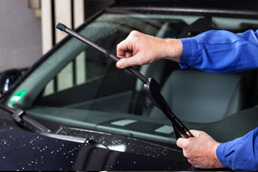
Maintenance Monday: Windshield Wiper Replacement


Windshield wipers are an often overlooked part of your car's safety system. If your windshield wipers are not working properly, it can be difficult to see when it rains. Faulty windshield wiper blades can smear your windshield, creating visibility hazards. So, it's important to make sure your wiper blades are in good shape.

What Needs To Be Done:

Windshield wiper blades need to be inspected and replaced, if needed, on a regular basis.

Why Do It?

  • Windshield wiper blades are made out of rubber, which can wear even with limited use.
  • By being certain that your windshield wiper blades are in optimum condition, you are ensuring the safety of your vehicle and its passengers.
  • If you are driving your car in pouring rain, snow or sleet, worn-out wiper blades can impede the wipers' ability to clean the windshield, which can limit your visibility.
  • Making sure your windshield wipers are newly inspected and replaced, if necessary, can help ensure safety.

How Often?

The frequency at which your windshield wiper blades need replacement depends, in part, on the conditions where you live and drive. Some general information is listed below, but always defer to your car owner's manual and the information that comes with your wiper blades for advice on maintenance.


Check? Replacement?
Sunny, Hot Climate At least every six months At least once yearly
Even if you use your wipers very little, the hot sun can damage the rubber on your wiper blades, making the wipers unusable,according to Autos.yahoo.com.
Cold Climate At least every six months At least once yearly
According to Autos.com, the grit and salt used in cold climates can wear out the rubber wiper blades quickly.
Dusty And Sandy Regions Every several months Every six months to a year
If you regularly drive in dusty or sandy areas, even if you don't use your wipers often, grit and sand can accumulate around and on the wiper blade, resulting in fast wear.


How to Do It:

Changing your wiper blades is simple. If you're unsure about your wiper blade-changing abilities, it's always a good idea to leave it to the professionals. This is something that is often done when you take your car in for an oil change, so ask your car dealership or quick-lube shop about it the next time you go in. But, if you want to do it yourself, you can follow these steps:

Step 1. Remove the old wiper.

Check Wiper Blades
Lift the wiper arm away from the windshield, depress the small tab and slide the blade off the arm.
Lift the wiper arm away from the windshield and depress the small tab on the underside of the wiper where it meets the wiper arm. When the tab is depressed, slide the wiper blade off the arm by pulling the center toward the bottom of the arm.

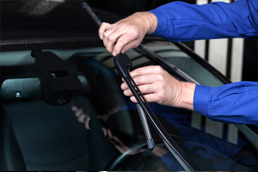
Step 2. Line up the new wiper blade with the arm.

Move the hook on the arm over the plastic clip on the new wiper blade.

Step 3. Pull it tight.

Wipers Snap in Place
Attach the new wiper blade, making sure it clicks into place.
Pull the wiper blade tight onto the arm. You will hear a clicking sound when it clicks into place. Now, simply lower the arm slowly back onto the windshield and repeat this process on the other wiper arm.

Remember, you should always consult the owner's manual to find out the best windshield wipers for your vehicle and best practices for optimal maintenance.

Tips provided by Allstate